

Lelito's Work Helps St Clair Athletes Play
By
Paul Costanzo
Special for MHSAA.com
May 31, 2017
If not for sports, Tim Lelito isn’t sure he would have finished high school.
 Now that he’s entering his fifth season in the National Football League, Lelito is doing what he can to make sure kids in St. Clair County don’t have to worry about that.
The Lelito Legacy Foundation has teamed with the Community Foundation of St. Clair County to grant $9,000 for county schools to cover athletic participation fees for students in need.
“I used sports as a vehicle for where I am now – to get to college and get through high school,” the 2007 St. Clair High School graduate said. “If I didn’t have sports, I don’t think I would have graduated high school at all. School wasn’t a priority; the horses that my grandparents raised were the priority, because that was our livelihood.
“Making it to college and being the first one in my family to graduate with a degree, sports was that vehicle for me to get that degree, and that really hit home with me.”
Five St. Clair County community partners were able to raise $4,500, and Lelito’s foundation matched. The funds will be able to cover participation fees for 116 students at St. Clair County high schools and middle schools during the 2017-18 school year.
 The Port Huron Schools Endowment Fund, East China School District Athletic Boosters and PTOs, the Community Foundation of St. Clair County’s Youth Advisory Council and its Marysville Community Fund, and the Capac Adolescents Preventing Abuse and Crime (CAPAC) Fund were the five partners.
“It’s exciting to see someone who is not only successful and has come back to help his hometown, but he’s so humble about it,” Community Foundation Vice President Jackie Hanton said. “When we were in our meetings, it’s not about Tim. It’s that he has this vision to help kids who are like him.”
Lelito was a mauling all-state offensive lineman at St. Clair, paving the way for the team’s option attack. He was also an all-state thrower on the Saints’ track & field team.
Playing sports required a participation fee, something Lelito’s grandparents handled, even if they struggled to do so.
“When I was younger, my grandparents raised racehorses, and money was tight for a while,” Lelito said. “My grandparents put my brother and I in sports, and we always played sports. I didn’t realize how bad it was until I was older. They were pinching pennies together and taking care of us before taking care of their needs.”
Lelito earned a scholarship to Grand Valley State University, where – after redshirting as a freshman and being forced to take a medical redshirt his second year – he started 45 straight games and was named Offensive Lineman of the Year by the Great Lakes Intercollegiate Athletic Conference in 2012.
He was signed by the New Orleans Saints as an undrafted free agent in 2013, and worked his way into the rotation almost immediately, seeing action in 63 games during his four years in New Orleans and starting 24 games, including 13 in 2015.
This past offseason, Lelito signed a free-agent deal with the Tennessee Titans.
Throughout his NFL career, Lelito has given back, both to his hometown and his professional town. He has conducted free football camps for St. Clair County kids for the past few years.
 “He’s just a young man that I’ve continued to be impressed with how grounded he’s remained,” Bill Nesbitt, Lelito’s football coach at St. Clair, said. “He understands the big picture. His success is not just in playing at that level, but in helping others. That’s his great success.”
Funds for the participation fees will be given to the school districts in St. Clair County, and the schools will be tasked with selecting students most in need. In future years, Lelito hopes to help schools purchase equipment for kids in need, and eventually he wants his foundation to reach more than just athletes.
“My foundation isn’t just for kids in sports, it’s for underprivileged youth,” Lelito said. “I think moving forward, in the next five years, I want to be able to take care of a lot of kids in a very broad spectrum – in sports and arts and other extracurricular activities.”
That will take funding, but Lelito said he has found generous donors in St. Clair County.
“That’s why I bought a house here,” he said. “I love it here. I love the people; they’ll give you the shirt off their back. That’s why I wanted to put roots down here.”
With his efforts, Lelito is doing all he can to make it an even better place to call home. Nesbitt believes the funds could be the difference in playing sports as opposed to sitting out for some students, which he hopes will have a lasting effect.
“I think it definitely can have a positive impact that way,” Nesbitt said. “Hopefully, in a larger, greater, grander sense, these kids who are participants could one day give back themselves. If they are able to go on and have some success, maybe they could remember that somebody had helped them out and do the same.”
 Paul Costanzo served as a sportswriter at The Port Huron Times Herald from 2006-15, including three years as lead sportswriter, and prior to that as sports editor at the Hillsdale Daily News from 2005-06. He can be reached at [email protected] with story ideas for Genesee, Lapeer, St. Clair, Sanilac, Huron, Tuscola, Saginaw, Bay, Arenac, Midland and Gladwin counties.
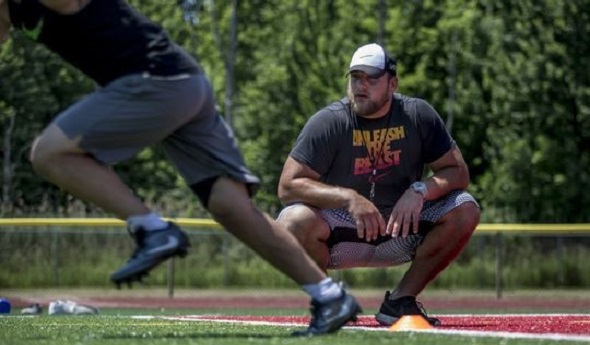
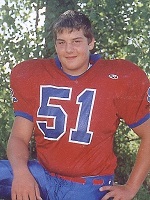
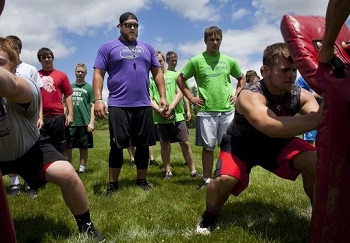
PHOTOS: (Top) Tennessee Titans offensive lineman Tim Lelito watches an athlete work out during a camp he conducts in the St. Clair area. (Middle) Lelito during his high school career at St. Clair. (Below) Lelito, middle, has worked this offseason to help pay participation fees for athletes in need of financial assistance. (Top and below photos courtesy of the Port Huron Times Herald.)
Mendon Coach Takes Reins from Mentor
By
Wes Morgan
Special for MHSAA.com
September 6, 2016
It wasn’t the right time for an interview because John Schwartz didn’t want to be the center of attention. Besides, he had said all he wanted to say in February when he announced his retirement.
 More than anything else, just a few minutes prior to the Mendon varsity football team opening the 2016 season against Bridgman, he wanted to address his attire.
Swiftly moving through the parking lot toward his car, Schwartz looked up, made eye contact with me, and his voice boomed through a shop broom of a mustache, “I put my shirt on backwards.”
Of course he did. His routine was off after more than four decades.
Schwartz exchanged pleasantries as he stood bare-chested about 30 parking spaces from the entrance to the field named after him. He checked to make sure the tag of his T-shirt was at the back of his neck this time.
We walked back to the stadium and talked about his kids and his grandchildren, whom he adores, and for whom, along with his wife, he retired from the game he treasures. When he turned in his letter of retirement to the Mendon school board in February at the age of 66, he said it was time to make more time for them.
He then climbed the bleachers to the press box, where he plans to watch the Hornets and provide advice when requested. Of all places, most of our interaction these days is on Facebook, where he’s quick to like a family photo.
I never took John Schwartz, a man who enjoys crafting things out of wood in his spare time, for a social media fan. But I learned over the years he’s full of surprises.
For a long time, Schwartz boasted the all-time best winning percentage in Michigan prep history. At the end of the 2014 season, his record at Mendon was 269-43 for a .862 percentage. That would have been a good time to retire. He knew, however, the Hornets were in for a rough 2015 season with low numbers in terms of bodies, and, as it turned out, victories. Mendon went 5-5, making his career record 274-48 and his winning percentage .851 — second all-time behind former Schoolcraft coach Larry Ledlow (.853).
He took one for the team.
It’s Bobby Kretschman’s team now, and you’re not going to find anyone in the small town of Mendon who would disagree with Schwartz concerning Kretschman’s worthiness to continue a tradition that includes 13 MHSAA championships — 10 of which were with Schwartz at the helm.
Kretschman, a former star linebacker for the Hornets and an assistant coach with the program for 10 years, was groomed for this role. In the same week in March when his first child, Connor, was born, Kretschman officially accepted the job.
Ranking third all-time in program history with 360 career tackles, including 11.7 stops per game as a senior on the 2005 Division 8 championship team, Kretschman fully understood the significance of becoming the school’s 23rd head coach.
“I’m excited,” he said at the time. “It’s going to be fun. We’re replacing a legend here. This is why I went into coaching and teaching. I didn’t think it was actually going to be at Mendon.”
The Hornets are 1-1 this season under his watch, with a loss to an excellent Cassopolis team in Week 2. But after the Hornets topped the Bridgman Bees in Kretschman’s debut, the new ball coach sounded an awful lot like the old one.
He asked the players gathered around him in the west end zone if they wanted to win a state title this year — perhaps a reach to some after Mendon went .500 last fall. They all believe they can. So did every kid who put on the green jersey since 1989.
Schwartz would always tell you that the Mendon staff coached the kids the same from the Rocket level to varsity. The plays, the verbiage and the expectations were consistent.
And it was all underscored by a sense of responsibility.
“There’s a great sense of pride at Mendon and I’ll be damned if that’s going to be lost,” Kretschman said. “That’s why you want to put the time into things and make sure you’re putting the best product out there you can. Your name is on it and you want it to be done right.”
 Wes Morgan has reported for the Kalamazoo Gazette, ESPN and ESPNChicago.com, 247Sports and Blue & Gold Illustrated over the last 12 years and is the publisher of JoeInsider.com. He can be reached at [email protected] with story ideas for Berrien, Cass, St. Joseph and Branch counties.
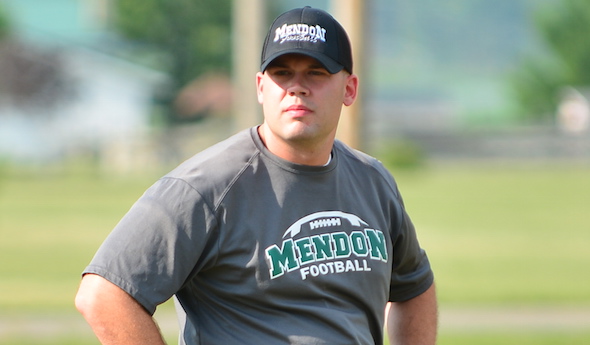
PHOTO: Former linebacker Bobby Kretschman takes over the Mendon program this season from longtime coach John Schwartz. (Photo by Wes Morgan.) VIDEO courtesy of JoeInsider.com.