

Let's Not Forget These Winning Coaches
December 15, 2015
By Ron Pesch
Special for Second Half
Buried deep within the MHSAA’s list of coaches with 200 career football wins is the name Oscar Johnson. Sharp eyes will note that Johnson began his coaching career in 1925 – 90 years ago.
Following graduation from Western State Normal School (today, Western Michigan University) in Kalamazoo, Oscar E. Johnson coached two seasons at Mount Pleasant High School before moving on to Muskegon Heights in 1927. Known by his nickname, like most from the time period, “Okie” coached multiple sports including football, basketball and baseball. After 37 years (1927 to 1963) and six mythical gridiron championships (as well as three Class A basketball titles), he retired and moved to Baldwin.
During a teacher’s strike in 1979, Johnson, now in his 70’s, came out of retirement to coach Baldwin’s football team for four contests, earning three wins against a single loss. In 40 seasons, Johnson’s teams posted 209 victories against 106 defeats and 28 ties.
In 1975, his was the lone name that would have appeared on the MHSAA’s list of coaches with 200 football wins.
In 1980, Bill Maskill, a graduate of Michigan State University and head coach for six seasons at Sheridan, then Galesburg-Augusta for 29 years, was the second to join the list. Jack Castignola, who started his coaching career in Ohio before becoming varsity coach at Monroe Catholic Central and then Trenton, was added to the list in 1981.
They were followed by Dick Mettlach, long of Crystal Falls and that school’s successor, Crystal Falls Forest Park, Jack Streidl who led Plainwell for 37 seasons, and Dick Soisson, who coached for a combined 41 seasons at Owosso St. Paul, Kalamazoo St. Augustine and Kalamazoo Hackett. Each posted his 200th win in 1984. Leo “Smokey” Boyd, who coached 40 years at Standish-Sterling, Saginaw Sts. Peter and Paul and Saginaw Nouvel, notched his 200th win in 1985, becoming only the seventh coach to accomplish the task in 90-plus years of high school football in Michigan.
Only two additional names were added over the next five years. Walt Braun, long of Marysville, joined the exclusive group in 1986. Al Fracassa, who spent a combined 46 seasons coaching at Royal Oak Shrine and Birmingham Brother Rice and turned down the chance to join Muddy Waters’ coaching staff at MSU in 1980, picked up his 200th win in 1988. That brought the list to nine total.
Twenty five years later, the list totals 58 names. So what changed?
Of course, it was the addition of the MHSAA football playoffs, which debuted in 1975.
A look at two coaches helps illustrate the issue.
Fracassa, the list’s current leader in all-time wins with 430, took 29 seasons to tally his first 200 victories. It took only 23 more seasons for him to gain the next 200. Farmington Hills Harrison’s John Harrington took 24 years to total 200 wins, but picked up his 400th after only 20 more.
Between 1960, Fracassa’s first season, and 1988, Fracassa’s teams played an average of 8.30 games a season. Between 1970, Herrington’s first year and 1993, the year of his 200th, his teams averaged 9.64 games per season.
Between 1988 and 2011, when Fracassa won his 400th game, his teams played an average of 11.61 games a season. Between 1994 and 2013, Herrington’s 400th, his teams played an average of 11.09 games per year. Fracassa’s teams compiled 68 victories in the MHSAA postseason. Herrington’s teams lead the state with 87 victories in the state playoffs.
Simply put, with the arrival of the postseason, it became easier to get to 200.
While no one would debate the accomplishments of any of the 58 gentlemen on the list, all but a few benefit from a baseline that few others who coached only 40 years before them were unlikely to reach.
Of course, those previous years included an amazing array of mentors. In hindsight, perhaps the list should include a mark for coaches from who assemble 150 varsity wins during the regular season only.
Johnson, and many others on the current list, certainly fall within such a category. But so would people like Ted Sowle, who, according to extensive research by former state historian Dick Kishpaugh, compiled a combined 171-47-10 mark between 1937 and 1963 as varsity coach at Grant, Algonac, Cathedral Prep in Erie, Pa., and Grand Rapids Catholic Central. At the time of his retirement from coaching in 1963, he ranked second in the state on the career wins list, behind only Johnson.
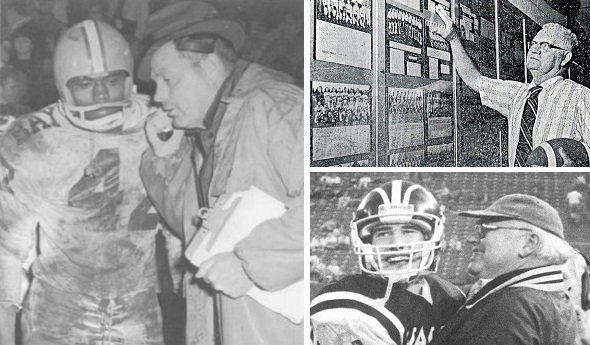
Ray Rynberg, a Grand Rapids Union and Central Michigan graduate, began his coaching career at Cedar Springs in 1939. After 12 years, he stepped away from the coaching ranks to pursue a degree in school administration from the University of Michigan. In the fall of 1955 he returned to the sidelines at Grant. He remained for 21 years, compiling a record of 189-62-9 (including seven unbeaten seasons) surpassing Sowle on the list upon retirement following the 1975 season.
Elmer Engel, who is honored in Bay City with his name attached to the city’s beautiful football stadium, also would appear on such a list. A three-year starter at the University of Illinois, Engel arrived in 1950 and installed the T-formation. He worked the sidelines for the Wolves through the 1972 season, compiling a 165-34-8 record and mythical Class A state titles in 1958, 1965, 1967, 1969 and 1972 according to the Associated Press polls ranking the state’s top teams.
Traverse City’s Jim Ooley led the Traverse City Trojans to a 164-56-4 regular season record (and a 179-60-4 record overall). Muskegon’s C. Leo Redmond led the Big Reds to a 156-29-13 record and six mythical Class A state titles between 1923 and 1946.
Certainly, there are others, many long-forgotten by most to the sands of time, who would qualify for the list. But who are they?
Incredibly successful coaches, like Flint Northern’s Guy Houston, would still fall shy. Playing in the incredibly tough Saginaw Valley Conference, Houston’s teams posted a remarkable 148-41-13 mark in 24 seasons as head coach of the Vikings. Nick Annese, who rolled up a 55-29-2 mark (including 38 straight victories) in 10 seasons at New Lothrop, then led Corunna to a 91-32-3 mark over 14 seasons but falls several games short.
So will many other of the state’s more well-known names, like Lloyd Carr, best known for his years at the University of Michigan, (who served as an assistant at Detroit Nativity and Belleville, before becoming head coach at Westland John Glenn for a few years), University of Nebraska’s Bob Devaney (who spent years 14 years coaching in Birmingham, Keego Harbor, Saginaw, and Alpena) and Colorado’s Bill McCartney (who assisted under his brother Tom at Detroit Holy Redeemer, then served as varsity football and basketball coach at Dearborn Divine Child). All moved on to the college game as assistants before reaching 150 high school wins.
Nick Annese’s son, Tony, who coached at Montrose, Ann Arbor Pioneer, Jenison and Muskegon tallied 169 regular season wins (and 195 victories overall) at the prep level before moving on to the college ranks at Grand Rapids Community College, then Ferris State University.
Can you name others, missing from the list of 200-game winners, with 150 varsity victories in the regular season? If so, contact me at the e-mail address below.
 Ron Pesch has taken an active role in researching the history of MHSAA events since 1985 and began writing for MHSAA Finals programs in 1986, adding additional features and "flashbacks" in 1992. He inherited the title of MHSAA historian from the late Dick Kishpaugh following the 1993-94 school year, and resides in Muskegon. Contact him at [email protected] with ideas for historical articles.
PHOTOS: (From left) Longtime Bay City coach Elmer Engel with a player from the 1968 Bay City Central yearbook, legendary Grant coach Ray Rynberg from the Muskegon Chronicle and championship-winning coach Jim Ooley of Traverse City.

Preview: Favorites to Meet in Final
November 18, 2016
By Geoff Kimmerly
Second Half editor
It’s easy to promote tonight’s MHSAA 8-Player Football Final at Legacy Field in Greenville as the meeting of the two best teams in the state this season.
Powers North Central and Deckerville entered the playoffs both undefeated and with the highest and second-highest playoff-point averages, respectively, in the division. And both have surged through the playoffs despite impressive opponents attempting to get in the way.
 The Jets are known for a high-flying offense, while the Eagles are powered by a stifling defense – and yet, both are pretty strong on the other sides of the ball as well. See below for a glance at both teams, and if you can’t make it to Greenville the game also will be broadcast live on FoxSportsDetroit.com, with live audio streaming on MHSAANetwork.com. On-demand video will be available shortly after the game’s conclusion at MHSAA.tv.
(Statistics below are through Regional Finals unless noted. Rankings are based on playoff-point averages at the end of the regular season.)
DECKERVILLE
Record: 11-0, No. 2
Coach: Bill Brown, 24th season (190-69)
League finish: First in North Central Thumb League.
Championship history: 8-Player champion 2012.
Best wins: 36-6 over No. 4 Wyoming Tri-unity Christian in the Semifinal, 58-12 over No. 6 New Haven Merritt in the Regional Final, 40-0 over No. 11 Webberville in the Regional Semifinal.
Players to watch: RB/DB Austin Fritch, 6-0/175 sr. (1,305 yards/23 TDs rushing); FB/LB Wade Saldana, 5-8/170 sr. (596 yards/13 TDs rushing); QB/DB Brandon Pattullo, 6-0/180 sr. (379 yards/9 TDs rushing, 496 yards/8 TDs passing); LB/OG Reese Bays-Kramer, 5-11/180 sr.; DT/SE Austin Spaetzel, 6-0/210 sr.
Outlook: Deckerville’s defense has gotten a lot of attention this week, and rightfully so – the Eagles have given up a mere 50 points this season and only 18 combined the last two weeks against previously-undefeated playoff teams. Bays-Kramer and Spaetzel lead on that side of the ball, playing massive roles in helping the team to five shutouts while never giving up more than 12 points in a game. But we shouldn’t forget the offense, which was especially dominant last week running for more than 400 yards without attempting a pass. Fritch added 263 yards and four touchdowns to his totals above, giving him 1,568 yards and 27 scores rushing this season, and the team as a whole has run for 3,417 yards while needing to throw for only 517. All 11 wins have been by at least 22 points.
POWERS NORTH CENTRAL
Record: 12-0, No. 1
Coach: Kevin Bellefeuil, 11th season (64-52)
League finish: First in Western 8 Conference.
Championship history: 8-Player champion 2015.
Best wins: 60-50 (Regional Final) and 60-42 over No. 8 Crystal Falls Forest Park, 68-32 over No. 12 Stephenson, 62-22 over No. 9 Pickford in the Semifinal, 76-18 and 64-0 (Regional Semifinal) over No. 16 Rapid River.
Players to watch: QB/DB Jason Whitens, 6-4/210, sr. (2,170 yards/40 TDs passing, 536 yards/15 TDs rushing, 2 punt return TDs); RB/DB Bobby Kleiman, 5-9/175, sr. (594 yards/9 TDs rushing, 452 yards/10 TDs receiving, 3 interception return TDs, 3 punt return TDs); WR/DT Dylan Gagne, 5-8/175, sr. (439 yards/10 TDs receiving, 290 yards/4 TDs rushing); WR/DB Marcus Krachinski, 6-0/170 sr. (549 yards/10 TDs receiving); RB/LB Tyler Bentley, 5-7/175 sr. (541 yards/9 TDs rushing, 351 yards/3 TDs receiving).
Outlook: North Central remains undefeated in two seasons of 8-player football, bolstered by a Whitens-led offense averaging 67.4 points per game – only a few off last season’s average of 70.4. In fact, a loss would be the first for these seniors in either football or basketball since 2014 – Whitens, Kleiman, Krachinski, junior linebacker Lucas Dombrowski and senior center Ryan Plunger all also saw time in last winter’s Class D hoops Final as the Jets finished a second straight undefeated run in that sport. For the second straight football season, no opponent has come within single digits of North Central; only Forest Park got the deficit down to 10. Whitens added another 226 yards and three scores passing last week, giving him 2,396 and 43 total this fall.
The MHSAA Football Finals are sponsored by the Michigan National Guard.