

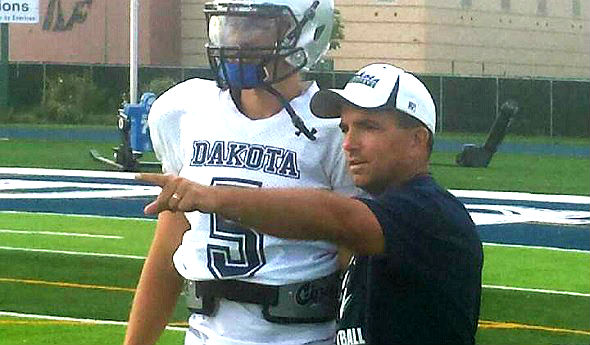
Longtime Assistant Set to Lead Dakota
By
Tom Markowski
Special for Second Half
August 17, 2016
MACOMB TOWNSHIP – Greg Baur was content to continue coaching in the background, much like a supporting actor in a movie.
 Baur, 46, had been an assistant football coach for 26 years at four different schools, most recently at Macomb Dakota. For 21 seasons he was a defensive coordinator, including the last 12 for the Cougars.
And he was good at it. In 2001, under then-head coach Mike Carr, Bauer was instrumental in guiding Clinton Township Chippewa Valley to its only MHSAA title, in Division 2. Chippewa Valley held Jenison to 139 yards in its 26-13 victory in the Final. In 2006 and 2007, Baur was with head coach Mike Giannone when Dakota won its two MHSAA Division 1 titles. That gives him the distinction of being the only Macomb County coach to play a big part in three MHSAA championships.
Last January, Giannone left Dakota to take the head coaching position at Warren DeLaSalle. The move took Baur by surprise – but it also started the wheels turning in his head.
Just once had Baur sought to be a head coach. When Carr left Chippewa Valley after the 2004 season, Baur applied to take over. When he didn’t get the job, Giannone quickly hired him at Dakota.
With Giannone gone, Baur made another bid at a head coaching gig. This time, he got it.
“I don’t remember the date,” Baur said. “I just remember it was a snow day. They called me and told me I had it. The first thing I did was make sure the staff would stay, and they did. Next I met with the players, and the kids were really excited about it.”
At most programs, going from a coordinator position to take over as head coach is akin to jumping into a pool after sitting an hour with just your feet in. Baur said it isn’t like that for him.
 Sure there’s more paper work, and yes, the fundraising becomes more of his responsibility. But as far as the workload, it’s not as daunting for Baur as it might be for others. Baur has always been a workaholic.
“I’ve always worked extra hard,” he said. “I told my wife, this will amp things up. It’s 24/7. The good thing is the kids have grown up a bit. And it’s not work for me. It’s fun. I’m really excited to get things going. When you wait 25 years you look at what you can tweak here and there. Offensively, I’ll tweak it a little. Defense is the same. I’m still running it. I can’t see myself not coaching (the defense).”
In a sense, Baur has already experienced success. He convinced Carr to come out of retirement and serve as his offensive coordinator.
It’s come full circle.
There are a number of reasons why Baur hadn’t looked elsewhere for a head coaching job. He and his wife, Renee, live in the area, and their three children attend schools in the Chippewa Valley school district, of which Dakota is a part. Their eldest child, Jason, played football at Dakota and graduated this spring. He’s now attending Wayne State University and helping out with Dakota’s freshmen team.
Professionally, there isn’t a program in Macomb County that can match Dakota. It is the only school in the county with more than one MHSAA title, and the Cougars are consistently one of the state’s top teams. They’ve made the playoffs 15 consecutive seasons, and just once since 2003 have they failed to win a playoff game. Last season Dakota lost to Detroit Cass Tech, 16-10, in a Regional Final.
Given that, there’s a certain amount of pressure that comes with being the head coach of such a program. It’s similar to the pressure that’s on coaches like Ralph Munger at Rockford and Kurt Richardson at Clarkston. Those in the community not only expect them to win every year, but expect their teams to be a factor in the playoffs every year. A first-round loss is not only disappointing – it can also raise a few eyebrows.
Baur’s attitude? Bring it on.
“To me, it’s not pressure,” he said. “I love to compete. If all goes well, great. If not, then we move on. I might not be the smartest coach around, but no one is going to outwork me.”
During this time of year, time is scarce. Double sessions start at 9 a.m. and end at 3 p.m. There’s time for dinner, then its film sessions followed by an hour or two of quality time with his children.
“That hasn’t changed,” he said. “That was always the schedule. But now there’s paperwork, putting out fires.
“I love this. There isn’t a part of the job I don’t like. There’s no complaining. You get an opportunity, you make the best of it. I know there’ll be tougher times.
“Being a head coach, it never really crossed my mind. (Giannone) is relatively young. I thought he’d retire (as a head coach) here. It wasn’t something I was campaigning for.”
Baur owes much of his success and where he’s at to those who mentored him. A graduate of Sterling Heights Stevenson, he played and coached under one of Macomb County’s legendary coaches, Rick Bye. After four years, Baur went to Romeo and coached under Greg Ganfield. Ganfield was gave Baur his first shot as a coordinator. Four years later, Baur went to Chippewa Valley.
Carr showed Baur how to run a program, not just coach. He lectured him on how to deal with parents and their concerns. A bit overwhelming then, Baur has gained the experience where such responsibilities are more easily managed.
“(Giannone) wasn’t that much different,” Baur said. “Heck, he coached under Carr, too. But (Giannone) took the program to another level.”
As good as Dakota has been recently, expectations are even higher this season. The senior and junior classes did not lose a game on the freshman or junior varsity levels. Many outside the program, including Utica Eisenhower coach Chris Smith, have said this senior class at Dakota is one of the best they’ve seen.
Baur said one of his biggest tasks is to make sure this group doesn’t become complacent.
“I’m a players’ coach,” he said. “When it got real hot recently, I dialed back. They don’t even call me Coach. It’s like, hey Baur.”
Baur is just like one of the guys – except this time he’s playing the leading role.
 Tom Markowski is a columnist and directs website coverage for the State Champs! Sports Network. He previously covered primarily high school sports for the The Detroit News from 1984-2014, focusing on the Detroit area and contributing to statewide coverage of football and basketball. Contact him at [email protected] with story ideas for Oakland, Macomb and Wayne counties.
PHOTO: Greg Baur (right), the new head coach at Macomb Dakota, directs one of his players. (Photo by Tom Markowski.)
Fracassa's Remarkable Records Still Rule
By
Tom Markowski
Special for Second Half
June 24, 2020
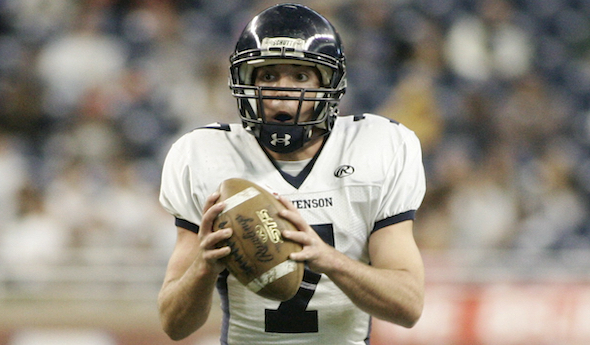
As a senior at Sterling Heights Stevenson during the 2009 season, Jason Fracassa lit up the high school football world with his aerial display.
 Fracassa shattered the MHSAA career totals for passing yards and touchdowns held by Mill Coleman of Farmington Hills Harrison. Fracassa also etched his name into the national record book in three career passing categories before the remarkable run ended with a 31-21 loss to Detroit Catholic Central in the Division 1 Final at Ford Field.
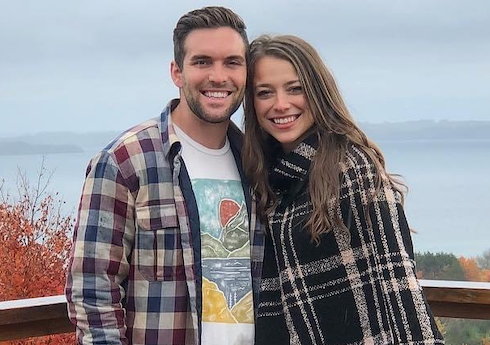
The numbers he posted at Stevenson indeed were staggering. And just more than a decade later, after securing two undergraduate degrees and a masters in finance from Walsh University in Ohio, Fracassa lives in Auburn Hills and continues to crunch numbers – now for a development company in Birmingham – while also planning for a Sept. 12 wedding to fiancé Kelsey Torzy.
Fracassa has always been a highly-motivated person, and that held true in the classroom and as a three-sport varsity athlete and continues now in the business world. But while driven by success, Fracassa doesn’t dwell on what he accomplished in the sports world – which also included Division II college careers in both football and baseball. What was important then remains so now, and those are the relationships he built through trust, hard work and having a little fun.
“I miss going to practice each day and hanging out with my friends,” he said. “Just walking around school and trying to set an example to the kids, that’s what was important. I’ll go to the golf course now and I’m with all of my friends. That’s what it’s all about. That was the best part. We had the best relationships, no matter if we won or lost. Playing for Coach (Rick) Bye and your friends, that’s the best memories I have.”
A four-year varsity starter for Bye, Fracassa led Stevenson to a combined 23-3 record over his last two seasons, culminated by that fourth trip in program history to an MHSAA Final.
During his junior season, Fracassa threw for 3,353 yards and 34 touchdowns over 12 games. He then took aim at Coleman’s career passing records for touchdowns (77) and yards (7,464), records that had stood for 20 years.
 Fracassa and his teammates put on a show that 2009 season as he threw for 4,433 yards and 44 touchdowns. His career (10,615) and single season (4,433) passing yards remain MHSAA records, the career total by nearly 2,000 yards. Fracassa also continues to own the records for career passing attempts (1,104) and completions (656), accrued over 44 games, and he briefly held the MHSAA record for career TD passes with 97 before it was broken in 2013. The career attempts and yards and senior-season yardage all rank in the National Federation record book as well.
Fracassa credits the coaching staff at Stevenson for the success he and his teammates enjoyed. He couldn’t have imagined playing for anyone but Bye and his staff. Fracassa said he’s spoken with many of Bye’s former players, and they all agree playing for Stevenson and Bye was a phenomenal experience.
Like Fracassa, Bye – who retired after 2009 with a record of 268-94 over 35 seasons – also keeps tabs of his cronies by playing golf once a week with former assistants like Ken Fiott, Jerry Lajeunesse, Larry Zimmerman, Joe Emanuele and D.J. Hill among others. Bye is quick to point out that many of his former players, including Fracassa, keep in touch on a regular basis.
“I saw (Fracassa) at a Stevenson playoff game,” Bye said. “He calls me at least once every two months or so to see how I’m doing. I appreciate that. He was always a highly-respected kid. He’s not a kid anymore.”
Bye recalls hearing about Fracassa when Fracassa was in the eighth grade at St. Lawrence in Utica. Fracassa enrolled at Davis Junior High, Stevenson’s feeder school, for his ninth grade and tried out for the football team not knowing whether he’d make the varsity or not.
“His dad wasn’t pushy one bit,” Bye said. “(Rick Fracassa) asked if Jason was going to be on the JV. A big reason he wanted his son to come (to Stevenson) was Joe Emanuele, who was our baseball coach, and Rick knew Joe had a good program. He wanted Jason to play baseball, too.
“Jason came out and won the (quarterback) job. He proved himself. And he had to win over our seniors.”
Jason Fracassa said that was the hard part – convincing a group of seniors that a freshman could come in, start at quarterback and lead the team can be daunting.
“I knew I could compete at that level,” Fracassa said. “It was more of my getting to associate myself with the older players. That was the most difficult part. The coaches were always there to back me.”
 Stevenson made the playoffs that 2006 season finishing 5-5. The next season was rough as the Titans lost a number of close games and finished 2-7. Stevenson improved substantially to 10-2 in 2008, losing to Lake Orion, 38-36, in a Regional Final.
That all built up to the memorable 2009 season, which included a tense Semifinal game against Clarkston won by Stevenson 37-35 on a Fracassa scoring pass on the final play.
Emotions also ran high the game before when Stevenson took on Detroit Public School League power Detroit Southeastern, led by Michigan State-bound and now-NFL defensive end William Gholston. Fracassa threw for a career-high 494 yards, and Stevenson defeated Southeastern, 38-32.
After a busy and accomplished prep career, Fracassa maintained a hectic athletic schedule in college first at Northwood University – where he started on the baseball team for three seasons and was a member of the football team for two.
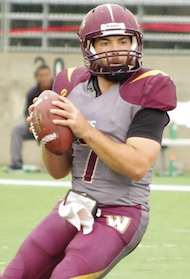
After sitting out a term, Fracassa transferred to Walsh, located in North Canton, Ohio. There he revived his football career starting at quarterback his last two years. Walsh, then a recent addition to the Great Lakes Intercollegiate Athletic Conference, nearly upset conference power and undefeated Ferris State in Fracassa’s final game. Fracassa threw his second touchdown pass of the game to give Walsh a 42-32 lead with 9:38 left before Ferris State came back with two touchdowns, the second with 36 seconds left, to win 46-42.
Fracassa hasn’t completely abandoned football since his last game at Walsh. He and his father coached the Oakland University club team in 2018 and that team reached a championship game. Jason was the offensive coordinator, his father the head coach – branches from the coaching tree rooted with Jason’s grandfather Al Fracassa, the second-winningest high school football coach in MHSAA history and Bloomfield Hills Brother Rice legend.
Jason’s competitive juices continue to flow.
“We had a great run,” Fracassa said, “and any other year could have taken the championship trophy.”
Made in Michigan 2020
June 16: Muskegon Grad Casts "Magic" in HBO Series - Read
Tom Markowski is a correspondent for the State Champs! Sports Network and previously directed its web coverage. He also covered primarily high school sports for the The Detroit News from 1984-2014, focusing on the Detroit area and contributing to statewide coverage of football and basketball. Contact him at [email protected] with story ideas for Oakland, Macomb and Wayne counties.
PHOTOS: (Top) Jason Fracassa rolls out during the 2009 Division I championship game at Ford Field. (Middle) Fracassa and fiancé Kelsey Torzy. (Below) Fracassa drops back to pass while playing for Walsh. (Middle and below photos courtesy of Jason Fracassa.)