

Low-Scoring Rematch Goes to Clarkston
By
Tom Markowski
Special for Second Half
November 25, 2017
DETROIT – The final score of the Clarkston-West Bloomfield Division 1 Final might cause many football purists to cringe and scoff in disbelief.
 But Clarkston coach Kurt Richardson offered no apologies.
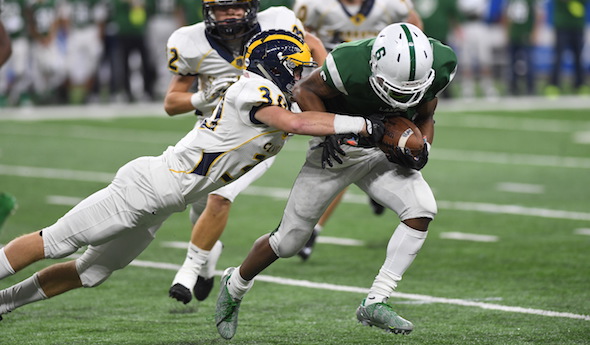
Richardson and his staff should be applauded for the job they did this season. Clarkston may not have been loaded with star power this season, but won its third Michigan High School Athletic Association title by defeating West Bloomfield, 3-2, in the Division 1 final on Saturday at Ford Field.
Clarkston (12-2) also won titles in 2013 and 2014. This was West Bloomfield’s first Finals appearance; the Lakers opened this season 0-2 but rebounded to finish 11-3.
The teams combined for the second-lowest points total in Finals history. In 1987, Ann Arbor Pioneer defeated Detroit Catholic Central, 3-0, in the Class A Final.
The teams also tied a Finals record for the most punts (14), and Clarkston tied the record for most punts (8) by one team.
Clarkston (12-2) finished third in the Oakland Activities Association Red this fall behind West Bloomfield and Rochester Adams, which tied for the division title. West Bloomfield soundly defeated Clarkston, 37-16, in the fourth game of the season, and the Lakers were a sensible pick to win again.
“That’s what these kids have been about all season,” Richardson said. “(They) find a way to win.
“We always talk about turning a negative into a positive. When we got beat by Adams (21-14 on Oct. 6), we changed our run game. When we were (5-2, after Week 8), I reamed the coaches. I thought we were doing a shoddy job. We changed our run game. We became a more power running team.”
Clarkston was never a team that wowed with statistics this season. The Wolves relied on their running game, a strong defense and a good kicking game.
Against West Bloomfield – a team with no fewer than 10 players who have either committed to or received a scholarship offer from a Division I college program – Richardson wanted to shorten the game and win the turnover battle.
In its first game against West Bloomfield, Clarkston committed four turnovers. On Saturday, the Wolves had a 3-0 edge.
“We knew they were going to blitz more,” West Bloomfield coach Ron Bellamy said. “Defensively, they we’re going to grind it. We had too many penalties (11 for 105 yards). Clarkston was going to shorten the game. Our special teams weren’t special today.”
The first half, and much of the second, was filled with mishaps.
 Clarkston, on its second possession, gave up a safety when a fourth-down snap flew over the punter’s head and over the end line.
The Lakers failed to convert a first down on the ensuing possession and their punt went 19 yards, giving Clarkston the ball on West Bloomfield’s 33.
The Wolves did nothing with that gift and lost 10 yards in three plays, and when they punted it went just three yards.
West Bloomfield pieced together the best drive of the half as the Lakers gained three first downs and had a 1st-and-goal at the 5-yard line. But on the next play, Zach Scott grabbed an interception in the end zone.
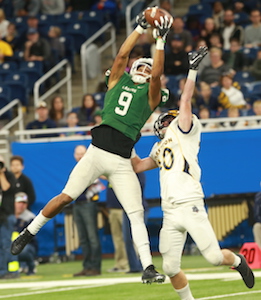
The longest play of the half was a 35-yard pass from West Bloomfield quarterback Bryce Veasley to A.J. Abbott that gave the Lakers a first down at its 47. On the next play, Cody Hughes recovered a fumble for Clarkston.
Finally, with time running out in the first half, Wolves quarterback Nathan Uballe completed a 15-yard pass to Conner Heaton, and 13 yards was tacked onto that gain as West Bloomfield was called for roughing the passer. With six seconds left, Clarkston opted for a field goal try and Roemer converted from 30 yards out to give the Wolves a 3-2 halftime lead.
That was it for the scoring. Clarkston did its best to work the clock in the second half with its run game, and not make the big mistake.
Clarkston gained 117 yards, 84 on the ground. Its main ball carrier was junior Jacob Billette, who was in the lineup because Clarkston’s best running back, senior Josh Cantu, suffered a knee injury in the Semifinal and was unavailable. Billette rushed for 69 yards on 14 carries.
“We needed someone to run up the middle,” Richardson said. “Billette is a wrestler. He’s a tough kid. He was the answer.”
West Bloomfield had none for Clarkston’s defense. Veasley came in with nearly 3,300 yards and 24 touchdowns passing. On Saturday, he was 15 of 32 for 214 yards and two interceptions, and he was sacked twice.
“We didn’t make enough plays that needed to be made,” Veasley said. “Every time we made a big play, we had a penalty.”
Clarkston blanketed West Bloomfield’s receivers; all are expected to play at a major university. Michael Fluegel, who doubles as a running back and defensive back for Clarkston, said it was a challenge to go against such a talented group.
“All their receivers are really good,” he said. “You just have to make plays. You have to stay with them.”
For Richardson, this was the unlikeliest of titles. His other title teams had some of the state’s top players, like quarterback D.J. Zezula (Wayne State), who threw two touchdown passes in the 2013 Final and passed for one touchdown and ran for another in the 2014 championship game.
“This is very special,” Richardson said. “This team doesn’t have 5-star kids. We don’t have 4-star kids. We’re unselfish. The kids played with a chip on their shoulder. Nobody picked us to win today.”
The MHSAA Playoffs are sponsored by the Michigan Army National Guard.
PHOTOS: (Top) Clarkston senior Michael Fluegel (30) wraps up West Bloomfield’s Collin Heard during the Division 1 Final. (Middle) Lakers receiver AJ Abbott stretches for a grab over a defender.
St. Mary's Standout McLaurin Becomes Chinese Football Pioneer
By
Tom Markowski
Special for Second Half
August 19, 2021
The eight years Chris McLaurin spent in China not only changed his life, but they changed the perception of American football in China and elsewhere – and just may have opened the door to a whole new market.
 We're talking “American football,” not soccer. Most of us are familiar with NFL Europe, but NFL China? Not so much. When McLaurin went to China in 2011, the thought of teaching the locals American football never occurred to him. He went there to work for a private company, and circumstances just seemed to fall in place.
Some might say McLaurin was in the right place at the right time, but it can also be said he was the right person at the right time to lead this undertaking. McLaurin had the background, both athletically and organizationally, to take on such an endeavor.
“I met a lot of people who were interested in football,” McLaurin said. “I thought, football? I had a limited understanding of what they knew. I was very surprised they would reach out to me. I quickly found out they were hungry to learn.”
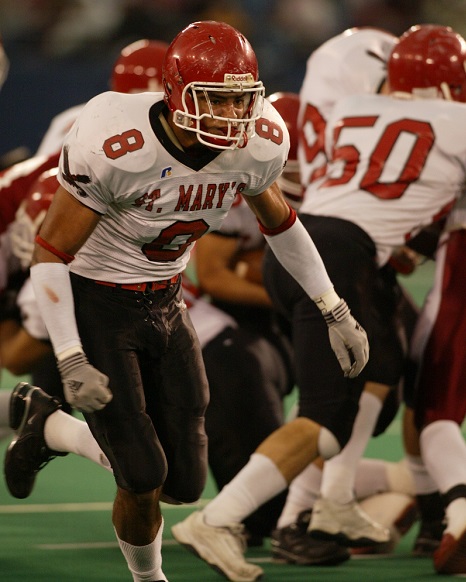
A 2005 graduate of Orchard Lake St. Mary's, McLaurin started at tight end and linebacker, and helped the Eaglets reach the MHSAA Division 2 Final in 2004 (where they lost to Muskegon). McLaurin went on to play four seasons at Michigan and graduated in 2009 with a degree in history and minor in urban and community studies. He had thoughts of entering law school when other opportunities interceded.
During his time in Ann Arbor, McLaurin worked with an organization that focused on disadvantaged youth in the area and helped open doors for them. They were allowed to attend lectures at the university as well as sporting events.
Upon graduation, the seeds that would blossom in Asia began being sown in other parts of the world.
McLaurin received a Fulbright Scholarship and went to Johannesburg, South Africa, to work with underprivileged youth as part of a program called Tomorrow Trust. During this time he worked with the United Nations Development Programme and Harvard Law School in their pursuit of promoting economic rights for the poor.
Following his work in South Africa, McLaurin began his post-graduate work at the London School of Economics. He earned his degree after working in the House of Commons and as a research assistant for the Runnymede Trust. Then came a six-month internship within the Obama Administration as part of the White House Domestic Policy Council.
And after that, he was off to Chongqing in western China to work for a private equity company as a project manager. Two years later, he started his own company in addition to a non-profit organization. Much of his work centered on the automobile industry and global technology.
During this time he learned to speak Mandarin and, in doing so, was introduced to more of the local customs – including American football.
 What McLaurin found was a rudimental brand of football, what we would term a recreational type of competition. McLaurin began his involvement gradually, on weekends.
“After that first year (2012), I took it up a notch,” McLaurin said. “We started recruiting players and bought new equipment. They watched football on TV, but it's not an easy game to understand. You have to play football to learn it. You don't get that from watching TV.”
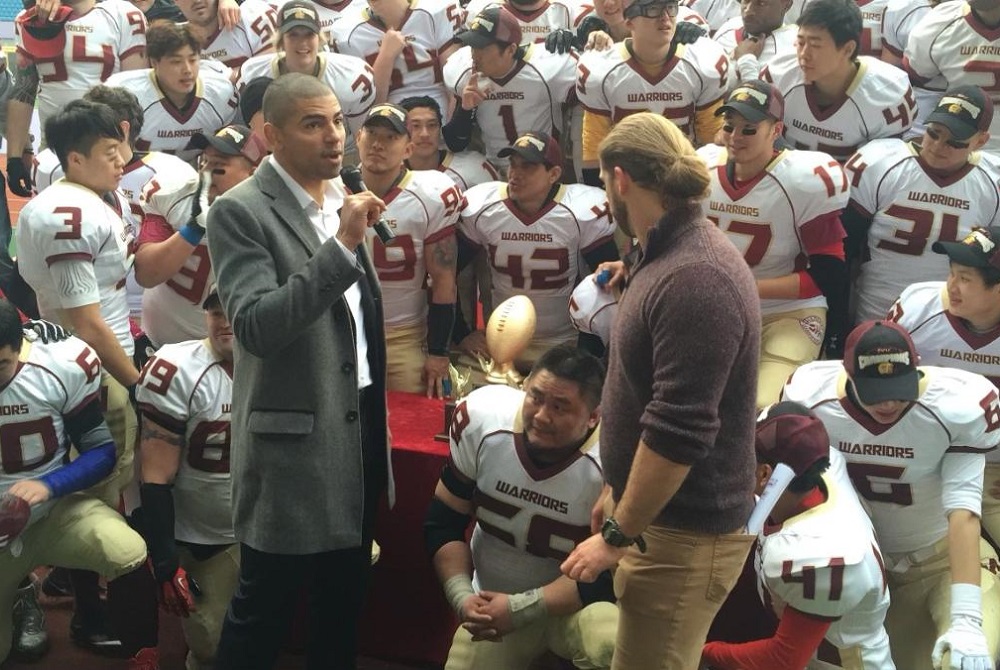
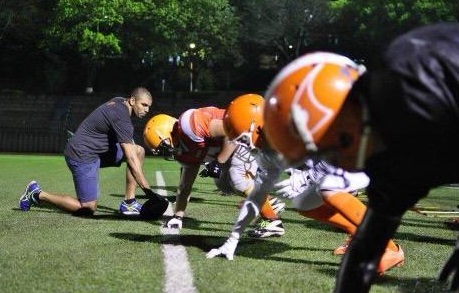
A year of training, recruiting and, yes, some frustration, led McLaurin to start a league, the American Football League of China (now known as the China National Football League). The rules are similar to those at the U.S. college level. There are 11 players a side, and when a ball carrier's knee touches the ground the play is over.
In the beginning “it was successful,” he said. “There were no leagues when I got there. There was no one to organize it. We went from (fewer than) 10 teams to, 3-to-4 years later, there are 80-90.”
McLaurin quickly learned he needed help if this adventure was to succeed. USA Football had a footprint in Shanghai, and McLaurin reached out to the organization. McLaurin contacted a handful of former teammates including Prescott Burgess and Morgan Trent for advice. Former NFL player Bruce Plummer and NFL coach and scout Jerry Hardaway worked some of the camps and clinics with McLaurin and added much-needed experience and expertise.
After playing at Southern Illinois, Hardaway’s first coaching position was at Memphis State as an assistant, and then he went to Grambling State to coach under the legendary Eddie Robison for six seasons. He also coached at the University of California under Joe Kapp prior to working in the NFL and then heading to China.
“I was told, through another guy, that (McLaurin) needed some help,” Hardaway said. “It was all about getting back to basics. That's what made it fun. They had no clue when you'd say to them, control the ground at impact when you're making a block. They had no idea of the terms that you'd use. To see the young kids, to see on their faces, they were absorbing everything.
 “Yes, yes, yes, it was worthwhile. First of all, people had no clue about what it takes to do something like this. They were learning. Some of the parents thought it was a violent sport. That's what they heard. Then they switched. They saw me, us, teach the basics and they saw what we were doing. For me, it gave me a sense, like hey, you have to teach and you have to enjoy it.”
Soon after that first season, the NFL got involved as did the National Committee on United States - China Relations. McLaurin credits the NFL for advising him on the business end of starting a new league and structuring. After 18 months, McLaurin got out of coaching and became the commissioner.
“(The NFL) wanted to expand,” he said. “They saw how their brand was quite low (in China). China is a natural.”
Progress was slow, but it was still progress. The 2015 championship game was played in Shanghai, and McLaurin estimates it drew 3,500 spectators.
He continued to work with the AFLC through 2019 but then decided to make a career move. He returned to the U.S. and, this fall, is pursuing a dream he's held since leaving U-M. At age 34, McLaurin entered Harvard Law School.
“When I started, the last thing we wanted was a U.S. version of football,” he said. “We wanted it to be Chinese football. There were limitations on how many foreigners would compete. At first it was five (per team), then three. We wanted it to be a Chinese experience."
2020-21 Made in Michigan
August 5: Herremans' Focus on 'Dadding,' Giving Kids Similar Small-Town Childhood - Read
July 29: Loy Norrix Career Prepped Crocker for U-M Success, Law Degree Pursuit - Read
July 19: Top PGA Pro Finish Latest Greatest Highlight as Cook Continues Climb - Read
July 16: TC West Standout Renews Ties to Titans, Cheers Past Teammates' Gold Pursuit - Read
July 8: Caro Champs Find Common Ground Again as Mental Health Providers - Read
June 28: Michigan's Minor Leaguers Making Up for Lost Season - Read
PHOTOS: (Top) Former Orchard Lake St. Mary's standout Chris McLaurin started an American football league in China and remained part of its leadership through 2019. (Middle) McLaurin was a two-way starter for St. Mary's 2004 Division 2 runner-up team. (Below) McLaurin runs drills for one of the Chinese teams. (Top and below photos courtesy of Chris McLaurin; middle photo from MHSAA archives.)