

Mann Makes Great on High Expectations
By
Tom Markowski
Special for Second Half
April 20, 2017
BEVERLY HILLS – Entering high school, Steve Mann faced high expectations.
 His mother and father both experienced much success as student-athletes at Detroit Country Day, and his sister, Brittany, was one of the top track athletes to compete at and graduate from the school.
But while it's still too early to tell, Steve might end up the best of the Mann bunch.
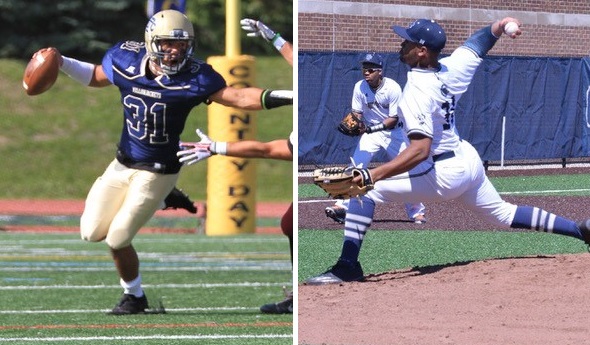
Steve, 18, has played varsity football and baseball for four seasons each at Country Day, earning all-state honors in football this past fall and baseball as a junior. Also an outstanding student, he has signed to continue his academic and baseball careers at Duke University, where he’ll end up unless he’s drafted by a Major League Baseball team this summer and offered a deal he can’t refuse – it’s possible he’ll be taken during the first five rounds.
Country Day varsity baseball coach Steve Lepkowski – a 1993 graduate of the school and former football assistant as well before taking over the baseball program in 2015 – said he’s never coached an athlete like Mann.
“Steve is going to be successful at whatever he does,” Lepkowski said. “He’s a four-year captain here. That’s as unique as you can get. We vote for that. And every year we re-vote, and (each) time we re-voted him in.”
Last season, Mann hit .396 with 25 RBI, 24 stolen bases and 27 walks. Through seven games this season, he’s hitting .536 with three home runs, 18 RBI, nine stolen bases and nine walks. He also is 3-0 pitching with a 1.65 ERA.
In football, Mann played defensive back, quarterback and receiver. He’s 6-foot tall, and his weight has fluctuated depending on what sport he is playing. For football, his playing weight was 195 pounds. For baseball he’s up to 210. Mann is a centerfielder who, out of necessity, also pitches for Country Day. He’s expected to be an outfielder at the next level.
With his Duke signing in November, Mann left a football future behind. But he has known for a while where he wanted to be next. Scholarship offers from a more prestigious baseball conference, the Southeastern Conference, fed Mann’s appetite. But he had his sights set on Duke (which plays in the Atlantic Coast Conference) early on, so when the scholarship offer came, that was the end of his recruiting process.
 “The scouts ask me, why Duke? Why not the SEC?" Lepkowski said. "Well, I said, Steve cares about academics. Duke has been number one with him all along. As a sophomore, I asked him, where do you want to go? It was Duke. So I talked with Duke. I know of the coaches there. And I told them I have a player here that wants to go to your school, and they asked who. I told them Steve Mann. They said, Steve Mann? He wants to come here? That was it. I call him the Shane Battier of baseball.”
If an explanation is needed, Battier helped lead Duke to an NCAA basketball championship after being at the forefront of Country Day’s Class B titles in 1995, 1996 and 1997. Battier was named Mr. Basketball by the Basketball Coaches Association of Michigan as a senior, and Mann is a leading candidate for the Mr. Baseball Award this spring.
Like Battier, Mann also is an outstanding student. He carries a 3.94 grade-point average, taking classes including honors English and advanced placement mathematics and Spanish.
And as for mentors, Mann has to look no further than his living room couch. His father, Steve, also played football, basketball and ran track at Country Day. He caught the winning touchdown pass in the 1986 Class C title game against Muskegon Catholic Central (Final score: 18-14). He went on to play football at University of Wyoming.
His mother, Kira (Lewis), played basketball, lacrosse and volleyball at Country Day before continuing her education at Penn.
Then there’s his sister, Brittany. A 2012 Country Day graduate, Brittany was the Lower Peninsula Division 2 discus and shot put champion as a junior and senior. Country Day won the team title her junior season. Brittany went on to compete at Oregon before graduating last year. She’s enrolled at Southern California and in pursuit of her master’s in communications.
At Oregon, Brittany set the school record in the shot put (57 feet, 4¾ inches) and helped lead her school to its first NCAA team title (2015) in 30 years. She was a four-time All-American.
“I had some big shoes to fill when I came here,” Steve Mann said of Country Day. “Since high school started, even in eighth grade, I knew baseball was going to be it. Before eighth grade I focused on being an athlete. With Brittany coming through Country Day, it was easy to see what I needed to do (to be successful). It was kind of like a competition. I want to be like you, but I want to be better.”
Individually, Mann and his sister are pretty much on par. But there’s that elusive team title he has yet to help win, though he has come close.
County Day lost in the Division 4 Football Final this past November, and last spring the Yellowjackets reached the Division 2 Quarterfinals in baseball before they were eliminated by Dearborn Divine Child, 4-3.
Mann has one more shot.
“I tell myself, I have to win a state championship,” he said. “We’re good enough to win it.”
Mann has always been around sports, even when he was too young to realize it. The year he was born was the year his father became an assistant football coach at Country Day. Whether he was the water boy, ball boy or just tagging along, Steve grew up watching sports.
 “I was always with my dad,” he said. “When I was 5, 6 years old, just being out there was great. My dad has taken me through this journey. It was a step-by-step process.
“Another big factor for me was Brittany going on her recruiting visits.”
When he was in the eighth grade, Steve Mann had the opportunity to meet Olympian Devin Allen through his sister. In 2016, Allen became the first man since 1956 to win the 110-meter hurdles at both the NCAA Outdoor Championships and U.S. Olympic Trials. Allen also played receiver on Oregon’s football team.
“I was star-struck,” Mann said. “He was so humble. How could you not want that for yourself?”
Mann is unassuming. Bragging is not a trait his household condones. Great athletes don’t have to tell you how good they are. Their actions do the talking.
His parents deserve much of the credit for this. A part of Mann’s training was to compete against athletes two and three years older to see, for one, how they train and, two, to see how much Mann needed to improve athletically to become like them.
“There were a lot of expectations,” his father said. “He is very self-driven, to live up to both the Mann name at Country Day and to create his own path. I’ve tried to teach him what it’s like to play at the next level.”
As an example, Steve Mann had his son train in the baseball offseason with Major League players who were home away from the game. This experience was not so much about throwing or hitting a baseball. It was about being around those who made it to see how they trained, what foods they ate and the like.
“I did a similar thing with him when he was in middle school,” Mann said of his son. “I’d have him train with the guys in high school, like a Jonas Gray (currently an NFL free agent) and a Bennie Fowler (Denver Broncos). I do that with my younger son, too.”
The Manns' third child is Brandon, who is 13 years old and about to complete the seventh grade. And, yes, Brandon Mann also plays baseball and football, and, yes, his is quite good at both.
 Tom Markowski is a columnist and directs website coverage for the State Champs! Sports Network. He previously covered primarily high school sports for the The Detroit News from 1984-2014, focusing on the Detroit area and contributing to statewide coverage of football and basketball. Contact him at [email protected] with story ideas for Oakland, Macomb and Wayne counties.
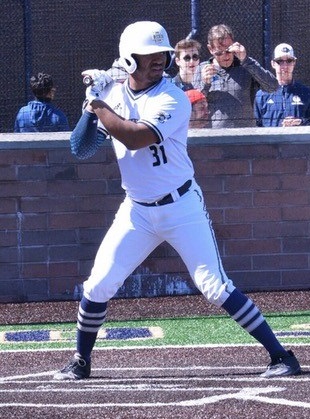
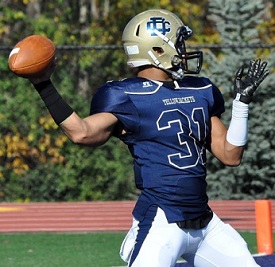
PHOTOS: (Top) Steve Mann starred as a multi-position football player during the fall and also pitches and plays outfield during baseball season. (Middle) Mann, here at the plate, could be drafted during the top five rounds in June. (Below) Mann prepares to unload a pass last fall. (Baseball photos by D’Andrea Parnell. Football photos by Scott Bertschy.)
Inside Selection Sunday: Mapnalysis 2012
October 24, 2012
By Geoff Kimmerly
Second Half editor
Between double checking data for more than a third of our 626 football teams, and creating 136 first-round games for our most popular tournament, the morning of MHSAA football "Selection Sunday" is both one of the most exciting and nerve-wracking of the school year.
So for those scratching their heads the last few days over how we picked the brackets this season, I offer one question and one warning:
How would you have done so differently?
And before you answer, remember that moving the position of one school affects at least seven more – if not all 32 in that division.
This was the second year I was involved in the football selection process, which while appearing simple on its face actually is layered with hours of discussions, calculations, checking and re-checking, and anything else we at the MHSAA can do to make sure we’ve created the best tournament possible.
Simply put, it’s more than just drawing circles and calling them good.
Below are a brief description of what we do, the history behind the process, and some challenges we face each time we draw these brackets – including some examples of our toughest this time around.
The process
Our past: The MHSAA playoff structure – with 256 teams in eight divisions, and six wins equaling an automatic berth – debuted in 1999. An 8-player tournament was added in 2011, resulting in nine champions total when November is done.
That’s a long way from our start. The first playoffs were conducted in 1975 with four champions. Four more football classes were added in 1990 for a total of eight champions each fall. Through 1998, only 128 teams made the postseason, based on their playoff point averages within regions (four for each class) that were drawn before the beginning of the season. The drawing of Districts and Regions after the end of the regular season did not begin until the most recent playoff expansion.
In early years of the current process (or until the middle of the last decade), lines were drawn by hand. Dots representing qualifying schools were pasted on maps, one map for each division, and those maps were then covered by plastic sheets. Districts and Regionals literally were drawn with dry-erase markers.
Our present: After a late Saturday night tracking scores, we file in as the sun rises Sunday morning for a final round of gathering results we may still need (which can include making a few early a.m. calls to athletic directors). Then comes re-checking and triple-checking of enrollments, co-ops, some records and more before the numbers are crunched and the field of 256 is set.
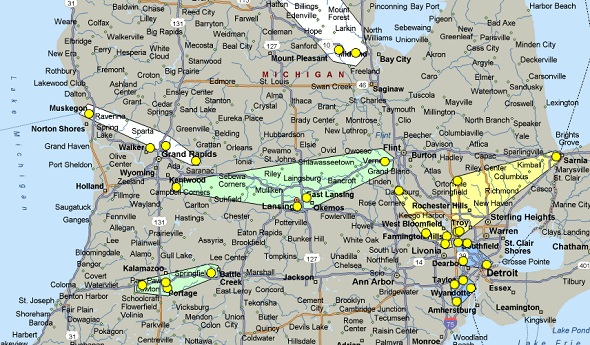
Those teams are then split into eight equal divisions based on enrollment, and their locations are marked on digital maps that are projected on wall-size screens and then discussed by nearly half of the MHSAA staff plus a representative from the Michigan High School Football Coaches Association. Only the locations themselves are marked (by yellow dots) – not records, playoff points averages or names of the schools or towns. In fact, mentions of those are strictly prohibited. Records and playoff points are not part of the criteria. Matchups, rivalries, previous playoff pairings, etc. also DO NOT come into play.
Geography rules: Drawing Districts and Regionals is all about location. Travel distance and ease DO come into play. Yes, ease is important. Schools near the same major highway might be further from each other in mileage than other options but have a better trip. A good example this year is in Division 6, which has seven teams in the U.P. and the northern Lower Peninsula. That meant Shelby needed to be included with those teams to make eight, and left Montague to a District that includes Hemlock – more than halfway across the Lower Peninsula. But at least, in this case, much of that trip will be on one roadway, M-46.
There is certainly conversation about every possible option. The staff splits into two groups, each handling four divisions (plus one of the groups handles 8-player too), and then the entire committee comes together to view all nine maps. There wasn’t one division where the group as a whole said, “That looks great, what’s next?”
Observations and answers
A different ballgame: I was asked whatever happened to Districts, meaning teams opening with opponents nearby. Remember that with eight divisions and 32 teams in each, the difference between maximum and minimum enrollments for each division is smaller than it used to be with just four classes, and the probability of finding two schools in the same division next door to each other is lower. This is especially true for our smaller schools, and those pairings are more spread out. Division 7 provides an excellent example. Opponents Dansville and Ottawa Lake Whiteford are 84 miles apart. But in another option considered, Dansville would’ve played Gobles – and those two are separated by 114 miles.
Points still matter: And that means strength of schedule is a big factor. After Districts are drawn, playoff point average determines the home team for those two games and Regionals as well. There are five Districts in which the team with the best or second-best record did not get home games because those teams’ playoff point averages ranked third among the four teams in those brackets. A number of other Districts have 8-1 teams playing at other 8-1 teams. It’s true: there are times a school can’t help the opponents it plays, because of league affiliation perhaps, and they have no control over how an opponent does the rest of the season. But a Class B team playing in a league with Class D schools can’t expect to compare averages well against teams in their division who face similarly-sized opponents during the regular season.
No boating: This didn’t come up last season, but did twice Sunday. We had to decide if it was a better trip for teams in the thumb to go around Saginaw Bay to play northern opponents, or instead send teams a little bit south of the thumb but with a straight shots north. As the bird flies, the thumb teams were closer in some cases. But I’ve never heard of a team hopping into a boat to get to a playoff game.
The fifth wheels: The toughest lines to draw are around areas with five schools in the same division. Remember, Districts come in fours, and one dot affects the rest. The Grand Rapids area gave us tough calls because of five teams in Divisions 2 and 4. The same was true in the southwest corner in Division 7 and the southeast corner in Division 6. No matter how we circled it, one of those teams got stuck with a longer trip. This time, that group included Caledonia, Grand Rapids South Christian, Blissfield and Gobles.
It’s easy to say certain areas of these maps should’ve been drawn differently. But again, keep in mind a statewide view.
Some of our pairings could create gigantic matchups earlier in the playoffs than those teams might like. But again, who is to decide which teams are the best and which matchups most “gigantic” before they prove it on the field? At least three teams touted during this fall as potentially the best in the state this season didn’t even win their conference titles.
And as I said in this analysis last year, determining the playoff schedule is just one step in many. Nine MHSAA champions must survive until the end, regardless of which opponents they face along the way.
Their journeys begin Friday.