

Marine City Focused on Comeback Quest
By
Paul Costanzo
Special for MHSAA.com
October 11, 2016
Ryan Alexander was in a familiar place this past Thursday.
 The Marine City senior running back was at East China Stadium, the junior varsity team on the field in front of him playing against Warren Woods-Tower and a group of junior program football players behind him, preparing to get onto the big field and play at halftime.
He and his Mariners teammates were coming off a win against archrival St. Clair, and had just finished their last practice in preparation for a Week 7 game against Warren Woods-Tower, one they would also win.
All of that is familiar for Alexander and the Mariners. The start of the season, however, was far from it.
“It was different than anything I’ve ever experienced,” Alexander said of Marine City’s first 0-4 start since 1971. “I’ve been on varsity for three years now, and to start 0-4, it was the first time I’ve ever felt anything like that since I’ve been in the program, since I’ve been in Marine City.
“It was a new feeling, but it was also a sense of motivation. It pushed me harder knowing that we had something to prove and that everyone was doubting us because we were 0-4. It’s hard to go through, but I think it made us a better team.”
Alexander and his teammates are on the road back, sitting at 3-4 and eyeing two more wins which could possibly preserve the school’s streak of qualifying for the postseason, which started in 1998. He said getting there would show those junior program players that by coming together as a team, you can accomplish anything.
The Mariners have already shown their coach plenty.
“I wondered, because our program has had so much success, what would happen if we had a bad start like this, how would that team be and how difficult would it be to coach,” Marine City coach Ron Glodich, who is in his fifth season as head coach after serving as a longtime assistant in the program. “What I found is these kids are incredible. Their perseverance and their work ethic has not changed. Nobody has quit, even though I challenge them week in and week out, nobody has quit. The bigger the challenge I give them, the bigger they step up.”
‘We live football’
Football in Marine City has a bit of a “Friday Night Lights” feel to it.
The town with a population of a little more than 4,000 essentially shuts down on game nights to support its team. Not long ago, it moved trick-or-treating because it conflicted with a Friday night playoff game. When the team went to Ford Field for MHSAA championship games in 2007, 2011 and 2013, it filled its entire side of the lower bowl with fans clad in orange and black.
“It’s a football crazy town,” Alexander said. “We live football.”
Kids grow up wanting to be Mariners as much as they grow up wanting to be Wolverines or Spartans, and you can’t even go to a JV game without seeing groups of them playing a side game of touch – or tackle – at East China Stadium.
“They were always winning, ever since I’ve been a kid and ever since my parents have been around,” senior lineman Andrew Steinmetz said. “It’s a great feeling to grow up here, live here and then play here.”
Always winning isn’t hyperbole, especially for someone Steinmetz’s age. The playoff streak is only scratching the surface of the Mariners’ success in the past few decades.
The program won MHSAA championships in 2007 and 2013, and – prior to this year – had lost more than two games in a season only three times since 1992.
From 2006 through 2009, Marine City had three undefeated regular seasons, and in the only exception, it went 13-1 with a Division 4 championship. The Mariners’ last losing season came in 1982.
There have been stars who went onto play Division I college football – Brendon Kay, a 2008 graduate went to Cincinnati and was the Most Valuable Player of the Belk Bowl, and Anthony Scarcelli, who was the Associated Press Division 3-4 Player of the Year in 2011 and is currently a senior on Central Michigan University’s football team – but most of Marine City’s success has come thanks to players who don’t have a recruiting site ranking.
“When you mention the name Marine City outside the area, it’s common for someone to say, ‘Oh, you’ve got a great football program,’” Glodich said. “And we’re proud of that. It’s been a long time since we built it, and a lot of people are proud of it in the area and they come out to support it. It’s nice that that’s linked to the town, and that people believe we have a great football program. And I believe we do.”
 In Marine City, even 8-1 teams catch flack. At 0-4, the loud minority of the fan base gets more vocal.
“As any coach who doesn’t win, there are critics out there,” Glodich said. “I happened to get a letter and I shared it with the kids. I told them, ‘We’re all in this together. You’re being criticized in the stands, I’m being criticized, so understand that we’re all in this together and it’s all about getting better.’
“The good news is, I’m at the point in my career where I know that this staff does a great job. So when you get letters like that, you chuckle and say, ‘OK, this person is venting, but they don’t know what the hell they’re talking about.’ And I would tell that person if they ever had the guts to look me in the eye, I would tell them, ‘You don’t know what the hell you’re talking about.’”
Glodich’s players said they were able to shut out the outside noise, for the most part, and anything that did enter their brains was used as motivation. Alexander said it went in one ear and out the other, because practicing with a clear mind was much more necessary than reacting to insults.
Even better, however, was the fact there was much more support than derision. Marine City may be football crazy and unaccustomed to waking up on a Saturday after a loss, but its love for football goes beyond a stunning win-loss record.
“The parents and the past players, they really had our backs,” senior lineman Tom Kaminski said. “(Former player) Ethan Cleve made a nice Facebook message on the Marine City football fans page, and (former player) Jarrett Mathison was saying, ‘Don’t worry about it, it will get better.’”
Writing the final chapter
The message within the team was similar to Mathison’s, but the players knew they were the ones who would have to make things better.
“A lot of it came from themselves,” Glodich said. “After that fourth loss, we challenged them and said you guys make a decision of how you want to move forward. That’s where your senior leadership and the guys that really care about the program, they kind of step forward and they rally the troops. We challenged them come Monday, and they responded to the challenge.”
The change could be seen in practice, and it translated into a 37-29 win against Madison Heights Madison in Week 5. That was followed by a 27-6 win against St. Clair in Week 6 and most recently a 49-31 win against Warren Woods-Tower in Week 7.
“We just had to put our heads down and keep fighting for it, because we knew we were better than what we were,” Kaminski said. “It’s big on your shoulders, because everyone’s used to 9-0 teams here, so that was a big wake-up call, but I think we’ve got it.”
As stated above, while this is a position Glodich never wanted to be in, he said he’s always wondered what would happen if a Marine City team had a start like this one. He’s wondered how the players would react. He’s wondered how difficult it would be to coach a team that no longer held its playoff destiny in its own hands before the midpoint of the season.
“I’m amazed that these kids are working this hard – I don’t know if any other team that was 0-4 is working as hard as we do,” Glodich said. “It’s just a credit to these kids and their background; they’re not afraid to work. The kids that come to school here in this community are not afraid to work, and that’s why I’m one of the luckiest guys in the state to be able to coach in this community.”
The 0-4 start may have put the Mariners on the brink of playoff extinction, but their opponents in weeks 1-4 could wind up helping push them over the top when it comes to playoff selection, should Marine City get to 5-4.
Algonac, Port Huron Northern, Detroit Loyola and Marysville were a combined 25-3 through seven weeks, with one of those losses a Northern defeat against Marysville.
The Mariners are taking the one-game-at-a-time approach to the end of the season, but they know that can help. They know they can do something special to close it out, and accomplish something no Marine City team has done before – rebound from a start that could cause some to pack it in.
Glodich said he can’t look past the next game, but admits he and his coaches have talked to the players about writing the final chapter in their book, and how they want their story to end.
Alexander has already started writing in his head.
“It would mean the world (to finish 5-4) especially because it’s my senior year and I’d love to end on a high note,” he said. “I’d love to be the team that started 0-4, won the last five games and then proved what we have in the playoffs. We have a good team, we have a good shot.
“We just want to get to 5-4. We don’t really focus on anything else (in terms of playoff points). If we get there, it doesn’t matter, we’ll be happy.”
 Paul Costanzo served as a sportswriter at The Port Huron Times Herald from 2006-15, including three years as lead sportswriter, and prior to that as sports editor at the Hillsdale Daily News from 2005-06. He can be reached at [email protected] with story ideas for Genesee, Lapeer, St. Clair, Sanilac, Huron, Tuscola, Saginaw, Bay, Arenac, Midland and Gladwin counties.
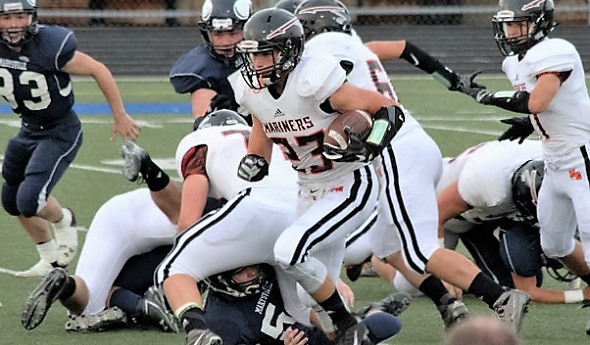
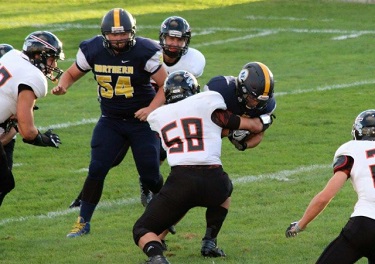
PHOTOS: (Top) Marine City's MJ Frank cuts through an opening against Marysville this season. (Middle) A group of Mariners surround and take down a Port Huron Northern ball carrier. (Photos courtesy of the Marine City football program.)
Performance: Cass Tech's Rodney Hall
December 1, 2016
 Rodney Hall
Detroit Cass Tech senior – Football
A year ago, Hall’s junior season ended on the Ford Field sideline, watching Cass Tech fall 41-27 to Romeo in the Division 1 Final after he suffered a lower leg injury two weeks before. But he came back this season fueled by championship motivation, and made it pay off. Hall threw for 220 yards and an MHSAA Finals record-tying five touchdown passes to lead the Technicians to a 49-20 win over Detroit Catholic Central in the Division 1 Final on Saturday and earn the Michigan National Guard “Performance of the Week.”
Hall started a pair of playoff games as a freshman before taking over the varsity fulltime in 2014 and leading Cass Tech to a 12-1 record. The Technicians were a combined 36-3 under him the last three seasons and scored a program-record 619 points (44.2 per game) this fall. The 6-foot-2, 210-pound signal-caller completed 10 of 18 passes in the Final and also ran for 58 yards on only seven carries. He finished this season 142 of 238 passing for 2,535 yards and 28 touchdowns, after a junior season when he threw for 2,232 yards and 20 touchdowns and ran for 1,053 yards and 14 scores.
 After admitting Saturday to being a little timid to run at the start of the fall, and with a steel plate still in his ankle, Hall ran for a combined 253 yards and three touchdowns over his final three playoff games. He has committed to sign to play football at Northern Illinois University but said he’s unsure which course of study he’ll pursue. MLive-Detroit reported Hall carries a 3.4 grade-point average in its feature on the Technicians standout as one of 10 finalists for MLive’s High School Football Player of the Year award.
Coach Thomas Wilcher said: Let's say it like this: He lost one game his first year, two games his second year, zero games his third year. That's enough said. ... I think the most important thing about Rodney Hall is you have to look at his stats. He has phenomenal stats. He has a phenomenal win-loss record. I haven't been around anything like that before. I just look at his game – (he's) the gamer. He's always bringing back a victory. We went down to the wire several times, and it was all about him. And I just told him this week, 'Look, I don't need you to run the ball. All I want you to do is throw the ball. You should throw the ball for over 300 yards.’ That’s it. And I told him, just stick with the game plan; no running. And I just kept telling the offensive coordinator, don't let him run. Let him throw it. That's it."
Performance Point: “Just to be able to make it back to this point and play in this game, I was just excited to come play, and glad we won,” Hall said. “The offense was clicking, and guys were open. They did the rest. I just put it to them. … (At last season’s Final) I was crying. I was hurt that I couldn't be out there to help my teammates. I wanted (this year) bad. We made history at Cass because I think we’re the first team to go 14-0 and win the state championship. We just wanted to win this game because we’ve been losing ever since we came into high school. We have a lot of wins, but we’ve been coming up short for the last three years – and it’s great to come out with the championship this year.”
Learning to run again: “I came in (to this season), I was a little timid to run, actually. I didn't want to get hurt again and miss this opportunity. Coach, he's been pressing me to run all year, and when I finally do, I get positive yards.”
 Star among the stars: “Quarterback is simple. You just have to keep everybody on the right track and make sure teammates don’t get down when we get behind. The last two weeks we’ve been losing, and I just remind my guys, ‘Come on, we can win this. We’re going to go back and score.’ Just remind them to keep scoring, remind the defense we’re going to keep getting stops, and just keep everybody’s heads up.”
Pass is present: “This year, I’ve been a way better passer. Because all offseason, I haven’t been able to run. I’ve just been working the pocket, making sure I’m looking at everything, making sure I’m reading the defense better. And I’ve had a better passing year this year, I believe.”
Leaving a legacy: “I just can’t believe it’s over with. I just want people to know I was a guy to go out there and give it all I’ve got. Just sell out for the team, and that’s what you should do – and you’ll end up a champion.”
- Geoff Kimmerly, Second Half editor
Every week during the 2016-17 school year, Second Half and the Michigan National Guard will recognize a “Performance of the Week" from among the MHSAA's 750 member high schools.
The Michigan Army National Guard provides trained and ready forces in support of the National Military Strategy, and responds as needed to state, local, and regional emergencies to ensure peace, order, and public safety. The Guard adds value to our communities through continuous interaction. National Guard soldiers are part of the local community. Guardsmen typically train one weekend per month and two weeks in the summer. This training maintains readiness when needed, be it either to defend our nation's freedom or protect lives and property of Michigan citizens during a local natural disaster.
Previous 2016-17 honorees:
Nov. 24: Ally Cummings, Novi volleyball – Read
Nov. 17: Chloe Idoni, Fenton volleyball – Read
Nov. 10: Adelyn Ackley, Hart cross country – Read
Nov. 3: Casey Kirkbride, Mattawan soccer – Read
Oct. 27: Colton Yesney, Negaunee cross country – Read
Oct. 20: Varun Shanker, Midland Dow tennis – Read
Oct. 13: Anne Forsyth, Ann Arbor Pioneer cross country – Read
Oct. 6: Shuaib Aljabaly, Coldwater cross country – Read
Sept. 29: Taylor Seaman, Brighton swimming & diving – Read
Sept. 22: Maggie Farrell, Battle Creek Lakeview cross country – Read
Sept. 15: Franki Strefling, Buchanan volleyball – Read
Sept. 8: Noah Jacobs, Corunna cross country – Read
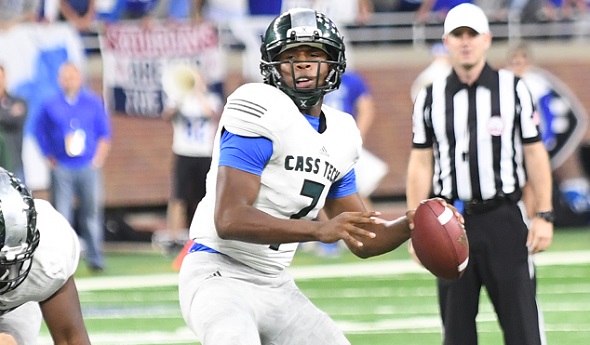
PHOTOS: (Top) Detroit Cass Tech's Rodney Hall prepares to unload a pass during Saturday's Division 1 Final at Ford Field. (Middle) Hall hurdles a would-be Detroit Catholic Central tackler.