

MCC Extends Streak, Hands Off Legacy
November 25, 2016
By Geoff Kimmerly
Second Half editor
DETROIT – A trio of running backs who played major roles in Muskegon Catholic Central’s last three MHSAA championships closed their high school careers celebrating the school’s fourth straight title Friday.
Along the way, they also handed off the program’s future.
Seniors LaTommy Scott, Logan Helton and Walker Christofferson had become Ford Field fixtures the last few seasons, and each contributed to their combined four touchdowns in this Division 8 Final. But the fifth score of MCC’s 35-6 victory over Ottawa Lake Whiteford was scored by a freshman who will take over from here – and showed the promise that makes the Crusaders look good to continue these annual trips to Detroit.
Splitting time at quarterback with senior Trenton Bordeaux, freshman Cameron Martinez ran for a team-high 154 yards and a touchdown and threw for 61 yards and a score to help MCC pull into a tie for second all-time with its 12th MHSAA football title.
Although a freshman, the scene wasn’t entirely unfamiliar for Martinez; his brother Christian had quarterbacked the team to its 11th title last year as a senior.
“Every time we made it, I was watching from the crowd. I couldn’t wait to put on the gold helmet and bring this team back again,” Cameron Martinez said. “I love this group of seniors. I’m going to miss them, and that’s what I wanted to do – give them their fourth straight title.”
With four straight, the Crusaders (14-0) are now one shy of the MHSAA record of five consecutive titles shared by the Farmington Hills Harrison teams from 1997-2001 and East Grand Rapids’ teams from 2006-10. With 12 championships total, MCC is tied with now-closed Detroit St. Martin dePorres for second most in the sport, one behind Harrison’s record 13 football titles.
Martinez entered the Final third on the team with 614 rushing yards, tallying 12 touchdowns on the ground, and second to Bordeaux with 540 passing yards plus nine scoring passes. Also a starting linebacker, he didn’t play offense in MCC’s 35-0 Semifinal win over St. Ignace last week. But he was impacting the Crusaders’ offense by the end of Friday’s first quarter.
Martinez’ first carry came on the final play of that quarter, for three yards, and he opened the second with a 26-yard run. He also had a 19-yard run and 23-yard pass to set up Helton’s five-yard scoring run that put the first points on the board with 9:05 to go in the first half.
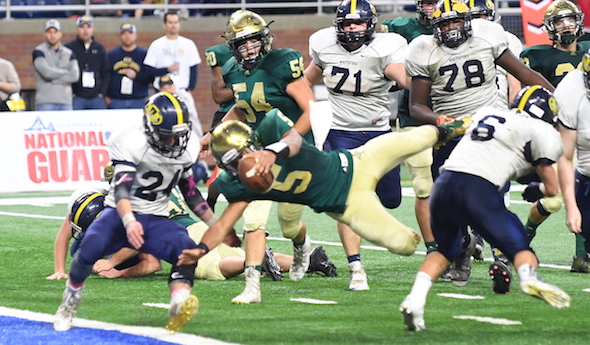
After coming up shy on another drive late in the half and then pushing the score to 14-6 on a 35-yard Helton run to cap its first possession of the second, MCC made it 21-6 with 3:08 to play in the third quarter with a drive that included 55 rush yards on five Martinez carries, including the final one for three yards into the end zone.
“Anytime you have a running quarterback, you have to defend 11 and not 10; it’s just simple math sometimes,” MCC coach Steve Czerwon said. “Having somebody in the backfield as dynamic as Cameron, with the ability to make plays … people are like, ‘He’s a freshman.’ Well, he’s a freshman, fine. But he doesn’t play like a freshman.”
 MCC welcomed its captains from the last three seasons to Thursday’s practice, and after, Czerwon asked Christian Martinez if he was nervous for his brother. Christian’s response to Czerwon: “Nah, he’s made for these big moments.”
“After he said that – and he knows him a heck of a lot better than I do – I felt good about using him today,” Czerwon added. “And I thought he performed very well.”
So did those seniors. Helton ran seven times for 67 yards and those two scores, and Scott ran eight times for 69 yards and scored on the 25-yard touchdown “pass” which was more of a front pitch on a sweep around the left side. Christofferson, who ran for 200 yards and three touchdowns in the Semifinal win, added the day’s final score with 1:04 to play.
Helton, also a linebacker, had 10 tackles and Christofferson, a defensive back, had seven to follow up all-state senior linebacker Andrew Schulte's team-leading 13. The Crusaders never trailed this season, and the defense was a big reason why; including 13 points surrendered over five playoff games, MCC allowed only 77 points this fall (5.5 per game).
But Friday’s score didn’t tell well how close this matchup was for most of it. Whiteford had six turnovers on downs, falling short of first downs by only a yard four times. Twice, MCC sophomore defensive back Dawson Steigman made rally-ending stops. Three of the fourth-down misses came in Crusaders territory.
Whiteford junior quarterback Thomas Eitniear was especially impressive, completing 7 of 10 passes for 96 yards and running nine times for 111 yards including the team’s lone score, an 81-yard sprint around the left end that made it 7-6 with 2:37 to go in the first half.
“Coming into halftime, that was the exact kind of game we were looking to play – to chew clock, and we just didn’t articulate a couple of our possessions into scores,” Whiteford coach Jason Mensing said. “Second half, they found some things offensively against us and took advantage. And on top of that, we didn’t articulate our drives as well.
“Overall, I’m pleased with the effort and passion, and probably the thing I’m most proud of was I didn’t feel like the moment was too big for our kids, which oftentimes you get into this type of stage, the moment can be a little large. I thought our kids handled themselves with great composure, and that’s one of those attributes for life that really matters.”
Whiteford made its first appearance in an MHSAA Final, following up its second straight – and second ever – Semifinal appearance. The Bobcats finished 13-1.
“Me and a bunch of the senior guys, we dreamed about this since freshman year,” said senior running back Jesse Kiefer, who finished as the school’s career record holder in rushing yards, points and total offense. “Coming in and being able to play on this field, it’s just not real to me. Obviously, we wanted it to come out a different way than this, but it’s still an experience I’ll never forget.”
Kiefer had seven tackles at linebacker, following senior safety Herbie Bertz’ 13 and junior tackle Jared Atherton’s eight. Kiefer also broke up three passes.
With it being their last, MCC’s seniors asked to not come out of this game early as they have most of this season with the Crusaders beating all of their opponents by at least two touchdowns.
But as they left Ford Field once more, surrounded by 13 underclassmen, they were confident with who might lead MCC back next time.
“Handing it off the Cameron, our program is in good hands,” Helton said. “I don’t expect anything less than what we’ve been doing.”
The MHSAA Football Finals are sponsored by the Michigan National Guard.
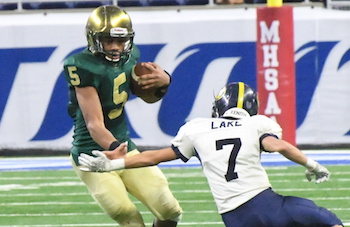
PHOTOS: (Top) Muskegon Catholic Central’s Cameron Martinez stretches toward the goal line for a score late in the third quarter. (Middle) Martinez works to elude Whiteford’s Hunter Lake.
Menominee Follows Winning Formula
October 29, 2015
By Dennis Grall
Special for Second Half
MENOMINEE – Explaining the continued success of football at Menominee High School is not difficult.
"Football is just work. The kids are willing to work," fourth-year coach Joe Noha said of a simple explanation of a premier program for decades.
 The Maroons (9-0) host Grayling (6-3) Friday at venerable Walton Blesch Stadium in a Division 5 opener. Noha, a former Menomninee player and assistant coach under legendary head coach Ken Hofer, is 45-4 since taking over the program.
Menominee was Division 5 runner-up under Noha in 2013 and reached the MHSAA Semifinals the other two seasons. Under Hofer, with Noha as the top assistant, the Maroons won Division 5 titles in 2006 and 2007 and Class BB in 1998.
There is more to this amazing success than simply hard work, something every successful program can also claim.
"We try to put our guys in the best position to have success," Noha said. "We can do a lot of different things."
Again, all successful teams can make that claim.
The Maroons also can point to stability in the coaching staff. Hofer, who retired after the 2011 season, is the all-time leader in victories among Upper Peninsula coaches with a 313-141-2 record. Noha, who graduated from Menominee in 1983 and then played football at Saginaw Valley State University, joined Hofer's staff in 1994.
Assistants like Ron "Satch" Englund, Jamie Schomer, Dave Mathieu, Nathan Linsmeier, Lucas Chouinard, Tyler Uecke, Bill Schwanz and Mark Klapp have also been part of the program for many years, providing stability to that success. Many of them also played for Hofer.
"After every practice we evaluate and look at ways to get better," said Noha, mentioning something else that of course is done across the sports universe.
Noha noted successful operations, referring to Fortune 500 companies, as he said, "everyone has core values. We put kids first, teach them hard work and responsibility (and discipline). Our teaching staff, our community; it is all part of what we do. We always have a support staff to lean on. Our kids know that. They know what the Menominee standard looks like."
He also pointed out, "There is a lot of pride there. We talk about giving back to what was given to you."
 Noha also notes a "family mantra" in Menominee. "There is definitely family here, there is definitely community support here, the school supports us. There is not a lot of turnover here. We stick together, we work well together. A lot of people maintain the standard.
"A lot of people have a vested interest."
Again, nothing different from other successful programs.
But here's what is different: The Menominee Maroons do all of those things, and most importantly, perhaps, is it has been like that for nearly half a century.
One other explanation could also be how the Maroons operate on the gridiron. They are one of the very few remaining teams who use a single-wing offense, which makes it difficult for potential playoff opponents to prepare for since it is tough to emulate in practice.
Familiar Upper Peninsula opponents such as Escanaba, Kingsford, Gladstone and Marquette get to see the single-wing every year, as well as at the freshmen and jayvee levels. Grand Rapids West Catholic, which beat the Maroons in the 2013 title game and the 2012 semis, also has a good idea of the single-wing intricacies.
"West Catholic has beaten us because they were better," admitted Noha. "Trying to replicate it in practice is very difficult. You have to execute. It comes down to putting kids in good spots."
The Maroons have obviously modified the single-wing through the years, from fullback spinners to jump passes to bubble screens and fly patterns for receivers. "We can spread it out and we can pound it, but the single-wing concepts are still there,” Noha added.
"Everybody puts their tweaks on everything. If you are defending us, you better know the top three plays in our formations. Everyone's film is your DNA, your template. It is not brain surgery by any means."
It still comes down to other areas. "You have to have the kids, the coaches, and the kids have to be resilient," Noha said. "You can have any system you want."
Talent also comes in handy, and the Maroons again are blessed in that department. Led by quarterback/running back Nathan Nowack, the Maroons fill six defensive positions and five offensive positions on the Great Northern Conference all-star team this fall.
Nowack, who scored seven touchdowns against Gladstone this year, is the GNC's offensive player of the year, and lineman Adam Beyersdorf is the GNC's defensive player of the year.
Noha said changes have been made throughout the 35 years he has been associated with the program, some mandated by the MHSAA such as the reduction of contact in practice and the emphasis on concussions.
"The practices and the schemes stay the same. We look at nutrition more and we don't hit nearly as much as we used to," said Noha, who also indicated weight training has been emphasized much more since he was a player.
 "The kids are bigger, stronger, faster and more physically fit. The game is faster, the kids are more skilled and get out in space more," Noha said.
While the Maroons usually boast good size in the line, Noha said the Maroons look more at body composition and how it best suits the players and positions. Many of the players go around the 180-190 pound area and are well-conditioned, solid athletes, he said.
Noha noted the first three playoff games are usually held outdoors, and then the Maroons usually play in the Superior Dome at Northern Michigan University and then hit Ford Field if they reach the title game. He said heavier kids may wilt under the indoor conditions. "We want kids that can run and move," he said.
Menominee's future may look even brighter. After not having a freshmen football team the past four years, Noha said that level will resume in 2016 as 30 freshmen players are anticipated. There were 22 freshmen on the 2015 junior varsity team.
Football is played to be fun for the Maroons, and it is always more fun when you can enjoy success like the Maroons experience. What it all comes down to in Menominee, Noha said, is "the scoreboard never defines us. We try to use football to get us to a better place."
 Denny Grall retired in 2012 after 39 years at the Escanaba Daily Press and four at the Green Bay Press-Gazette, plus 15 months for WLST radio in Escanaba; he served as the Daily Press sports editor from 1970-80 and again from 1984-2012. Grall was inducted into the Upper Peninsula Sports Hall of Fame in 2002 and serves as its executive secretary. E-mail him at [email protected] with story ideas for the Upper Peninsula.
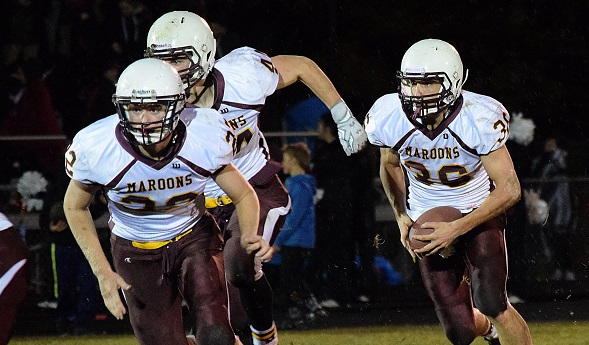
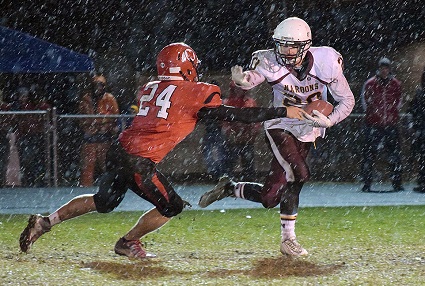
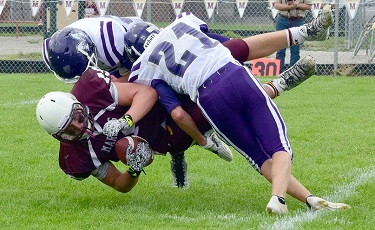
PHOTOS: (Top) Senior Nathan Nowack (36) follows two of his blockers during this season's game against Marquette. (Middle) Hunter Hass works to avoid a Marquette defender on a rainy night. (Below) A Menominee ball-carrier holds onto the ball as two Marinette, Wis., players tackle him. (Photos courtesy of Val Ihde.)