

Memorable Wakefield Run Won't Be Forgotten
October 2, 2019
By Ron Pesch
Special for Second Half
When it comes to football, Russ Maki wears his heart on his sleeve. A 1971 graduate of Wakefield High School, he’s on a mission.
As a 7-year-old, he fell in love with the sport and, in particular, with a team.
“My Dad brought me to every (Wakefield) game,” he recalled. “We lived four blocks from the football field, and I watched every morning and afternoon practice.”
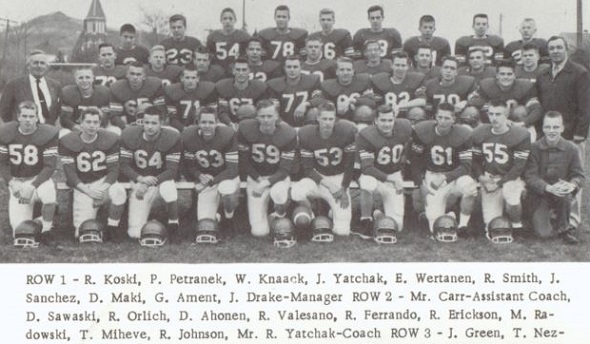
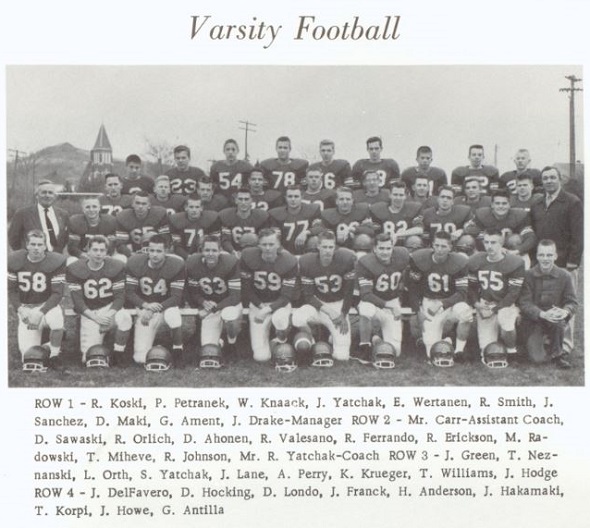
Maki’s memories are of the 1960 Cardinals, and he’s on a quest to honor the team.
Football began in 1920 at Wakefield. Interrupted briefly for a national crisis, it returned to the gridiron stronger than ever – but then, until recently, disappeared from the landscape of this Upper Peninsula town. Like in other cities across the nation, shrinking enrollments have impacted the sport.
“(That 1960) team just kicked everybody's butt,” added Maki. “The players on this team were my heroes then and still are to this day. Hardly anybody in town knows they were State Champs.”
Football state championships in Michigan are decided on the playing field via a tournament these days. But that wasn’t the case when Maki was a kid.
Hence, his challenge. He would like the school district to honor the team with recognition such as a pennant to hang in the gym. So he needs proof.
Big Iron
The City of Wakefield proudly notes that it is located in the heart of Big Snow country. Indeed, nearby are three of the finest ski hills in the Midwest. Located in the center of town is Sunday Lake. Porcupine Mountains State Park and Lake Superior are a little north. It is beautiful country.
 But it wasn’t snow, scenic waterways or quality of life that initially attracted folks to the Gogebic Range area of Michigan. Rather, it was the discovery of iron ore in 1881. The find inspired a mad rush to capitalize, and that led to the founding of the village of Wakefield in 1887. The city was incorporated in 1919.
Hop on highway US-2, head west, and around 10 minutes later, you’ll be in Wisconsin. Stay on US-2, jog a bit to the north, and in two hours you’ll find yourself in Duluth, Minnesota. A trip from Wakefield to Fargo, ND, is six and a half hours. For comparison, a visit to Detroit, with traffic cooperating, would require a commitment of at least nine hours.
So it’s completely understandable that, from the beginning, Hurley High School – located a mere 13 miles away in the Badger State – became a rival.
“The Wakefield high school football team will meet Hurley on the local grounds Saturday afternoon,” announced the Ironwood Daily Globe on October 20, 1920. According to Coach (Fred) Hackett, who has charge of the team, the boys are light and newly organized and have only a fair chance of winning the game with Hurley.”
Indeed, it was a mismatch, with Hurley trouncing the “green but willing youngsters” from Wakefield, 46-6.
“In the two weeks that the Wakefield team has been out in uniform, Coach Hackett had little time to even drill some of the youngsters in ordinary tactics of the game, much less develop a strong team.”
The schools met again in 1921 with similar result, but continued to play each other sporadically in the coming years. A field goal by Pat O’Brien with eight seconds left to play in the 1929 contest gave Wakefield a 23-20 victory over its natural rival, sealing the school’s first ever unbeaten (but once tied) season.
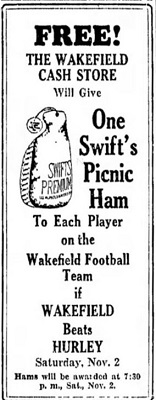
“A local grocery store offered a free ham to each player on the team if they beat Hurley in that season-ending game,” said Maki, laughing. “Can you imagine that?”
They became league rivals when both teams, along with Bessemer and Ironwood from Michigan and Ashland from Wisconsin, became charter members of the Michigan-Wisconsin Conference in 1937.
Hopes for a different moniker, “for brevity’s sake,” were tossed around by the press at the time. The ‘Big Five’ was pitched by the Iron Mountain News. The Ironwood Daily Globe suggested ‘Michwico’, a juxtaposition of the words Michigan, Wisconsin and Conference. Another thought was the ‘WHABI’, a combination or first letters from each member town.
Instead, as time wore on, the league simply became known as the “M-W.”
Alumnus comes home
Wakefield discontinued football for two years – some say three – due to World War II. The team returned in the fall of 1945. Ansel Anderson, a graduate of league rival Ashland and Stout Institute in Menomonie, Wis. – where he took part in basketball, track and captained the football team – guided the athletic squads at Wakefield for two seasons.
In 1947, the school hired one of its own.
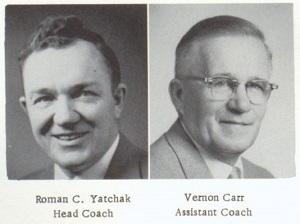 Roman Charles Yatchak had starred in both football and basketball at Wakefield, earning all-U.P. honors in the early 1930s, then lettered in football, basketball and baseball at Iowa State Teachers College. He coached prep ball in Iowa, then at Highland Park in metro Detroit before returning to Wakefield. A year earlier, the Cardinals became members of the newly formed Western Upper Peninsula Football Conference, comprised of Class ‘C’ schools from Houghton, Hancock, L’Anse, Ontonagon, Lake Linden and Crystal Falls. The 1947 season would be the first during which each member played one game against all the other members.
“The squad has responded magnificently to his tutoring,” wrote the News near the end of Yatchak’s first gridiron season at the helm. Wakefield had posted a 5-2 mark heading into the season-ending contest with Bessemer, now a nonleague game. The Cardinals had faced the Speedboys on 17 occasions with minimal luck, winning only four contests since 1924 when the teams first met.
Bessemer again came out on top, 13-0. Still, the season featured a third-place finish in conference play and was deemed a success. Ten juniors were expected back for the 1948 season.
The Cardinals, under Yatchak and assistant Vern Carr, won the Western Upper Peninsula Conference title in the fall of 1948 and posted a 7-1 mark overall. The loss was 6-0 to Ironwood, an old M-W conference rival, in the season opener and was played on the road. At season’s end, eight Cardinals earned all-conference honors, with center Ed Kuivinen receiving first-team all-U.P. accolades and Bob Novack appearing on the second team honor roll.
It was Wakefield’s best mark since 1929. Yatchak’s squad finished the 1949 season with another league title and a 7-1 mark. Again, the loss was to Ironwood.
Good times
After a nine-year absence, in 1951 Wakefield and Hurley renewed their cross-border rivalry. It would continue uninterrupted until 1993.
The game was played beneath the lights at the new home of the Hurley Midgets before a crowd of 2,000.
“The Cards opened the season with a thriller but a heart-breaker,” wrote the sports editor of the school’s yearbook, The Echo.
Both teams opened scoring in the first quarter. Trailing 7-6, Wakefield grabbed a single point advantage with a safety secured late in the third by downing a Hurley back behind his own goal line. The 8-7 lead held until late in the fourth, when Hurley halfback Louis Grandelis “tossed a perfect pass to end Tony Cornolo,” who rumbled to the Wakefield 6-yard line. The play covered 51 yards. Fullback Bob Johnson plowed over his left tackle on the ensuing play for the touchdown with just over a minute to play. Johnson then “drove through center to tally the extra point” and a 14-8 victory.
 The Cardinals romped over the Midgets 27-0 in 1952 on their way to their first 8-0 season. There were only three undefeated U.P. teams that year, and the Floyd Barber Trophy – symbolic of gridiron supremacy above the straits – was awarded by the U.P. Sportswriters Association to Menominee, which finished 7-0 and had won its last 15 games.
Wakefield fell to Hurley, 14-0, in 1953 and 38-14 in 1954. A 32-13 victory by the Cards in 1955 cemented the annual battle as a highlight of the schedule.
Attendance issues and stellar success
“Wakefield football teams seem to be a drawing card in every football stadium except their own,” wrote the Wakefield News in mid-September 1954. “The local populace has never really supported football as other range towns have. … This fact is surprising, especially since local teams have been extremely successful.”
In an attempt to improve local support, in 1957, Hurley and Wakefield again became conference rivals when the Cards returned to the Michigan-Wisconsin league from the Western Upper Peninsula Football Conference.
“The recommendation of the change of conferences was made by Coach Roman Yatchak to draw a larger attendance at football games,” stated the Globe. Contests with foes from the Western U.P. Conference, all 50 to 110 miles in distance from Wakefield, simply didn’t capture the attention of local fans. With the change, league contests would be no more than 50 miles away – the longest when they needed to travel to Ashland.
The Cardinals finished 3-1 in the M-W Conference in 1957 and 6-2 overall that first year. In the fall of 1958, Wakefield ran the table, ending the year with the M-W crown and a flawless 8-0 record on the season, the best in school history. Wakefield outscored its opponents 234-26.
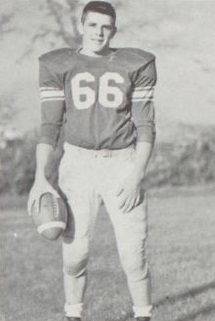
Yatchak’s team had included 13 returning lettermen including four regulars. Dick Koski, winner of 12 varsity letters at Wakefield, was much of the reason for the success. At season’s end, he was named to the Detroit Free Press’ Class C all-state team backfield. He netted 943 yards from scrimmage and finished as the third-highest scorer in the U.P. with 106 points. Teammate Jerry Bugni earned honorable mention recognition.
(Koski would go on to star at Northern Michigan College, then coach high school ball, guiding Ontonagon for three seasons and then Negaunee for 31 more. He retired following the 1999 season with a 211-113-1 record).
Despite the perfect mark, Wakefield finished the season ranked No. 7 in Class C-D by United Press International in its 1958 season-ending prep ratings. Charlevoix was the leading vote getter in the classification according to UPI’s panel of 21 top high school coaches. The Barber Trophy again went to Menominee. Wakefield, which finished second in the voting, was one of five undefeated U.P. teams that year.
A loss in the final 60 seconds of play, again to Ironwood, was the single flaw on the Cardinals’ 1959 slate. The team ended the year ranked 10th in the final UPI Class C-D rankings.
State Champs
Maki’s favorite, the 1960 squad, included 12 seniors. Ontonagon, winner of one game in 1959, dropped from the schedule, leaving Wakefield with only seven games as the season opened. About a dozen schools in Michigan and Wisconsin had been contacted in an effort to secure an opponent for the early October date. Despite Yatchak’s best efforts, he couldn’t find a replacement.
A Friday night blockbuster kicked off the season. At Longyear Field in Ironwood, a crowd of 3,000 lined the grounds on a warm, humid night for the rematch between the ’59 Michigan-Wisconsin Conference co-champs. Tied at 7-7 at the end of the first quarter, Wakefield opened a 21-7 lead as the teams headed to the locker room for halftime. Ironwood took the opening kick of the second half 11 yards to its 28, and then mounted a 10-play, 72-yard drive for a touchdown. A low kick kept the margin at eight. 21-13.
“Shortly after that the Red Devils were unable to capitalize on two golden opportunities to score following the recovery of Wakefield fumbles,” stated the Globe in its coverage the following day.
Ironwood snagged the first bobble on the Cardinals’ 32-yard line, but Wakefield held firm, allowing only seven yards on four plays: “Ironwood lost a certain touchdown when an end dropped a pass just a few steps from the goal line.”
The Red Devils grabbed the second fumble at the Wakefield 13, but the Cardinals’ unrelenting defense drove Ironwood back to the 17-yard line. An attempted field goal on fourth down sailed beneath the crossbar. From there, “neither team made a serious threat.”
For Wakefield, there were really no other major threats for the remainder of the season.
The Cards topped a strong Houghton 11 on a beautiful sunny Saturday by a score of 20-7 before a home crowd of 1,000. Again, an inopportune fumble by the hosts at their own 21 was snuffed out in four downs by the staunch Wakefield defense.
Next came conference victories over Bessemer, 40-0, Ashland, 20-6, and Hurley, 46-6. The win at Hurley was highlighted by a 50-yard interception return by Bob Orlich and an 81-yard kickoff return for a touchdown by Dewey Maki that opened the second half. Dave O’Leary, Hurley’s signal caller, picked up a Wakefield fumble and streaked 90 yards for the Midgets’ only points in the contest.
With the wins, the Cardinals secured the M-W championship and jumped from third place to first place in UPI’s weekly ratings, replacing Imlay City as the state’s top team in the Class C-D listings.
Despite continued efforts, no opponent could be found for the open date. When the team returned to action in mid-October, it squared off against Iron River. A 61-yard touchdown run by Tom Miheve on the second play of the game opened the scoring. Bob Erickson’s 31-yard TD dash followed. Then Dewey Maki “streaked 58 yards up the middle” in tallying the Redbirds’ third score. Miheve capped the scoring in the fourth quarter, whizzing 57-yards for his second TD as Wakefield grabbed a 27-0 road win before 2,500 at Nelson Field.
“Roman had the same personality traits as Coach Vince Lombardi of the Green Bay Packers. They were clones of one another,” said Russ Maki, describing the coach based on observation and conversations with former players in the years to come. “Yatchak was such a perfectionist. He’d have the players run a play, say an end sweep, over and over, six, seven times, maybe more, until it was perfect.”
The coach yelled and instructed and blew his whistle at afternoon practices audible to residents of the surrounding neighborhood.
“Mothers quickly learned to recognize signs to when practice was wrapping up, and the players were headed for the showers. It was time to cook the roast beef,” added Maki. “Their sons would be home in an hour.”
The season-ending contest with Calumet was a track meet, with the Cardinals steamrolling the Copper Kings 61-7 at Agassiz Field in Calumet on Friday, October 21.
According to the Globe:
 “Shifty Tom Miheve registered three markers, Bob Erickson, power-driving fullback added three more, followed by Dewey Maki, Bob Koski and Tom Neznanski each with a TD apiece. Bob Orlich added three extra points and Miheve, Erickson, Bob Smith and Pete Petramek each posted one.”
Still topping the UPI rankings after the game, now all Wakefield could do was wait for the rest of the state to finish the schedule.
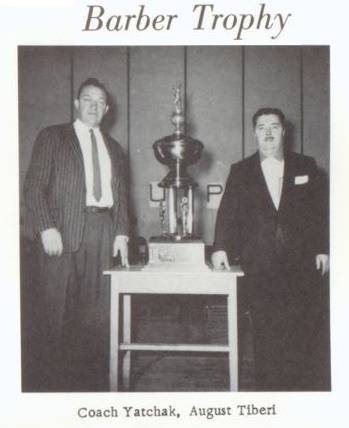
On Saturday, November 5, the Upper Peninsula Sportswriters Association gathered in Iron Mountain and awarded the Barber Trophy to Wakefield. The trophy was presented to Coach Yatchak and captain Bob Erickson at a special assembly at the high school on Monday.
The Cardinals had ranked No. 35 in Hal Schram’s Top 50 teams in the state, regardless of size, published in November in the Detroit Free Press. It was an impressive accomplishment for the little U.P. squad, especially when one considered 675 schools in Michigan sported prep football teams.
It would take until after Thanksgiving weekend – more than a month – before the UPI coaches panel would announce its final poll.
Word finally appeared in print in the SHORTS IN SPORTS column in the December 1 edition of the Wakefield News, which was published weekly.
“Congratulations this week go to: Wakefield Cardinal football team for being named top Class ‘C’ team in Michigan by United Press International.”
The city with a population of 3,231 celebrated its first (and only) mythical state football championship.
The annual Fourth of July parade included a red flatbed truck, adorned with an ornamental goal post and a large banner that read “State Class C Champs.” Four players, dressed in their uniforms, stood on the bed, carrying footballs.
Yatchak’s 1961 team extended the win streak to 14 games (and 25 wins in 26 dating back to 1957) with victories in its first two games before falling to Bessemer in a heartbreaker, 13-7. It would be the only loss of Wakefield’s seven-game season.
Following the 1961-62 school year, Yatchak departed Wakefield to help develop the athletic program at newly-opened Lansing Waverly High School. His Cardinals teams had posted 90 wins and two ties over his 15 years in charge, against only 25 losses.
Changing landscape
The coming years saw plenty of regular-season success, but no team would match the accomplishment of the 1960 squad. Mythical state titles, where state championships were determined by press polls and media input, were replaced in 1975 by MHSAA championships decided by postseason play.
“The Sunday Lake mine closed in 1961. They employed 225 guys. It was a big deal,” recalled Maki. Between the mine’s first shipment in 1885 and closing, Sunday Lake had raised an estimated 17 million tons of ore. Between 1960 and 1970, Wakefield’s population plunged by nearly 15 percent to 2,757. “A lot of people left for mining work elsewhere in Michigan, Wisconsin, Minnesota, Arizona.”
Maki himself made honorable mention all-state in 1970 as a senior when the Cards went 6-2 with losses to Hancock and Hurley.
“Dick Koski had a brother who was the same age as me. He was as good as Dick, maybe better. The Koski family left. There’s no doubt in my mind that we would have won some basketball state titles, maybe another Barber Trophy if they stayed. You just don’t know.”
The Gogebic area did see its fortunes improve, but the reprieve wouldn’t last.
“White Pine, a little town about 35 miles northeast of Wakefield, had a small copper mine. Digging deeper they found new veins of copper. All of sudden, they (needed workers). I remember five charter busses would line up near the football field each morning to take people to work there. That was happening all around the area.”
“Of the more than 3,000 workers at White Pine Copper Mine, less than 1,000 live here,” noted the Ironwood Daily Globe in September 1971. “Many workers commute great distances – some up to 90 miles each day.”
 However, uncertainty and layoffs began in 1975 and 1976. Employment dropped in half or more. In 1995, the mine shut down completely.
Wakefield’s 1991 football team was the first to qualify for the MHSAA postseason and won its opening-round contest with Central Lake before falling to Lake Linden-Hubbell in Class DD. The 1998 and 2000 teams also qualified.
Dropping student enrollment was impacting athletic programs at schools across upper and lower Michigan, including at Wakefield. Between 1985 and 2003, enrollment had fallen from 225 to 100. Following the 2003-04 school year, Wakefield consolidated with Marenisco, a district located 15 miles southeast. Still, for a variety of reasons, enrollment continued to drop. In 2009, Wakefield-Marenisco entered a co-op with Bessemer for football, and that fall, the Gogebic Miners were formed. Past rivals became teammates.
The rivalry with Hurley had been resurrected in 2000 and continued through the 2017 season. That school year, Ironwood joined the co-op, supplied the football schedule and its home field for the games.
In 2018, games were played at Bessemer. With enrollment now determined by combined school totals, the Wisconsin schools on the Gogebic schedule were replaced with games against Negaunee, Ishpeming Westwood and Iron Mountain, each with similar-sized enrollments.
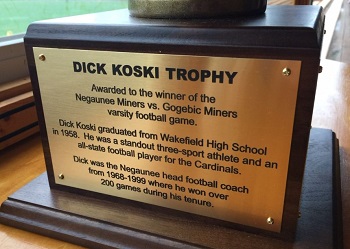
The Dick Koski Trophy, a new entry in the state’s collection of rivalry hardware, also was created in 2018. Awarded annually to the winner of the Negaunee-Gogebic game, it celebrates Koski’s connection to Wakefield and Negaunee.
This season, home contests are staged at Ironwood. In 2020, the games are scheduled to move to Wakefield.
Celebration
Maki hopes a lesson in history may help inspire future kids, so he’s been doing his homework.
“They have banners honoring conference champions,” he said.
If all goes as hoped, a new banner could be unfurled in time to celebrate the 60th anniversary of the 1960 championship.
“I am scheduled to speak at the next Wakefield school board meeting in late October to try to get this team some recognition such as a pennant to hang in the gym,” added Maki, also noting a desire for a public dedication, perhaps during Wakefield’s annual Independence Day celebration. “A lot of people come back to watch the fireworks.”
Now, wouldn’t that be a blast!
 Ron Pesch has taken an active role in researching the history of MHSAA events since 1985 and began writing for MHSAA Finals programs in 1986, adding additional features and "flashbacks" in 1992. He inherited the title of MHSAA historian from the late Dick Kishpaugh following the 1993-94 school year, and resides in Muskegon. Contact him at [email protected] with ideas for historical articles.
PHOTOS: (Top & 5) The 1960 Wakefield team is celebrated in the school’s yearbook for the 1960-61 school year. (2) An Ironwood Daily Globe advertisement announced a local store would guarantee a ham to every Wakefield player for a win over Hurley in 1929. (3) Roman Yatchak and Vernon Carr led Wakefield to its greatest football glories. (4) Dick Koski starred on the field for Wakefield before becoming a legendary coach. (6) Wakefield earned the Barber Trophy as the Upper Peninsula’s best team of 1960. (7) The Dick Koski Trophy is awarded annually to the winner of the Negaunee/Gogebic football game. (Photos gathered by Ron Pesch.)
Drive for Detroit: Week 6 in Review
October 3, 2016
By Geoff Kimmerly
Second Half editor
A total of 52 Michigan high school football teams celebrated 6-0 starts this past weekend and qualifying for the MHSAA playoffs set to begin in four weeks. A handful more celebrated the first league championships awarded this season.
And we’re just getting started.
Take a look below at the results that rang most significant from Week 6, including a number of games that set up what we’ll be watching as the regular season heads into its final third.
Bay & Thumb
Davison 20, Midland 0
The Saginaw Valley League Red race appears down to two teams after Davison handed Midland its first league loss of this season. The Cardinals – now 6-0 and with more wins than in any season total since 2012 – take on co-leader Lapeer this week. Midland does remain in the hunt, however; the Chemics (3-3) get Lapeer in Week 8 with a chance to share the title if the Lightning is successful Friday. Click for more from the Midland Daily News.
Also noted:
Fenton 54, Holly 35 – The Tigers (4-2) are among teams that dropped their first game or two but have come back strong, and now sit a win ahead of Holly (4-2) and two others atop the Flint Metro League standings.
Marine City 27, St. Clair 6 – The Mariners (2-4) continued their run at finishing a 34th straight winning season by earning their second victory in a row, with St. Clair falling to 3-3.
Unionville-Sebewaing 20, Reese 12 – The Patriots (5-1) held on to a share of the lead in the Greater Thumb Conference West with a third straight win over Reese (4-2).
Flint Carman-Ainsworth 34, Bay City Central 34 – The Cavaliers (4-2) remain tied atop the Saginaw Valley League Blue with Midland Dow after facing their toughest challenge this season from Central (3-3).
Greater Detroit
Detroit Cass Tech 31, Detroit Martin Luther King 18
The Technicians (6-0) were held to their fewest points this season, but the story was Cass Tech’s defense. King (5-1) hadn’t scored fewer than 39 points in a game since last season’s Division 2 Regional Final win over Detroit East English and put up 31 and 27 in beating Cass Tech twice last fall. And just like in 2015, don’t be stunned if these two face off again in the Detroit Public School League final at Ford Field in three weeks. Click for more from MLive-Detroit.
Also noted:
Allen Park 23, Trenton 10 – The Jaguars (6-0) now hold a one-win lead in the Downriver League on both Trenton (5-1) and Wyandotte Roosevelt with three games to play and victories over both.
Warren Cousino 36, Grosse Pointe North 33 – Cousino (5-1) hasn’t been considered a football power for about a decade, but the Patriots are creeping toward their best finish since 2007 and sit in first in the Macomb Area Conference Blue after dealing Grosse Pointe North (4-2) a first league loss.
Birmingham Groves 14, Farmington Hills Harrison 7 (OT) – The Falcons (6-0) won their second Oakland Activities Association White game by seven points or fewer this fall to remain a half-win ahead of Rochester Adams, this week’s opponent, and send Harrison to 3-3.
Oak Park 14, Clarkston 7 – The Knights (4-2) are a win back in the OAA White standings but have two of the league’s most impressive victories over Adams and now Clarkston (4-2), which is tied for second in the OAA Red.
Mid-Michigan
Breckenridge 38, Carson City-Crystal 0
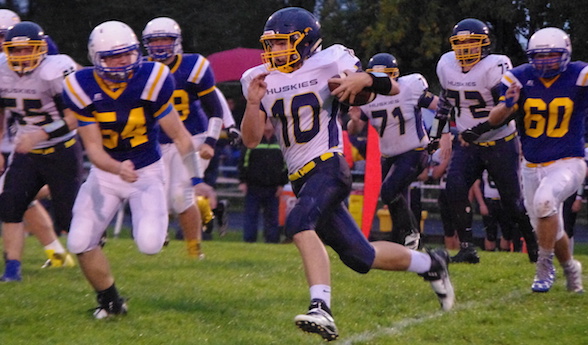
One of the state’s top turnaround stories keeps getting better. The Huskies, 6-0 after going 0-9 only a year ago, clinched their first playoff berth since 1993 while taking over first place in the Mid-State Activities Conference alone by handing the Eagles (4-2) their first league loss. Breckenridge hasn’t won six games in a season since 1994. Click for more from the Mount Pleasant Morning Sun.
Also noted:
Ithaca 17, Saginaw Michigan Lutheran Seminary 6 – The Yellowjackets (6-0) had beaten the rest of their Tri-Valley Conference West opponents by at least 27 and now look good to clinch at least a share of the title after fending off the Cardinals (4-2).
Howell 48, Grand Blanc 46 – Not only did the Highlanders (4-2) end a five-game losing streak to the Bobcats (4-2), but they opened up a chance to claim a share of the Kensington Lakes Activities Association West title against Brighton in Week 8.
Pewamo-Westphalia 40, Laingsburg 7 – The Pirates (6-0) did score their fewest points since opening night and also gave up their first score since Week 1, but still win comfortably to hold on to first place in the Central Michigan Athletic Conference, a win ahead of the Wolfpack (5-1).
Lake Odessa Lakewood 34, Olivet 27 – The Vikings (6-0) clinched a share of a second straight Greater Lansing Activities Conference title, potentially relegating Olivet (4-2) to second place for the second straight season as well.
Northern Lower Peninsula
Frankfort 26, Maple City Glen Lake 21
This matchup for first place in the Northern Michigan Football Conference Leaders division was as good as billed, with Frankfort holding on to a slim lead as the only team without a league loss. The Panthers (6-0) scored the go-ahead points this time with just more than four minutes to play, and a final drive by Glen Lake (4-2) ended in a turnover. Click for more from the Traverse City Record-Eagle.
Also noted:
Boyne City 21, Kalkaska 14 – The Ramblers (4-2) continued their rebound from an 0-2 start by possibly eliminating another contender in the NMFC Legends division; Kalkaska (5-1) is a win back of Boyne City and Traverse City St. Francis in the league standings.
Charlevoix 21, East Jordan 0 – The Red Rayders (5-1) bounced back from a tough Week 5 loss to Glen Lake with a third straight shutout of East Jordan (4-2) – which is hoping to rebound and earn its first playoff berth since 2003.
AuGres-Sims 22, Whittemore-Prescott 20 – The Wolverines (5-1) kept pace a half-win behind leader Lincoln Alcona in the North Star League by winning their first meeting with the Cardinals (3-3) since 1992.
Cadillac 16, Gaylord 12 – The Vikings (5-1) hung on for a Homecoming win to remain tied for first in the Big North Conference and send Gaylord (2-4) potentially out of playoff contention.
Southeast & Border
Milan 27, Grosse Ile 6
The Big Reds may be breathing only a little easier after taking over first place alone in the Huron League and sending Grosse Ile (5-1) into second place. Two league games remain, and nemesis Monroe St. Mary Catholic Central is up next for Milan, which surely will be amped up after losing the title-decider to the Falcons last year. Click for more from the Southgate News-Herald.
Also noted:
Hillsdale 14, Hudson 6 – The Hornets (4-2) kept themselves in the Lenawee County Athletic Association discussion by knocking Hudson (5-1) out of a first-place tie with Ida; both now trail the leader by a win and play Ida successively over the next two weeks.
Jackson Lumen Christi 21, Coldwater 20 (OT) – The Titans (4-2) have avenged both of their 2015 Interstate 8 Athletic Conference losses over the last two weeks and sit a win back of league leader Harper Creek, this week’s opponent for the reigning champ Cardinals (4-2).
Sand Creek 12, Clinton 7 – Just as Morenci’s win the week before over Clinton was one of its best in some time, Sand Creek (6-0) can claim the same as it held on to a first-place tie in the Tri-County Conference while likely knocking the reigning champ Redskins (4-2) out of contention.
Springport 20, Concord 16 – Concord (5-1) had won three games by a touchdown or less to take the lead in the Big 8 Conference, but first place is now a tie between the Yellowjackets, Springport (5-1), Quincy and Homer; Springport’s only loss was by two to the Trojans.
Southwest Corridor
Constantine 60, Watervliet 58
The Southwestern Athletic Conference Lakeshore race has three first-place teams with one game to play, with Constantine, Watervliet and Delton Kellogg all 3-1 in league play and Watervliet playing Delton next. This Falcons/Panthers matchup mirrored at least in score Constantine’s 49-48 Division 6 District Final win last fall. This time, the teams combed for more than 1,000 yards of total offense. Click for more from JoeInsider.com.
Also noted:
Benton Harbor 21, Traverse City West 16 – Benton Harbor (6-0) continued its best start since 1985 with a second straight and second-ever playoff berth after beating West (4-2), which has lost its two games by a combined seven points.
Climax-Scotts 48, Pittsford 28 – The Panthers (6-0) ran their Southern Central Athletic Association winning streak to 48 in clinching a share of this season’s championship and sending Pittsford (3-3) into a tie for second place.
Kalamazoo Central 14, Battle Creek Lakeview 7 – Central (3-3) moved into first place in the Southwestern Michigan Athletic Conference East by handing the reigning co-champ Spartans (3-2) their second straight loss – and second straight by seven or fewer points.
Schoolcraft 56, Lawton 7 – Second-place Gobles still can shake things up a bit this week, but Schoolcraft claimed (6-0) a share of the SAC Central championship by knocking Lawton (5-1) out of the tie for first.
Upper Peninsula
Menominee 28, Escanaba 14
The Eskymos are playing their best football since the start of this decade, but the Great Northern U.P. Conference looks to still belong to Menominee (6-0) after this matchup of previously undefeated teams. The Maroons can clinch a share of the league title this week against Sault Ste. Marie and still haven't given up more than 14 points in a game. Escanaba (5-1) hadn’t given up more than 13 in a game but did hold Menominee to a season low. Click for more from the Escanaba Daily Press.
Also noted:
Calumet 34, Iron River West Iron County 7 – The Copper Kings (5-1) pulled within a win of clinching a share of the West-Peninsula Athletic Conference title by downing West Iron (3-3); Calumet’s final two league games are against teams that are a combined 1-11.
St. Ignace 36, Gaylord St. Mary 8 – The Saints (5-1) are one of the first league champions of 2016 after clinching a share of the NMFC Legacy title by sending St. Mary (5-1) into a four-team tie for second place.
Hancock 47, Hurley, Wis. 40 – The Bulldogs (4-2) most likely ended Hurley’s West-PAC chances and gave themselves an outside shot while continuing their best season since at least 2010.
Negaunee 28, Norway 14 – The Miners (6-0) remain the only undefeated team in the Mid-Peninsula Athletic Conference and can clinch a share of the league title this week against rival Ishpeming, with Norway (5-1) and Iron Mountain cheering for the Hematites.
West Michigan
Rockford 7, Grandville 6
The Ottawa-Kent Conference Red is not a league teams come to looking to rebound from a slow start. But it's been quite a month for Rockford (4-2), which opened 0-2 and now finds itself back in the driver's seat in the Red after just surviving the league's top team to date. Grandville (5-1) had beaten all of its opponents by at least 30, but now will be rooting especially for Hudsonville in Week 9 to beat Rockford and create a shared championship. Click for more from the Grand Rapids Press.
Also noted:
East Grand Rapids 28, Grand Rapids Christian 7 – The Pioneers (4-2) moved to the top of the O-K Gold standings ahead of the Eagles (5-1), running their streak to two straight over Christian after losing their regular-season meeting but winning their playoff rematch last fall.
Byron Center 54, Hamilton 32 – The Bulldogs (5-1) have turned the O-K Green into a two-team race by delivering upstart Hamilton (5-1) the first loss of an otherwise outstanding turnaround season.
North Muskegon 14, Montague 6 – In one of the weekend’s biggest shockers, North Muskegon (2-4) handed West Michigan Conference co-leader Montague (5-1) its first defeat; Montague now trails Muskegon Oakridge by a win.
Reed City 12, Remus Chippewa Hills 8 – The Coyotes (6-0) can clinch a share of the Central State Activities Association Gold title this week after just edging former co-leader Chippewa Hills (5-1).
8-Player
New Haven Merritt 36, Owendale-Gagetown 32
This arguably is the best win of Merritt’s five-season history. Although these teams play in different divisions of the Mid-Michigan 8-Man Football League, they lead those divisions. During its first season, 2012, Merritt (6-0) lost both of its games to Owendale-Gagetown by at least 50 points; the Mustangs cut the deficit to 24 when the teams met last October. The Bulldogs (5-1) had won 16 straight regular-season games. Click for more from the Huron Daily Tribune.
Also noted:
Lawrence 32, Camden-Frontier 8 – The Redskins absolutely have been impressive with a 4-1 start, but Lawrence (6-0) proved to still be another level above at this point in the season.
Webberville 16, Battle Creek St. Philip 14 – These two at this point are among what would be the final teams selected for the 16-team playoff field, and Webberville (5-1) owns a nice advantage now – although St. Philip (4-2) still has plenty of opportunities to secure its spot.
PHOTO: Breckenridge quarterback Carter Staley (10) breaks away during the Huskies' win over Carson City-Crystal on Friday. (Photo courtesy of Gratiot County Herald.)