

Memphis Tastes Victory, Plays for More
By
Paul Costanzo
Special for MHSAA.com
September 12, 2018
Winning was such an unfamiliar feeling for the Memphis varsity football team that when the Yellowjackets picked up a victory in Week 1, coach Pat Connell had to give some of his players a push when it came to enjoying it.
 “We call (the victory formation), they take a knee and nobody knows what to do,” Connell said. “The kids on the field are starting to celebrate, and I looked at the kids behind me and said, ‘Hey, this is when you celebrate.’”
Memphis’ 14-12 win against Burton Bentley on Aug. 23 snapped a 26-game losing streak for the Yellowjackets, who hadn’t been victorious since Week 1 of the 2015 season. It was a cathartic moment for the players, coaching staff, school and community – one that won’t soon be forgotten.
“Honestly, I’d say it was the best feeling I’ve ever felt on that field,” senior wingback and defensive tackle Cole Myers said. “My entire time playing football at my school, we hadn’t gotten a win in the last two to three years. It felt like the turning point of our program.”
One win was great, and something Memphis desperately needed. But while everyone involved in the Memphis program knows things are looking up, they also know there is plenty of work still to be done to turn things completely around. That was evident in 44-0 and 42-0 losses to Ubly and Brown City, respectively, in the following weeks.
But it’s work the coaches and players are now willing to put in.
“I enjoyed it; it was nice to have my first Memphis football win,” senior quarterback and safety Cale Shivers said. “I’ve played football my whole life and been on winning teams my whole life, so I know that if we want to win more games, we have to keep working.”
When Connell and his staff took over, Memphis had just finished its first 0-9 season in 2016, which came on the heels of back-to-back 1-8 seasons.
During those struggles, numbers had gotten so low for the Yellowjackets that there were talks of prematurely ending a season -- not to end the losing, but to keep kids safe.
To build the program, Connell first needed players, and to get players, he needed to be recruiting in the hallways. Unfortunately for him, he teaches at Port Huron Northern, a good 30-minute drive from Memphis, as does his assistant Casey Kucsera. Assistant coach Pete Fox teaches at St. Clair, which is closer, but clearly not in the building.
“That first year when we took over in April or May, we were trying to get any kids, but it was a slow process,” Connell said. “We were taking personal days to set up in the school to go meet kids.”
The idea of simply playing a junior varsity schedule was brought up, but Connell said that if there was just one senior who wanted to play, the Yellowjackets would play as a varsity team so that player could have that experience. They wound up with 10, and while it was another 0-9 season, that fall was a building block.
“That first year was just about making it fun,” Connell said. “It isn’t us coming in to yell and scream at you; we want you to come out and enjoy football. It was opening the weight room, and sometimes kids would stumble in, and we were developing that trust. Then the word started getting out.”
 When comparing 0-9 seasons, it can be hard to find tangible improvement. But Memphis scored more points (60-39) and allowed fewer (427-538) while playing a similar schedule in 2017.
Most importantly, though, the players were noticing that things were different.
“Kids didn’t really see the progression until other coaches and players from teams were saying, ‘Even though you guys lost, we can tell you really look like a football team now,’’ Shivers said. “And we were hearing from the public that we actually looked good out there.”
Despite not winning a game, Memphis did pick up some momentum.
“When I first got out to Memphis, I would ask kids, ‘Are you interested in playing football?’ and it was, ‘I don’t know, maybe,’” said Connell, who is up to 28 players on his roster. “This offseason, it was, ‘Are you playing,’ and they were like, ‘Yes sir, I’m playing.’ We had like 20 kids who were all in on football. Now, that didn’t mean that they realized they had to be there three days a week in the winter lifting, but they were excited.”
The excitement grew after the opening win against Burton Bentley, a game that was filled with drama. After Memphis took a 14-12 lead on Shivers’ second touchdown pass of the evening and his ensuing 2-point conversion run, it had a chance to ice the game by running out the clock with a few first downs. Before that could happen, however, the lights -- which were set on a timer -- went out in the stadium.
When they came back on about 20 minutes later, Burton Bentley forced a Memphis punt to give itself one more chance.
Fortunately for the Yellowjackets, that drive ended with a turnover, and Memphis was able to run a play out of the victory formation for the first time in three years.
“I wouldn’t even call it remembering how to win,” Myers said. “Because I’ve never been on a winning team for football. It was something new.”
The feeling, Myers said, made him want to win more. And while Weeks 2 and 3 were a return to Earth for the Yellowjackets, those defeats haven’t dampened their spirits or their outlook. Connell knows there is still plenty of work to be done in the weight room and on the field to have his team competing with its Greater Thumb Conference East opponents.
But his players believe in what he and his staff are doing, and they are now starting to believe in themselves.
“It might take a couple more wins before people (in the school) start realizing this is a different program from past years,” Myers said. “(A successful season would be) to put in everything that we possibly can and have more wins than losses at this point. I would say five to six wins would be what I would hope out of this season.”
 Paul Costanzo served as a sportswriter at The Port Huron Times Herald from 2006-15, including three years as lead sportswriter, and prior to that as sports editor at the Hillsdale Daily News from 2005-06. He can be reached at [email protected] with story ideas for Genesee, Lapeer, St. Clair, Sanilac, Huron, Tuscola, Saginaw, Bay, Arenac, Midland and Gladwin counties.
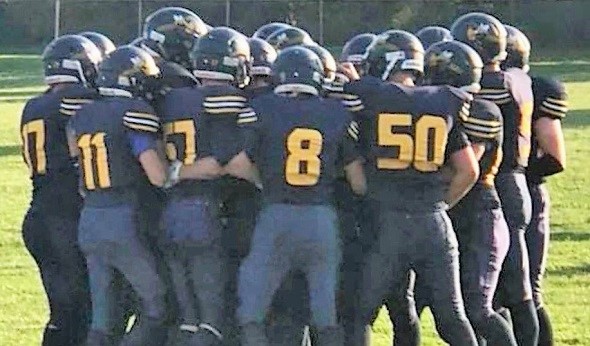
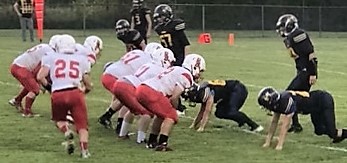
PHOTOS: (Top) Memphis players huddle up before a game this season. (Middle) The Yellowjackets defense held Burton Bentley to 12 points. (Photos courtesy of the Memphis football program.)
Drive for Detroit: Week 9 in Review
October 22, 2018
By Geoff Kimmerly
Second Half editor
This week, 288 Michigan high school football teams are starting anew.
 But before we turn our focus entirely toward the playoffs, let’s say a final goodbye to another memorable regular season.
The last of available league championships were clinched Friday and Saturday, and more teams than we can mention won to get into the postseason. Sunday, of course, was highlighted by the announcement of playoff divisions and pairings – and we’ll jump into the most intriguing first-round matchups later this week.
But for now, let’s take an acknowledging glance at the storylines from Week 9, which in many cases set up some of what we’ll be watching the rest of the way.
“Drive for Detroit” is powered by MI Student Aid.
Bay & Thumb
HEADLINER: Lapeer 28, Davison 6 The Saginaw Valley League Blue title went outright to the Lightning with this winner-take-all win. Lapeer (9-0) also capped its first perfect regular season since 2015 and third in five years since the former West and East high schools merged heading into fall 2014. Davison (7-2) finished league runner-up for the second straight season after winning it in 2016. Click for more from the Flint Journal and see below for highlights from WJRT.
.@LapeerFootball downs rival @DavCardFootball, claim SVL Red title @LapeerAthletics @Phoenixdickson @apple_brady @DavisonMade https://t.co/BwOFBEPAup
— ABC12WJRT (@ABC12WJRT) October 20, 2018
Also of note: Ortonville Brandon 34, Swartz Creek 27 The Blackhawks (8-1) held off Swartz Creek to cap their best regular season run since 2000 with a share of the Flint Metro League title (with Flushing), while dropping the Dragons (6-3) out of first place and into a tie for third.
Remember this one: Midland 14, Midland Dow 8 Players never forget this kind of rivalry game. Midland (6-3) made it two straight over the Chargers (5-4) and in the process earned an automatic playoff berth. Dow became an additional qualifier, and they could meet again in a Division 2 District Final.
More shoutouts: Millington 34, Warren Michigan Collegiate 26 The Cardinals’ 14-year playoff streak was on the line, but Millington (6-3) earned an automatic bid by handing Michigan Collegiate (8-1) its lone regular-season defeat. Byron 31, Flint Beecher 27 Croswell-Lexington 47, Goodrich 13 Both ended up in the playoffs, but the Pioneers (6-3) made sure this time after missing last year at 5-4; Goodrich (5-4) did qualify with that record this time despite the defeat.
Greater Detroit
HEADLINER: Detroit Cass Tech 42, Detroit Martin Luther King 8 The Technicians (9-0) will carry Detroit Public School League Green and now PSL A playoff titles into the postseason after avenging last year’s 10-point loss to King. The perfect regular season finish was the team’s second in three years and fourth in six. King, the PSL Black champ, fell to 7-2. Click for more from MLive-Detroit and see below for highlights from State Champs Sports Network.
??VIDEO: Check out the highlights of the Cass Tech (@Detroit_CTFB) vs. King football game from last night pic.twitter.com/9QN0kOYTpf
— STATE CHAMPS! (@statechampsnet) October 20, 2018
Also of note: Warren DeLaSalle 24, Detroit Catholic Central 6 A week after falling to the Shamrocks 10-7 in what created a shared Detroit Catholic League Central title between the two, DeLaSalle (7-2) came back to down DCC (6-3) in the Prep Bowl A-B championship game at Ford Field.
Remember this one: Farmington Hills Harrison 48, Farmington 7 The final regular-season game in Harrison’s illustrious football history saw the Hawks (6-3) earn an automatic playoff bid with a big win over Farmington (6-3), which also qualified for the first time since 2015.
More shoutouts: Oak Park 21, Clarkston 14 The Oakland Activities Association White champion Knights (8-1) bounced back from a Week 8 loss to gain a boost by beating the OAA Red champ Wolves (7-2). Belleville 32, Brighton 17 They met to open and close the regular season, but this Kensington Lakes Activities Association overall championship win for the Tigers (9-0) wasn’t as nail-biting as that five-point Week 1 victory over the Bulldogs (7-2).
Mid-Michigan
HEADLINER: Pewamo-Westphalia 28, Williamston 27 (OT) The Pirates (9-0) stopped a 2-point conversion try in overtime to win this matchup of league champions and finish their third straight perfect regular season in four years. The two-time reigning Division 7 champion hadn’t had a game closer than 28 points this fall before getting a valuable test from the Division 4 Hornets (7-2). Click for more from the Lansing State Journal and see highlights below from FOX 17.
Pewamo-Westphalia 28, Williamston 27 - OT https://t.co/XiISeK5umW
— FOX 17 Blitz (@FOX17Blitz) October 20, 2018
Also of note: Howard City Tri-County 48, Holton 16 The Vikings (5-4) made the playoffs for the first time since 2004 after giving themselves the opportunity with this win over Holton (5-4), which also was selected. Tri-County also guaranteed its first .500-or-better season since 2005 after going 1-8 a year ago.
Remember this one: East Lansing 20, Okemos 17 These neighbors already had qualified for the playoffs, Okemos (6-3) for the first time since 2014. But this might be another indication this rivalry is on its way back – East Lansing (8-1) has won four straight meetings, but four of the last six have been decided by seven points or fewer.
More shoutouts: Portland 27, Montague 20 The Raiders (9-0) look playoff-ready again after capping their third perfect regular season in four years by beating a Montague team that finished 7-2 with its only other defeat to also-unbeaten Reed City. Vermontville Maple Valley 42, Comstock 18 The Lions (5-4) struggled mightily through a 2-4 start, but finished with three straight wins to line up their second straight playoff appearance.
Northern Lower Peninsula
HEADLINER: Traverse City West 21, Petoskey 6 The Titans (7-2) entered this game with the possibility of falling into a three-way shared Big North Conference title. Instead, West won outright and finished a regular season where its two defeats were by a combined 10 points. Petoskey (5-4), meanwhile, earned its first playoff berth since 2015 after going a combined 5-14 over the last two seasons. Click for more from the Traverse City Record-Eagle.
Also of note: Benzie Central 42, Frankfort 6 The Huskies (6-3) clinched their first playoff berth since 2011 – and after not having a team in 2016. Benzie came back to go 1-8 last season before completing the turnaround. Frankfort finished 5-4 but was an additional qualifier after winning three of their last five games.
Remember this one: Traverse City St. Francis 35, New Lothrop 14 Remember it, because the Hornets (8-1) do not lose often during the regular season. This was just their second regular-season defeat in nine seasons, but came against a Gladiators team that at 9-0 finished its third perfect regular season in four years.
More shoutouts: Maple City Glen Lake 27, Grayling 19 The Lakers (5-4) won the Northern Michigan Football League Leaders championship but were in jeopardy of missing the playoffs; beating Grayling (3-6) made them eligible as an additional qualifier. Gaylord 41, Sault Ste. Marie 0 Gaylord’s Blue Devils (6-3) bounced back from two straight one-point defeats to clinch their first playoff berth since 2015 and leave Sault Ste. Marie (5-4) just short, although those Blue Devils more than doubled their 2-7 records of both last season and 2016.
Southwest Corridor
HEADLINER: Cassopolis 21, Centreville 0 It’s rare to luck out with two undefeated teams meeting for a league championship in their regular-season finale. Cassopolis (9-0) chipped away to claim the Southwest 10 Conference title with its sixth shutout this fall. Centreville (8-1) entered averaging nearly 44 points per game, and still has plenty to celebrate – the Bulldogs have their first playoff berth and winning season both since 2008. Click for more from the Cassopolis Vigilant.
Cassopolis 21, Centreville 0 https://t.co/B9D4g32MP9
— FOX 17 Blitz (@FOX17Blitz) October 20, 2018
Also of note: Kalamazoo United 21, Schoolcraft 20 The Southwestern Athletic Conference Valley championship was decided by a point as the Titans (9-0) edged Schoolcraft for the second straight season after beating the Eagles (7-2) last year by three.
Remember this one: Portage Northern 16, St. Joseph 7 The Southwestern Michigan Athletic Conference West sent five of its six teams to the playoffs, and the league race frequently is close. Portage Northern (7-2) with this win earned a share of the title while dropping the Bears (5-4) out of a possible share and into a tie for third place.
More shoutouts: Stevensville Lakeshore 18, Mattawan 13 The Lancers’ 20-year playoff streak was on the line, but this win put them at 5-4 and allowed them to be selected as an additional qualifier. Mattawan (5-4) was selected as well. Coloma 52, Watervliet 36 The Comets (5-4) beat Watervliet for the first time since 2009 (they didn’t play 2012-14) to finish 5-4 for the second straight regular season – but this time they were selected for the playoffs for the first time since 2008.
Southeast & Border
HEADLINER: Reading 55, Grass Lake 7 The Rangers (9-0) took their domination outside of the Big 8 Conference with this crossover win over the Cascades Conference champion. Grass Lake (8-1) also entered undefeated and scoring nearly 39 points per game. Click for more from the Hillsdale Daily News.
Also of note: Jackson 36, Lake Fenton 14 The dream season continued for the Vikings (9-0), who ended the regular season unbeaten for the first time perhaps ever (?). Someone surely will be doing some digging to confirm, but it will be well worth it to celebrate a historic accomplishment – and after Jackson went 4-5 a year ago.
Remember this one: Brooklyn Columbia Central 35, Hudson 16 The Eagles (8-1) broke a two-game losing streak to the Tigers (4-5) to clinch a share of the Lenawee County Athletic Association title with Hillsdale, which it defeated in Week 8.
More shoutouts: Hillsdale 30, Dundee 13 The Hornets (8-1) held on to their share of the LCAA title by avenging two straight defeats to Dundee (5-4), and by doing so kept the Vikings out of the playoffs. Michigan Center 25, Springport 16 The Cardinals finished the regular season 8-1 for the second straight as Springport (7-2) lost for the second straight week but only second time this season.
Upper Peninsula
HEADLINER: Escanaba 39, Kingsford 27 The Eskymos (7-2) probably didn’t anticipate ending the weekend with a share of the Great Northern Conference championship. But by beating the Flivvers (4-5), Escanaba was able to benefit from Menominee’s upset of first-place Marquette. The win over Kingsford held additional significance too – the Flivvers edged the Eskymos for the GNC title last season with a win in their Week 9 meeting. Click for more from the Escanaba Daily Press.
Also of note: Gwinn 20, Munising 16 The Modeltowners (6-3) flipped last season’s 3-6 record to earn an automatic playoff berth and keep Munising (4-5) from possible selection as an additional qualifier.
Remember this one: Menominee 32, Marquette 14 This ended an uncharacteristic down season for the Maroons (2-7) – they saw their 22-year playoff streak come to an end. But they did finish by adding to a seven-game winning streak over Marquette, denying the Redmen (4-5) an outright league title and possible additional qualifier bid for the playoffs.
More shoutouts: Ishpeming 54, Bark River-Harris 13 The Hematites (9-0) put together their fourth perfect regular season in six years and coming off back-to-back three-win finishes. St. Ignace 44, Gaylord St. Mary 0 The Saints missed the playoffs, but finishing 5-4 was a great jump from 1-8 in 2017.
West Michigan
HEADLINER: East Kentwood 28, Rockford 17 The Falcons (8-1) made their way through an Ottawa-Kent Conference Red that will send four of seven teams to the playoffs – and with Rockford making a bid Friday to grab a share of the league title. The win over the Rams was East Kentwood’s first since 2015 and put Rockford (5-4) in an unfamiliar spot of briefly not knowing if its season was done – although the Rams did make the playoffs as an additional qualifier for a record 24th straight season. Click for more from the Grand Rapids Press and see highlights below from WZZM.
GOTW: East Kentwood goes for league title against Rockford https://t.co/LfNw9tzVdS pic.twitter.com/RLlHOu4Vhh
— 13 On Your Sidelines (@13OYSL) October 20, 2018
Also of note: Zeeland East 36, Hudsonville Unity Christian 13 The Chix (8-1) completed a repeat O-K Green championship after Unity Christian (7-2) entered with an opportunity to create a three-way tie for the top spot.
Remember this one: Saugatuck 56, Fennville 20 The Indians (8-1) claimed the SAC Lakeshore title in this winner-take-all matchup, avenging the Week 9 loss to the Blackhawks (7-2) a year ago that gave Fennville the championship ahead of Saugatuck.
More shoutouts: Holland Christian 24, Spring Lake 17 Despite playing in an O-K Green with three other playoff teams, the Maroons (6-3) are headed back to the postseason for the first time since 2012 and with a guaranteed final winning record for the first time since 2009. Spring Lake (5-4) also made the playoffs as an additional qualifier after going 0-9 a year ago. Hudsonville 23, Holland West Ottawa 16 Two more of the O-K Red’s best met with playoffs on the line for the Eagles, who earned an automatic berth with the win. These two will settle things one more time with a Division 1 rematch this week.
8-Player
HEADLINER: Wyoming Tri-unity Christian 22, Colon 14 The Midwest Central Michigan Conference West champion Defenders (9-0) handed the Southern Central Athletic Association A champion Magi their only loss of the regular season, holding Colon (8-1) to almost 33 points under its average. The win also gave Tri-unity its second perfect regular season in three years. These teams could meet again in an 8-Player Division 1 Semifinal. Click for more from the Sturgis Journal.
Tri-Unity Christian 22, Colon 14 https://t.co/7UrJSCWRLt
— FOX 17 Blitz (@FOX17Blitz) October 20, 2018
Also of note: Morrice 32, Webberville 0 The Orioles finished 9-0 for the first time in program history and reached nine wins for the third time in four years. Webberville made the loss pay off getting enough bump to make the playoffs at 4-5 with a higher playoff-point average than other teams that finished 5-4.
Remember this one: Engadine 52, Crystal Falls Forest Park 42 The Eagles (8-1) edged the reigning 8-player Division 2 champ Trojans (5-4), but these teams could see each other again in a Regional Final.
More shoutouts: Pickford 48, Cedarville 8 The Pirates (9-0) completed their second straight perfect regular season and finished an outright title run in the Great Lakes Conference East. Cedarville (5-4) will join three others from the league in the playoffs. Deckerville 20, Peck 8 The Eagles (7-2) eluded a possible shared North Central Thumb League Blue title, holding on to the championship outright by holding off an upset bid by the Pirates (5-4).
Second Half’s weekly “Drive for Detroit” previews and reviews are powered by MI Student Aid, a part of the Student Financial Services Bureau located within the Michigan Department of Treasury. MI Student Aid encourages students to pursue postsecondary education by providing access to student financial resources and information, including various student financial assistance programs to help make college more affordable for Michigan students. MI Student Aid administers the state’s 529 savings programs (MET/MESP) and eight additional aid programs within its Student Scholarships and Grants division. Click for more information and connect with MI Student Aid on Facebook and Twitter @mistudentaid.
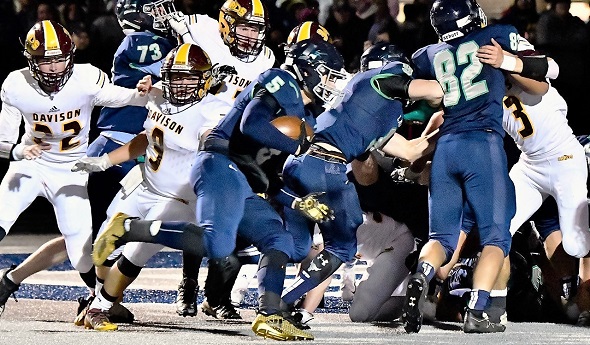
PHOTO: Lapeer pushes through for a touchdown during its league title-clinching win over Davison. (Photo by Terry Lyons.)