

MHSAA Opposes Big Ten Friday Football
November 2, 2016
By Geoff Kimmerly
Second Half editor
The executive director of the Michigan High School Athletic Association said today that he is “disappointed and disheartened” by the Big Ten Conference announcement that it will play and televise football games on Friday nights beginning with the 2017 season.
Friday night football remains one of the strongest and longest-standing traditions in high school athletics, and the MHSAA has fought since the start of this century to keep Friday nights sacred against the overstepping of college football and the damage televised Big Ten games are now expected to cause to attendance and media coverage of the sport at the high school level.
MHSAA Executive Director John E. “Jack” Roberts was contacted by both Big Ten Conference commissioner Jim Delany and Michigan State University athletic director Mark Hollis before the decision was announced. Roberts said he is appreciative of Michigan State and University of Michigan’s low tolerance to be included in this venture – at most, both will host a Thursday or Friday night game during Labor Day weekend and play one Friday night away game during the remainder of a season – but remains frustrated that similar respect for high school football was not shown by the conference as a whole.
Michigan State has played Friday night games during Labor Day weekend the last six seasons, hosting five and playing at Western Michigan University in 2015. However, most Michigan high school games continue to be scheduled and played on the Thursday before Labor Day, relieving holiday travel conflicts in most communities. University of Michigan did play on the Thursday before Labor Day at University of Utah in 2015, but has not played on a Friday night of Labor Day weekend this decade. The Wolverines are one of five Big Ten schools without a Friday night game in 2017.
“We are saddened by this decision. We had hoped that the Big Ten Conference would stay above this. We think this cheapens the Big Ten brand,” Roberts said. “Fans won’t like this. Recruits won’t like this. And high school football coaches won’t like this.
“We are grateful that Michigan State University and the University of Michigan are trying to minimize the effects of this decision by the Big Ten. But overall, this is just the latest step by major college athletics in the pursuit of cash that is just crushing high school sports.”
The MHSAA has shown its opposition to the use of Friday nights for televised collegiate football games for more than 15 years, dating back to 2001 when the NCAA lifted its restrictions on Friday night telecasts, which at first led to the broadcasting of “mid-major conference” games on the same night traditionally reserved for high school athletes.
The MHSAA launched in 2001 its “Save Our Friday Nights” campaign to emphasize the role that Friday night high school athletic events play in communities and to rally MHSAA member schools to contact NCAA member school football coaches, athletic directors and conference commissioners to voice their concerns.
In addition to causing lower attendance at events going up against Big Ten football games, Roberts anticipates that Friday night college games also will leave high school football as a secondary priority in many media markets. More than 80 radio stations statewide cover high school games regularly, but many also carry Michigan State or University of Michigan football. High school football could lose significant time on local TV highlights shows and in print and online coverage as well, as resources are diverted to cover a college game – potentially quieting significantly the positive buzz that comes from the typical high school football Friday night.
“Everyone knows that football is struggling right now,” Roberts said. “It’s getting a lot of bad publicity. Participation is declining. And now this; there couldn’t be worse timing.”
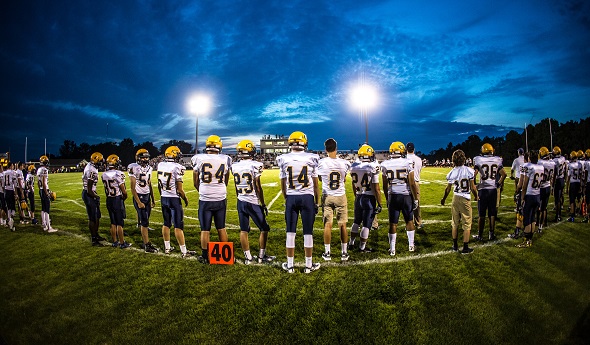
PHOTO: Grand Ledge takes on Okemos under the Friday night lights this season. (Click to see more from HighSchoolSportsScene.com.)
Final-Seconds Field Goal Ends Defensive Stalemate, Delivers Gladwin's 1st Title
By
Paul Costanzo
Special for MHSAA.com
November 26, 2022
DETROIT – As Treyton Siegert warmed up with the kicking net on the Gladwin sideline late in the Division 5 Football Final on Saturday, he was kind of hoping it wouldn’t be necessary.
“I was just trying to focus on making good contact with the ball, and just hoping they would score a touchdown,” the junior kicker said. “I knew it would probably come to me.”
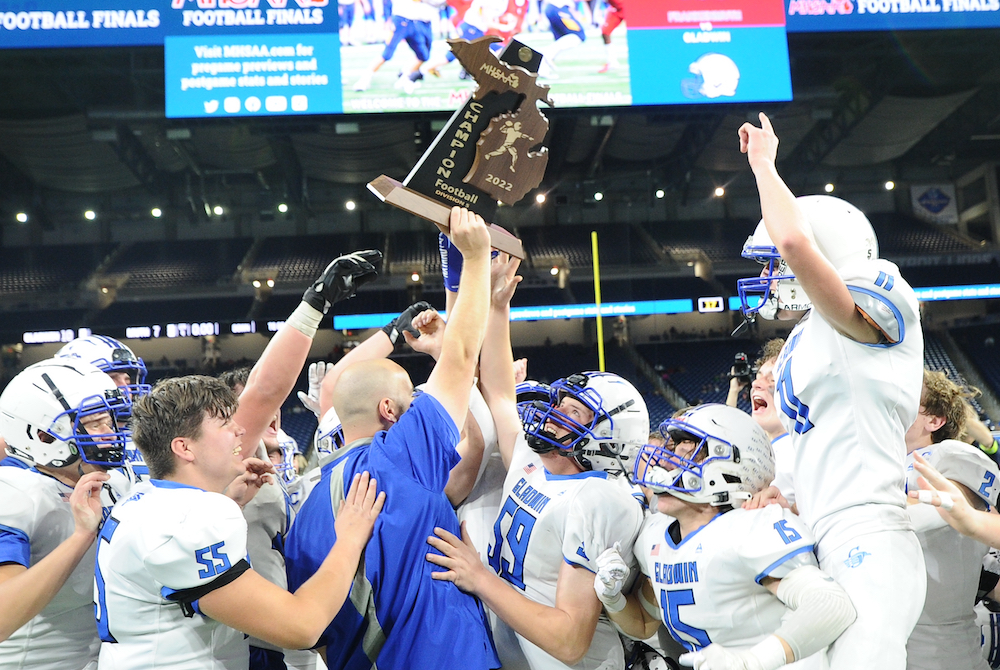
It did, and Siegert delivered with a 21-yard field goal from the right hash to give Gladwin a 10-7 win against Frankenmuth and its first MHSAA football title.
“It was a crazy moment,” Siegert said. “I never doubted it once we got up close enough, but it was just a crazy moment. I’m really speechless. It was awesome to have that feeling. … I wouldn’t have that opportunity without a team behind me. It was really a great moment.”
Siegert’s moment capped a defensive struggle between two unbeaten teams, each in search of a first Finals title. For Frankenmuth, it was the second trip to the Finals in three seasons. Gladwin, meanwhile, was making its first appearance in a Final, and it came just three seasons after the team went 1-8 to cap a four-year stretch during which it won seven games total.
 The 1-8 season was the first for coach Marc Jarstfer and his staff. Two players who were on the field Saturday – receiver/safety Kaden McDonald and running back/linebacker Logan Kokotovich – played on the 1-8 team as freshmen.
“The culture,” McDonald said of what changed. “The culture was a huge thing. And the brotherhood. We worked out all the time and got after it in the offseason.”
Gladwin needed every bit of that culture and brotherhood to overcome a Frankenmuth team that had been building the same thing for decades.
With the game tied at 7 midway through the fourth quarter, it was the Flying Gs who found just a little bit more.
Senior quarterback Nick Wheeler connected with senior receiver Lucas Mead for a 43-yard gain down the sideline to put Gladwin at the Frankenmuth 28-yard line. Senior running back Earl Esiline then chipped away for 24 yards over the next five plays to set up Siegert’s game-winning field goal.
The junior soccer player left little doubt on it, too, smashing the kick through the middle of the uprights with two seconds remaining. That was only enough time for Frankenmuth to unsuccessfully attempt multiple laterals on the ensuing kickoff.
“I never doubted it for a second,” Jarstfer said of Siegert’s kick. “I was thinking of taking knees a little bit earlier to just ensure that we had that opportunity. Upstairs, on the phones, they were telling me to keep punching it and maybe we’ll break one through and we can seal the deal that way. I have a lot of trust and faith in him, and I’m glad he’s back for another year.”
The drive that set up the winning kick was a rare win for an offense in the game. It covered 74 yards, and Gladwin finished the game with 225 of total offense.
Frankenmuth, meanwhile, was held to 199 yards of offense, and 3.9 yards per play.
“Both defenses have been pretty sound all year,” Frankenmuth coach Phil Martin said. “I think both offenses probably left a little bit on the field that they would have liked to cash in on; I know we did. But again, I thought the kids played a whale of a smash-mouth football game. Small-town football in Division 5 is a lot of fun.”
 The first offensive breakthrough didn’t come until late in the third quarter, when Frankenmuth junior Griffin Barker scored on a 2-yard run. He was helped with a push from behind by senior Brenden Marker, who had started as his lead blocker. The Frankenmuth drive covered 90 yards, and featured a 56-yard pass from senior quarterback Aidan Hoard to junior receiver Hunter Bernthal.
Gladwin immediately responded, putting together a four-play, 80-yard drive that ended with a 30-yard pass from Wheeler to McDonald.
The rare flash of offense wasn’t matched previously, nor after, until the game-winning drive.
Gladwin looked to have broken the deadlock on the first play of the second quarter, but a 55-yard touchdown run by Esiline was wiped off the board by an illegal formation penalty.
The Flying Gs did get into the red zone twice in the first half, but both trips came up empty. The first ended on downs at the Frankenmuth 16. The second ended with an incomplete pass on a fake field goal at the Frankenmuth 9.
“I just couldn’t be more thankful for the defense that I have on this team,” Hoard said. “They kept us in it the entire thing, and as the quarterback, seven points, that’s not really acceptable. We should have done a better job. The defense was what really kept us in it, and it was the main key of our team. That was our identity right there, a strong defensive team. All the way from the coaching staff to every player who played on the defensive side of the ball, I couldn’t be more proud of you guys.”
Hoard was 4 of 10 passing for 77 yards for the Eagles, while Barker led the rushing attack with 43 yards. Colin Main had nine tackles to lead Frankenmuth’s defense, while Dalton DeBeau added eight.
Wheeler had 123 yards on 7 of 15 passing, and Esiline led the Gladwin rushing attack with 67 yards. Mead had 81 yards on four catches. Esiline was the leading tackler for Gladwin with eight, while McDonald had seven.
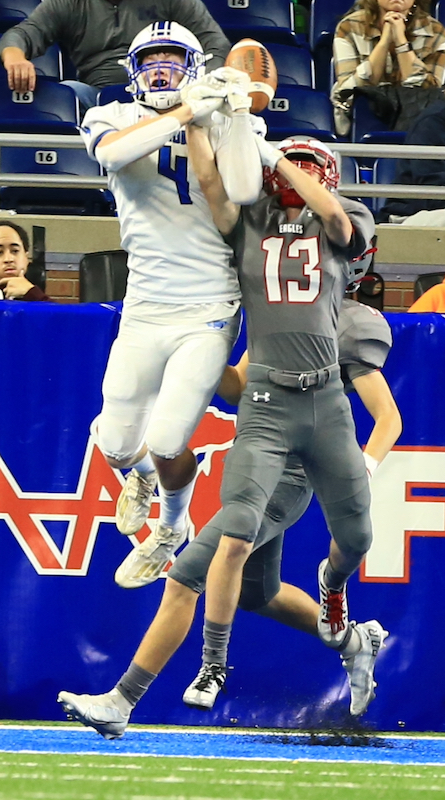
PHOTOS (Top) Gladwin celebrates its first Finals championship Saturday at Ford Field. (Middle) The Flying Gs’ Lucas Mead (4) and Frankenmuth’s Will Soulliere (13) contend for a jump ball in the end zone. (Below) Mead (4) wraps up Frankenmuth’s Hunter Bernthal (3). (Click for more from Hockey Weekly Action Photos.)