

MHSAA Opposes Big Ten Friday Football
November 2, 2016
By Geoff Kimmerly
Second Half editor
The executive director of the Michigan High School Athletic Association said today that he is “disappointed and disheartened” by the Big Ten Conference announcement that it will play and televise football games on Friday nights beginning with the 2017 season.
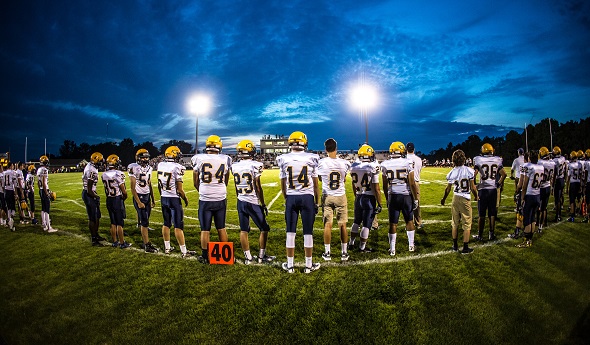
Friday night football remains one of the strongest and longest-standing traditions in high school athletics, and the MHSAA has fought since the start of this century to keep Friday nights sacred against the overstepping of college football and the damage televised Big Ten games are now expected to cause to attendance and media coverage of the sport at the high school level.
MHSAA Executive Director John E. “Jack” Roberts was contacted by both Big Ten Conference commissioner Jim Delany and Michigan State University athletic director Mark Hollis before the decision was announced. Roberts said he is appreciative of Michigan State and University of Michigan’s low tolerance to be included in this venture – at most, both will host a Thursday or Friday night game during Labor Day weekend and play one Friday night away game during the remainder of a season – but remains frustrated that similar respect for high school football was not shown by the conference as a whole.
Michigan State has played Friday night games during Labor Day weekend the last six seasons, hosting five and playing at Western Michigan University in 2015. However, most Michigan high school games continue to be scheduled and played on the Thursday before Labor Day, relieving holiday travel conflicts in most communities. University of Michigan did play on the Thursday before Labor Day at University of Utah in 2015, but has not played on a Friday night of Labor Day weekend this decade. The Wolverines are one of five Big Ten schools without a Friday night game in 2017.
“We are saddened by this decision. We had hoped that the Big Ten Conference would stay above this. We think this cheapens the Big Ten brand,” Roberts said. “Fans won’t like this. Recruits won’t like this. And high school football coaches won’t like this.
“We are grateful that Michigan State University and the University of Michigan are trying to minimize the effects of this decision by the Big Ten. But overall, this is just the latest step by major college athletics in the pursuit of cash that is just crushing high school sports.”
The MHSAA has shown its opposition to the use of Friday nights for televised collegiate football games for more than 15 years, dating back to 2001 when the NCAA lifted its restrictions on Friday night telecasts, which at first led to the broadcasting of “mid-major conference” games on the same night traditionally reserved for high school athletes.
The MHSAA launched in 2001 its “Save Our Friday Nights” campaign to emphasize the role that Friday night high school athletic events play in communities and to rally MHSAA member schools to contact NCAA member school football coaches, athletic directors and conference commissioners to voice their concerns.
In addition to causing lower attendance at events going up against Big Ten football games, Roberts anticipates that Friday night college games also will leave high school football as a secondary priority in many media markets. More than 80 radio stations statewide cover high school games regularly, but many also carry Michigan State or University of Michigan football. High school football could lose significant time on local TV highlights shows and in print and online coverage as well, as resources are diverted to cover a college game – potentially quieting significantly the positive buzz that comes from the typical high school football Friday night.
“Everyone knows that football is struggling right now,” Roberts said. “It’s getting a lot of bad publicity. Participation is declining. And now this; there couldn’t be worse timing.”
PHOTO: Grand Ledge takes on Okemos under the Friday night lights this season. (Click to see more from HighSchoolSportsScene.com.)
Troy Athens' Winning Work Promotes Importance of Becoming MI HEARTSafe
By
Geoff Kimmerly
MHSAA.com senior editor
July 22, 2022
Troy Athens, and more specifically its girls soccer team, has been selected as this year’s winner of the MI HEARTSafe School Video Contest promoting the importance of Michigan schools becoming an MI HEARTSafe school.
The Kimberly Anne Gillary Foundation partners with the MHSAA to promote cardiac awareness – and Athens’ student-produced video (above) earned the school $5,000.
Michigan has lost at least 81 students to sudden cardiac arrest (SCA) and related causes since 1999, according to data compiled by the Kimberly Anne Gillary Foundation. Randy and Sue Gillary lost their daughter Kimberly to a cardiac arrest in a high school water polo game in April of 2000. Randy and Sue Gillary founded the Kimberly Anne Gillary Foundation, a 501 (c)(3) charitable foundation within days of losing Kimberly. The mission of the Foundation is to donate automated external defibrillators (AEDs) to Michigan high schools and to advocate cardiac screening and testing of Michigan high school student athletes.
A major drive of the foundation is for every Michigan school to become an MI-HEARTSafe School. This is a designation given by the Michigan Department of Health and Human Services (MDHSS) when a school has met the criteria to demonstrate it is prepared to respond to a cardiac emergency on school property. Schools receive a banner and other materials that can be displayed in the school to let those who attend and visit know that the school is an MI-HEARTSafe School.