

MHSAA Opposes Big Ten Friday Football
November 2, 2016
By Geoff Kimmerly
Second Half editor
The executive director of the Michigan High School Athletic Association said today that he is “disappointed and disheartened” by the Big Ten Conference announcement that it will play and televise football games on Friday nights beginning with the 2017 season.
Friday night football remains one of the strongest and longest-standing traditions in high school athletics, and the MHSAA has fought since the start of this century to keep Friday nights sacred against the overstepping of college football and the damage televised Big Ten games are now expected to cause to attendance and media coverage of the sport at the high school level.
MHSAA Executive Director John E. “Jack” Roberts was contacted by both Big Ten Conference commissioner Jim Delany and Michigan State University athletic director Mark Hollis before the decision was announced. Roberts said he is appreciative of Michigan State and University of Michigan’s low tolerance to be included in this venture – at most, both will host a Thursday or Friday night game during Labor Day weekend and play one Friday night away game during the remainder of a season – but remains frustrated that similar respect for high school football was not shown by the conference as a whole.
Michigan State has played Friday night games during Labor Day weekend the last six seasons, hosting five and playing at Western Michigan University in 2015. However, most Michigan high school games continue to be scheduled and played on the Thursday before Labor Day, relieving holiday travel conflicts in most communities. University of Michigan did play on the Thursday before Labor Day at University of Utah in 2015, but has not played on a Friday night of Labor Day weekend this decade. The Wolverines are one of five Big Ten schools without a Friday night game in 2017.
“We are saddened by this decision. We had hoped that the Big Ten Conference would stay above this. We think this cheapens the Big Ten brand,” Roberts said. “Fans won’t like this. Recruits won’t like this. And high school football coaches won’t like this.
“We are grateful that Michigan State University and the University of Michigan are trying to minimize the effects of this decision by the Big Ten. But overall, this is just the latest step by major college athletics in the pursuit of cash that is just crushing high school sports.”
The MHSAA has shown its opposition to the use of Friday nights for televised collegiate football games for more than 15 years, dating back to 2001 when the NCAA lifted its restrictions on Friday night telecasts, which at first led to the broadcasting of “mid-major conference” games on the same night traditionally reserved for high school athletes.
The MHSAA launched in 2001 its “Save Our Friday Nights” campaign to emphasize the role that Friday night high school athletic events play in communities and to rally MHSAA member schools to contact NCAA member school football coaches, athletic directors and conference commissioners to voice their concerns.
In addition to causing lower attendance at events going up against Big Ten football games, Roberts anticipates that Friday night college games also will leave high school football as a secondary priority in many media markets. More than 80 radio stations statewide cover high school games regularly, but many also carry Michigan State or University of Michigan football. High school football could lose significant time on local TV highlights shows and in print and online coverage as well, as resources are diverted to cover a college game – potentially quieting significantly the positive buzz that comes from the typical high school football Friday night.
“Everyone knows that football is struggling right now,” Roberts said. “It’s getting a lot of bad publicity. Participation is declining. And now this; there couldn’t be worse timing.”
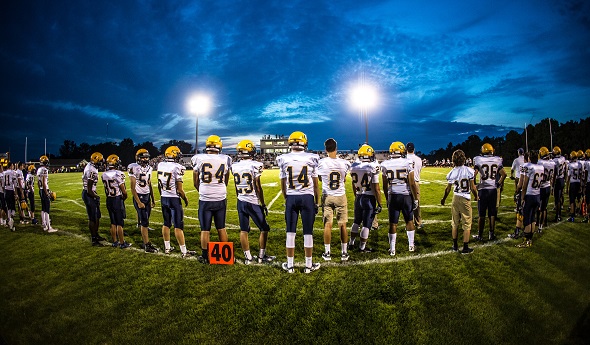
PHOTO: Grand Ledge takes on Okemos under the Friday night lights this season. (Click to see more from HighSchoolSportsScene.com.)
Moment: The Final Thrill
December 16, 2020
By John Johnson
MHSAA Director of Broadcast Properties
Over the course of nearly 34 years on this job, you often get asked what single championship game you would rank at the top of your list. You could ask that question to 100 people and get 100 answers – and guess what? They’d all be right. Such is the beauty of high school sports.
Which is why, after all these years, my game for the ages is one that has stood the test of time in my mind for over 30 years. It had everything you would want in a high school game – fantastic competition – great plays – and when it was over, some of the best sportsmanship I’ve ever seen – NO – make that THE best sportsmanship I’ve ever seen. To be on the field, you’d have a hard time telling who won and who lost by the way the players from both teams hugged and shook hands and sincerely congratulated each other. Which is how it should be after every – single – game.
And what topped it all off after that was the winning team making a trip to a pep assembly at the other team’s gym the following week to thank them for a great game, and present a banner signed by every member of the team.
That game was the 1989 Class B Football Playoff Final. The last year that four divisions were conducted in that postseason tournament. The last game played in that format.
Farmington Hills Harrison and DeWitt. The powerful, dominant Hawks and even legendary at that time coach John Herrington – and the All-America quarterback in Mill “The Thrill” Coleman; against the pride of the Ingham County League, the Panthers of DeWitt, from what was an old farming bedroom community north of Lansing transforming into a new money suburb of the Capitol City.
The Hawks, the reigning Class B champs after winning the third of their state-record 13 titles against St. Joseph the previous November, were heavy favorites. DeWitt was making its fourth Playoff appearance and moving up in class after reaching the Semifinals in 1988, only to lose to powerhouse Detroit St. Martin dePorres.
The underdogs used an efficient running attack to take a 21-14 halftime lead on Harrison. John Telford, who rushed for 153 yards in the game, had two of the scores. Harrison tied the game early in the final period on the first of two scoring runs by Coleman, this one from 19 yards out.
DeWitt then put together a grinding drive, culminated by quarterback Chris Berkimer sneaking it from one yard out. Harrison blocked the extra point and DeWitt led 27-21 with 2:20 on the clock.
That left way too much time for Coleman. He engineered a 67-yard, five-play drive to tie the game. It didn’t even take a minute off the clock.
“When they scored I looked at the clock and knew we had enough time and all three of our time outs,” Coleman told the Detroit Free Press after the game. “I kept thinking back to that drive John Elway had against the Browns a couple of years ago in the playoffs when he had to go 98 yards.”
Three straight passes to Mike Saputo, Steve Hill and Greg Piscopink got Harrison down to the DeWitt 16; and Coleman then rolled out on a Student Body Right for another seven yards.
At the DeWitt 9, Coleman dropped back for what appeared to be another pass, but the Panthers' pressure forced The Thrill to run. Coleman eluded five tacklers along the way, finally diving into the end zone to score.
“We knew he (Coleman) was good, and we just tried to contain him,” DeWitt coach Gail Thornton told the Lansing State Journal after the game. “But every once in a while he would get loose for a big one.”
Steve Hill kicked the extra point and Harrison was back in the lead, 28-27. Hill would then intercept Berkimer on DeWitt’s first play after the ensuing kickoff to seal the deal.
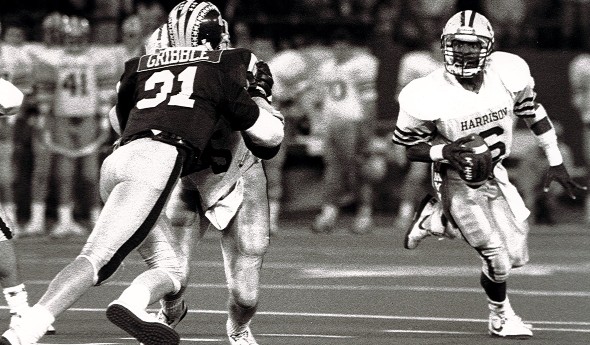
PHOTO: Farmington Hills Harrison's Mill Coleman rolls left at the start of what would be the game-winning run for his team in the 1989 Class B Football Final. (Photo by Gary Shook).