

MHSAA Reveals Football Playoff Format
September 25, 2020
By Geoff Kimmerly
Second Half editor
The Representative Council of the Michigan High School Athletic Association has approved an adjusted format for this season’s 11 and 8-Player Football Playoffs to accommodate the shortened regular season that began late due to COVID-19-related restrictions earlier this fall.
All teams this season are able to play up to six regular-season games before the start of the MHSAA Playoffs – down from the usual nine games because the first games this season weren’t played until the traditional Week 4. However, the playoff fields for both 11 and 8-player will be doubled this season, giving nearly every team in Michigan a guaranteed seventh game.
Changes to the football postseason are for the 2020 season only. Following are brief descriptions of the adjusted MHSAA Football Playoffs in each format:
11-PLAYER
· Field: 512 teams. (There are currently 507 playing 11-player football this season, so five teams are scheduled to receive first-round byes at this time.)
· Schedule: 3 District Rounds, Regional Finals, Semifinals, Finals. The host sites for the Semifinals and Finals will be pre-arranged and announced at a later time. Finals will be played the weekend of Dec. 4-6.
· Brackets: Teams have been placed in pre-arranged divisions based on enrollment. Teams in Districts will be seeded 1-8 based on playoff-point average, with the teams with highest averages hosting at the District and Regional levels. Because of a small number of teams opting to not play this fall, division lines were adjusted from what was released during the spring classification announcement, moving 20 teams to different divisions than previously published – those changes will be reflected next week on the playoff points page of the MHSAA Website. Click for District groupings.
8-PLAYER
· Field: 64 teams. (There are currently 78 teams playing 8-player this season. Those teams that finish the season but do not qualify for the playoffs will be allowed to schedule one more game against other non-qualifiers.)
· Schedule: 3 Regional Rounds, Semifinals, Finals. Finals will be played the weekend of Nov. 27-28 at site(s) to be determined.
· Brackets: Teams were placed in pre-arranged divisions based on enrollment during the classification process this spring. The top 32 teams in each division based on playoff-point average will qualify for the playoffs. Brackets will be drawn and announced Oct. 25. Teams with higher playoff-point averages will host Regional and Semifinal games. Additionally, there are six 8-player teams too large by enrollment to qualify for the playoffs; they will be allowed to schedule their own non-MHSAA playoff if they choose to do so after the regular season.
Further details will be provided soon on the Football page of the MHSAA Website.
The Representative Council is the 19-member legislative body of the MHSAA. All but five are elected by member schools. Four members are appointed by the Council to facilitate representation of females and minorities, and the 19th position is occupied by the Superintendent of Public Instruction or designee.
The MHSAA is a private, not-for-profit corporation of voluntary membership by more than 1,500 public and private senior high schools and junior high/middle schools which exists to develop common rules for athletic eligibility and competition. No government funds or tax dollars support the MHSAA, which was the first such association nationally to not accept membership dues or tournament entry fees from schools. Member schools which enforce these rules are permitted to participate in MHSAA tournaments, which attract more than 1.4 million spectators each year.
1st & Goal: 2025 8-Player Finals Preview
By
Geoff Kimmerly
MHSAA.com senior editor
November 21, 2025
The competition truly will be superior again at Saturday’s 8-Player Football Finals at Northern Michigan University’s Superior Dome.
 Three of four teams playing in the two championship games are undefeated – and the one loss among the four came when two played each other during the final week of the regular season.
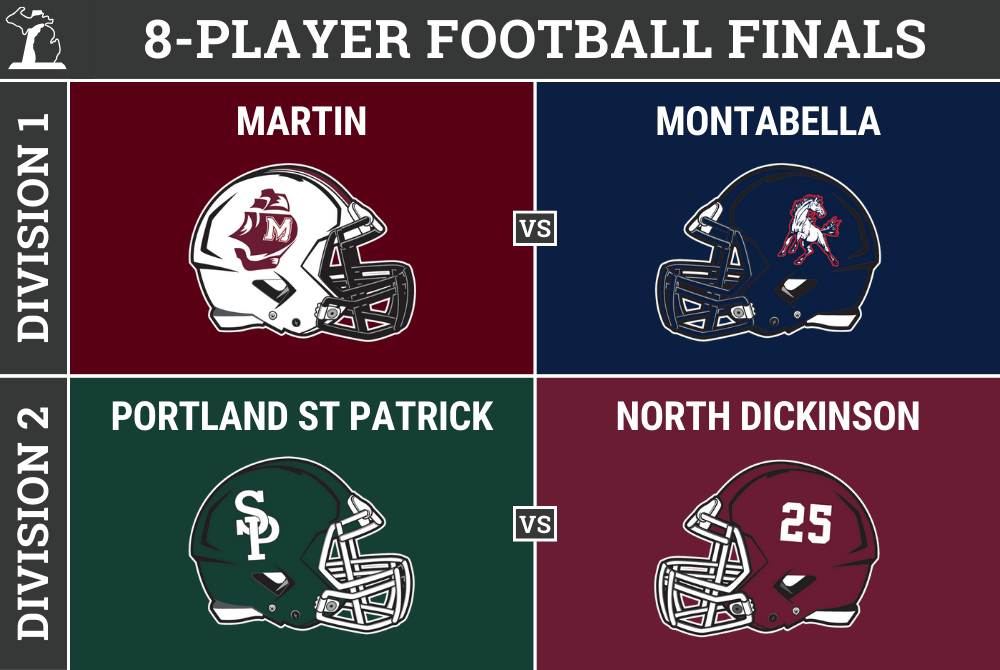
Blanchard Montabella and Martin will kick off at 11 a.m., and Felch North Dickinson and Portland St. Patrick follow at 2 p.m. Tickets cost $10 and are good for both games, and may be purchased online through NMU or at the door – click for details.
Both games will be broadcast by the NFHS Network:
Audio of both games will be streamed live on MHSAANetwork.com.
Below is a look at all four finalists:
Division 1
BLANCHARD MONTABELLA
Record/Rank: 11-1, No. 2
Coach: Tim Webb, sixth season (32-23)
League finish: First in Mid-State Activities Conference Blue
Championship history: Has never played in an MHSAA Final.
Best wins: 32-28 over No. 3 Norway in Semifinal, 26-0 (Regional Final) and 36-26 over No. 9 Merrill, 64-26 (Regional Semifinal) and 54-18 over Breckenridge.
Players to watch: RB/DB Austin Jensen, 5-10/155, jr. (828 yards/14 TDs rushing, 681 yards/6 TDs receiving); QB Gabe Kauffman, 5-9/160, jr. (1,215 yards/14 TDs passing, 481 yards/9 TDs rushing); RB/LB Brady Kieff, 5-10/160, sr. (1,561/19 TDs rushing); DL Cody Omo, 6-0/160, sr. (95 tackles, 12 sacks).
Outlook: Montabella’s longest playoff run has included its first Regional title and second-straight league championship, The Norway win – during which the Mustangs came back from a 20-point deficit – was Montabella’s only single-digit win, with the lone defeat to Division 2 finalist Portland St. Patrick. Kieff missed all of last season but has led a rushing attack that averages nearly 300 yards and five touchdowns per game. Omo made the all-state second team last season. Junior linebacker Mason Bogart always seems to be around the ball and has 145 tackles.
MARTIN
Record/Rank: 12-0, No. 1
Coach: Brad Blauvelt, eighth season (78-14)
League finish: First in Southwest Michigan 8-Man Football League Red
Championship history: Three MHSAA Finals titles (most recent 2023).
Best wins: 20-8 over No. 5 Kingston in Semifinal, 36-20 over No. 10 Climax-Scotts in Regional Final, 48-26 over Division 2 No. 6 Grand Rapids Sacred Heart, 52-6 over Gobles, 58-20 over Bridgman.
Players to watch: QB/S Haylen Buell, 5-10/175, sr. (1,528 yards/32 TDs rushing, 866 yards/13 TDs passing); WR/DB Weson Elkins, 6-0/170, sr. (408 yards/6 TDs receiving); RB/OLB Seth Toris, 5-3/155, jr. (1,331 yards/10 TDs rushing); OL/DL Peyton Schuring-Harris, 6-3/280, sr. (Statistics through Regional Finals.)
Outlook: Martin is back at Superior Dome after most recently winning back-to-back championships in 2022 and 2023. Buell as a sophomore was among the team’s leading rushers and receivers in the 2023 title game, and he earned an all-state honorable mention last year at linebacker. The Clippers’ closest game this season was the Semifinal win; no other opponent has come closer than two touchdowns. Senior Bryer Watson also has been among offensive leaders, with 562 yards and nine touchdowns rushing and 379 yards and five TDs receiving heading into the Semifinal.
Division 2
FELCH NORTH DICKINSON
Record/Rank: 12-0, No. 7
Coach: Mike Christian, 10th season (37-59)
League finish: First in Great Lakes Eight Conference Central
Championship history: 11-Player Class D runner-up 1998.
Best wins: 44-28 over No. 2 Onekama in Semifinal, 32-12 (Regional Final) and 38-34 over Lake Linden-Hubbell, 40-22 over St. Ignace in Regional Semifinal.
Players to watch: TE/DE Trenton Kramer, 6-4/190, jr. (1,062 yards/18 TDs receiving); FB/LB Jason Graham, 5-8/160, jr. (1,207 yards/17 TDs rushing); QB/DB Brady Jungwirth, 5-10/155, sr. (1,888 yards/28 TDs passing); HB/LB Tyler Fleming, 5-3/110, sr. (612 yards/6 TDs rushing). (Statistics through Regional Final.)
Outlook: North Dickinson has gone from not having a team two years ago to reaching its first championship game in nearly three decades. The Nordics have played only one single-digit game this fall, defeating Lake Linden-Hubbell by four in their season opener before winning the rematch two weeks ago by 20. North Dickinson missed the playoffs last season but did win their final five games, giving them a current 17-game unbeaten streak. Jungwirth’s ability to throw gives the Nordics more balance than most, and Kramer was averaging 19.3 yards per catch heading into last week.
PORTLAND ST. PATRICK
Record/Rank: 12-0, No. 3
Coach: Patrick Russman, 19th season (138-61)
League finish: First in MSAC Red
Championship history: 11-Player Class D champion 1992, five runner-up finishes.
Best wins: 36-15 over No. 4 Deckerville in Semifinal, 51-22 over No. 1 Mendon in Regional Final, 14-7 over No. 9 Morrice, 42-16 over Division 1 No. 2 Blanchard Montabella, 62-12 over Division 1 No. 9 Merrill.
Players to watch: QB/DB Jerryd Scheurer, 5-1/165, jr. (572 yards/10 TDs passing, 306 yards/11 TDs rushing, 32 tackles/7 interceptions); RB/DB Brady Leonard, 6-0/185, sr. (1,263 yards/17 TDs rushing, 55 tackles/10 interceptions); RB/DB Hudson King, 5-8/160, sr. (932 yards/16 TDs rushing); OL/LB Augustus Teachworth, 6-3/190, sr. (85 tackles)
Outlook: St. Patrick most recently finished Division 2 runner-up in 2017, 2019 and 2020 and will make this trip to Superior Dome after navigating arguably the toughest playoff path of any team in 8-player. After defeating Division 1 finalist Montabella in Week 9, the Shamrocks opened the postseason with a 62-16 win over Marion before taking on Mendon and Deckerville, and Morrice is the only opponent this fall to get closer than 21 points. It’s easy to point to the powerful offense, but the defense has given up only 10.2 points per game and been opportunistic with 24 interceptions and seven fumble recoveries.
MHSAA.com's weekly “1st & Goal” previews and reviews are powered by MI Student Aid, a division within the Department of Lifelong Education, Advancement, and Potential (MiLEAP). MI Student Aid encourages students to pursue postsecondary education by providing access to student financial resources and information. MI Student Aid administers the state’s scholarship and grant programs that help make college Accessible, Affordable and Attainable for you. Click to connect with MI Student Aid and find more information on Facebook and Twitter @mistudentaid.