

MHSAA Vault: Shooks a Legend as Freshman Coach
By
Geoff Kimmerly
MHSAA.com senior editor
September 4, 2026
The following originally appeared in the Lansing State Journal on Oct. 28, 2004, and was reprinted by the MHSAA that winter.
Wayne Shooks retired from coaching entirely in 2008 and died Tuesday at the age of 84.
Wayne Shooks tried the varsity football thing once. Some time during the late 1980s, longtime DeWitt coach Gail Thornton asked Shooks to be his offensive coordinator.
“I didn't sleep a night. My wife, after three weeks, said, ‘You're going back to freshmen,’” Shooks remembered.
And those three weeks were in the month of June.
But Shooks' wife must have been on to something. Because few, if any, freshman football coaches have accomplished what Shooks finished with one last win last fall.
He ended his 16th and final season as freshman coach with a 135-2-1 record.
Amazing.
“You can't lose a game for him, or you'll feel bad,” DeWitt senior Mat Brynick recalled from his days as a freshman. “Coach never says it, but it's what everyone expects.
“He taught us how to win.”
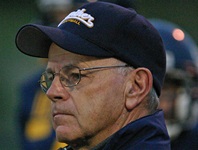 Guys like Shooks, 62, usually go unappreciated.
They get the kids fresh to high school, fresh to high school sports, and still learning things like not spiking the ball after a touchdown.
But few freshman football coaches are as legendary as Shooks is in DeWitt. They are so unappreciated that it's impossible to find out if anyone has accomplished what he's done.
Shook is not big on numbers. Never has been during his 41 years teaching in the district, or more than 20 coaching everything from football to basketball to wrestling to tennis. Oh, and track since 1980.
He also coached 8th-grade football for a few years, junior varsity for one season and was a varsity assistant. But he'll be remembered for what he did with the freshmen.
The losses came in 1993 to Mason during a terrible wind storm, and in 2002 to Greenville. That same year, the Panthers tied Haslett, meaning it was the only year during his tenure that DeWitt wasn't sure if it finished first in its league, since league titles aren't handed out at the freshmen level.
“The kids felt bad. They did their best,” Shooks remembered.
But the losses, however few, were more of a relief for Shooks than a letdown.
Don't take that to mean Shooks doesn't like to win.
Sure, he embraced the role of teacher as much as any freshman coach. But as DeWitt varsity coach Rob Zimmerman said, “If he was a 5th-grade coach, he'd be the most competitive 5th-grade coach you've ever seen.”
“I never pointed (our record) out, it was not our goal,” Shooks said. “Our goal was to win the next week. Although the kids knew it. They just assumed we were going to go 9-0, I guess.”
Guess so.
Shooks had more easily-attainable goals:
- Have fun
- Learn fundamentals
- Emphasize the logical stuff, like the importance of bringing equipment to school every day
“He does a really good job teaching expectations about being young men and being great students,” Zimmerman said. “It's gigantic.”
And it kept kids coming back to junior varsity and varsity. You could hear the fun coming out in Brynick's voice.
He was remembering his freshman football experience, remembering his time with perhaps Michigan's most successful coach at that level.
“I remember a few games, we'd find one play that works, and we ran it to death, pounding it and pounding it,” Brynick recalled. “He loves running the same play over and over. If you can do that, march 80 yards down the field, you're doing something right. No one could stop us.”
That was not all Brynick remembered, or didn't.
Shooks almost never yelled. If he did, it meant a kid messed something up over and over and over again.
He has a doctorate in zoology. Education is obviously a big deal. He loves to win, but he loves to teach. And he's hesitant to go looking for any attention for what he's done.
All made him a perfect freshmen football coach.
“Sometimes I don't think people understand about coaches. You think college level, they are coaches first, that's their job, but not at the high school level,” Shooks said.
“It's not what I've done, it's what they've done. I've always believed the focus should be on the kids. My job is a teacher. I coach because I love to coach.”
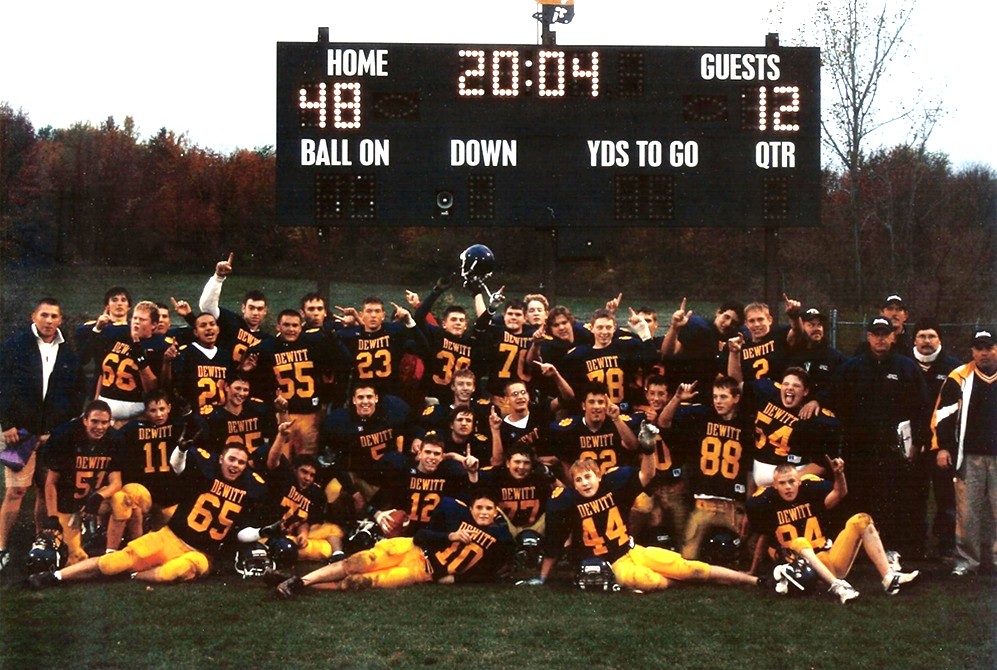
PHOTO DeWitt freshman coach Wayne Shooks, fourth from right, stands for a photo with this final football team in 2004. (Photos courtesy of the DeWitt football program.)
Search for Longest FG Starts in '50s
October 30, 2020
By Ron Pesch
Special for Second Half
Rob LaMielle’s first attempted field goal was a memorable one, and frankly, a bit amazing.
For starters, his track record on extra points, at least to that point in the season, was less than stellar. Flint Holy Redeemer entered their third game of the 1963 slate with a 1-1 record. The Flyers were defeated by Bad Axe in Week 1, then trounced Imlay City the next week. The senior had been successful on only 3 of 9 extra-point placements on the year.
“You had to bring that up,” said LaMielle over 55 years later, laughing at the statistic. “That’s probably so. Bad Axe was rated No. 1 in the state in Class ‘B.’ We were a ‘C’ school. They beat us 13-12 that night, because I missed two extra points. They scored in the very last couple minutes.”
The fact that his field goal was on the mark is all the more impressive considering it traveled 50 yards, clearing the crossbar by three feet, according to observers. Even more remarkable, it was a mere three yards shy of Lou ‘The Toe’ Groza’s best effort for the National Football League’s Cleveland Browns, and just six yards short of the NFL record, set by Bert Rechichar of the Baltimore Colts in 1953. Rechichar held the mark until it was famously topped by New Orleans Saints kicker Tom Dempsey in 1970 against the Detroit Lions.
“We practiced behind our football field,” said LaMielle, recalling how he got the job. “Behind our football field was two baseball fields with a backstop at each end. Well the coach lined everybody up on second base and said, ‘OK, we’re going to find out who can kick a field goal.’ So we started kicking the ball over the backstop. One of the times I kicked it, and it went a long ways.”
St. Redeemer’s coach Dick Clark stopped the drill and named LaMielle the team’s kicker.
“Before my senior year, I’d never kicked off, never attempted an extra point.”
At the time, the 220-pound LaMielle, who, like Groza, played tackle, was asked if he was surprised by the success of his kick.
“I was more surprised Coach Clark asked me to try it,” he said.
The field goal helped Flint Holy Redeemer top Bay City St. James, 29-6.
It also prompted another question from sports reporters. Was LaMielle’s kick a Michigan high school record?
The Search
The publicity surrounding the kick sent sportswriters around the state scurrying for the archives.
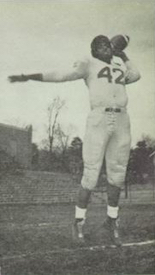 Initial inquiries indicated that Jim Yore of Battle Creek Central held the state mark, with a 56-yard field goal about 10 years prior, but a recheck of records by Dick Kishpaugh, “sports publicity director at Kalamazoo College and a close observer of Michigan prep football records,” indicated that Yore’s longest had been a 38-yard field goal, kicked on the last play of the game to beat Ypsilanti 3-0 on Oct. 3, 1952. It was thought to be the longest in state history.
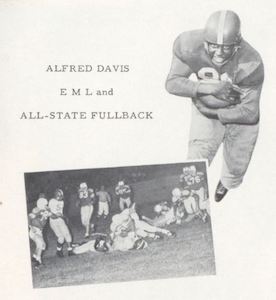
Additional digging found that Port Huron High School’s Alfred Davis, a 212-pound fullback, had drilled a flawless 46-yard field goal in a 19-14 win over Hazel Park in 1953.
“The word ‘tremendous’ is probably one of the most overused words in sports lexicon,” wrote Port Huron Times reporter Fred J. Vincent, “but it should be used in describing this kick.”
Vincent called it “perfect, splitting the uprights and clearing the bar by about six feet.”
Impressively, Davis also had kicked a 36-yarder earlier in the contest. “Bob Boyd held on both kicks,” added the sportswriter. “Not since Oct. 8, 1930 had a Big Red player kicked a three pointer. Hank Ceasor did it then to best Ferndale, 3-0.”
Word came that Cheboygan Catholic’s Joe Poirier had kicked one “reported to have traveled at least 53 yards from the point of the kick to the goal posts” in a 10-0 victory over Alcona in 1957. Since the MHSAA didn’t keep records at the time, Kishpaugh added it to his listing of unofficial state records.
The Ironwood Daily Globe unearthed a nugget. While it wasn’t considered by Kishpaugh for his record book, it did bring back memories of changes seen in the game.
Ironwood’s John ‘Cutz’ Cavosie made a “tremendous boot on Oct. 10, 1925 in the final seconds of a game at Oliver Field here in which Ironwood swamped Menominee 41-0. Cavosie apparently was back to punt, but instead he dropkicked the ball squarely through the goal posts 55 yards away. He was in his senior year that fall and was captain of the team. He played a big role in the rout on Menominee by scoring on runs of 42, 51 and 67 yards.”
Record Toppled
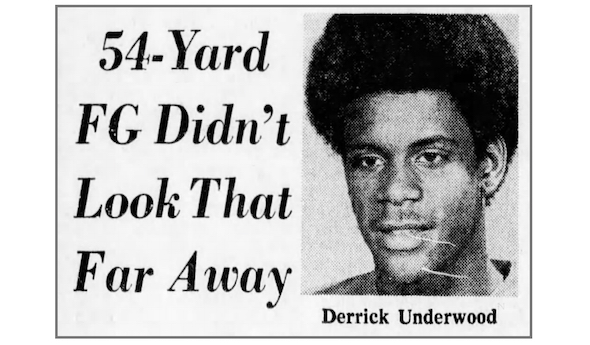
So it was quite the event when, nearly 19 years later, junior Derrick Underwood broke Poirier’s mark on a cold October Friday at Inkster.
A week earlier, Underwood had made his first field goal of the season, a 23-yard boot in overtime to give Ecorse its first victory of the year in five starts, 9-6, over River Rouge. This time, his kick gave Ecorse a 3-0 victory over the Vikings, although in decidedly less dramatic fashion as the kick came in the second quarter.
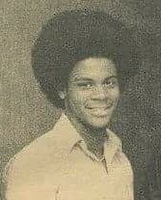
 “The strange thing is I didn’t even know that I was kicking it from the 44-yard line. To be honest, I wasn’t paying that much attention and it didn’t look that long,” Underwood told the Detroit Free Press in 1976. “But I got a real good snap on it and an excellent hold.
Red Raiders coach Patrick Kearney believed the kick would have been good from another five or 10 yards out.
“It felt good when I hit it,” added Underwood, “but because I was in front of the goal posts, I couldn’t tell whether it went over or under the crossbar. But I saw my teammates jumping up and down on the sidelines and I knew it made it.
“I was pretty loose because I figured that if I missed, we still had another half to come back and win it.”
Underwood’s accomplishment garnered national attention in the June/July ’77 issue of Joe Namath’s National Prep Sports magazine. At the time, Jerry Spicer of Hobart (Ind.) High School held the national record with a kick of 61 yards in 1975.
Exasperation to Jubilation
Underwood, who also served as the Red Raiders’ quarterback and defensive end, guided the team to Inkster’s one-foot line in that same game as the clock wound down. But with the lead, instead of pushing for the end zone, they let time expire.
A year earlier, in 1975, the Ecorse players watched their season disappear after a single game.
“The school millage was defeated just prior to the start of that season,” said Underwood, recalling his high school days some 45 years later. “I was the starting QB for the Red Raiders through my senior year ('78). We were heartbroken that our season was over after the first game against Muskegon Heights. No energy for that game.
“We were foaming at the mouth to be playing organized football. Some of us played flag football to stay active.”
“I was just practicing holding for a teammate,” Underwood had told the Free Press back in October 1976. “Eventually I thought I’d try and I got to be pretty good at it.”
“I didn’t take kicking seriously at all,” he states now. “I wasn’t a dedicated kicker. My stars were aligned in my head as being the next Thomas Lott.”
 Lott, a Parade All-American out of San Antonio, Texas, played quarterback at Oklahoma, where his coach, the legendary Barry Switzer, once called him the greatest wishbone quarterback in Oklahoma history.
“Went down to Tennessee State University and found out how much football I didn’t know,” Underwood said.
Reminiscing he added, “Looking back, wouldn’t change a thing growing up in Ecorse.”
Equaled, then Topped – in the Same Game
Underwood’s mark would hold in Michigan until 1979, when junior Harold Moore of Dearborn equaled, then topped the mark in a season-ending game against Plymouth Canton.
Moore, a left-footed, straight-on kicking specialist, matched Underwood’s record with a 54-yard boot in the game’s first half, and then topped the record with a 55-yard field goal during the second half.
“I’ve never seen anyone with the leg power he has,” said his coach, Dick Ryan. “His 55-yard field goal cleared the bar with 20 feet to spare.”
Over the next two seasons, three players – Mike Prindle of Grand Rapids Union (1980), Bob Hirschman from Sterling Heights Ford (1980), and Dave Blackmer of Farmington Hills Harrison (1981) – would match Moore’s longest kick.
Since then, only five players have matched or exceeded 55 yards. John Langeloh of Utica shattered the mark in 1985 with a 58 yarder. Doug Kochanski of Warren Woods-Tower is the state’s current record holder, with a kick in 1994 that traveled 59 yards before splitting the uprights. The successful kick came in his final high school contest.
In these days of more and more specialization, one wonders, will Michigan ever see one of 60 yards or more?
 Ron Pesch has taken an active role in researching the history of MHSAA events since 1985 and began writing for MHSAA Finals programs in 1986, adding additional features and "flashbacks" in 1992. He inherited the title of MHSAA historian from the late Dick Kishpaugh following the 1993-94 school year, and resides in Muskegon. Contact him at [email protected] with ideas for historical articles.
PHOTOS: (Top) The Detroit Free Press told the story behind Derrick Underwood’s record field goal for Ecorse in its Oct. 30, 1976 edition. (2) Battle Creek Central’s Jim Yore was one of the earliest record holders for longest field goal in Michigan high school history. (3) Alfred Davis also was a standout fullback for Port Huron. (4) Underwood also played quarterback and defensive end for the Red Raiders. (Photos gathered by Ron Pesch.)