

MHSAA Vault: Shooks a Legend as Freshman Coach
By
Geoff Kimmerly
MHSAA.com senior editor
September 4, 2026
The following originally appeared in the Lansing State Journal on Oct. 28, 2004, and was reprinted by the MHSAA that winter.
Wayne Shooks retired from coaching entirely in 2008 and died Tuesday at the age of 84.
Wayne Shooks tried the varsity football thing once. Some time during the late 1980s, longtime DeWitt coach Gail Thornton asked Shooks to be his offensive coordinator.
“I didn't sleep a night. My wife, after three weeks, said, ‘You're going back to freshmen,’” Shooks remembered.
And those three weeks were in the month of June.
But Shooks' wife must have been on to something. Because few, if any, freshman football coaches have accomplished what Shooks finished with one last win last fall.
He ended his 16th and final season as freshman coach with a 135-2-1 record.
Amazing.
“You can't lose a game for him, or you'll feel bad,” DeWitt senior Mat Brynick recalled from his days as a freshman. “Coach never says it, but it's what everyone expects.
“He taught us how to win.”
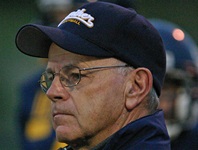 Guys like Shooks, 62, usually go unappreciated.
They get the kids fresh to high school, fresh to high school sports, and still learning things like not spiking the ball after a touchdown.
But few freshman football coaches are as legendary as Shooks is in DeWitt. They are so unappreciated that it's impossible to find out if anyone has accomplished what he's done.
Shook is not big on numbers. Never has been during his 41 years teaching in the district, or more than 20 coaching everything from football to basketball to wrestling to tennis. Oh, and track since 1980.
He also coached 8th-grade football for a few years, junior varsity for one season and was a varsity assistant. But he'll be remembered for what he did with the freshmen.
The losses came in 1993 to Mason during a terrible wind storm, and in 2002 to Greenville. That same year, the Panthers tied Haslett, meaning it was the only year during his tenure that DeWitt wasn't sure if it finished first in its league, since league titles aren't handed out at the freshmen level.
“The kids felt bad. They did their best,” Shooks remembered.
But the losses, however few, were more of a relief for Shooks than a letdown.
Don't take that to mean Shooks doesn't like to win.
Sure, he embraced the role of teacher as much as any freshman coach. But as DeWitt varsity coach Rob Zimmerman said, “If he was a 5th-grade coach, he'd be the most competitive 5th-grade coach you've ever seen.”
“I never pointed (our record) out, it was not our goal,” Shooks said. “Our goal was to win the next week. Although the kids knew it. They just assumed we were going to go 9-0, I guess.”
Guess so.
Shooks had more easily-attainable goals:
- Have fun
- Learn fundamentals
- Emphasize the logical stuff, like the importance of bringing equipment to school every day
“He does a really good job teaching expectations about being young men and being great students,” Zimmerman said. “It's gigantic.”
And it kept kids coming back to junior varsity and varsity. You could hear the fun coming out in Brynick's voice.
He was remembering his freshman football experience, remembering his time with perhaps Michigan's most successful coach at that level.
“I remember a few games, we'd find one play that works, and we ran it to death, pounding it and pounding it,” Brynick recalled. “He loves running the same play over and over. If you can do that, march 80 yards down the field, you're doing something right. No one could stop us.”
That was not all Brynick remembered, or didn't.
Shooks almost never yelled. If he did, it meant a kid messed something up over and over and over again.
He has a doctorate in zoology. Education is obviously a big deal. He loves to win, but he loves to teach. And he's hesitant to go looking for any attention for what he's done.
All made him a perfect freshmen football coach.
“Sometimes I don't think people understand about coaches. You think college level, they are coaches first, that's their job, but not at the high school level,” Shooks said.
“It's not what I've done, it's what they've done. I've always believed the focus should be on the kids. My job is a teacher. I coach because I love to coach.”
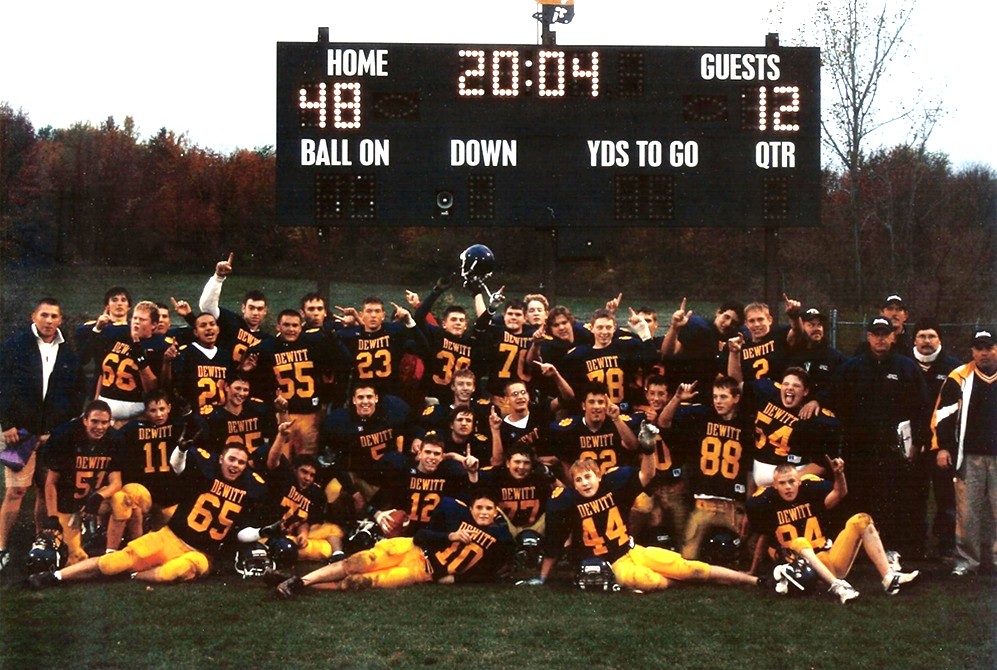
PHOTO DeWitt freshman coach Wayne Shooks, fourth from right, stands for a photo with this final football team in 2004. (Photos courtesy of the DeWitt football program.)
Football to Move to Spring for 2020-21
August 14, 2020
By Geoff Kimmerly
Second Half editor
The Representative Council of the Michigan High School Athletic Association today announced it will move the 2020 Fall football season to Spring 2021, due to football’s higher risk for spreading COVID-19, with the rest of Fall sports proceeding as scheduled.
The football season switch was made based on consultation with state health department officials and after surveying MHSAA member high schools on their progress and preferences after the first four days of practice. Football is considered a high-risk sport for potential spread of the COVID-19 virus because of its level of player-to-player contact.
A total of 34,219 student-athletes played football at MHSAA member schools during the 2019 season. A total of 520 11-player teams and 83 8-player teams were anticipated during late summer to play football this fall season.
“At the end of the day, we did everything we could to find a path forward for football this fall,” MHSAA Executive Director Mark Uyl said. “But while continuing to connect with the Governor’s office, state health department officials, our member schools’ personnel and the Council, there is just too much uncertainty and too many unknowns to play football this fall.
“No one is willing to take the risk of COVID being passed on because of a high-risk sport. Decisions have to be made on our other sports as well, but none of those carry the same close, consistent, and face-to-face contact as football.”
The MHSAA announced July 17 it would proceed this school year with its traditional calendar beginning with Fall sports but with enhanced precautions to help limit the spread of COVID-19. At that time, the MHSAA also stated it would move football, and other Fall sports seasons, to the spring of 2021 if they were deemed unsafe to proceed when originally scheduled. Football was allowed to begin practice, with helmets but no other padding, on Aug. 10.
Volleyball and soccer are considered moderate-risk for virus spread, while cross country, golf, tennis and swimming & diving are considered low-risk. Cross Country, Lower Peninsula girls golf and boys tennis and Upper Peninsula girls tennis began practice Aug. 12; golf and tennis teams may begin competing Aug. 19, and cross country teams may begin competing Aug. 21.
Volleyball, boys soccer and Lower Peninsula girls swimming & diving also began practice Aug. 12, and competition guidelines for those sports will be announced Aug. 19. Schools in regions under Phase 4 of the MI Safe Start Plan remain unable to play volleyball or swim/dive indoors due to governmental restrictions. Further guidance from Governor Gretchen Whitmer’s office is expected in the near future regarding these indoor facilities.
Details for the spring football season including a specific schedule and format will be announced over the next few months. The MHSAA will be working to limit overlap of spring football and the traditional Spring sport seasons.
“While this is tremendously disappointing, we will do everything possible to provide the best possible experience in the spring while adding football into the calendar,” Uyl said.
The MHSAA is a private, not-for-profit corporation of voluntary membership by more than 1,500 public and private senior high schools and junior high/middle schools which exists to develop common rules for athletic eligibility and competition. No government funds or tax dollars support the MHSAA, which was the first such association nationally to not accept membership dues or tournament entry fees from schools. Member schools which enforce these rules are permitted to participate in MHSAA tournaments, which attract more than 1.4 million spectators each year.
PHOTO by Robert Batzloff.