

MHSAA Vault: Shooks a Legend as Freshman Coach
By
Geoff Kimmerly
MHSAA.com senior editor
September 4, 2026
The following originally appeared in the Lansing State Journal on Oct. 28, 2004, and was reprinted by the MHSAA that winter.
Wayne Shooks retired from coaching entirely in 2008 and died Tuesday at the age of 84.
Wayne Shooks tried the varsity football thing once. Some time during the late 1980s, longtime DeWitt coach Gail Thornton asked Shooks to be his offensive coordinator.
“I didn't sleep a night. My wife, after three weeks, said, ‘You're going back to freshmen,’” Shooks remembered.
And those three weeks were in the month of June.
But Shooks' wife must have been on to something. Because few, if any, freshman football coaches have accomplished what Shooks finished with one last win last fall.
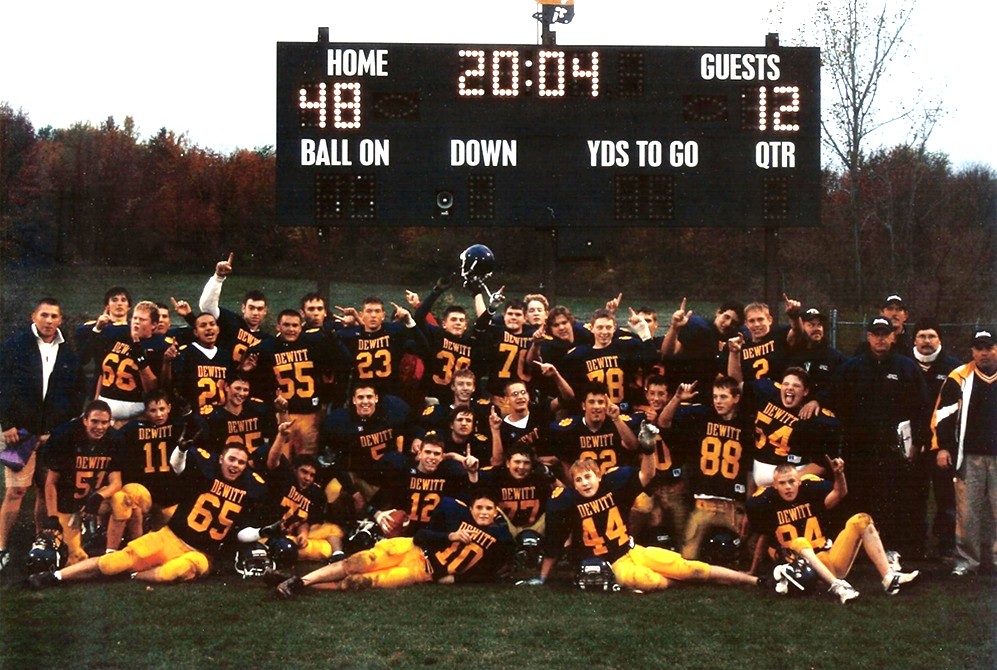
He ended his 16th and final season as freshman coach with a 135-2-1 record.
Amazing.
“You can't lose a game for him, or you'll feel bad,” DeWitt senior Mat Brynick recalled from his days as a freshman. “Coach never says it, but it's what everyone expects.
“He taught us how to win.”
 Guys like Shooks, 62, usually go unappreciated.
They get the kids fresh to high school, fresh to high school sports, and still learning things like not spiking the ball after a touchdown.
But few freshman football coaches are as legendary as Shooks is in DeWitt. They are so unappreciated that it's impossible to find out if anyone has accomplished what he's done.
Shook is not big on numbers. Never has been during his 41 years teaching in the district, or more than 20 coaching everything from football to basketball to wrestling to tennis. Oh, and track since 1980.
He also coached 8th-grade football for a few years, junior varsity for one season and was a varsity assistant. But he'll be remembered for what he did with the freshmen.
The losses came in 1993 to Mason during a terrible wind storm, and in 2002 to Greenville. That same year, the Panthers tied Haslett, meaning it was the only year during his tenure that DeWitt wasn't sure if it finished first in its league, since league titles aren't handed out at the freshmen level.
“The kids felt bad. They did their best,” Shooks remembered.
But the losses, however few, were more of a relief for Shooks than a letdown.
Don't take that to mean Shooks doesn't like to win.
Sure, he embraced the role of teacher as much as any freshman coach. But as DeWitt varsity coach Rob Zimmerman said, “If he was a 5th-grade coach, he'd be the most competitive 5th-grade coach you've ever seen.”
“I never pointed (our record) out, it was not our goal,” Shooks said. “Our goal was to win the next week. Although the kids knew it. They just assumed we were going to go 9-0, I guess.”
Guess so.
Shooks had more easily-attainable goals:
- Have fun
- Learn fundamentals
- Emphasize the logical stuff, like the importance of bringing equipment to school every day
“He does a really good job teaching expectations about being young men and being great students,” Zimmerman said. “It's gigantic.”
And it kept kids coming back to junior varsity and varsity. You could hear the fun coming out in Brynick's voice.
He was remembering his freshman football experience, remembering his time with perhaps Michigan's most successful coach at that level.
“I remember a few games, we'd find one play that works, and we ran it to death, pounding it and pounding it,” Brynick recalled. “He loves running the same play over and over. If you can do that, march 80 yards down the field, you're doing something right. No one could stop us.”
That was not all Brynick remembered, or didn't.
Shooks almost never yelled. If he did, it meant a kid messed something up over and over and over again.
He has a doctorate in zoology. Education is obviously a big deal. He loves to win, but he loves to teach. And he's hesitant to go looking for any attention for what he's done.
All made him a perfect freshmen football coach.
“Sometimes I don't think people understand about coaches. You think college level, they are coaches first, that's their job, but not at the high school level,” Shooks said.
“It's not what I've done, it's what they've done. I've always believed the focus should be on the kids. My job is a teacher. I coach because I love to coach.”
PHOTO DeWitt freshman coach Wayne Shooks, fourth from right, stands for a photo with this final football team in 2004. (Photos courtesy of the DeWitt football program.)

NFHS Voice: Find Answers at Youth Level
November 13, 2019
By Karissa Niehoff
NFHS Executive Director
Are there long-term solutions to increasing the number of participants in high school sports and improving parental behavior at high school contests? The answer to both questions might start at the youth sports level.
The NFHS hosted a first-ever meeting of about 25 leaders of National Governing Bodies and the U.S. Olympic & Paralympic Committee last week to discuss common concerns and opportunities to align and work together.
Within the youth areas of these organizations, the issues are familiar ones to high school leaders – decline in participation, parent behavior, coaches education and minimizing the injury risk. Clearly, however, reaching parents with appropriate educational messages on sportsmanship, injury risk and the values of participation is a top priority for leaders at all levels – youth, middle school and high school sports.
Recently, the NFHS formed a Middle School Committee in an effort to build interest in education-based sports at that level and to share the proper messages with parents before their kids reach high school. However, as we learned last week, middle school may even be too late!
Those educational messages will be enhanced if the process starts in out-of-school youth sports. If messages about the values of multi-sport participation, playing for the love of the game, and limiting contact in sports like football are consistently shared and demonstrated at the youth level, the education-based concept should be firmly in place by the time students reach high school.
Coaches education is another common concern. While the NFHS has created an outstanding online education program for interscholastic coaches through the NFHS Learning Center (www.NFHSLearn.com), there is no standard requirement to coach at the youth level. There should be some type of required certification for anyone to walk onto a field or court to coach. And while knowledge about teaching the proper tackling form in football or the proper defensive positioning in basketball is important, those are not the most important prerequisites for coaching.
Similar to the NFHS’ online Fundamentals of Coaching course, youth coaches should be required to take courses that help them learn how to coach the kids more so than the sport. And since many of the coaches at this level are parents of players on the team, these individuals – and all youth parents – should be presented materials similar to what is presented at preseason meetings at the high school level. This would include, among other things, the non-negotiable requirement to positively support their child while letting the coaches coach, and the officials officiate.
Lofty goals, for sure, without a collective governing organization over youth sports. However, these concepts can be endorsed and promoted within the youth areas of sport-specific NGBs. These fundamentals of education-based athletics are essential for the 2-3 percent who play sports beyond high school as well as the majority who apply the values learned in high school sports in their chosen careers.
The skills will eventually fade – even for those individuals who play sports beyond high school – but the values learned from playing sports, beginning at the youth sports level, will last a lifetime.
Dr. Karissa L. Niehoff is in her second year as executive director of the National Federation of State High School Associations (NFHS) in Indianapolis, Indiana. She is the first female to head the national leadership organization for high school athletics and performing arts activities and the sixth full-time executive director of the NFHS, which celebrated its 100th year of service during the 2018-19 school year. She previously was executive director of the Connecticut Association of Schools-Connecticut Interscholastic Athletic Conference for seven years.