


MHSA(Q&)A: Detroit Lions rookie Chris Greenwood
May 25, 2012
 By Brian Spencer
Second Half
Five years ago, Chris Greenwood was No. 28 for the Detroit Martin Luther King football team, a key contributor for a Crusaders as they finished 7-3 and made the playoffs.
These days, he's a national sports story.
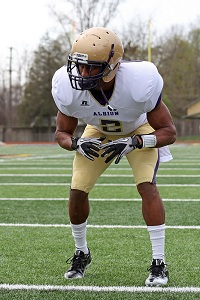
Greenwood, a 6-foot-1, 193-pound cornerback, is attempting the rare jump from Division III college football to the NFL. A standout at Albion College, he was selected in the fifth round of last month's NFL draft by the Detroit Lions.
His round-trip travels from his hometown and back again also included a stop at Northwood University. Greenwood played his final three college seasons for the Britons, last fall being named the Michigan Intercollegiate Athletic Association Defensive Player of the Year.
What is your favorite high school memory?
Winning the city championship senior year at Ford Field.
Were there any life/football lessons that you learned in high school that you’ve carried with you through college and now to the league?
Work hard; don’t let anything distract you. You are capable of doing anything that you put your mind to, and then some.
What is the biggest transition you’ve seen from DIII football at Albion to the Lions?
The talent difference I’ve had to get acclimated to, as well as technique. Technique has a much heavier emphasis now. I’ve also noticed a difference in speed and different terminology. For example, simple names for coverages have changed.
If you could trade places with anyone in the world right now, who would it be?
Nobody! I feel like I am in the best position possible. I’m living the dream.
What advice would you give to aspiring athletes who want to make the jump from high school to college? College to professional?
Never give up. Don’t ever quit. Don’t let anybody tell you that you can’t do something. If you work hard and have the ability, they will find you.
 What wide receiver tested you most to get to where you are at today?
My older brother (Doug Greenwood); growing up he was always stronger. We used to play, just him and I. He was pretty good. I had to figure out what way I was going to cover him because he was that much faster and stronger. This all took place just in the backyard or the park.
Would you say that your past at a Division III college has helped or hurt you more in the transition from college to professional ball?
It didn’t hurt, as far as what I have to do and what I’m doing now (in practice or off the field), but I feel like it affected my draft position. I could have gotten more exposure at bigger schools. At this point none of that matters; I’m glad to be where I am. Very happy.
Who was your favorite football player growing up?
Charles Woodson (former University of Michigan and current Green Bay Packers cornerback)
Is Donald Driver (Packers WR) more or less intimidating now that he has won "Dancing with the Stars?" If asked, would you be on "Dancing with the Stars?"
No way, he is not more intimidating because of that. If I were asked to do that, I wouldn’t right now. Maybe later on in my career I would do that, but right now I've got to stay focused.
PHOTOS courtesy of Albion College. Note about the interviewer: Brian Spencer is an MHSAA intern this summer, and was an Albion College football teammate of Greenwood's the last three seasons.

NFHS Voice: Football Continues to Thrive
September 25, 2019
By Karissa Niehoff
NFHS Executive Director
When the annual High School Athletics Participation Survey was released by the National Federation of State High School Associations (NFHS) in August, many headlines across the country focused on the drop in the number of boys playing 11-player football. After all, the report showed 30,829 fewer participants than the year before. However, perhaps the most important number was overlooked – 14,247.
Yes, 14,247, the number of high schools with 11-player football teams. While there was a slight decline in the number of participants in many states, the number of schools sponsoring the sport was the highest in five years. In fact, the number of schools last year with 11-player teams has only been topped twice in the survey’s history – 14,262 in 2013-14 and 14,279 in 2010-11.
In addition, smaller schools in some states have shifted to 6-player, 8-player and 9-player football and have had good responses. The survey indicates an additional 156 schools and 1,594 participants involved in these alternate forms of the sport; and, in the past 10 years, participation by girls in 11-player football has doubled, with more than 2,400 participants this past year.
These numbers express the desire by high schools to keep alive one of the oldest and most treasured traditions in our nation – Friday Night Football Under the Lights. Although there are many options today for the entertainment dollar, nothing surpasses supporting the local high school football team on Friday nights. The No. 1 fan base in America? The answer is that number again – 14,247.
In Week 2 of the National Football League season, just under 1.1 million fans attended the 16 games. While impressive, it doesn’t come close to the number of fans who watched high school football during the corresponding week. It’s all in that number – 14,247.
With approximately 7,123 games every Friday night (14,247 divided by 2), and with a conservative estimate of 1,000 fans per game, there are more than 7 million fans in high school football stadiums every week. An unofficial attendance survey conducted by the NFHS in 2011 indicated about 165 million fans attended high school football games during that season, which included up to five weeks of playoffs and a weekly average of 11 million fans. Either way, the number of fans at high school football games dwarfs the numbers attending professional football games.
Early season crowds have been strong in many areas of the country with terrific fall weather – filled by current and former students; parents, grandparents and friends of players on the team; and longtime fans and supporters in the community. Unlike crowds at the college and professional levels where fans have little, if any, identity with the players, there is a connection between the players and fans at the high school level.
With concussion protocols and laws in place in every state, with a reduction in contact levels before the season and during practices, and with teaching of proper tackling skills at lower levels, we believe people, including parents of high school student-athletes, are seeing and believing that the sport of football at the high school level is as safe as it ever has been.
We urge you to support your local high school football team this Friday night.
Dr. Karissa L. Niehoff is in her second year as executive director of the National Federation of State High School Associations (NFHS) in Indianapolis, Indiana. She is the first female to head the national leadership organization for high school athletics and performing arts activities and the sixth full-time executive director of the NFHS, which celebrated its 100th year of service during the 2018-19 school year. She previously was executive director of the Connecticut Association of Schools-Connecticut Interscholastic Athletic Conference for seven years.