


MHSA(Q&)A: Football Coaches Jim Ahern and Brad Weber
August 31, 2012
 Pewamo-Westphalia football coach Brad Weber and Lansing Catholic's Jim Ahern had experienced plenty of success long before the end of last season.
But this month marked the first time either had returned to the sideline after a trip to the MHSAA Finals.
Their teams faced off on opening night at Holt Junior High, the Cougars' home field. Gone were Lansing Catholic's all-state quarterback-receiver tandem that helped the Cougars finish Division 5 runner-up last fall, as well as the large group of standout se niors who guided the Pirates to the Division 7 Final.
 But the coaches are back for more, and we caught up briefly with both after Lansing Catholic's 45-21 win. (Lansing Catholic fell to 1-1 this week with a loss at Saginaw Nouvel, while P-W improved to 1-1 with a win over Potterville.)
This has to be the most unfamiliar group you've had at Lansing Catholic?
Ahern: They're a good group from the standpoint that they have a lot of team chemistry. They're a close-knit group, and they've worked extremely hard in the offseason. I know every coach says that. But this, probably of all the groups I've had, has really worked hard. We were a little nervous. We had a lot of kids playing in spots where they hadn't been there, but they settled down a little bit.
Have the players approached things differently because of how you ended up last year?
Weber: A little bit. But it's still football, and they've been playing football since sixth grade. It shouldn't be too different.
Are you (as a coach) approaching some things differently?
Weber: Yes and no. We're still getting down to business. Practices are the same. We still have a lot of energy at practice. But you do. You're looking for a little bit of the senior leadership to step up because it was so good last year. These guys kinda took it for granted, and they rode on their coat tails, and it's time for them to step up and be leaders of this team. It's 2012 now.
Ahern: Not really. Every year I tell everyone the same thing. Our goal is to win the league. If we do that, good things will happen. That's our goal -- to win the conference. ... We're still running the same stuff pretty much. We haven't changed a whole lot.
Do you have to say things to certain guys who are replacing (all-staters), like 'Do you know what you're stepping into?'"
Ahern: You don't have to remind them about it. They know it. They don't need to hear it. I think that's why they work so hard in the offseason. The bar's set pretty high for them, so they want to continue that.
Warriors Continue Fight Against Cancer
September 26, 2014
By Geoff Kimmerly
Second Half editor
An exemplary effort that has raised more than $200,000 for cancer research and awareness will continue tonight at Walled Lake Western when the Warriors take on Waterford Mott in its annual “Warriors for Warriors” game.
This is the fourth season Western has hosted the event, which benefits the Susan G. Komen Detroit Race for the Cure, St. Baldrick’s Foundation for Pediatric Cancer and the American Cancer Society. Fans will be wearing pink shirts designed for the event, with more than 1,000 sold as of two weeks ago.
Last fall, “Warriors for Warriors” was recognized by the NFL and featured in a 30-second commercial shown during NFL football games, and the team was hosted and honored by the Detroit Lions (see below).
“We continue to be grateful for the selfless dedication of parents, staff members, community members and all of the countless volunteers who support the fourth annual Pink Out effort,” Walled Lake superintendent Kenneth Gutman said. “Breast cancer and all cancers continue to challenge thousands of people, and we will continue to work together to eradicate it.”
A “Warriors’ Survivors Parade” will kick off the event at 6 p.m. and include patients, survivors and others who wish to honor those who are fighting or have died after battling cancer of any form. The parade will continue into the stadium.
Prior to the 7:30 p.m. kickoff, Western’s players, wearing pink jerseys sponsored in honor of those who have fought the disease, will line the field from end zone to end zone with jersey honorees and their families. More than 170 people have been honored during the first three years of the event.
The game’s honorary captain is Commerce Elementary fifth-grader Sydney Balzer, who has fought leukemia twice and founded a community service project, Colors for Cancer Kids.
For information, click for the Warriors for Warriors website and follow the effort on Twitter @WLW_W4W.
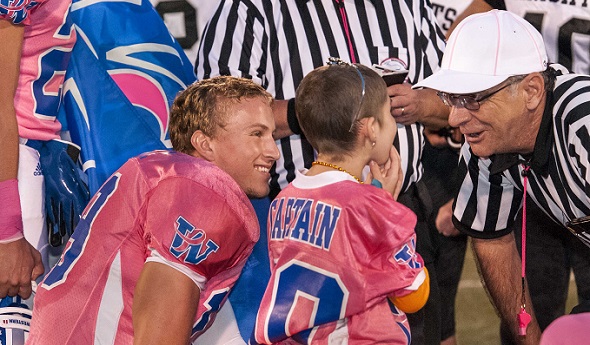
PHOTO: Walled Lake Western’s Kyle Bambard and 7-year-old Akayla Hodgins call the coin flip during the 2013 Warriors for Warriors game.