


MHSA(Q&)A: Football Coaches Jim Ahern and Brad Weber
August 31, 2012
 Pewamo-Westphalia football coach Brad Weber and Lansing Catholic's Jim Ahern had experienced plenty of success long before the end of last season.
But this month marked the first time either had returned to the sideline after a trip to the MHSAA Finals.
Their teams faced off on opening night at Holt Junior High, the Cougars' home field. Gone were Lansing Catholic's all-state quarterback-receiver tandem that helped the Cougars finish Division 5 runner-up last fall, as well as the large group of standout se niors who guided the Pirates to the Division 7 Final.
 But the coaches are back for more, and we caught up briefly with both after Lansing Catholic's 45-21 win. (Lansing Catholic fell to 1-1 this week with a loss at Saginaw Nouvel, while P-W improved to 1-1 with a win over Potterville.)
This has to be the most unfamiliar group you've had at Lansing Catholic?
Ahern: They're a good group from the standpoint that they have a lot of team chemistry. They're a close-knit group, and they've worked extremely hard in the offseason. I know every coach says that. But this, probably of all the groups I've had, has really worked hard. We were a little nervous. We had a lot of kids playing in spots where they hadn't been there, but they settled down a little bit.
Have the players approached things differently because of how you ended up last year?
Weber: A little bit. But it's still football, and they've been playing football since sixth grade. It shouldn't be too different.
Are you (as a coach) approaching some things differently?
Weber: Yes and no. We're still getting down to business. Practices are the same. We still have a lot of energy at practice. But you do. You're looking for a little bit of the senior leadership to step up because it was so good last year. These guys kinda took it for granted, and they rode on their coat tails, and it's time for them to step up and be leaders of this team. It's 2012 now.
Ahern: Not really. Every year I tell everyone the same thing. Our goal is to win the league. If we do that, good things will happen. That's our goal -- to win the conference. ... We're still running the same stuff pretty much. We haven't changed a whole lot.
Do you have to say things to certain guys who are replacing (all-staters), like 'Do you know what you're stepping into?'"
Ahern: You don't have to remind them about it. They know it. They don't need to hear it. I think that's why they work so hard in the offseason. The bar's set pretty high for them, so they want to continue that.
Drive for Detroit: Week 2 in Review
September 11, 2013
By Geoff Kimmerly
Second Half editor
The definition for "rivalry game" has grown pretty broad over the history of high school athletics.
Some are considered rivalry games based purely on the fact they've been played for years. Others have been around for only a few, but the competition has become so fierce that it's the first date circled when schedules are printed each fall. Both include the intensity, anticipation and excitement that generally bring a few more casual fans to the bleachers on Friday night.
Some of Michigan's best rivalry games are among the most notable results from Week 2.
West Michigan
Zeeland East 50, Zeeland West 44 (OT)
This is shaping up as one of the best football rivalries in the state, with three of the last four games decided by eight points or fewer and East — last season’s regular-season winner — then losing to West 46-0 in their playoff opener. East has the upper hand again between schools separated by mere yards. Click to read more from the Grand Rapids Press.
Also noted:
Muskegon 35, Grand Rapids Christian 13: This would’ve been the best game on the west side any other week with the reigning MHSAA Division 2 runner-up Big Reds (2-0) continuing to look impressive in knocking off the reigning Division 3 champ Christian (1-1) in their first matchup since 1994.
Comstock Park 39, Grand Rapids West Catholic 20: West Catholic (0-2) won the first five games of these teams’ recent series before Comstock Park (2-0) got on the board last week.
Hamilton 21, Coopersville 20: A blocked extra point saved this win for the Hawkeyes (1-1) while dropping the Broncos to 0-2.
Grand Rapids Catholic Central 16, Muskegon Catholic Central 13: These teams brought this series back last season after a seven-year break, and the Cougars (1-1) have won both while this time dropping the Crusaders to 0-2.
Greater Detroit
Detroit U-D Jesuit 28, Detroit Country Day 27 (OT)
In part because it plays in a Detroit Catholic League Central with Orchard Lake St. Mary’s, Detroit Catholic Central, Birmingham Brother Rice and Warren DeLaSalle, U-D Jesuit has had some tough seasons over the last decade; its last playoff appearance was in 2000. But this win over the reigning Division 4 runner-up Yellowjackets (0-2) made the Cubs 2-0 — equaling last season’s win total — and could be an indication of more to come. Click to read more from MLive Detroit.
Also noted:
Belleville 17, Chelsea 14: The Tigers (1-1) are seeking their first playoff berth since 2004, and beating annual qualifier Chelsea (0-2) is a great start.
Detroit Martin Luther King 6, Detroit East English 0 (2 OT): King (2-0) and East English (0-2) — formerly Crockett — are always two of the best teams in the city, and this might go down as the best regular-season game before the Public School League playoffs.
Farmington Hills Harrison 20, Rochester Adams 7: Harrison (2-0) made it four straight over Oakland Activities Association White rival Adams (1-1).
Plymouth 28, Milford 27: The Wildcats (2-0) came back from a two-touchdown deficit early in the third quarter to edge Milford (1-1).
Southwest and Border
Schoolcraft 37, Constantine 28
This was only the second week of nine on the Kalamazoo Valley Association schedule, but the league title could again be Schoolcraft’s to lose after this win over reigning Division 6 runner-up Constantine (1-1). A 47-yard touchdown pass after a Constantine turnover sealed the victory for the Eagles (2-0). Click to read more from the Kalamazoo Gazette.
Also noted:
Kalamazoo Central 23, Battle Creek Central 7: The 110th meeting in one of the nation’s longest football rivalries saw Kalamazoo Central (2-0) climb within 12 (47 wins to 59) of catching up to the Bearcats (1-1 this season) for the series lead. This game played for the Totem Pole traveling trophy dates to 1893.
St. Joseph 14, Battle Creek Harper Creek 9: After missing the playoffs for the first time in seven seasons in 2012, St. Joseph is 2-0 after handing a first loss to back-to-back MHSAA Semifinalist Harper Creek.
Mattawan 64, Marshall 34: The Wildcats (1-1) awakened on offense after scoring only once on opening night; Marshall also upped its offensive output by 20 despite falling to 0-2.
Plainwell 14, Three Rivers 7: They’re not in the same division of the Wolverine Conference anymore, but Plainwell (2-0) made it three straight over the Wildcats (1-1).
Lower Up North
Maple City Glen Lake 28, Charlevoix 0
A big win by Charlevoix (1-1) over St. Ignace on opening night made this one look like a potential nail-biter. But Glen Lake (2-0) made it three in a row and two straight shutouts over the Rayders, and this week starts its pursuit of a second straight Northwest Conference championship. Click to read more from the Petoskey News.
Also noted:
Boyne City 35, Kent City 14: After a tough opening-night loss to Glen Lake, Boyne City (1-1) bounced back against the Eagles (1-1).
Standish-Sterling 47, Gladwin 7: The Panthers (2-0) made it 10 straight over Gladwin after also beating the Flying G’s (1-1) in last season’s playoff opener.
Harbor Springs 40, Frankfort 12: The Rams (2-0) pulled within a win of last season’s total while dropping the Panthers to 1-1 as they try to make up for last year’s first playoff miss since 1994.
Traverse City West 21, West Branch Ogemaw Heights 8: The Titans (1-1) got a leg up by winning their Big North Conference opener while also avenging last season’s 56-39 loss to Ogemaw Heights (1-1).
Upper Peninsula
Houghton 26, Ishpeming Westwood 20 (2 OT)
Not only did Westwood (0-2) own two straight wins over Houghton before last weekend, but the Patriots won those games by a combined score of 70-0. They led again this time by two touchdowns early before the Gremlins (1-1) came back to claim their first victory this fall and pull within one more of equaling their victory total of all 2012. Click to read more from the Marquette Mining Journal.
Also noted:
Iron Mountain 27, Gwinn 8: Iron Mountain (1-1) bounced back from an opening-night loss; Gwinn (1-1), despite this loss, played the Mountaineers much closer than the last two seasons.
St. Ignace 26, Mancelona 20 (OT): After their first opening-night loss in four seasons, the Saints (1-1) bounced back while dropping Mancelona to 0-2 after the Ironmen lost just once in 2012.
Ishpeming 38, Manistique 0: The Hematites (2-0) have outscored their first two opponents, both 2012 playoff teams, by a combined 74-0. Have no fear Emeralds: You also started last fall 0-2 but made the postseason.
Powers North Central 14, Munising 12: Munising (0-2) no doubt is smarting after losing its first two games by a combined nine points, but the Jets surely are celebrating their second straight 2-0 start.
Mid-Michigan
Lansing Everett 48, Saginaw 14
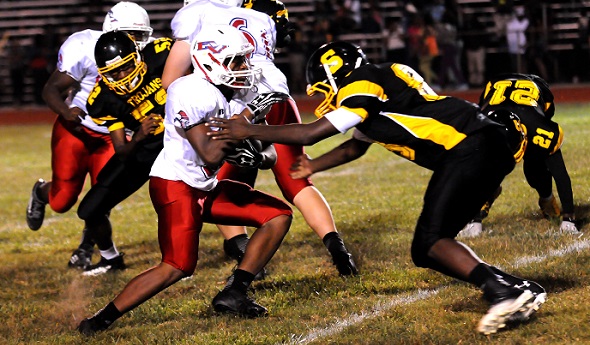
Five Capital Area Activities Conference Blue teams left Greater Lansing for Week 2 games, but only the Vikings (2-0) returned with a victory. Everett’s offense has scored 83 points so far and looks even better than last season’s best effort in four seasons. Saginaw did struggle to keep up this time, but is 1-1 entering Saginaw Valley Association North play this week.
Bath 40, Fulton 22: For a Bees (1-1) team that hasn’t made the playoffs since 2000, a second straight win over traditionally powerful Fulton has to be encouraging. The Pirates (1-1) also are looking to climb back into the playoffs after missing in 2012.
Fowler 26, Laingsburg 12: This has been one the best Central Michigan Athletic Conference games for a decade; Fowler (1-1) enjoyed a nice bounce-back after a loss to Mendon on opening night, but the Wolfpack finds itself in a recently-rare 0-2 spot.
Beal City 48, Clare 0: This was expected to be much closer, but Beal City (2-0) might just be this strong. The Aggies have now outscored their first two opponents by a combined 109-0 while Clare is 0-2 again although it ended up 9-3 with the same start in 2012.
St. Johns 28, Dearborn 13: The Redwings (1-1) followed up a lackluster opening-night loss to Charlotte with an impressive win over a playoff regular in Dearborn (0-2).
Bay and Thumb
Essexville-Garber 25, Millington 6
The Saginaw News called this a “program-defining” win for Garber, and it might’ve been the team’s biggest in the Tri-Valley Conference East since also beating the Cardinals in 2009. The Dukes (2-0) broke a two-season playoff hiatus last fall, and this season could be league title contenders as well — although the Cardinals (1-1) certainly shouldn’t be expected to fall out of the mix. Click to read more from the Saginaw News.
Mount Pleasant 21, Flint Powers Catholic 14: The Oilers (1-1) had a rare struggle in 2012 and opened this fall with a loss to DeWitt, but got back on the right foot by beating recently powerful Powers (1-1).
Fenton 43, Adrian 7: The Tigers (2-0) continued to roll after a rivalry win over Linden in Week 1; Adrian fell to 1-1 but 0-2 versus Fenton over the last two seasons.
Flint Carman-Ainsworth 49, Saginaw Heritage 20: Carman-Ainsworth (2-0) enhanced its status as a Saginaw Valley South favorite by knocking off a solid Hawks team (1-1).
Richmond 28, Croswell-Lexington 21: The Pioneers (1-1) had beaten Richmond (1-1) in six straight including a second time last season during the playoffs.
Trophy Games
Each week the MHSAA highlights trophy games played across the state. One was mentioned above, and we also knew about this one heading into the weekend.
Promise Bowl Trophy: Jackson High and Lumen Christi began playing for this prize a year ago, and the Titans own both matchups so far. Final: Lumen Christi 43, Jackson 14.
PHOTO: Lansing Everett (white jerseys) improved to 2-0 with last week's win on the road against Saginaw High. (Click to see more from High School Sports Scene.)