


MHSA(Q&)A: Mendon football coach John Schwartz
February 2, 2012
 John Schwartz didn’t really want the Mendon football head coaching job when a group of players convinced him to take it before the 1989 season. And his first contract started out on a napkin. The rest is history.
Mendon won its 11th MHSAA football championship this fall, downing Fowler 33-0 in the Division 8 Final, to tie for third-most football titles won by one program. Schwartz has coached in the program for all 11, including 10 as head coach, and his record of 236-39 gives him a winning percentage of .858, tops in the MHSAA record book. He recently was selected as this year’s recipient of the high school Duffy Daugherty Award, annually given for career contributions to the game. He follows recent winners Ralph Munger of Rockford and Herb Brogan of Jackson Lumen Christi.
His Mendon teams have had just one losing season. And although he retired a year ago after 36 teaching middle school science, and then fought off cancer over the summer, he has no plans to leave his post on the Hornets’ sideline.
How would you characterize your program?
I think we have very good coaches and I think the kids respect the coaches, and they know the coaches think more of them than just being football players. They care about them. We have their attention, and what we really try to do is form a team concept as soon as we can. We try to stay away from giving any one person too much recognition. We don't give out MVP awards at the end of the year. It's a program where we're all in it together: coaches, kids and community. We try to get the best out of the kids, give the kids the best shot we have at being the best we can be.
How does a small school continue to reload every season?
My first year there, the first thing I did as a head coach was I started the junior high program. I think that's where everything starts. We even have the younger kids called the rocket kids, and those coaches come in and talk about (football) terms so when kids move from one level to another there's no re-teaching. Everyone has an ego, coaches have egos, and they like to do some things differently. But we don't have that. They do what we do. We give them a lot of flexibility, but we have certain drills we want to run. By the time we get them, these kids are in tune with what we are doing. The summer program also is something I started my first year as head coach too. ... It means that during the season we can concentrate more on teaching than conditioning.
You went from 3-6 in 2006 to 12-0 in 2007. Explain how you bounced back.
The losing season we had, we didn't have a lot of kids, and our two best kids were hurt early in the season and couldn't play. We never did bounce back. Even in that season, we were ahead at halftime in all but one game. We just didn't have enough to come back and pull the game out, and we had some very tough games. It wasn't a good season, but I thought those kids played awfully hard for what we had. We got a lot of experience, and it paid off the following year.
Our JVs practice with the varsity. When I work with inside linebackers, I work with (grades) 9-12. Kids learn quicker from kids than from coaches, as far as I'm concerned. ... Football's really changed. It's become a lot more complex. I think we have to delegate more and more every year so we can stay with the changes. It's too much for one person. I remember my first three, four or five years it was just three of us at the varsity level. The other two, neither one taught at the school. We were pretty successful right off the bat, and we started getting more and more interest from people. Now 9-12 we have seven coaches, and we have three at the junior high, and all the coaches but two have played for me. They know what I expect, what I'm looking for, what I want. ... And they want to win. I'd be lost without those guys.
Are there certain seasons that have meant more than others?
The first year I took the job, in 1989, we went undefeated and won a state title. A lot of those kids are very good friends of mine yet, and they're pretty special to me. They were a big boost to my program. In the '95 year, my son was a sophomore on that state title team. I remember a lot about that team.
They all have something they did very well. They either threw the ball well or played great defense or had a big line. When I hear a year now, I think about those teams.
You grew up in a small town (Colon) and have taught and coached in a small town. Was that important for you to do?
I've never taught anywhere else. I never felt I really had a reason to leave. I've gone through at least six superintendents since I've been there. The fourth or fifth said to me, "The only thing that bothers me about Mendon is these people think an awful lot of winning. There are other things." He asked me, "How do you feel about it?" I said, if they didn't feel that way, I wouldn't be here.
Who was your biggest coaching influence?
I would say Morley (Fraser, Jr., under whom Schwartz was an assistant for three seasons). Years before I got there, Mendon was pretty good in the early 70s, and then in the mid 70s football wasn't very good. I was the JV coach the first year, and the second year after two games they brought me up to varsity. The best thing I did was I told them I would not take the head job, but I'll assist. I knew (Fraser) was the kind of person and personality we needed there. It wasn't necessarily all of his football knowledge, but his energy and excitement that he brought to the game.
You said during the Finals postgame press conference that you'd battled cancer during the summer. How did you come back, and did you ever think that might be time to step down?
Everything's fine. I had coaches that took over. At the same time that that happened, I was retiring. If you retire in Michigan, you can't be at the school for one month. So I couldn't be at summer weights all the way through June. So my coaches did all the summer weights. But I had no intention of stepping down. If something (bad) came down ... but once they said they got it, everything went as normal.
After a championship season, how do you ramp things back up for the next fall and a new group of players?
When we go to the playoffs, we take all the JVs unless there are couple who don't want to go. They experience that and get an extra five weeks of practice if we win a state title. And they're excited about it. They want to do that. They’ve' tasted it, and they want a part of that the next year. We remind them it's not what you did, it's what can you do for me now. ... This is your year.
We talk about winning state championships from day one. A lot of people say we shouldn't do that, but why not? Isn't that the ultimate goal? I can't imagine telling a team we think we could be 7-2 this year. We expect to be 9-0 every year. Of course, that's not going to happen. But at same time, I think the losses make you better the following week. We've won state titles where we haven't won the league title. ... You get better.
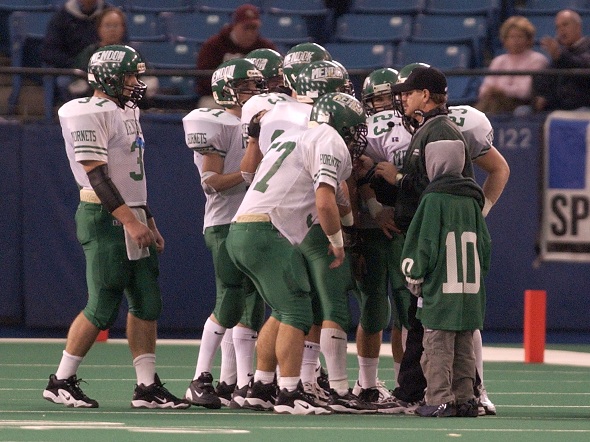
PHOTO: Mendon coach John Schwartz talks things over with his players during the Hornets' 21-14 win over Decatur in the 2002 Division 7 Final at the Pontiac Silverdome.
Everett 'family' sticks together, wins together
October 19, 2012
By Geoff Kimmerly
Second Half editor
At the end of Thursday’s practice, another chance at history only 24 hours away, Lansing Everett’s football team met for a players-only “family meeting” in the shadow of Archie Ross Stadium’s high concrete bowl.
These brief night-before-game gatherings have become a staple of the Vikings’ best season in more than a quarter century.
With seniors Jaleel Canty and James Mills leading, the players discuss expectations for the team as a whole and each other individually.
This is what was missing two seasons ago when Everett, with 16 of these players on the roster, finished 0-9. The transformation began to take root last fall as the Vikings finished 4-5. Tonight, they can end the regular season 9-0.
“We knew what we could do. We knew our abilities. We’ve known each other since sixth or seventh grade,” Canty said. “We knew that all it took was a little hard work. Everyone dedicated themselves, and we stuck together.
“Honestly, I think it’s because we’re like brothers. We say ‘family’ when we break the huddle, and everyone on this team loves each other. We argue, we fight all the time, but we love each other. We always stick together.”
Everett gets a Second Half High 5 this week because it's one of the top football teams in the state, but also for pulling off a tremendous turnaround – and against a schedule this fall that included annual powerhouses Grand Ledge, Holt, Lansing Sexton, East Lansing and nonleague foe DeWitt.
The Vikings have outscored opponents by a combined 234-64, after being outscored 223-102 during that winless season of 2010. Four this year's seniors joined the varsity as freshmen in 2009, and 15 plus junior quarterback Lucas Barner played significant roles on that winless squad.
History, recent and ancient
Don’t try to stump the Vikings on their family history. They’ve already scoured the Internet to figure out the context of what they’ve accomplished so far – and the meanings behind two important dates:
1986 – The last season, before this fall, that the Vikings won a league championship. The clinched a share of the Capital Area Activities Conference Blue title by beating Sexton last week, and can win it outright tonight at Jackson.
1954 – The last season Everett finished the regular season without a loss, although Canty was quick to point out that team played only eight games. His can finish 9-0.
“They’re excited. They know they’re doing something – or they’re close to doing something,” coach Marcelle Carruthers said.
“We wanted to know if we could make history,” Canty added. “It’s really crazy, seeing where we came from.”
Carruthers said only a handful of players are familiar with the stars that led to Everett’s resurgence last decade – like quarterbacks Mike Canfield and Reggie Williams and receiver Michael Stevenson.
But none are old enough to remember what Carruthers tackled when he took over the struggling program in the spring of 2000.
The streak
From opening night 1995 until Sept. 17, 1999, Everett didn’t win a game. The streak reached 39 losses, and in eight of them the Vikings didn’t score.
Coach Fred Ford shepherded Everett as it finally won that September night and then the next week too before closing 1999 with four more losses. A mission accomplished, he stepped down after the fall – and was at the press conference to greet Carruthers, considered by many the best quarterback and perhaps best player ever from the Lansing area.
Three more losing seasons followed, running that streak to 16 in a row. But the Vikings were making visible strides. Finally, they broke through with a 6-4 finish in 2003 that included the first of four playoff appearances over six seasons before having to hit the restart button again with a 2-7 record in 2009.
As mentioned above, four of these seniors played on that team as freshmen. They were joined by 11 more classmates and Barner among underclassmen in 2010. The record turned ugly, but the experience resulted in 19 returning starters heading into 2011. Everett finished last season 4-5, but with two losses by a combined eight points. Those taught the players what was necessary to finish a winning effort.
“You're always aware of where you came from, and how good it feels now,” said Carruthers, a Lansing Eastern grad who then played and coached at Central Michigan. “But you also have to know the trials and tribulations too, which makes you humble. You appreciate it and you stay humble because you know how (difficult) it is to stay up; you can go right back down.
“So I think about it all the time. I do.”
More to accomplish
Carruthers told his players Thursday how proud of them he is for sticking together and sticking it out.
That often doesn’t happen when programs hit bumps in the road like Everett did the last three years. Players quit, or move to other schools, or keep playing but keep struggling.
But this team always had talent. Canty, a receiver and defensive back, will sign this winter to play next fall at the University of Cincinnati. He's just one of a large group of standouts with Mills, Barner and running back/linebacker Anthony White other names that have been written and said frequently this fall. Senior Alec Cambric has been a pleasant surprise in his first season with the team, emerging as one of the Lansing area’s top running backs.
Regardless of what happens tonight, Everett will make its sixth playoff appearance ever next week. The Vikings have won playoff games only twice, and have never advanced beyond the District Final.
So there are more goals to achieve. And be sure those will be discussed at the next family meeting, as a large group of players who grew up together look to make history one more time.
“We aren’t having any of that playing around, any of that joking. We’re taking it real seriously,” Canty said. “And that’s one of the things we didn’t have our sophomore year when we went 0-9, someone to push us and let us know what we needed to do. And we’ve been there before, as far as losing.
“But we haven’t been here before. This is a first.”
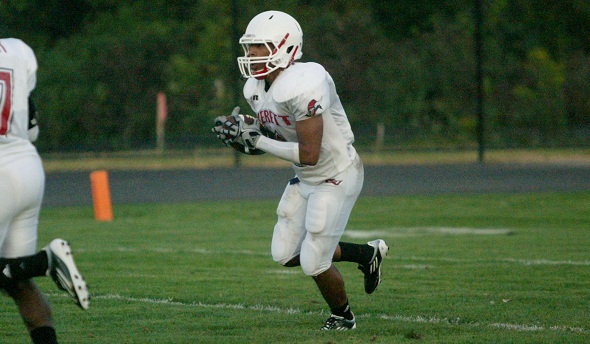
PHOTO: Lansing Everett's Jaleel Canty will sign this winter with the University of Cincinnati and is arguably the top player in the Lansing area this fall. (Click to see more from HighSchoolSportsScene.com).