


MHSA(Q&)A: Mendon football coach John Schwartz
February 2, 2012
 John Schwartz didn’t really want the Mendon football head coaching job when a group of players convinced him to take it before the 1989 season. And his first contract started out on a napkin. The rest is history.
Mendon won its 11th MHSAA football championship this fall, downing Fowler 33-0 in the Division 8 Final, to tie for third-most football titles won by one program. Schwartz has coached in the program for all 11, including 10 as head coach, and his record of 236-39 gives him a winning percentage of .858, tops in the MHSAA record book. He recently was selected as this year’s recipient of the high school Duffy Daugherty Award, annually given for career contributions to the game. He follows recent winners Ralph Munger of Rockford and Herb Brogan of Jackson Lumen Christi.
His Mendon teams have had just one losing season. And although he retired a year ago after 36 teaching middle school science, and then fought off cancer over the summer, he has no plans to leave his post on the Hornets’ sideline.
How would you characterize your program?
I think we have very good coaches and I think the kids respect the coaches, and they know the coaches think more of them than just being football players. They care about them. We have their attention, and what we really try to do is form a team concept as soon as we can. We try to stay away from giving any one person too much recognition. We don't give out MVP awards at the end of the year. It's a program where we're all in it together: coaches, kids and community. We try to get the best out of the kids, give the kids the best shot we have at being the best we can be.
How does a small school continue to reload every season?
My first year there, the first thing I did as a head coach was I started the junior high program. I think that's where everything starts. We even have the younger kids called the rocket kids, and those coaches come in and talk about (football) terms so when kids move from one level to another there's no re-teaching. Everyone has an ego, coaches have egos, and they like to do some things differently. But we don't have that. They do what we do. We give them a lot of flexibility, but we have certain drills we want to run. By the time we get them, these kids are in tune with what we are doing. The summer program also is something I started my first year as head coach too. ... It means that during the season we can concentrate more on teaching than conditioning.
You went from 3-6 in 2006 to 12-0 in 2007. Explain how you bounced back.
The losing season we had, we didn't have a lot of kids, and our two best kids were hurt early in the season and couldn't play. We never did bounce back. Even in that season, we were ahead at halftime in all but one game. We just didn't have enough to come back and pull the game out, and we had some very tough games. It wasn't a good season, but I thought those kids played awfully hard for what we had. We got a lot of experience, and it paid off the following year.
Our JVs practice with the varsity. When I work with inside linebackers, I work with (grades) 9-12. Kids learn quicker from kids than from coaches, as far as I'm concerned. ... Football's really changed. It's become a lot more complex. I think we have to delegate more and more every year so we can stay with the changes. It's too much for one person. I remember my first three, four or five years it was just three of us at the varsity level. The other two, neither one taught at the school. We were pretty successful right off the bat, and we started getting more and more interest from people. Now 9-12 we have seven coaches, and we have three at the junior high, and all the coaches but two have played for me. They know what I expect, what I'm looking for, what I want. ... And they want to win. I'd be lost without those guys.
Are there certain seasons that have meant more than others?
The first year I took the job, in 1989, we went undefeated and won a state title. A lot of those kids are very good friends of mine yet, and they're pretty special to me. They were a big boost to my program. In the '95 year, my son was a sophomore on that state title team. I remember a lot about that team.
They all have something they did very well. They either threw the ball well or played great defense or had a big line. When I hear a year now, I think about those teams.
You grew up in a small town (Colon) and have taught and coached in a small town. Was that important for you to do?
I've never taught anywhere else. I never felt I really had a reason to leave. I've gone through at least six superintendents since I've been there. The fourth or fifth said to me, "The only thing that bothers me about Mendon is these people think an awful lot of winning. There are other things." He asked me, "How do you feel about it?" I said, if they didn't feel that way, I wouldn't be here.
Who was your biggest coaching influence?
I would say Morley (Fraser, Jr., under whom Schwartz was an assistant for three seasons). Years before I got there, Mendon was pretty good in the early 70s, and then in the mid 70s football wasn't very good. I was the JV coach the first year, and the second year after two games they brought me up to varsity. The best thing I did was I told them I would not take the head job, but I'll assist. I knew (Fraser) was the kind of person and personality we needed there. It wasn't necessarily all of his football knowledge, but his energy and excitement that he brought to the game.
You said during the Finals postgame press conference that you'd battled cancer during the summer. How did you come back, and did you ever think that might be time to step down?
Everything's fine. I had coaches that took over. At the same time that that happened, I was retiring. If you retire in Michigan, you can't be at the school for one month. So I couldn't be at summer weights all the way through June. So my coaches did all the summer weights. But I had no intention of stepping down. If something (bad) came down ... but once they said they got it, everything went as normal.
After a championship season, how do you ramp things back up for the next fall and a new group of players?
When we go to the playoffs, we take all the JVs unless there are couple who don't want to go. They experience that and get an extra five weeks of practice if we win a state title. And they're excited about it. They want to do that. They’ve' tasted it, and they want a part of that the next year. We remind them it's not what you did, it's what can you do for me now. ... This is your year.
We talk about winning state championships from day one. A lot of people say we shouldn't do that, but why not? Isn't that the ultimate goal? I can't imagine telling a team we think we could be 7-2 this year. We expect to be 9-0 every year. Of course, that's not going to happen. But at same time, I think the losses make you better the following week. We've won state titles where we haven't won the league title. ... You get better.
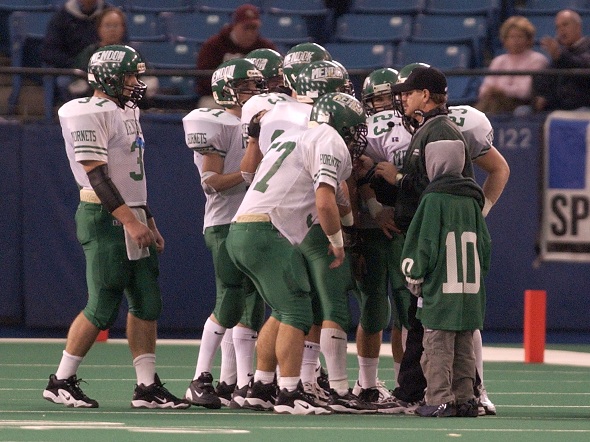
PHOTO: Mendon coach John Schwartz talks things over with his players during the Hornets' 21-14 win over Decatur in the 2002 Division 7 Final at the Pontiac Silverdome.

Summer Safety
August 28, 2012
As we have been considering changes for in-season football practice rules that are more in step with recent recommendations of the National Athletic Trainers Association, the American Academy of Pediatrics and the National Federation of State High School Associations, as well as the actions of several of our counterpart state organizations across the U.S., we have also been looking at the rules that apply out of season to assure they do not work against the preparation of students for a safe experience.
Except during the school’s designated summer dead period of at least seven consecutive days, football coaches may interact with any number of players in voluntary weight training and conditioning sessions as frequently as they desire. Introduce footballs and helmets, and the coach can still work with any number of students on the sideline and up to seven players at a time for any number of days. Add competition, and the coach can still work with up to seven players at a time for a maximum of seven days. In addition, football coaches may participate for a maximum of ten days at bona fide football camps where any number of their players are participating.
Plenty of time for coaches to teach, and even more time for players to train. During this time, the rules permit students to wear helmets, which protect against accidental collisions during drills; but the rules prohibit other pads that would allow activities to escalate to the point where contact is expected, leading to increased blows to the head at a time when the objective from the pros to Pop Warner is to reduce blows to the head.
When the brief preseason down time begins Aug. 1, the coach continues to be able to work with any number of players in conditioning and weight training. The down time prohibits those activities that could be a disguise for practice prior to the earliest allowed practice date – open gyms, camps, clinics and competition. The down time puts the emphasis where it’s most needed for a healthy student experience when practice actually begins: that’s weight training and conditioning.
Some critics may focus on what they can’t do in the summer; but clearly, there’s much they can do, and it’s all designed to help players improve and excel in a safe environment.