


MHSA(Q&)A: Menominee football coach Ken Hofer
June 28, 2012
By Brian Spencer
Second Half
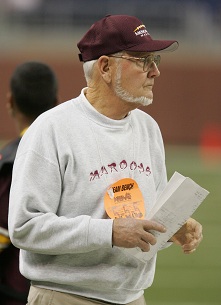
Ken Hofer has been nothing short of legendary during more than three decades as Menominee’s head football coach -- a tenure that came to an end earlier this month when he announced his retirement.
In 41 seasons -- including his first two, at Stephenson -- he won three MHSAA championships (1998, 2006, and 2007) and built a record of 342-136-3. He is one of nine coaches in MHSAA football history with at least 300 wins.
He guided more than a thousand athletes, and that influence extended to league rival Kingsford -- where his son Chris Hofer is the football coach. Ken also is known statewide as the guru of the single wing offense, a rarely-used but for the Maroons frequently unstoppable attack that does not utilize a traditional quarterback.
Hofer is a member of the Michigan High School Football Coaches Association and Upper Peninsula Sports Halls of Fame. He also served as the Menominee athletic director, principal, and assistant principal. He grew up in Stephenson, where he was an all-stater in football and track and field, and later competed in both sports at the University of Wisconsin.
Did you always want to become a football coach?
I was predicted to be a coach somewhere in our (Stephenson) annual (yearbook). So I suppose I was always predetermined to coach. However, before coaching I was in the service as a Lieutenant and spent two years in Germany. After Germany, I spent another five years working for Wilson Sporting Goods before I finally came back in 1964 to coach football and teach social studies for Stephenson.
How did you decide it was time to hang up the whistle?
Well, I’m 77 years old, so age was definitely a determinant. The biggest factor was that as much as my mind said I could continue, my body said “slow down.” So I guess age and my inability to continually go full throttle and stay energetic helped me make my decision.
In your 45 seasons, what is the most helpful piece of advice you are going to take away?
The best advice I will take away is to treat young people the way I like to be treated.
 What do you plan to do with your free time, now that your schedule has opened up slightly?
I am going to try and catch up on stuff that should have been done a long time ago. I’m sure that my wife will give me plenty of stuff to do, too. I also want to try to travel more and visit my kids. I now have a grandson who will be playing for Kingsford, so I will become a fan of my grandson’s at his Kingsford games.
Now that your grandson and son both have affiliations with Kingsford, will you become a Kingsford man?
No (chuckling), I will cheer for my son and grandson, but I will forever be connected with Menominee and Stephenson.
What was it like to be recognized by both the Michigan High School Football Coaches Association and Upper Peninsula Sports Halls of Fame?
It was like a utopia for coaching. When your peers give that honor it is a pretty special time. As a coach you don’t strive for that kind of accolade; however, it is definitely a special honor to receive.
What has been, in your opinion, your greatest achievement as Menominee’s head football coach?
My greatest achievement will always be working with younger people; I think that is the most important thing that most coaches would like to have, is the ability to stay young by working with these young men. You don’t always have to win to have that experience. Winning on the field doesn’t always correlate winning in other aspects of your life.
What advice can you give aspiring or current coaches who look to share similar successes as a head coach?
The biggest thing is to make sure that you treat the players like you like to be treated. Using that approach will get a great response.
Of your 300-plus career wins, is there any one that you find particularly special?
I always found that whenever I could beat Kingsford when my son was coaching (he said, followed by a bellowing laugh). My son Chris will like that one.
There are so many that I consider to be special. There were a ton of close games, too many to count. Two years ago, we had one of those close games where we played Morley-Stanwood, and won 41-40 in overtime (in a 2010 Regional Final). The young men played very hard. It was very special.
Do you think that your son will follow in your footsteps and coach for 45-plus seasons?
I think Chris has that type of coaching in his blood. He’s struggling physically with a knee injury; however he has a coaching mind that is as strong as ever. I think he’ll coach until he won’t be able to.
New Coach Takes Next Step at Escanaba
September 1, 2015
By Dennis Grall
Special for Second Half
ESCANABA – When school ended in early June, Dave Howes took a vacation trip to Florida and began thinking about his upcoming fourth season as junior varsity football coach at Escanaba High School.
Within a month he had become the school's varsity head coach, a position he had never thought about taking on.
 "To tell you the truth, I never wanted to be a head football coach," Howes said in the Eskymos’ lockerroom before the start of a recent practice. "It just kind of fell in my lap."
Escanaba had a 10-17 record over the last three seasons under previous coach Jim Hansen, who was dismissed in June, but opened this fall with a 21-7 win over Alpena on Thursday. The Eskymos travel to Petoskey on Friday.
When Howes was contacted about moving up from the jayvees, he said, "I had to make up my mind. Do I want it? It happened real fast. I wasn't expecting it. It just happened."
He was encouraged to apply by several people, including an Escanaba High School administrator, and was given the blessing of his wife, Holly, to pursue the position. He is the second coach in four years to direct the Eskymos, who during the previous 50 years had just two head coaches, Upper Peninsula Sports Hall of Fame inductees Jerry Cvengros and Dan Flynn.
When Howes first joined the Eskymos’ coaching staff in 2005, he said Flynn asked if he ever wanted to become the school's head coach. "I said, I don't know," said Howes. "I didn't envision it. Now I'm more than happy."
Howes said he has received excellent support from family, friends, players, coaches and the community during the short time he has been in charge.
"I want our fans to know that our kids are going to be competitive, and they are going to work hard. They will see there will be an edge about them," he said.
About 100 students came out for the three football levels, with 48 on varsity. Howes didn't have any preseason contact until after July 4, about a month behind the normal period. A big plus in the transition was all the previous assistant coaches stuck with the program, and they have all moved up a level in the process.
"They have all the kids they had in previous years, and we're running the same system," Howes said. "It has been an easy transition. Knowing the kids and knowing the coaches was easy. We had the same kids, the same coaches, the same philosophies. It's made practice easier."
 Athletic director Nick Nolde brought the coaches and players together and provided the introductions, which weren't really necessary because of the carry over. "It's been smooth sailing ever since," said Howes of the best-case scenario coming together.
Nolde said given the way "everything went down, it has been a seamless transition. He is familiar with the kids, and he is familiar with the program."
Howes is a native of neighboring Gladstone, graduating in 1993 and playing against Escanaba teams in football, basketball and baseball. "It's weird. As a kid, I hated Escanaba with a passion. Now, here I am," said Howes, whose older brother Dave is an assistant varsity coach with former Escanaba player Don Koish and former Gladstone athlete Jason Micheau.
"It is so funny how things happen," said Howes, who also coached subvarsity football in Gladstone and Beal City following his 1998 graduation from Northern Michigan University and before coming to Escanaba in 2005.
He does not feel any pressure taking over the tradition-laden, highly-respected program spotlighted by the MHSAA Class A championship in 1981 and 1979 runner-up finish.
"To me, it is just a game and we're going to be competitive and try our hardest," Howes said. "We are moving forward. Every day we come in here and see the (old) pictures. It is a great tradition with great pride. But the focus is now. Everything is about the present."
He already has noticed the difference of being in charge of the whole program, from dealing with the news media to handling financial situations and MHSAA rules and regulations. "There is a lot more on my plate. Instead of being in charge of 30 kids, you are the boss of the whole program grades 7-12," he said.
He has also installed his own touch, starting with practice sessions. "The last couple of years we have had super-paced practices. This year we're doing more teaching in our practices," he said. "We are keeping it as simple as possible and putting kids in position to succeed. We're getting more done in a shorter amount of time."
He is not worried about matching X's and O's against such legendary Upper Peninsula coaches as Chris Hofer at Kingsford or Joe Noha from Menominee, nor is he concerned about the imprint made by Cvengros and Flynn, or even his high school coach, the highly-regarded John Mileski.
"I can't follow in their footsteps," he said. "They are irreplaceable. We've just got to move on."
 Denny Grall retired in 2012 after 39 years at the Escanaba Daily Press and four at the Green Bay Press-Gazette, plus 15 months for WLST radio in Escanaba; he served as the Daily Press sports editor from 1970-80 and again from 1984-2012. Grall was inducted into the Upper Peninsula Sports Hall of Fame in 2002 and serves as its executive secretary. E-mail him at [email protected] with story ideas for the Upper Peninsula.
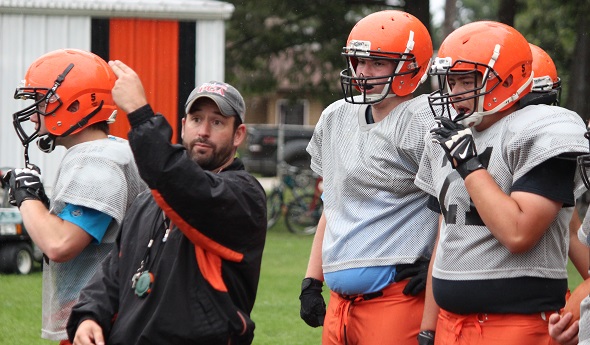
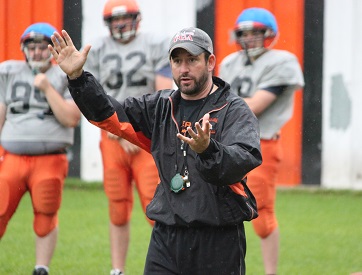
PHOTOS: (Top) Escanaba High School football coach Dave Howes makes a point to members of the Eskymos recently at Escanaba Athletic Field. Howes took over the tradition-laden program in July and is the second head coach in the past four years, after the late Jerry Cvengros and Dan Flynn served as the only head coaches during the previous 50 years. (Middle) Howes encourages his football team during a practice session.