


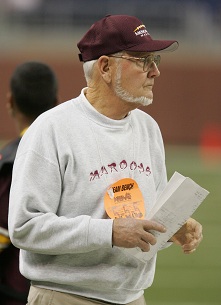
MHSA(Q&)A: Menominee football coach Ken Hofer
June 28, 2012
By Brian Spencer
Second Half
Ken Hofer has been nothing short of legendary during more than three decades as Menominee’s head football coach -- a tenure that came to an end earlier this month when he announced his retirement.
In 41 seasons -- including his first two, at Stephenson -- he won three MHSAA championships (1998, 2006, and 2007) and built a record of 342-136-3. He is one of nine coaches in MHSAA football history with at least 300 wins.
He guided more than a thousand athletes, and that influence extended to league rival Kingsford -- where his son Chris Hofer is the football coach. Ken also is known statewide as the guru of the single wing offense, a rarely-used but for the Maroons frequently unstoppable attack that does not utilize a traditional quarterback.
Hofer is a member of the Michigan High School Football Coaches Association and Upper Peninsula Sports Halls of Fame. He also served as the Menominee athletic director, principal, and assistant principal. He grew up in Stephenson, where he was an all-stater in football and track and field, and later competed in both sports at the University of Wisconsin.
Did you always want to become a football coach?
I was predicted to be a coach somewhere in our (Stephenson) annual (yearbook). So I suppose I was always predetermined to coach. However, before coaching I was in the service as a Lieutenant and spent two years in Germany. After Germany, I spent another five years working for Wilson Sporting Goods before I finally came back in 1964 to coach football and teach social studies for Stephenson.
How did you decide it was time to hang up the whistle?
Well, I’m 77 years old, so age was definitely a determinant. The biggest factor was that as much as my mind said I could continue, my body said “slow down.” So I guess age and my inability to continually go full throttle and stay energetic helped me make my decision.
In your 45 seasons, what is the most helpful piece of advice you are going to take away?
The best advice I will take away is to treat young people the way I like to be treated.
 What do you plan to do with your free time, now that your schedule has opened up slightly?
I am going to try and catch up on stuff that should have been done a long time ago. I’m sure that my wife will give me plenty of stuff to do, too. I also want to try to travel more and visit my kids. I now have a grandson who will be playing for Kingsford, so I will become a fan of my grandson’s at his Kingsford games.
Now that your grandson and son both have affiliations with Kingsford, will you become a Kingsford man?
No (chuckling), I will cheer for my son and grandson, but I will forever be connected with Menominee and Stephenson.
What was it like to be recognized by both the Michigan High School Football Coaches Association and Upper Peninsula Sports Halls of Fame?
It was like a utopia for coaching. When your peers give that honor it is a pretty special time. As a coach you don’t strive for that kind of accolade; however, it is definitely a special honor to receive.
What has been, in your opinion, your greatest achievement as Menominee’s head football coach?
My greatest achievement will always be working with younger people; I think that is the most important thing that most coaches would like to have, is the ability to stay young by working with these young men. You don’t always have to win to have that experience. Winning on the field doesn’t always correlate winning in other aspects of your life.
What advice can you give aspiring or current coaches who look to share similar successes as a head coach?
The biggest thing is to make sure that you treat the players like you like to be treated. Using that approach will get a great response.
Of your 300-plus career wins, is there any one that you find particularly special?
I always found that whenever I could beat Kingsford when my son was coaching (he said, followed by a bellowing laugh). My son Chris will like that one.
There are so many that I consider to be special. There were a ton of close games, too many to count. Two years ago, we had one of those close games where we played Morley-Stanwood, and won 41-40 in overtime (in a 2010 Regional Final). The young men played very hard. It was very special.
Do you think that your son will follow in your footsteps and coach for 45-plus seasons?
I think Chris has that type of coaching in his blood. He’s struggling physically with a knee injury; however he has a coaching mind that is as strong as ever. I think he’ll coach until he won’t be able to.

All Eyes on Ithaca's Winning Streak
November 1, 2012
By Geoff Kimmerly
Second Half editor
Terry Hessbrook has sensed this level of buzz around Ithaca's football program once before.
He was a senior running back during the 1984 "dream season" when the team finished the regular season 9-0 and made the playoffs for the first time. The Yellowjackets' postseason run lasted only a week – Ithaca fell to Grand Rapids South Christian 20-0 in the first round, which in those days of shorter playoffs was the Regional Final – but the excitement was reminiscent of the attention his program is getting heading into Friday's Division 6 District Final against Hemlock.
Except this hype extends far outside the city limits of his 2,900-resident hometown. Ithaca has won 38 straight games, the fifth-longest streak in MHSAA football history, and is only three more wins from a third straight trip to the Finals at Ford Field.
“It’s been really neat to have people take a look at what we’re doing in Ithaca,” Hessbrook said. “We’re not doing anything different. We’re not reinventing the wheel. We’re not a bunch of geniuses or anything like that. We just have a coaching staff that works really hard and supports each other, and we don’t care who gets the credit. And the players don’t care who gets the credit.”
How much the ninth-year coach is beaming comes through the phone as he talks of his players' handling of the growing expectations or how fortunate he is to be surrounded by assistants he's been close with, in at least a few cases, for decades.
And winning makes everything more fun. The Yellowjackets get a Second Half High 5 this week as they work toward becoming just the fifth school to win three straight MHSAA titles since the first playoffs were held in 1975. The winning streak is the third-longest among those that included at least one season since the postseason was added.
Ahead of Ithaca on that consecutive wins list are Hudson (72), Morenci (44), Cheboygan (43) and New Lothrop (39). But only Cheboygan accomplished its streak completely within the playoff era, with Hudson’s coming to an end in the first MHSAA Class C Final.
Making this run more special is that half the team has been together for nearly all of it.
Hessbrook brought his players into a huddle at the start of practice this August, and as he started looking at their faces, a thought crossed his mind.
“Wow, you guys have been around for a long time,” he told them.
Ithaca’s football players haven’t been around any longer than those on any other team in Michigan. But it sure feels that way. The Yellowjackets have played in 12 playoff games over the last three years, and five seniors who moved to varsity at the start of 2010 – receiver Markes Gadlen, linebackers Tyler Gibson and Jacob Barnes and linemen Bradley Martyn and Josh Capen – have played in 38 varsity games. That’s the equivalent of more than four regular seasons. And the team's other 12 seniors all came up for the playoffs in 2010, giving them more postseason experience than perhaps any group currently playing in this state.
During that 2010 run, they felt like they were along for the ride. Last season’s championship was about seniors like Garrett Miniard and David Brown showing they could win one too after following all-state quarterback Alex Niznak’s lead the year before. Now, these seniors similarly want to be the leaders of another title run.
But Hessbrook is sure to credit one more group – the 2009 team that played in the team's first MHSAA Semifinal.
“In 2009, that group of players raised the bar, and they made it possible, although they didn’t win,” Hessbrook said. “They didn’t get to the big game. But in 2009, for one quarter (in the Semifinal), we played with Montague (which went on to finish 14-0).
“The bar has been raised. I don’t know that the goal now is to (just) get into the playoffs. I think the kids are hungry enough that they don’t want to just get in. They want to get in and make noise.”
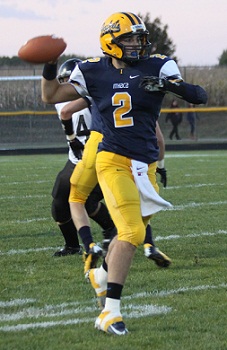
The name statewide observers are coming to know is that of junior quarterback Travis Smith. He took over in the 2011 opener and quarterbacked the team through the 42-14 championship game win over Constantine, throwing for 299 yards – fifth-best all-time for an MHSAA championship game.
His numbers this fall say plenty – 107 completions in 175 attempts for 1,696 yards and 30 touchdowns, with only four interceptions. Smith also leads the team with 610 rushing yards and 12 touchdowns on the ground. He’s 6-foot-2 and 200 pounds and already getting the college looks that came to Niznak during his senior season after he’d already committed to Central Michigan.
Total, the team is outscoring opponents on average 53-6. The defense is a little smaller but faster this fall, and is averaging exactly three turnovers per game.
Another stat helps it all make more sense. Teams submit the grade-point average for their top 11 players for academic all-state – and Ithaca’s group comes in at 3.85.
And visitors to Ithaca don’t get the feel they’re in a small town once they enter the stadium. Recent renovations included the addition of viewing platforms 15 feet above the track that put fans closer to the field than the first row of bleachers. There are new bathrooms and a larger concessions area, but the biggest blast comes from the 13 by 24-foot Jumbotron scoreboard that’s made the stadium feel more like the home of a Division II college team.
Hessbrook estimates at least 2,000 fans are showing up for home games, and similarly large crowds have followed his team on the road.
To Ithaca’s credit, the team is taking all of this in stride. It’s not that the streak isn’t a big deal – “It is what it is,” Hessbrook said – but the players just don’t talk about it too much.
“They’re really a mature group of seniors, really grounded, from great families with great parents who are very supportive of what we’re doing and just keep their kids grounded. The coaching staff does a good job keeping the kids grounded," Hessbrook said. "You’re only as good as your last game. Nobody’s going to care what you did last week or last month. And I think the players believe that.”
PHOTOS: (Top) Ithaca's Caden Kipp and Zach Allen (12) celebrate after a touchdown during last week's win over Grandville Calvin Christian. (Middle) Quarterback Travis Smith already is in the MHSAA record book for his performance during last season's Division 6 Final. (Click to see more from HighSchoolSportsScene.com).