


MHSA(Q&)A: Menominee football coach Ken Hofer
June 28, 2012
By Brian Spencer
Second Half
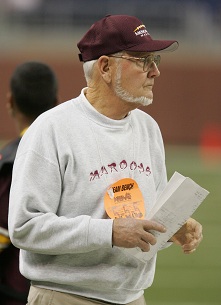
Ken Hofer has been nothing short of legendary during more than three decades as Menominee’s head football coach -- a tenure that came to an end earlier this month when he announced his retirement.
In 41 seasons -- including his first two, at Stephenson -- he won three MHSAA championships (1998, 2006, and 2007) and built a record of 342-136-3. He is one of nine coaches in MHSAA football history with at least 300 wins.
He guided more than a thousand athletes, and that influence extended to league rival Kingsford -- where his son Chris Hofer is the football coach. Ken also is known statewide as the guru of the single wing offense, a rarely-used but for the Maroons frequently unstoppable attack that does not utilize a traditional quarterback.
Hofer is a member of the Michigan High School Football Coaches Association and Upper Peninsula Sports Halls of Fame. He also served as the Menominee athletic director, principal, and assistant principal. He grew up in Stephenson, where he was an all-stater in football and track and field, and later competed in both sports at the University of Wisconsin.
Did you always want to become a football coach?
I was predicted to be a coach somewhere in our (Stephenson) annual (yearbook). So I suppose I was always predetermined to coach. However, before coaching I was in the service as a Lieutenant and spent two years in Germany. After Germany, I spent another five years working for Wilson Sporting Goods before I finally came back in 1964 to coach football and teach social studies for Stephenson.
How did you decide it was time to hang up the whistle?
Well, I’m 77 years old, so age was definitely a determinant. The biggest factor was that as much as my mind said I could continue, my body said “slow down.” So I guess age and my inability to continually go full throttle and stay energetic helped me make my decision.
In your 45 seasons, what is the most helpful piece of advice you are going to take away?
The best advice I will take away is to treat young people the way I like to be treated.
 What do you plan to do with your free time, now that your schedule has opened up slightly?
I am going to try and catch up on stuff that should have been done a long time ago. I’m sure that my wife will give me plenty of stuff to do, too. I also want to try to travel more and visit my kids. I now have a grandson who will be playing for Kingsford, so I will become a fan of my grandson’s at his Kingsford games.
Now that your grandson and son both have affiliations with Kingsford, will you become a Kingsford man?
No (chuckling), I will cheer for my son and grandson, but I will forever be connected with Menominee and Stephenson.
What was it like to be recognized by both the Michigan High School Football Coaches Association and Upper Peninsula Sports Halls of Fame?
It was like a utopia for coaching. When your peers give that honor it is a pretty special time. As a coach you don’t strive for that kind of accolade; however, it is definitely a special honor to receive.
What has been, in your opinion, your greatest achievement as Menominee’s head football coach?
My greatest achievement will always be working with younger people; I think that is the most important thing that most coaches would like to have, is the ability to stay young by working with these young men. You don’t always have to win to have that experience. Winning on the field doesn’t always correlate winning in other aspects of your life.
What advice can you give aspiring or current coaches who look to share similar successes as a head coach?
The biggest thing is to make sure that you treat the players like you like to be treated. Using that approach will get a great response.
Of your 300-plus career wins, is there any one that you find particularly special?
I always found that whenever I could beat Kingsford when my son was coaching (he said, followed by a bellowing laugh). My son Chris will like that one.
There are so many that I consider to be special. There were a ton of close games, too many to count. Two years ago, we had one of those close games where we played Morley-Stanwood, and won 41-40 in overtime (in a 2010 Regional Final). The young men played very hard. It was very special.
Do you think that your son will follow in your footsteps and coach for 45-plus seasons?
I think Chris has that type of coaching in his blood. He’s struggling physically with a knee injury; however he has a coaching mind that is as strong as ever. I think he’ll coach until he won’t be able to.
South Lyon United's Radcliffe Approaching Milestone Win, Another History-Making Moment
By
Keith Dunlap
Special for MHSAA.com
May 7, 2026
Originally, Deanna Radcliffe got into coaching lacrosse simply because it was a nice summer job.
 From that simple beginning, Radcliffe is now on the verge of making high school sports history within the state of Michigan.
No girls or boys lacrosse coach has reached 300 career victories since the sport became MHSAA-sponsored in 2005. But Radcliffe is oh-so-close. Following a win over Haslett on Wednesday, Radcliffe has 299 career victories.
The milestone 300th win likely will come Saturday when South Lyon United plays in a tournament at Saline.
In order to get their names etched in the record book, any high school coach in Michigan has had to reach at least 300 wins since the MHSAA brought the sport into its championship lineup. So Radcliffe is literally about to become the first and only coach in the MHSAA coaching records for lacrosse.
Radcliffe is in her 10th season coaching for South Lyon Unified and also coached at Hartland from 2013 to 2022. This is actually her second stint at South Lyon, where she spent seven years as head coach before taking the Hartland job.
“It just means I’ve been doing this for a long time,” Radcliffe said. “What it really represents to me is all the players, coaches and families I’ve had the opportunity to coach. I’ve been fortunate to coach in an area that was willing to embrace the sport. I have been able to catch some really great teams and athletes across all levels from youth to high school and even collegiately. That’s the part that means the most, those relationships and experiences. The wins are just a byproduct of that.”
Radcliffe got her start in lacrosse very young, saying she picked up the game at 3-4 years old while growing up in Pennsylvania. She was introduced to the game by her aunt.
 “It just became part of my life early on,” she said.
Radcliffe eventually became good enough as a player to earn a college opportunity, ultimately being named the Atlantic 10 Offensive Player of the Year in 2003 while playing for Temple.
Radcliffe eventually started a career as a special education teacher and was a high school coach in Pennsylvania before moving to Michigan in 2006, where she has coached club, high school and even college lacrosse as she spent time as an assistant at Cleary University.
“I just enjoyed being around the game and the competitive environment, so I kept doing it,” Radcliffe said of what has kept her coaching. “Over time, it stopped being something I was just doing in the summers and became something I really valued and stayed connected to. It’s grown naturally from there, and I’ve been fortunate to continue coaching while also working in education.”
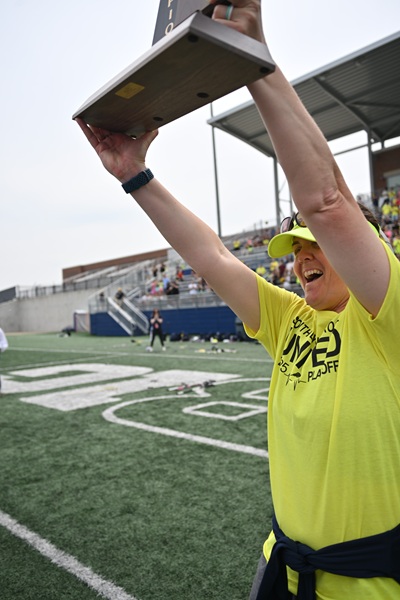
The most noteworthy win of her career came last June, when South Lyon Unified earned a 6-3 Division 1-clinching victory over Hartland to give Radcliffe her first MHSAA Finals championship as head coach in a matchup between the two programs she built up.
South Lyon Unified is 18-0 this season and has won 39 straight games going back to last spring's opener.
“She has so much knowledge of the sport and really cares for each and every one of us,” said South Lyon United senior captain Teagan Wesner. “Deanna has been one of the best coaches I have ever had, and I am extremely grateful to have had the opportunity to play for her. I am very happy for Deanna, and I am excited to be a part of the team who helped her reach 300 wins.”
When Radcliffe first arrived in Michigan, lacrosse was in its first years as a sanctioned sport by the MHSAA. Now, she has seen it grow by leaps and bounds.
“One of the most rewarding parts has been seeing the long-term impact,” she said. “Many of the players I once coached are now youth, high school or college coaches themselves. Some are officials, and some I’m even coaching against or alongside now. That’s been incredibly meaningful and really speaks to the strength of the community the sport has built.”
 Keith Dunlap has served in Detroit-area sports media for more than two decades, including as a sportswriter at the Oakland Press from 2001-16 primarily covering high school sports but also college and professional teams. His bylines also have appeared in USA Today, the Washington Post, the Detroit Free Press, the Houston Chronicle and the Boston Globe. He served as the administrator for the Oakland Activities Association’s website from 2017-2020. Contact him at [email protected] with story ideas for Oakland, Macomb and Wayne counties.
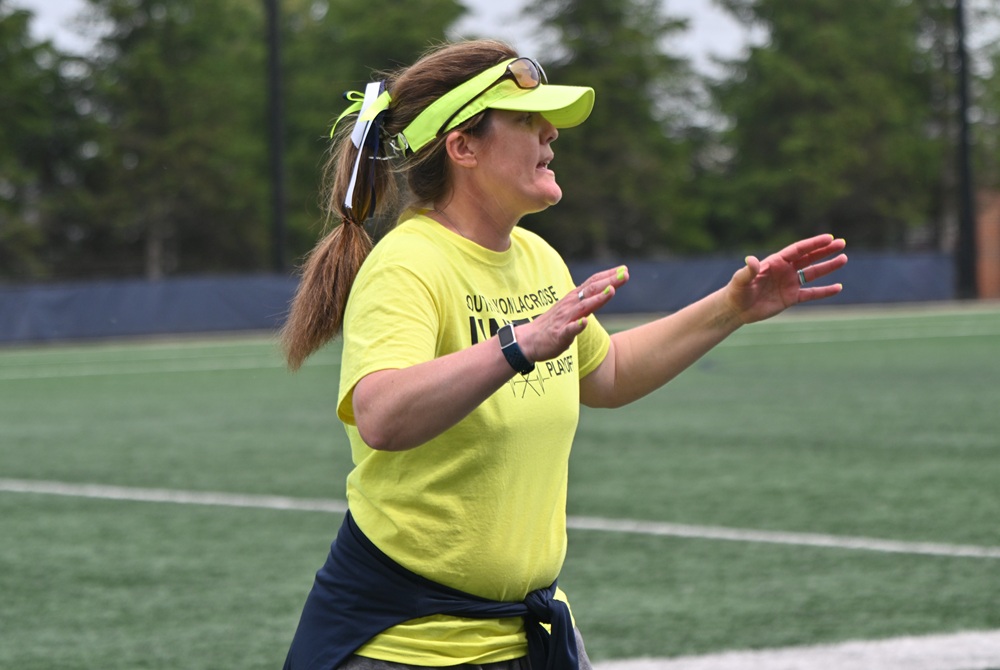
PHOTOS (Top) Deanna Radcliffe, here during the 2025 Division 1 Final, has reached 299 career coaching wins. (Middle) Radcliffe raises the championship trophy after last season’s clincher.