


MHSA(Q&)A: NFL official Ronald J. Winter
July 19, 2012
By Brian Spencer
Second Half
 Kalamazoo's Ron Winter has officiated in the National Football League for nearly two decades, and became a referee in 1999. But long before he joined the highest level of the game, he got his start on Michigan's high school fields.
Winter has officiated that sport at all three levels and also high school and college basketball. He's also served as a source of knowledge for officials around the state -- and an example for those hoping to start at the high school level and climb to the pros.
Winter remains registered as an MHSAA official, as he's been for 42 years. An associate professor emeritus of human performance and health education at Western Michigan University, Winter was appointed earlier this month to serve a two-year term on the Governor's Council on Physical Fitness, Health and Sports. The council focuses on increasing physical activity and health improvements.
He served on the WMU faculty first beginning in 1969 and then again from 1992-2008. Winter earned bachelor and master's degrees at Michigan State University.
Did you play any sports in high school or college?
I played football, basketball, baseball, and track in high school. However, once I got to Michigan State University, I started playing lacrosse. A couple guys that lived near me played lacrosse and asked me to come out to throw the ball around. After throwing with them a couple times they asked me to come out for the team. I ended up playing lacrosse for MSU for four years.
How did you decide to choose football as the sport you would officiate?
I started officiating as a student at MSU in their intramural program, officiating touch football and basketball. The next logical step was to then officiate in the high school leagues. From there, I began to proceed to all the different levels.
Are there specific requirements for becoming an NFL official?
The biggest requirement is experience. The progression that I went through went like this:
After officiating high school games, I went to the MIAA (Michigan Intercollegiate Athletic Association). They (MIAA) were looking for people that had 3-5 years of experience at the high school level. From there I went to the Mid-Continent conference. I wasn’t able to go to the Mid-American Conference because I was employed at Western Michigan University.
From there I went to the Big Ten. The Big Ten was looking for people with 5 to 10 years of experience in high school and people that had experience at different positions as an official. I ended up officiating in as a Big Ten football official for 10 years and a Big Ten basketball official for 15 years. I then submitted an application to the National Football League. Coincidentally, the NFL was scouting officials, and had followed me for four years before they finally asked me to be a part of the staff. The NFL decides on who they want to pursue through recommendations and personal interest. They look for personality traits as well as how (officials) carry themselves through different situations.
What has been your favorite level to officiate; High school, college or professional?
I enjoyed officiating all of them, but for different reasons.
I found high school to be the most fascinating because it’s all about the kids; they are playing the game for the love of the game. That is the purest sense of the sport. I loved being involved with kids simply because they love the game.
I found the Big Ten to be most exciting because of the kind of atmosphere that exists on a Big Ten campus on a Saturday afternoon. It’s electric. You don’t get that same sense or the same feel on Sunday afternoon in a pro stadium.
I found the NFL to be most intense. The NFL really has three or four different levels of play during the season. There is preseason play, the first third of the season, the second third of the season, and the last five games of the season. Each level is ramped up another notch as the season progresses. Playoffs are entirely different all together. In terms of the intensity and pure speed of the game, there is nothing like the NFL playoffs.
How important is getting along with your fellow officials on the field?
It’s imperatively important if you want to have a smooth and well-run game. This doesn’t mean that you have to buddy-buddy off the field, but on the field you have to be committed to one goal. We spend two or three hours on meetings Saturday afternoon to go over rules tests, tape, and more to prepare for the next game (and) to get over rough patches that develop on a personal level in a previous week. I need to know that the other six guys are focused and thinking about football like me. Everyone has to have confidence in one another. We spend plenty of time on Saturday to get to the point that we need to on Sunday.
What has been the most exciting game you’ve officiated?
I’ve been in plenty of exciting games from NFL playoff games, to the first Orange Bowl game, to the Rose Bowl, to the Division III Hope vs. Calvin basketball game, to when Indiana played Purdue in basketball. All of them were incredible to be a part of. During the Indiana vs. Purdue game, the arena was electric. The players, coaches, fans were intense. Everybody is totally focused on the game. Each coach had a tremendous respect for one another. Neither one wanted to show up or embarrass their counterpart. This game wasn’t that drastically different at the Division III level, however. The intensity of both was very similar.
Are there games that you get excited to officiate more than others, presently?
Not in terms of specific teams. It really just depends on the circumstances, of course. Pittsburgh vs. Baltimore is an intense game. The Jets vs. Patriots game is great. There are clearly rivalries that are very exciting to be a part of. The level of play and intensity of the athletes in the NFL is unmatched and can provide excitement every week.
What is the most difficult aspect of being a NFL official?
I would say that preparation and being able to maintain intensity on the field on Sunday are key aspects. The preparation is difficult because it’s time-consuming. It is a misconception that we simply show up on Sunday to work the game. By the time Sunday rolls around, I’ve spent over 20 hours during the week trying to prepare for a Sunday game. It isn’t hard in terms of physical labor, but difficult in terms of a time commitment. You have to have an understanding family to be in the occupational field that I am in.
Do you have any advice for aspiring officials who hope to make it to the league?
Practice, practice, practice. Be able to work any game at any level and get as much experience as you can. Be a good partner on the field. It takes time; it isn’t something that just happens. Like anything else, it takes practicing your trade to be able to make it to the top level.
Drive for Detroit: Week 2 in Review
September 4, 2018
By Geoff Kimmerly
Second Half editor
The east side of the Lower Peninsula enjoyed a rematch of last season’s Division 1 championship game. The west enjoyed a matchup of arguably the two best teams in all the state this fall.
 In between, Week 2 of Michigan’s high school football season included at least three headline-grabbing upsets, a memorable last-second score, and the end of a losing streak stretching more than four years.
Muskegon and Clarkston had a lot to celebrate over the long weekend, but so did Saline, Lansing Catholic and Harbor Springs – not to mention rejuvenated Battle Creek Central and Detroit Cass Tech, coming off a play that surely will be remembered in that program’s storied history.
And let’s give special shoutouts to Dexter – which ended a 42-game losing streak with a 36-22 win over Ypsilanti Community – and Spring Lake, which moved to 2-0 with a win over rival Fruitport after going winless for 2017.
Many more of last week’s storylines are covered below in our Drive for Detroit review, powered by MI Student Aid.
Bay & Thumb
HEADLINER: Flint Carman-Ainsworth 21, Midland 7 The reigning champions in the Saginaw Valley League Blue and Red, respectively, are off to opposite starts. Carman-Ainsworth is 2-0 heading into the start of league play this week, while Midland is a deceptive 0-2 after now falling to two 2017 playoff teams. Click for more from the Flint Journal and see below for highlights from State Champs Sports Network.
VIDEO: Check out the highlights of the Flint Carman-Ainsworth (@CarmanAinsworth) vs. Midland (@midlandchemics) football game from last night. Brought to you by @LTUAthletics pic.twitter.com/Aunc6u6ZhL
— STATE CHAMPS! (@statechampsnet) August 31, 2018
Also of note: Saginaw Swan Valley 56, Frankenmuth 20 The Vikings (2-0) were runners-up in Division 5 last season and Frankenmuth (1-1) was a semifinalist coming through opposite sides of the bracket. We could see how much changes over two months if they meet again this playoffs.
Remember this one: Richmond 24, Algonac 21 Last year it was Algonac winning this matchup to clinch the Blue Water Area Conference title in Week 8. This time the Blue Devils (1-1) have an edge on the Muskrats (0-2) but with the rest of the league schedule left to play.
More shoutouts: Marlette 20, Harbor Beach 14 (OT) The Raiders (1-1) broke a seven-game losing streak against the Pirates (1-1), last season’s Greater Thumb Conference East champ. Swartz Creek 16, Flushing 13 The Dragons are 2-0 for the first time since 2012 after winning three games total last season and losing to Flushing (1-1; 9-3 in 2017) last year 53-12.
Greater Detroit
HEADLINER: Clarkston 28, West Bloomfield 25 This rematch of last season’s Division 1 championship game saw many more than five points score (Clarkston won that Finals meeting 3-2). The Wolves (2-0) held off West Bloomfield (1-1) multiple times at the end to secure its second-straight three-point win to open the season and an important first step in the Oakland Activities Association Red race – West Bloomfield won the league meeting a year ago. Click for more from MLive-Detroit.
VIDEO: Jake Billette (@JakeBillette16) of @ClarkstonWolves with the 50 yard touchdown run in the 28-25 win over West Bloomfield tonight @TheeJungle pic.twitter.com/zoKvZcdCjh
— STATE CHAMPS! (@statechampsnet) September 1, 2018
Also of note: Detroit Cass Tech 21, Lakewood St. Edward (Ohio) 20 The Technicians (2-0) got past Ohio power St. Edward scoring all 21 of their points over the final five minutes and the winning touchdown on a 60-yard toss into the end zone on the game’s final play.
Remember this one: Oak Park 13, Birmingham Groves 7 These two and Farmington Hills Harrison shared the Oakland Activities Association White title last season. Oak Park (2-0) faces Harrison this week and Groves (0-2) is hoping to get into the mix after opening with close losses to the Knights and West Bloomfield.
Other shoutouts: Sterling Heights Parkway Christian 20, Waterford Our Lady 13 Parkway is now 2-0 by avenging two big 2017 losses, this one after falling to Our Lady (1-1) by 29 last season. Birmingham Brother Rice 13, Mishawaka Penn (Ind.) 7 The Warriors (2-0) appear back after a big Week 1 win over U-D Jesuit and this avenging of last year’s 38-0 loss to Indiana power Penn.
Mid-Michigan
HEADLINER: Lansing Catholic 15, Grand Rapids West Catholic 14 This might have made the loudest boom of the weekend statewide as the Cougars (2-0) edged the reigning five-time Division 5 champion. Quarterback Josh Kramer ran for 149 yards and two touchdowns and also for the winning two-point conversion. West Catholic fell to 0-2 after also losing Week 1 to reigning Division 6 champion Jackson Lumen Christi. Click for more from the Lansing State Journal and see highlights below from WZZM.
Also of note: Haslett 20, Lansing Sexton 6 The Vikings moved to 2-0 with their second win over a 2017 playoff team – Sexton (0-2) coming off an 8-4 finish – and Haslett has outscored its first two opponents by a combined 48-13.
Remember this one: Harrison 38, Houghton Lake 34 Half the Jack Pine Conference made the playoffs in 2017, including these third and fourth-place finishers, respectively, and the result this time could come into play if either challenges for the league title. Both are 1-1 overall.
Other shoutouts: Dansville 33, Laingsburg 0 The Aggies (1-1) bounced back from a tough Week 1 loss to Leslie to earn a nice win over a Laingsburg program that is 0-2 but won eight games each of the last three seasons. East Lansing 20, Dearborn Divine Child 10 The Trojans are looking especially tough defensively as they too are 2-0 for the first time since 2012 and after losing to Divine Child (0-2) a year ago.
Northern Lower Peninsula
HEADLINER: Harbor Springs 14, Frankfort 7 Frankfort was 28-7 over the last three seasons, so this is impressive for more than adding to Harbor Springs’ first 2-0 start since 2013. The Rams also are working to bounce back from last season’s 4-5 finish. Frankfort fell to 1-1 after opening with a win over Newberry. Click for more from the Petoskey News-Review.
Also of note: Rogers City 24, Tawas 8 The Hurons (2-0) equaled their win total for all of 2017, holding a Tawas team that scored 48 against Lincoln Alcona in a Week 1 win to only eight points.
Remember this one: Traverse City St. Francis 50, Maple City Glen Lake 12 This is the third straight season St. Francis has beaten Marquette and Glen Lake (0-2) to start, but a combined 92-15 scoring edge easily is the widest over the recent series.
More shoutouts: Kingsley 43, West Branch Ogemaw Heights 0 The Stags have welcomed back coach Tim Wooer with a 2-0 start after winning one game all of last season. Benzie Central 33, Kalkaska 0 The Huskies couldn’t finish 2016 and won one game last fall – but their 2-0 start equals their number of wins from the past four seasons combined.
Southeast & Border
HEADLINER: Saline 17, Grand Rapids Catholic Central 7 The Hornets broke the two-time reigning Division 4 champion’s 21-game winning streak, handing GRCC (1-1) its first defeat since Week 8 of 2016. Saline locked down the Cougars’ running game and scored the final 17 points to improve to 1-1 as well. Click for more from the Saline Post.
Touchdown! Griffin! pic.twitter.com/C8rYFTARpP
— TheSalinePost (@TheSalinePost) August 31, 2018
Also of note: Sand Creek 27, Climax-Scotts 16 The Aggies (1-1) are trying to bounce back from last season’s 4-5 finish, and avenging a 31-point loss to Climax-Scotts (1-1) certainly helps.
Remember this one: Napoleon 35, Addison 20 These were two of three co-champions last season in the Cascades Conference, but now Addison (1-1) must catch up quickly with the third title winner Michigan Center up next and Napoleon (1-1) not seeing Michigan Center until Week 8.
More shoutouts: Milan 26, Monroe St. Mary Catholic Central 21 These two frequently have decided the Huron League title, and Milan (2-0) surely is hoping that turns out the case again. St. Mary fell to 1-1 having played two 2017 playoff teams to open. Pittsford 10, Petersburg Summerfield 0 The Wildcats (2-0) have yet to give up a point this season and avenged a 12-point loss to the Bulldogs (1-1) from a year ago.
Southwest Corridor
HEADLINER: Battle Creek Central 34, Richland Gull Lake 33 The Bearcats may be back. Battle Creek Central pulled off a second straight win by seven or fewer points to reach 2-0 for the first time since 2005. Battle Creek Central finished 3-6 both of the last two seasons and last made the playoffs in 2008. Click for more from the Battle Creek Enquirer.
Also of note: Three Oaks River Valley 32, Galesburg-Augusta 24 River Valley had won a combined two games over the last four seasons but is 2-0 for the first time since 2006 and guaranteed to equal its best record since 2002.
Remember this one: Kalamazoo Central 30, Portage Central 14 The Maroon Giants (1-1) this fall are seeking their first playoff berth since 2004 and had lost to annual playoff qualifier Portage Central (1-1) by 22 and 10 the last two seasons.
More shoutouts: Springport 22, Union City 20 The Spartans (2-0) launched their Big 8 Conference schedule by avenging last season’s 26-point loss to the Chargers (1-1). Marshall 28, Battle Creek Harper Creek 27 After falling in overtime in its opener, Marshall (1-1) edged Harper Creek – which has lost its two games by a combined three points.
Upper Peninsula
HEADLINER: Ishpeming Westwood 34, Iron Mountain 7 The Patriots have kept churning after last season’s record nine-win finish, adding this victory for a 2-0 start during which they’ve outscored those opponents by a combined 76-7. Iron Mountain (1-1) opened with a solid win over Negaunee and will work to still figure into the Western Peninsula Athletic Conference “large school” race. Click for more from the Marquette Mining Journal and see below for a highlight from ABC10.
.@nbecks10 connects with Erik Anderson for a 39-yard touchdown in Westwood's 34-7 win over Iron Mountain pic.twitter.com/EpdU3lN0pO
— ABC 10 UP Sports (@ABC10UPSports) September 1, 2018
Also of note: Escanaba 15, Petoskey 14 The Eskymos (1-1) took an opening night loss to Alpena and needed every last point against this Big North Conference opponent in a game that could prove important to Escanaba’s eventual playoff hopes.
Remember this one: St. Ignace 38, Newberry 30 The Saints (1-1) played through an uncharacteristic one-win season a year ago and then fell on opening day last month, but avenging a 37-point loss to Newberry (0-2) from last year is a significant step in a better direction.
More shoutouts: Calumet 30, Negaunee 8 The Copper Kings (2-0) have outscored their first two opponents by a combined 78-14 to set up one of the U.P.’s best matchups this week against Westwood. Ishpeming 38, Lake Linden-Hubbell 12 The Hematites (2-0) have begun a bounce-back from a tough end to last fall with a pair of wins by a combined 90-12 score.
West Michigan
HEADLINER: Muskegon 24, Detroit Martin Luther King 21 This was everything expected and more from a matchup of two of the absolute top teams in the state, regardless of division. The Big Reds (2-0) took their final lead late to cement the victory and add to a 16-game winning streak and 18-game regular-season winning streak. The Crusaders (1-1) haven’t won fewer than 11 games since 2014 and are expected to make a double-digit run again. Click for more from the Muskegon Chronicle.
??VIDEO: Check out the highlights of the Detroit King (@DetKingFootball)) at Muskegon (@OnMuskegon) football game from tonight. Brought to you by @LTUAthletics pic.twitter.com/pvig2Q5zIM
— STATE CHAMPS! (@statechampsnet) September 1, 2018
Also of note: Holland West Ottawa 42, Grand Rapids Forest Hills Central 41 (2OT) The Panthers moved to 2-0 with a second straight impressive win and after falling by three to the Rangers (1-1) a year ago.
Remember this one: Rockford 36, Lowell 0 The Rams (1-1) had lost all four of their games this decade to the Red Arrows (0-2), but got a dboost that should pay off later as they seek to make the playoffs for the 24th straight season.
More shoutouts: Grand Haven 13, Traverse City West 10 The Titans (1-1) had won the last two meetings between these teams by 27 and 28 points, and Grand Haven (2-0) won only one game all of last season. Saugatuck 49, Watervliet 42 This was expected to be high-scoring and also delivered thanks in part to Brad Dunn’s 316 yards and five touchdowns rushing for the Indians (2-0), who handed Watervliet (1-1) its first regular-season loss since Week 6 of 2016.
8-Player
HEADLINER: Morrice 34, Deckerville 14 Twice in the last three seasons these two also have met in the playoffs, so this might not be the final chapter of this fall. Both times Morrice (2-0) won the regular-season meetings and Deckerville (1-1) won in the playoffs – including 38-0 in last season’s Regional Final – so the Orioles won’t rest much despite an impressive victory. Click for more from the Owosso Argus-Press.
Also of note: Pickford 52, Engadine 7 The Panthers (2-0) won big in the latest installment of what’s become a nice rivalry with Engadine (1-1), especially since both are now in the Great Lakes Conference East beginning this fall.
Remember this one: Suttons Bay 45, Bellaire 6 Both teams made the playoffs last season, previously playing in different leagues, but the Norsemen have opened with a 107-6 combined score over two games as they look to challenge in the Midwest Central Conference West both now share.
More shoutouts: Colon 45, Bellevue 20 The Magi (2-0) won just two games all of last season, but got a big one off Bellevue (1-1), which won 10 in 2017. Onekama 53 Central Lake 6 The Portagers (2-0) sent the reigning 8-player Division 1 champion Trojans to 0-2 by avenging last season’s 14-point defeat.
Second Half’s weekly “Drive for Detroit” previews and reviews are powered by MI Student Aid, a part of the Student Financial Services Bureau located within the Michigan Department of Treasury. MI Student Aid encourages students to pursue postsecondary education by providing access to student financial resources and information, including various student financial assistance programs to help make college more affordable for Michigan students. MI Student Aid administers the state’s 529 savings programs (MET/MESP) and eight additional aid programs within its Student Scholarships and Grants division. Click for more information and connect with MI Student Aid on Facebook and Twitter @mistudentaid.
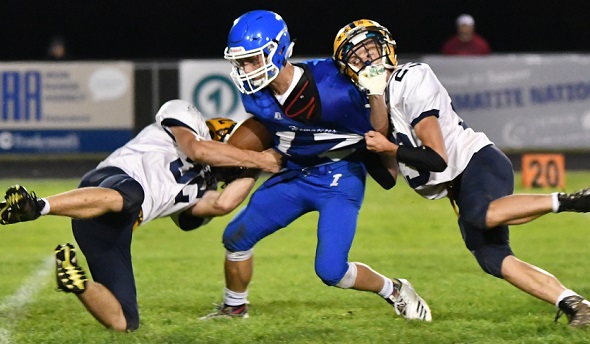
PHOTO: Lake Linden-Hubbell's Kyle Simpson (52) and Cole Gregiore (20) try to stop Ishpeming's Hunter Smith. (Photo by Cara Kamps.)