


MHSA(Q&)A: NFL official Ronald J. Winter
July 19, 2012
By Brian Spencer
Second Half
 Kalamazoo's Ron Winter has officiated in the National Football League for nearly two decades, and became a referee in 1999. But long before he joined the highest level of the game, he got his start on Michigan's high school fields.
Winter has officiated that sport at all three levels and also high school and college basketball. He's also served as a source of knowledge for officials around the state -- and an example for those hoping to start at the high school level and climb to the pros.
Winter remains registered as an MHSAA official, as he's been for 42 years. An associate professor emeritus of human performance and health education at Western Michigan University, Winter was appointed earlier this month to serve a two-year term on the Governor's Council on Physical Fitness, Health and Sports. The council focuses on increasing physical activity and health improvements.
He served on the WMU faculty first beginning in 1969 and then again from 1992-2008. Winter earned bachelor and master's degrees at Michigan State University.
Did you play any sports in high school or college?
I played football, basketball, baseball, and track in high school. However, once I got to Michigan State University, I started playing lacrosse. A couple guys that lived near me played lacrosse and asked me to come out to throw the ball around. After throwing with them a couple times they asked me to come out for the team. I ended up playing lacrosse for MSU for four years.
How did you decide to choose football as the sport you would officiate?
I started officiating as a student at MSU in their intramural program, officiating touch football and basketball. The next logical step was to then officiate in the high school leagues. From there, I began to proceed to all the different levels.
Are there specific requirements for becoming an NFL official?
The biggest requirement is experience. The progression that I went through went like this:
After officiating high school games, I went to the MIAA (Michigan Intercollegiate Athletic Association). They (MIAA) were looking for people that had 3-5 years of experience at the high school level. From there I went to the Mid-Continent conference. I wasn’t able to go to the Mid-American Conference because I was employed at Western Michigan University.
From there I went to the Big Ten. The Big Ten was looking for people with 5 to 10 years of experience in high school and people that had experience at different positions as an official. I ended up officiating in as a Big Ten football official for 10 years and a Big Ten basketball official for 15 years. I then submitted an application to the National Football League. Coincidentally, the NFL was scouting officials, and had followed me for four years before they finally asked me to be a part of the staff. The NFL decides on who they want to pursue through recommendations and personal interest. They look for personality traits as well as how (officials) carry themselves through different situations.
What has been your favorite level to officiate; High school, college or professional?
I enjoyed officiating all of them, but for different reasons.
I found high school to be the most fascinating because it’s all about the kids; they are playing the game for the love of the game. That is the purest sense of the sport. I loved being involved with kids simply because they love the game.
I found the Big Ten to be most exciting because of the kind of atmosphere that exists on a Big Ten campus on a Saturday afternoon. It’s electric. You don’t get that same sense or the same feel on Sunday afternoon in a pro stadium.
I found the NFL to be most intense. The NFL really has three or four different levels of play during the season. There is preseason play, the first third of the season, the second third of the season, and the last five games of the season. Each level is ramped up another notch as the season progresses. Playoffs are entirely different all together. In terms of the intensity and pure speed of the game, there is nothing like the NFL playoffs.
How important is getting along with your fellow officials on the field?
It’s imperatively important if you want to have a smooth and well-run game. This doesn’t mean that you have to buddy-buddy off the field, but on the field you have to be committed to one goal. We spend two or three hours on meetings Saturday afternoon to go over rules tests, tape, and more to prepare for the next game (and) to get over rough patches that develop on a personal level in a previous week. I need to know that the other six guys are focused and thinking about football like me. Everyone has to have confidence in one another. We spend plenty of time on Saturday to get to the point that we need to on Sunday.
What has been the most exciting game you’ve officiated?
I’ve been in plenty of exciting games from NFL playoff games, to the first Orange Bowl game, to the Rose Bowl, to the Division III Hope vs. Calvin basketball game, to when Indiana played Purdue in basketball. All of them were incredible to be a part of. During the Indiana vs. Purdue game, the arena was electric. The players, coaches, fans were intense. Everybody is totally focused on the game. Each coach had a tremendous respect for one another. Neither one wanted to show up or embarrass their counterpart. This game wasn’t that drastically different at the Division III level, however. The intensity of both was very similar.
Are there games that you get excited to officiate more than others, presently?
Not in terms of specific teams. It really just depends on the circumstances, of course. Pittsburgh vs. Baltimore is an intense game. The Jets vs. Patriots game is great. There are clearly rivalries that are very exciting to be a part of. The level of play and intensity of the athletes in the NFL is unmatched and can provide excitement every week.
What is the most difficult aspect of being a NFL official?
I would say that preparation and being able to maintain intensity on the field on Sunday are key aspects. The preparation is difficult because it’s time-consuming. It is a misconception that we simply show up on Sunday to work the game. By the time Sunday rolls around, I’ve spent over 20 hours during the week trying to prepare for a Sunday game. It isn’t hard in terms of physical labor, but difficult in terms of a time commitment. You have to have an understanding family to be in the occupational field that I am in.
Do you have any advice for aspiring officials who hope to make it to the league?
Practice, practice, practice. Be able to work any game at any level and get as much experience as you can. Be a good partner on the field. It takes time; it isn’t something that just happens. Like anything else, it takes practicing your trade to be able to make it to the top level.
New Football Coaches Rise for PCCP Schools
By
Tom Markowski
Special for Second Half
August 30, 2018
CANTON – Athletically, the Plymouth-Canton Community School system is like no other.
 Canton, Plymouth and Salem are the three high schools and all equally share student-athletes, who are randomly assigned to one of the three high schools in seventh grade.
This football season there is an added twist for the football players. All three schools have new varsity head coaches.
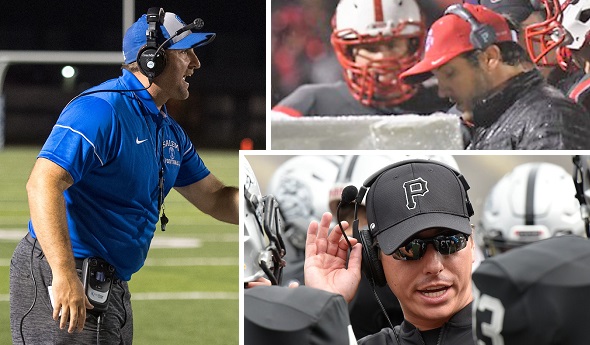
Former assistant Andy Lafata has taken over at Canton, while Brian Lewis has taken over Plymouth after leading Ann Arbor Gabriel Richard last season and Justin Reed brings championship experience to Salem after most recently assisting at Warren DeLaSalle and then Livonia Clarenceville.
“We’re finding out as coaches that the seniors don’t care that there is a new coach,” Lafata said. “There are goals that are attainable. They have high expectations. They don’t care who’s coaching. They want results.
“Plymouth (as a school district) has high expectations. It doesn’t matter (who the head coach is). What you learn is the kids are still the same. And we owe it to them to be the best coaches we can be.”
Two started 1-0 last week, Plymouth downing Livonia Stevenson 35-11 and Salem defeating Wayne Memorial 23-14. Canton opened with a 35-21 loss to Livonia Churchill.
Athletes’ expectations may be the same at all three schools, but as noted, the district is unique. Without being specific to the point of confusing, here’s the nutshell on how PCCS students are assigned to a high school:
As noted above, students entering seventh grade in the district are assigned at random, by computer, to one of the three high schools. It doesn’t matter where they want to study or whether they want to play football at Canton or softball at Plymouth or soccer at Salem. A student’s name is in the computer, and the selection process plays no favorites. If a student transfers into the school system, that student also has a 33 percent chance of attending any of the three schools.
Individual classes, however, can be a mix of students from all of them. It’s common for a student at Plymouth to have algebra classmates from Canton or Salem. You could have a student sitting next to you, and on Friday that same student could be doing his or her best to tackle you in the open field. All three high schools are located on the same campus, so classrooms are equally accessible to students from all three.
 Still with me? In addition there is just one marching band that represents all three schools – and the only time it plays during a football game is during homecoming for each.
Back to football. Of the three programs, the players at Canton might appear to have the easier time adjusting to the new coach. Lafata is a 2005 graduate of Canton and spent the last 10 seasons as an assistant coach under Tim Baechler, who retired as head coach following last season's 10-2 finish. Lafata was the starting center on the 2005 team that, with Baechler at the helm, reached the school’s only MHSAA Final – losing to Rockford, 31-21, in Division 1.
Reed, Salem’s new coach, is leading a program for the first time. His previous coaching experience, seven years in all, was split as an assistant between four schools – Royal Oak, Sterling Heights Stevenson and Warren DeLaSalle and, most recently, at Livonia Clarenceville in 2017. The Rocks finished 5-5 last season.
At 29, Plymouth’s Lewis is the youngest of the trio, but he does have experience as a head coach after leading Ann Arbor Gabriel Richard in 2017. Plymouth is coming off a 4-5 season, and his Gabriel Richard team was 7-3.
Lafata, 30, also benefitted by being hired in February. Reed was hired in early June, Lewis a few weeks later.
“To tell you the truth, having three schools on campus is unusual,” Lewis said. “We just focus on ourselves. The other things that happened (in the district) doesn’t affect us. The challenge for me, (Plymouth) is bigger than Richard. The bigger challenge is, I’m an east-sider. I have to learn the different nuances of how they run things here. It’s a work in progress. I have great administrative support. I’m hitting the ground running.”
Lewis was wise to surround himself with coaches who have experience at the high school and college levels. One important hire was his father Mike Lewis, a longtime defensive coordinator at DeLaSalle and Detroit Catholic Central, Mike’s alma mater. Lewis also lured Mike Mach away from Catholic Central where his father, the legendary Tom Mach, coached for 41 seasons. Cory Zirbel, a former University of Michigan offensive lineman, is also on the staff. Zirbel coached with Rich Rodriguez at Arizona.
Lewis played football at DeLaSalle and then cut his coaching teeth at his alma mater, Michigan, as an offensive analysist – or what Lewis termed as a sort of graduate assistant, from 2012-14. When Brady Hoke was fired as U-M’s head coach, Lewis decided to place his family (he has a wife, Teddi, and a 1-year-old child, Evelyn) above a potential college coaching career as he pursued teaching and coaching at the high school level instead.
Reed, 34, spent his first three seasons as an assistant at Royal Oak before going to DeLaSalle under Paul Verska, and he helped the veteran coach win the Division 2 title in 2015. He’s been working toward this kind of opportunity.
 “To have your own program, for the first time, the hardest thing is to convince the community that it’ll work,” he said. “For Andy it’s different. It’s a carryover.
“It’s a positive atmosphere here. They’re craving for success. We’re adding kids all the time. I got my 35th player (on varsity) the day after our first scrimmage. We have a freshmen team, too. They didn’t have one last year. It’s invaluable. It was a lot of work. I was kind of like a salesman.
“It’s an exciting time. For all three of us.”
Lafata, by all accounts, was the right person at the right time to replace Baechler. The retired coach had built the program into not only one of the best in the Detroit area, but one that competed well throughout the state. Since 1999, Canton has made the playoffs every season but one. The Chiefs came within one play of reaching the Finals a second time but lost to Detroit Cass Tech in a 2015 Semifinal, 48-41.
“Last year we knew every week was a special week,” Lafata said. “We all knew Tim would leave once his son (Lou, a linebacker) graduated. It was like being a senior when you knew this would be the last year that this group would be together.”
Lafata also is the offensive coordinator, a position he held under Baechler. Don’t look for Lafata to change the way Canton plays, especially on that side of the ball. The Chiefs will continue to run the full-house, T-formation with double tight ends and on occasion slip a receiver out wide with one of the three backs on a wing.
“Canton stays Canton,” he said. “We coach what we know.
 Tom Markowski is a columnist and directs website coverage for the State Champs! Sports Network. He previously covered primarily high school sports for the The Detroit News from 1984-2014, focusing on the Detroit area and contributing to statewide coverage of football and basketball. Contact him at [email protected] with story ideas for Oakland, Macomb and Wayne counties.
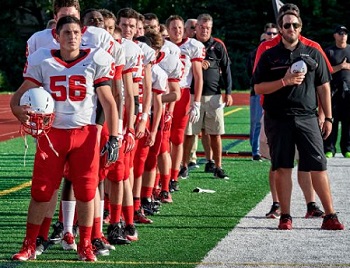
PHOTOS: (Top) Clockwise from left: Salem coach Justin Reed, Canton coach Andy Lafata and Plymouth coach Brian Lewis. (Middle) Lafata stands for the national anthem with his players. (Below) Salem players celebrate last week during a win over Wayne Memorial. (Photos submitted by respective athletic departments.)