


MHSA(Q&)A: NFL official Ronald J. Winter
July 19, 2012
By Brian Spencer
Second Half
 Kalamazoo's Ron Winter has officiated in the National Football League for nearly two decades, and became a referee in 1999. But long before he joined the highest level of the game, he got his start on Michigan's high school fields.
Winter has officiated that sport at all three levels and also high school and college basketball. He's also served as a source of knowledge for officials around the state -- and an example for those hoping to start at the high school level and climb to the pros.
Winter remains registered as an MHSAA official, as he's been for 42 years. An associate professor emeritus of human performance and health education at Western Michigan University, Winter was appointed earlier this month to serve a two-year term on the Governor's Council on Physical Fitness, Health and Sports. The council focuses on increasing physical activity and health improvements.
He served on the WMU faculty first beginning in 1969 and then again from 1992-2008. Winter earned bachelor and master's degrees at Michigan State University.
Did you play any sports in high school or college?
I played football, basketball, baseball, and track in high school. However, once I got to Michigan State University, I started playing lacrosse. A couple guys that lived near me played lacrosse and asked me to come out to throw the ball around. After throwing with them a couple times they asked me to come out for the team. I ended up playing lacrosse for MSU for four years.
How did you decide to choose football as the sport you would officiate?
I started officiating as a student at MSU in their intramural program, officiating touch football and basketball. The next logical step was to then officiate in the high school leagues. From there, I began to proceed to all the different levels.
Are there specific requirements for becoming an NFL official?
The biggest requirement is experience. The progression that I went through went like this:
After officiating high school games, I went to the MIAA (Michigan Intercollegiate Athletic Association). They (MIAA) were looking for people that had 3-5 years of experience at the high school level. From there I went to the Mid-Continent conference. I wasn’t able to go to the Mid-American Conference because I was employed at Western Michigan University.
From there I went to the Big Ten. The Big Ten was looking for people with 5 to 10 years of experience in high school and people that had experience at different positions as an official. I ended up officiating in as a Big Ten football official for 10 years and a Big Ten basketball official for 15 years. I then submitted an application to the National Football League. Coincidentally, the NFL was scouting officials, and had followed me for four years before they finally asked me to be a part of the staff. The NFL decides on who they want to pursue through recommendations and personal interest. They look for personality traits as well as how (officials) carry themselves through different situations.
What has been your favorite level to officiate; High school, college or professional?
I enjoyed officiating all of them, but for different reasons.
I found high school to be the most fascinating because it’s all about the kids; they are playing the game for the love of the game. That is the purest sense of the sport. I loved being involved with kids simply because they love the game.
I found the Big Ten to be most exciting because of the kind of atmosphere that exists on a Big Ten campus on a Saturday afternoon. It’s electric. You don’t get that same sense or the same feel on Sunday afternoon in a pro stadium.
I found the NFL to be most intense. The NFL really has three or four different levels of play during the season. There is preseason play, the first third of the season, the second third of the season, and the last five games of the season. Each level is ramped up another notch as the season progresses. Playoffs are entirely different all together. In terms of the intensity and pure speed of the game, there is nothing like the NFL playoffs.
How important is getting along with your fellow officials on the field?
It’s imperatively important if you want to have a smooth and well-run game. This doesn’t mean that you have to buddy-buddy off the field, but on the field you have to be committed to one goal. We spend two or three hours on meetings Saturday afternoon to go over rules tests, tape, and more to prepare for the next game (and) to get over rough patches that develop on a personal level in a previous week. I need to know that the other six guys are focused and thinking about football like me. Everyone has to have confidence in one another. We spend plenty of time on Saturday to get to the point that we need to on Sunday.
What has been the most exciting game you’ve officiated?
I’ve been in plenty of exciting games from NFL playoff games, to the first Orange Bowl game, to the Rose Bowl, to the Division III Hope vs. Calvin basketball game, to when Indiana played Purdue in basketball. All of them were incredible to be a part of. During the Indiana vs. Purdue game, the arena was electric. The players, coaches, fans were intense. Everybody is totally focused on the game. Each coach had a tremendous respect for one another. Neither one wanted to show up or embarrass their counterpart. This game wasn’t that drastically different at the Division III level, however. The intensity of both was very similar.
Are there games that you get excited to officiate more than others, presently?
Not in terms of specific teams. It really just depends on the circumstances, of course. Pittsburgh vs. Baltimore is an intense game. The Jets vs. Patriots game is great. There are clearly rivalries that are very exciting to be a part of. The level of play and intensity of the athletes in the NFL is unmatched and can provide excitement every week.
What is the most difficult aspect of being a NFL official?
I would say that preparation and being able to maintain intensity on the field on Sunday are key aspects. The preparation is difficult because it’s time-consuming. It is a misconception that we simply show up on Sunday to work the game. By the time Sunday rolls around, I’ve spent over 20 hours during the week trying to prepare for a Sunday game. It isn’t hard in terms of physical labor, but difficult in terms of a time commitment. You have to have an understanding family to be in the occupational field that I am in.
Do you have any advice for aspiring officials who hope to make it to the league?
Practice, practice, practice. Be able to work any game at any level and get as much experience as you can. Be a good partner on the field. It takes time; it isn’t something that just happens. Like anything else, it takes practicing your trade to be able to make it to the top level.
Norris Award to Honor Educator, Mentor
April 18, 2018
By Geoff Kimmerly
Second Half editor
Many of Jill Baker-Cooley’s favorite memories of officiating are funny ones, and she laughed last week recalling her first basketball game at the college level.
Fatigue was setting in quickly as she ran up and down the court during a Division III matchup at Calvin College. Teams played 20-minute halves, and she remembered wondering if halftime was coming up soon. “I didn’t know if I was going to make it. I thought I was going to die,” she said – and then she realized only four minutes had come off the clock and she had a long way to go.
She chuckled as well in recollecting another memory, but because it was drenched in irony. As an official starting out, she was encouraged to join an area officials association. She showed up for her first meeting at a local gym – and when she sat down in the bleachers, all of the men around her got up and sat in the stands on the other side.
 But that would serve only as motivation, not discouragement, for this year’s Vern L. Norris Award winner.
“When I see how different it is now … back then it was just a fight,” said Baker-Cooley, now living in Big Rapids. “Not only trying to officiate, but you had to prove (yourself) every single time you stepped out there. It was a tough go for a while.
“I think at the time, you don’t realize it. But I’m not a quitter. And if I do quit or retire, it’s going to be on my terms.”
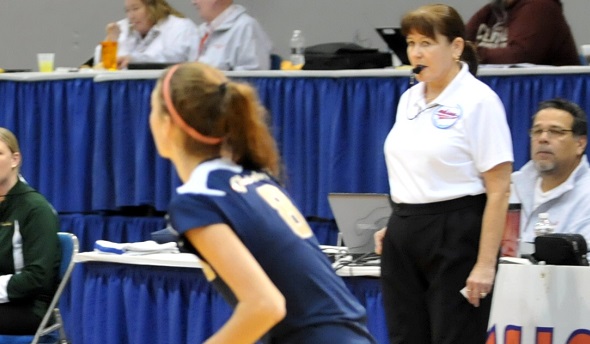
And she’s not done yet. Baker-Cooley is in her 39th year as an MHSAA-registered official, this school year for volleyball, cross country and track & field. She has worked MHSAA Finals in all three sports and 20 championship events total, in addition to officiating college volleyball and track as well and basketball at both levels during the first many years of her career.
The Norris Award is presented annually to a veteran official who has been active in a local officials association, has mentored other officials, and has been involved in officials’ education. It is named for Vern L. Norris, who served as executive director of the MHSAA from 1978-86 and was well-respected by officials on the state and national levels. Baker-Cooley will be honored at the Officials’ Awards & Alumni Banquet on May 5 at the Kellogg Hotel & Conference Center in East Lansing. Norris initiated the annual officials celebration in 1980, and this will be the first since his death Feb. 12.
Baker-Cooley’s first MHSAA Final was her only one in cross country, at the end of the 1994 season. She has officiated five Finals for volleyball, most recently the Class C championship match in 2012, and 14 in track & field and as recently as 2015.
“Jill Baker-Cooley has been a strong, pioneering official, and is well-respected not only for her work during competition but for her many contributions to building up the officiating avocation in our state,” MHSAA Executive Director John E. “Jack” Roberts said. “She’s personable and approachable, a valued teacher and mentor. We are delighted to honor Jill Baker-Cooley with the Norris Award.”
Baker-Cooley most recently has been affiliated with the West Michigan Volleyball Officials Association, Mid-Michigan Officials Association, Northern Sports Officials Association and Mecosta-Isabella-Clare Officials Association.
As noted above, the Norris Award salutes those who have contributed to mentoring and training officials, and education remains a cornerstone of Baker-Cooley’s work. She served more than 30 years as a school counselor, in admissions at Michigan Technological University and Montcalm Community College, as a grant recipient and academic counselor at Ferris State University and then working with high school students at the Wexford-Missaukee Career Technical Center.
That love of educating has been part of her officiating career as well, as she’s served as a volleyball trainer for three officials associations, presented at MHSAA “Train the Trainers” conferences four times and co-founded with 2006 Norris winner Jeanne Skinner the Ferris State Volleyball Officials Camp for those who work high school matches. She’s also served as president of the Association of Track Officials of Michigan (ATOM) and been involved with USA Track & Field, the Professional Volleyball Officials Association and the Michigan Board of Volleyball Officials.
“Jill Baker-Cooley is an educator in her primary vocation. Over many years, she has been able to translate her vocational skills exceedingly well and often into the realm of high school officiating,” wrote 2005 Norris winner Bruce M. Moss in recommending Baker-Cooley for this year’s award. “She has been a strong and continuous presence in her local officials association. Her efforts have lifted the expertise of innumerable officials across this state in all of the sports she touches, and she has been a true champion for women in sports officiating.”
Baker-Cooley is a 1974 graduate of Cadillac High School, where she raced on the ski team at a time when many schools were adding girls sports or expanding those offerings. She went on to earn bachelor and master’s degrees from Central Michigan University, then received further certification in administration and training from Western Michigan University.
While at CMU, Baker-Cooley took a basketball officiating class taught by Marcy Weston, a nationally recognized advocate for women’s athletics over more than four decades as a teacher, coach, official and athletic director. Baker-Cooley was hooked.
Longtime official Lew Clingman – who will receive his 50-year award at next month’s Officials’ Banquet – also served as an early mentor as Baker-Cooley navigated an officiating world where she said she was one of fewer than 10 women working basketball in Michigan when she first registered for 1976-77. Others, including Traverse City’s Barb Beckett (2000 Norris honoree), Skinner and Kentwood’s Betty Near also provided assistance and inspiration.
Baker-Cooley has received ATOM’s Judy Hagman Award recognizing women in track & field and/or cross country officiating. She received multiple honors for her work in education, including the 2014 Governor’s Economic Summit “Creative” Award for her efforts encouraging women to pursue STEM (science, technology, engineering and math) careers.
She retired from counseling at the start of 2016 and stopped officiating basketball a decade ago after knee injuries slowed her. But in addition to her MHSAA Finals, Baker-Cooley has officiated college league playoffs in volleyball and returned to Calvin a few seasons after that first basketball game as a table official for an NCAA Tournament contest in that sport.
Baker-Cooley also has participated in equestrian since childhood and continues to show horses with affiliation with the American Quarter Horse Association and American Paint Horse Association.
Previous recipients of the Norris Award
1992 – Ted Wilson, East Detroit
1993 – Fred Briggs, Burton
1994 – Joe Brodie, Flat Rock
1995 – Jim Massar, Flint
1996 – Jim Lamoreaux, St. Ignace
1997 – Ken Myllyla, Escanaba
1998 – Blake Hagman, Kalamazoo
1999 – Richard Kalahar, Jackson
2000 – Barb Beckett, Traverse City; Karl Newingham, Bay City
2001 – Herb Lipschultz, Kalamazoo
2002 – Robert Scholie, Hancock
2003 – Ron Nagy, Hazel Park
2004 – Carl Van Heck, Grand Rapids
2005 – Bruce Moss, Alma
2006 – Jeanne Skinner, Grand Rapids
2007 – Terry Wakeley, Grayling
2008 – Will Lynch, Honor
2009 – James Danhoff, Richland
2010 – John Juday, Sr., Petoskey
2011 – Robert Williams, Redford
2012 – Lyle Berry, Rockford
2013 – Tom Minter, Okemos
2014 – Hugh R. Jewell, West Bloomfield
2015 – Sam Davis, Lansing
2016 – Linda Hoover, Marshall
2017 – Michael Gentry, Shelby Township
High school game officials with 20, 30, 40, 45 and 50 years of service also will be honored at the Officials’ Awards & Alumni Banquet on May 5.
Fifteen officials with 50 or more years of service will be honored, along with 42 officials with 45 years. A 40-year award will be presented to 65 officials. In addition, 107 officials with 30 years and 182 officials with 20 years of experience will be honored. With the induction of this year’s group of 411, the honor roll of officials who have aided young student-athletes grows to 11,006 since the inception of the banquet in 1980.
Tickets for the banquet are available to the public and priced at $20. They will not be sold at the door. Tickets can be ordered by calling the MHSAA office at (517) 332-5046 or by sending the order form. Deadline to order is April 27.
MICHIGAN HIGH SCHOOL ATHLETIC ASSOCIATION
20, 30, 40, 45 & 50-YEAR OFFICIALS
The officials on this list will receive their 20, 30, 40, 45 or 50-year service awards at the 39th annual Officials’ Awards & Alumni Banquet on May 5 at the Kellogg Hotel & Conference Center in East Lansing.
20 YEAR OFFICIALS
Ada - Douglas R. Gaddy
Adrian - Lisa K. Rickaby
Allegan - Shane A. Wesseldyk
Alma - David H. Justin
Atlantic Mine - Bucky S. Beach
Auburn - Alan M. Berner
Bath - James M. Cramer
Bay City - Craig S. Bauer
Bay City - Dale L. Clyde
Bay City - Tommie R. Gonzales
Bay City - Richard L. Haga
Bay City - Thomas M. Jablonski
Beaverton - James L. Latocki
Berkley - Charles Dzwigalski
Bloomfield Hills - Matthew T. McDermott
Brighton - Stephen V. Pontoni
Brownstown - Anthony Terry
Brownstown Township - Earl C. Duby Jr.
Burton - Andrew J. Gehrig
Burton - Kevin R. Hall
Burton - Keith Y. Richardson
Byron Center - Peggy A. Bruin
Cadillac - Robert J. Nelson
Cadillac - Michael L. Stump
Calumet - Joel L. Keranen
Camden - Jeff A. Clark
Canton - Jay S. Obsniuk
Canton - Keith R. Jungquist
Chelsea - Jesse J. Berkebile
Clinton Township - Devlin D. Bell
Clinton Township - Steven N. Price
Clyde Township - Kathie D. Toth
Coleman - Richard L. Bradford
Commerce Township - Rob Witherspoon
Conklin - Michael R. Dunnuck
Davisburg - Christopher J. King Jr.
Davison - Matthew M. Newcomb
Dearborn - William S. Deckert
Detroit - DaCory S. Cooper
Detroit - Timothy J. Ebendick
Detroit - Lamard H. Howell
Detroit - Rickie M. Miller
Detroit - Duane J. Threatt
DeWitt - Martin E. Kolka
DeWitt - Robert Schafer
Dexter - Robert J. Wilker
Dorr - Shawn E. Wyatt
Dowagiac - Bryan C. Henry
Dowagiac - Martin G. Smallbone
Elsie - Sonya K. Latz
Essexville - Bruce K. Moore
Farwell - Bryan M. Wieferich
Fenton - Michael R. Clapp
Fenton - Mike J. Harding
Flint - David Leyton
Flint - Rico L. Phillips
Flint - William E. Sargent
Flint - Harold V. Steinman
Flushing - Eric E. Smith
Galesburg - Patrick R. Griffin
Gaylord - Alan H. Pettis
Gaylord - Gordon H. Richardson
Goodrich - Robert D. Sanborn Jr.
Gowen - John J. Derylo Jr.
Grand Blanc - Randall D. Lewis
Grand Ledge - Dan L. Fuller
Grand Rapids - Christian S. Bileth
Grand Rapids - Paul A. Holwerda
Grand Rapids - Jack L. Wolf
Grandville - Mark P. Howells
Greenville - Linda J. Ruwersma
Grosse Pointe Woods - Bob Blair
Highland Park - Anthony C. Ball
Hillsdale - Jacquelyn K. Snook
Holland - Larry VanWieren
Holt - Jeff P. Therrian
Houghton - Amy M. Evans
Hudson - Robert S. Shewman
Hudsonville - Edward A. Steenbergen
Ironwood - Sam W. Fontecchio
Jackson - Andrew L. Rieman
Jackson - John M. Wilkins
Jenison - Tate A. Jesky
Jenison - Leonid F. Petrenko
Jerome - Ryan K. McClain
Kalamazoo - Michael A. Nowak
Kalamazoo - Nicholas R. Schirripa
Kalamazoo - Delphis Stokes Sr.
Kentwood - Poj Chanopas
Kentwood - William E. Mumper
Kentwood - Daniel R. Stevens
Kincheloe - Jeffrey A. Clark
Kingsford - David A. Paoli
Lansing - Susan K. Cheadle-Holt
Lansing - Fredrick E. Galloway
Lansing - Lonnie Marshall Jr.
Lawrence - Matthew R. Whitman
Livonia - Michael R. Fenbert
Livonia - Anthony K. Hall
Livonia - Mark J. Michels
Lowell - Keith A. Millhisler
Manistee - Robert W. Hallead
Manistique - Everett M. Wood III
Marinette - David L. Klegin
Marinette - Tom P. Mailand
Marquette - Steven D. Holman
Marquette - Curtiss J. Umstead
Marquette - Bret M. Zorza
Mason - Graig A. Hayes
Mason - Angela L. Madden
Maumee - Chris E. Steiner
Mayville - David C. Patterson
Melvindale - Patrick S. Frederick
Midland - Dennis M. Sentz
Midland - Joseph L. Squires
Midland - Patrick D. Wilkins
Midland - Andrew P. Wolf
Mt. Pleasant - David G. Grinzinger
Muskegon - Ken E. Overla
Negaunee - Bryon K. Nelson
Newport - Shaun Demers
Niles - Timothy J. Gean
Oak Park - Wheeler A. Winslow (Tee)
Onsted - Elizabeth A. Chase
Ortonville - Robert A. Eisiminger Jr.
Otsego - Richard L. Sincler
Owosso - Jon C. Carroll
Owosso - Kyle W. Nesbit
Paw Paw - James H. Alden
Peck - Jeffrey A. Kosal
Petoskey - William R. Brown
Pinckney - William T. Shaw
Pontiac - Peter T. Long
Port Huron - Philip J. Jensen
Portage - Michael A. Baker
Rochester Hills - Angelo P. Matera
Rockford - Anthony R. Kuhtz
Rockford - Sandy J. Peterson
Rockford - Danny R. Sapp
Rosebush - Jeffrey E. Hohlbein
Rudyard - James A. Myers
Saginaw - James R. Clark
Saginaw - Steven E. Swanton
Sanford - John P. VanHolstyn
Sault Ste. Marie - Brad M. Bosbous
Sault Ste. Marie - Theo J. Hendriks
Schoolcraft - Paul L. Schonveld
Shelby Township - Christopher H. Craft
South Lyon - Kenneth M. Landis
Southfield - Timothy J. Adams
Southfield - John H. Barnhill III
Southgate - Gregory S. St. John
Spring Arbor - Michael D. Raffin
Spring Lake - Rollie C. Madison II
St. Ignace - Mark Elmblad
St. Johns - Frederick G. Gibbs
St. Louis - Richard W. Crowley
Sterling Heights - Daniel M. Kellogg
Sterling Heights - Raymond E. Lemanski
Sterling Heights - James M. Whitbread
Swartz Creek - Ronald H. Huffman
Three Rivers - David T. McGee
Traverse City - Thomas A. Cosgrove
Traverse City - Benjamin R. Post
Trenton - Frank R. Garcia
Trenton - Gary A. Gilliand
Troy - Shane F. Bies
Tustin - Ron l. Thompson
Union Lake – D. John Andrews
Wakefield - Loraine S. Mussatti
Walker - Erin L. Windemuller
Walled Lake - Larry E. Wilinski
Warren - Dennis W. Donald
Warren - Richard D. Massad
Warren - Gary L. Wagenschutz
West Bloomfield Township - Charles O. Redden
West Branch - John C. Dowd
West Branch - Jeffrey M. Wade
Whitmore Lake - Brian Bower
Whitmore Lake - Jeremy R. Valentine
Whittemore - Brian K. Ragels
Woodhaven - John G. Presnell
Wyoming - Travis M. Plain
30 YEAR OFFICIALS
Adrian - Carl J. Harsh
Allen Park - Timothy Turgyan
Ann Arbor - Curtis T. Howard
Ann Arbor - Godwin C. Okonkwo
Bath - Russell A. Hewitt
Battle Creek - Russell D. Bortell
Battle Creek - Michael L. Brown
Bay City - Robert .J Kohn
Belmont - Douglas J. Peterman
Berrien Springs - Dale R. Yoder
Beulah - Robert B. Bennett
Boyne City - Jim A. Kozlowski
Byron Center - Donald E. Walker
Cadillac - Douglas J. Sprik
Caledonia - David A. Poplawski
Caro - DJ J. Svacha
Channing - Michael R. Roell
Charlevoix - Thomas W. Dycio
Davison - Roger L. Westenfeld
Dearborn Heights - Andrew T. Sitarski
Deckerville - Douglas B. Kirkpatrick
Detroit - Nikito K. Merchant
Detroit - Walter R. Strong Sr.
Dexter - Mark R. Stroia
Fairgrove - Sky L. Carolan
Flint - Roger R. Brownell
Flint - Stephen P. Tesler
Flushing - Alvin D. Calloway
Flushing - Betty M. Cowden
Gaylord - Charles J. Lovelace
Gladstone - Kendall L. Apelgren
Gladstone - Gregory T. Rubick
Gladstone - Todd A. Salo
Goshen - Larry Nantkes
Grand Rapids - Scott E. Allen
Grand Rapids - Joel L. Potter
Grand Rapids - Daniel Powell
Grand Rapids - Kevin J. Raymond
Grand Rapids - Jeffrey A. Trimpe
Grayling - Richard Robbins
Hartford - George D. Friday
Hillsdale - Brian M. Eves
Howell - James D. Garofalo
Hudsonville - William P. VanderVelde
Iron Mountain - Robert J. Boyle
Jackson - Kenneth D. King
Jackson - Mick D. Linderman
Jackson - Mary Anne Papiersky
Jenison - Joe T. Piccione
Kalamazoo - John A. Du Bois
Kalamazoo - Jerry A. Mastenbrook
Lansing - Mark A. Bates
Ludington - Dale D. Horowski
Ludington - Mike Winczewski
Manistee - Randy M. Ronning
Midland - James L. Martin
Milford - Douglas A. Flees
Millington - Jeffrey Yorke
Monroe - Jon P. La Beau
Mt. Morris - John C. Montney
Muskegon - Dennis R. Jones
Muskegon - William F. Sorensen
Muskegon - William J. Young
New Baltimore - Daniel P. DiCristofaro
Northville - Leonard J. Piner
Northville - Lee A. Scafidi
Norton Shores - Scott R. Wieman
Okemos - Keith W. Byrd
Osseo - Bruce W. Keeling
Parchment - Kirk J. Strehlow
Paw Paw - Terry R. Fosdick
Perry - Joel R. Crane
Plymouth - David J. Workman
Portage - Randall S. Schau
Portland - Frederick L. Kramer
Rockford - Douglas J. McIntyre
Roseville - Robert W. Meyer
Rudyard - David Bourgeault
Rudyard - Gary W. Davis
Saginaw - Dale W. Brown
Saginaw - Patrick W. Hart
Saginaw - Brad Rhora
Sault Ste Marie - Bryan D. Marger
Southgate - Reginald E. Smith
St. Johns - Fred E. Wright
St. Joseph - Gregg A. Buschlen
Stevensville - Denny L. Dock
Taylor - Mickey G. Turcheck
Toledo - Mark T. DeNucci Sr.
Twin Lake - Joseph J. Gabriel
Ubly – H. Jerry Osentoski
Warren - Malcolm D. Pennington III
Warren - Jackson D. White Jr.
Washington - Thomas J. Polite
West Bloomfield - Daniel Camarena
Westland - Gary S. Gaspas
Westland - William J. Strang
White Cloud - James J. Smith Jr.
White Lake - Bruno H. Molin
Whitehall - Charles Hiltz
Wixom - Charles A. Phillipson
Wyandotte - Jay F. Steffensky
Wyoming - Steven A. Bilski
Wyoming - Theodore R. Simons
Wyoming - Paul E. Titchenell
Ypsilanti - Jerry L Massey
40 YEAR OFFICIALS
Alpena - Scott A. MacKenzie
Ann Arbor - Erich S. Schifter
Battle Creek - Daniel V. Eversole
Berkley - Charles A. Tyrrell
Boyne City - Peter C. Moss
Bronson - Randy H. Houtz
Brown City - Curt D. Lowe
Bruce Crossing - Robert J. Franti
Buchanan - Dale E. Matteson
Buchanan - Larry A. Monsma
Burton - Thomas E. Rau Sr.
Cheboygan - Peter A. Stempky
Conklin - Gary J. Meerman
East Lansing - Bruce W. Heeder
Flint - Joseph H. Johnson Sr.
Flushing - David P. Cowden
Fowler - Dean L. Schrauben
Frankenmuth - David C. Auernhamer
Frankfort - Peter T. Olson
Grand Rapids - William D. Dripchak Jr.
Grand Rapids - Delbert M. Fend
Grand Rapids - Todd M. VandenAkker
Grosse Pointe Park - Joseph M. Macksoud
Holland - Craig K. Kuipers
Holt - Michael A. Clark
Houghton - Roy A. Britz
Iron Mountain - Robert C. Barkle
Ironwood - Dennis L. Routheaux
Jackson - Steven C. Town
Jenison - James Kerbel
Lake Isabella - James L. Novar
Lambertville - Jon D. Jones
Lansing - Archie C. Mills
Linden - John Cross
Ludington - Richard Catt
Madison Heights - Joseph E. Marcinkowski
Manistee - Rod K. Worch
Midland - David C. Millhisler
Midland - Bob W. Ribble
Muskegon Heights - Johnny R. Robinson
Negaunee - Megs S. Collins
Novi - James S. Kowalczyk
Okemos - Heidi J. Doherty
Oxford - Donald J. Maskill Jr.
Petoskey - Paul A. VanWagoner
Plymouth - Charles M. Hempel
Port Hope - Gene Schuett
Port Huron - Donald A. Button Sr.
Portage - Richard M. Bird
Portage - Robert J. Burch
Posen - Donna M. Couture
Prescott - Charles J. Wren
Rapid River - Dale M. Jamison
Richland - Mike A. Foster
Richland - Michael W. Stripp
Roseville - Robert W. Iwasko Sr.
Shelby Township - Michael R. Gentry
South Lyon - Dan Riggs
Sterling Heights - Jack Abbate Jr.
Taylor - Clayton S. Conner
Toivola - Joe A. Romano
Toledo - Tom Ladd
Trenton - Richard B. Weiss
Warren - Vern C. Rottmann
White Lake - Bob W. Lorenz
45 YEAR OFFICIALS
Adrian - Gary E. Laskowsky
Ann Arbor - Michael H. Parsons
Bay City - Paul A. Anderson
Bronson - Keith R. Dykman
Canton - David H. Mattingly
Caseville - Daniel Korbutt
Comstock Park - Stanley J. Hill
DeWitt - Raymond L. Barnes
Dowagiac - Randy J. Melvin
East Jordan - H. Michael Burr
East Lansing - John H. Southwick
Escanaba - Daniel T. Flynn
Fenton - Hewitt R. Judson
Fruitport - David W. Fisher
Grand Blanc - William R. Chilcutt
Grand Rapids - James L. Groendyke
Grandville - William R. Garrett
Kalamazoo - Charles Hartman
Kalamazoo - David L. Turley
Lansing - Jerry Sutter
Leesburg - John F. Long
Livonia - Steven A. Boyak
Livonia - John D. Dunn
Ludington - Roger D. Chappel
Marlette - Jerry L. Sauder
Marquette - Gene E. Aho
Monroe - Gary E. Nowitzke
North Muskegon - Donald E. Bourdon
Norway - Raymond P. Bray
Ontonagon - John E. Gravier
Port Huron - James E. Allen Jr.
Posen - Charles S. Wozniak
Rodney - Jeffrey C. Greene
Rogers City - Michael J. Grulke
Saginaw - Richard L. Havercroft
South Haven - Robert W. Linderman
South Lyon - Richard M. Gibson
Stevensville - Bruce P. Arter
Traverse City - Tom C. Post
Trenton - Frank Jaskula
West Bloomfield - Anthony Magni
Whitehall - Chuck Hulce
50 YEAR OFFICIALS
Bad Axe - Lee W. Kahler
Dearborn - Eugene L. Smith
Flint - Joseph D. Ragnone
Grand Blanc - Thomas W. Evans
Grand Rapids - Lewis B. Clingman
Grandville - Steve D. Start
Grayling - Clayton F. Brown
Hopkins - Mark F. Austin
Iron Mountain - Richard P. Olds
Lake Orion - G. Timothy Curtis
Muskegon - Michael R. Henry
New Boston - Richard F. Nicholson
Paw Paw - Robert C. Adams
Roseville - James D. Hillock
Wyandotte - Stephen J. Semetko
PHOTO: MHSAA official Jill Baker-Cooley monitors the action during the 2012 Class C championship match at Kellogg Arena.