


MHSA(Q&)A: NFL official Ronald J. Winter
July 19, 2012
By Brian Spencer
Second Half
 Kalamazoo's Ron Winter has officiated in the National Football League for nearly two decades, and became a referee in 1999. But long before he joined the highest level of the game, he got his start on Michigan's high school fields.
Winter has officiated that sport at all three levels and also high school and college basketball. He's also served as a source of knowledge for officials around the state -- and an example for those hoping to start at the high school level and climb to the pros.
Winter remains registered as an MHSAA official, as he's been for 42 years. An associate professor emeritus of human performance and health education at Western Michigan University, Winter was appointed earlier this month to serve a two-year term on the Governor's Council on Physical Fitness, Health and Sports. The council focuses on increasing physical activity and health improvements.
He served on the WMU faculty first beginning in 1969 and then again from 1992-2008. Winter earned bachelor and master's degrees at Michigan State University.
Did you play any sports in high school or college?
I played football, basketball, baseball, and track in high school. However, once I got to Michigan State University, I started playing lacrosse. A couple guys that lived near me played lacrosse and asked me to come out to throw the ball around. After throwing with them a couple times they asked me to come out for the team. I ended up playing lacrosse for MSU for four years.
How did you decide to choose football as the sport you would officiate?
I started officiating as a student at MSU in their intramural program, officiating touch football and basketball. The next logical step was to then officiate in the high school leagues. From there, I began to proceed to all the different levels.
Are there specific requirements for becoming an NFL official?
The biggest requirement is experience. The progression that I went through went like this:
After officiating high school games, I went to the MIAA (Michigan Intercollegiate Athletic Association). They (MIAA) were looking for people that had 3-5 years of experience at the high school level. From there I went to the Mid-Continent conference. I wasn’t able to go to the Mid-American Conference because I was employed at Western Michigan University.
From there I went to the Big Ten. The Big Ten was looking for people with 5 to 10 years of experience in high school and people that had experience at different positions as an official. I ended up officiating in as a Big Ten football official for 10 years and a Big Ten basketball official for 15 years. I then submitted an application to the National Football League. Coincidentally, the NFL was scouting officials, and had followed me for four years before they finally asked me to be a part of the staff. The NFL decides on who they want to pursue through recommendations and personal interest. They look for personality traits as well as how (officials) carry themselves through different situations.
What has been your favorite level to officiate; High school, college or professional?
I enjoyed officiating all of them, but for different reasons.
I found high school to be the most fascinating because it’s all about the kids; they are playing the game for the love of the game. That is the purest sense of the sport. I loved being involved with kids simply because they love the game.
I found the Big Ten to be most exciting because of the kind of atmosphere that exists on a Big Ten campus on a Saturday afternoon. It’s electric. You don’t get that same sense or the same feel on Sunday afternoon in a pro stadium.
I found the NFL to be most intense. The NFL really has three or four different levels of play during the season. There is preseason play, the first third of the season, the second third of the season, and the last five games of the season. Each level is ramped up another notch as the season progresses. Playoffs are entirely different all together. In terms of the intensity and pure speed of the game, there is nothing like the NFL playoffs.
How important is getting along with your fellow officials on the field?
It’s imperatively important if you want to have a smooth and well-run game. This doesn’t mean that you have to buddy-buddy off the field, but on the field you have to be committed to one goal. We spend two or three hours on meetings Saturday afternoon to go over rules tests, tape, and more to prepare for the next game (and) to get over rough patches that develop on a personal level in a previous week. I need to know that the other six guys are focused and thinking about football like me. Everyone has to have confidence in one another. We spend plenty of time on Saturday to get to the point that we need to on Sunday.
What has been the most exciting game you’ve officiated?
I’ve been in plenty of exciting games from NFL playoff games, to the first Orange Bowl game, to the Rose Bowl, to the Division III Hope vs. Calvin basketball game, to when Indiana played Purdue in basketball. All of them were incredible to be a part of. During the Indiana vs. Purdue game, the arena was electric. The players, coaches, fans were intense. Everybody is totally focused on the game. Each coach had a tremendous respect for one another. Neither one wanted to show up or embarrass their counterpart. This game wasn’t that drastically different at the Division III level, however. The intensity of both was very similar.
Are there games that you get excited to officiate more than others, presently?
Not in terms of specific teams. It really just depends on the circumstances, of course. Pittsburgh vs. Baltimore is an intense game. The Jets vs. Patriots game is great. There are clearly rivalries that are very exciting to be a part of. The level of play and intensity of the athletes in the NFL is unmatched and can provide excitement every week.
What is the most difficult aspect of being a NFL official?
I would say that preparation and being able to maintain intensity on the field on Sunday are key aspects. The preparation is difficult because it’s time-consuming. It is a misconception that we simply show up on Sunday to work the game. By the time Sunday rolls around, I’ve spent over 20 hours during the week trying to prepare for a Sunday game. It isn’t hard in terms of physical labor, but difficult in terms of a time commitment. You have to have an understanding family to be in the occupational field that I am in.
Do you have any advice for aspiring officials who hope to make it to the league?
Practice, practice, practice. Be able to work any game at any level and get as much experience as you can. Be a good partner on the field. It takes time; it isn’t something that just happens. Like anything else, it takes practicing your trade to be able to make it to the top level.
Powers North Central Extends Title Legacy
November 18, 2016
By Geoff Kimmerly
Second Half editor
GREENVILLE – Their parents are taking credit for this, and for many reasons, rightfully so.
But the moms and dads who birthed the athletes rolling through Powers North Central’s football and boys basketball programs these last few years never stacked championships like this. For that matter, no class at any Michigan school has accomplished what the Jets seniors added to Friday night.
North Central’s 58-22 win over Deckerville at Legacy Field finished a second straight undefeated 8-player football championship season for the Jets, to go with two straight undefeated Class D championship teams for their boys basketball team – and ignited questions of how a school with only 115 students from a small Upper Peninsula community could come up with such a collection of talent.
Jets assistant coach Gerald Whitens provided his son, star quarterback and hoops guard Jason Whitens, with one explanation.
“Most of our parents went to North Central. It’s coming back around,” Jason Whitens said. “We had a good family group that stayed at Powers North Central, and we just kept filtering through and growing as a group. My dad said he blazed the path for us, and we just made it even bigger. So I have to give him a little credit.”
Added senior running back Bobby Kleiman, whose dad Scott also is a football assistant and played with Gerald Whitens on the school’s 1984 Class D champion basketball team: “(This kind of group) doesn’t come by often, I can tell you that. But we’re blessed to have the kids we have. The timing, everything, it just fell into place. We grew up with each other, we love each other, and it’s just a blessing to have the kids we have.”
That blessing to North Central athletics has been an unmovable obstacle for football opponents the last two seasons.
The Jets finished this run 13-0 to move to 26-0 since switching to 8-player before the start of the 2015 season.
But this most recent win didn’t come as smoothly as the score might indicate – at least during most of one quarter.
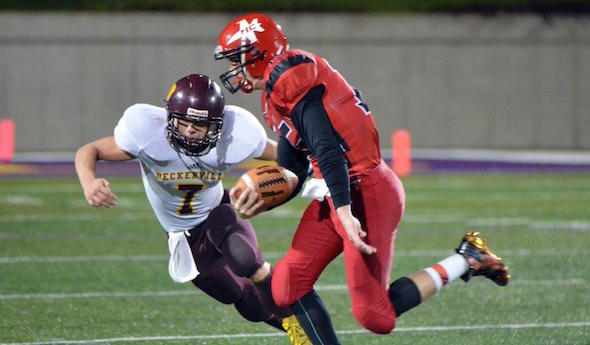
The first belonged to North Central, and the 6-foot-4, 210-pound Whitens in particular. In 2015, Kleiman became the first player in the then-five seasons of 8-player football to run for more than 200 yards in an MHSAA Final, finishing with 205. Whitens obliterated that record in the first quarter Friday, running for 231 yards and three touchdowns on only five carries as the Jets opened up a 20-0 lead.
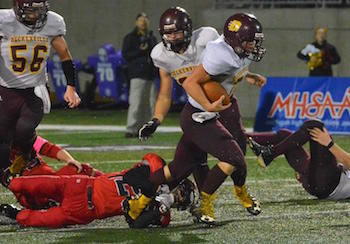 But Deckerville, also undefeated and making its first championship game appearance since winning 8-player in 2012, didn’t fold. In fact, the Eagles (11-1) rode the running of senior tailback Austin Fritch and senior quarterback Brandon Pattullo, who combined for 162 yards rushing and three touchdowns during the second quarter to put the Eagles up suddenly 22-20 with 1:57 to play before the break.
North Central had trailed only once before this season, into the third quarter Week 2 against Crystal Falls Forest Park before coming back to win 60-42.
“We’re not used to other people scoring on us and having close games,” Bobby Kleiman said. “But we played Crystal Falls two weeks ago (a 60-50 Regional Final rematch); they’re an exact replica of this team. We had one of the craziest games ever with them, and they really prepared us for this game.”
Indeed, Whitens scored on a 44-yard run a minute after Deckerville took its lead, and the Jets never trailed again. Kleiman added a 49-yard scoring run less than three minutes into the third quarter, and Whitens added 37 and 2-yard scoring runs and a 71-yard touchdown pass to senior Marcus Krachinski.
Whitens finished with an 8-Player Finals rushing record that may not be broken in some time, 352 yards on only 17 carries (20.7 yards per carry) with six touchdowns. His numbers could’ve been greater, or at least different if for just two plays, both dropped passes that likely would’ve resulted in touchdowns. Still, Whitens completed 6 of his 12 throws for 100 yards despite rain that blew sideways for most of the first three quarters.
Deckerville had given up only 50 points total this season and only 18 during the playoffs despite facing two other undefeated teams.
“We made a nice comeback there, but you’ve still got to keep going, and we weren’t able to make some plays,” Deckerville coach Bill Brown said. “We can’t give up big plays and expect to win. We don’t have a kid like that that can get 80-yard runs every time and score.”
Fritch and Pattullo did both finish with 133 yards rushing, Pattullo on only 12 carries for an average of 11.1 yards per attempt.
Kleiman added 123 yards rushing on 10 carries despite what North Central read as Deckerville aligning to stop him early on. That read led to Whitens’ big first quarter, including a 38-yard run on the first offense play of the game, on the “dart” quarterback keeper play that North Central continued to throw at the Eagles throughout the night.
 The addition of Friday’s performance gave Whitens 2,496 yards and 44 touchdowns passing this season, along with 943 yards and 22 touchdowns rushing.
He’s one of 11 seniors who played his last high school football game – and six of those seniors also played in last season’s Class D Basketball Final.
“This is the best class probably ever in the state, to do what they’ve done,” North Central coach Kevin Bellefeuil said. “Two basketball titles, two football titles, and they have to be a favorite to win a third one (in hoops).
“This is a special group of kids. We have the right mix of skill players, offensive linemen, linebackers; we have a little bit of everything.”
And some will take only a short break. Whitens said at first he’d be back to work for basketball Saturday morning. Then he self-corrected – he’ll wait until Monday instead.
“You’re never satisfied with who you were last year, or the day before. You’re always growing to get better each and every day of your life, and that’s how I go about my life,” Whitens said.
“We’ve got our eyes on the ultimate prize. This is our last year, last run at it, and we’re going to enjoy it. … I’m going to get home, join our community, let them bask in the glory with us. And then Monday morning, I’m ready to go.”
The MHSAA Football Finals are sponsored by the Michigan National Guard.
PHOTOS: (Top) Powers North Central quarterback Jason Whitens breaks away for one of his six rushing touchdowns Friday. (Middle) A Deckerville ball carrier works to get free of a North Central defender. (Below) Whitens confers with Jets coach Kevin Bellefeuil. (Photos by John Johnson/MHSAA.)