


MHSA(Q&)A: NFL official Ronald J. Winter
July 19, 2012
By Brian Spencer
Second Half
 Kalamazoo's Ron Winter has officiated in the National Football League for nearly two decades, and became a referee in 1999. But long before he joined the highest level of the game, he got his start on Michigan's high school fields.
Winter has officiated that sport at all three levels and also high school and college basketball. He's also served as a source of knowledge for officials around the state -- and an example for those hoping to start at the high school level and climb to the pros.
Winter remains registered as an MHSAA official, as he's been for 42 years. An associate professor emeritus of human performance and health education at Western Michigan University, Winter was appointed earlier this month to serve a two-year term on the Governor's Council on Physical Fitness, Health and Sports. The council focuses on increasing physical activity and health improvements.
He served on the WMU faculty first beginning in 1969 and then again from 1992-2008. Winter earned bachelor and master's degrees at Michigan State University.
Did you play any sports in high school or college?
I played football, basketball, baseball, and track in high school. However, once I got to Michigan State University, I started playing lacrosse. A couple guys that lived near me played lacrosse and asked me to come out to throw the ball around. After throwing with them a couple times they asked me to come out for the team. I ended up playing lacrosse for MSU for four years.
How did you decide to choose football as the sport you would officiate?
I started officiating as a student at MSU in their intramural program, officiating touch football and basketball. The next logical step was to then officiate in the high school leagues. From there, I began to proceed to all the different levels.
Are there specific requirements for becoming an NFL official?
The biggest requirement is experience. The progression that I went through went like this:
After officiating high school games, I went to the MIAA (Michigan Intercollegiate Athletic Association). They (MIAA) were looking for people that had 3-5 years of experience at the high school level. From there I went to the Mid-Continent conference. I wasn’t able to go to the Mid-American Conference because I was employed at Western Michigan University.
From there I went to the Big Ten. The Big Ten was looking for people with 5 to 10 years of experience in high school and people that had experience at different positions as an official. I ended up officiating in as a Big Ten football official for 10 years and a Big Ten basketball official for 15 years. I then submitted an application to the National Football League. Coincidentally, the NFL was scouting officials, and had followed me for four years before they finally asked me to be a part of the staff. The NFL decides on who they want to pursue through recommendations and personal interest. They look for personality traits as well as how (officials) carry themselves through different situations.
What has been your favorite level to officiate; High school, college or professional?
I enjoyed officiating all of them, but for different reasons.
I found high school to be the most fascinating because it’s all about the kids; they are playing the game for the love of the game. That is the purest sense of the sport. I loved being involved with kids simply because they love the game.
I found the Big Ten to be most exciting because of the kind of atmosphere that exists on a Big Ten campus on a Saturday afternoon. It’s electric. You don’t get that same sense or the same feel on Sunday afternoon in a pro stadium.
I found the NFL to be most intense. The NFL really has three or four different levels of play during the season. There is preseason play, the first third of the season, the second third of the season, and the last five games of the season. Each level is ramped up another notch as the season progresses. Playoffs are entirely different all together. In terms of the intensity and pure speed of the game, there is nothing like the NFL playoffs.
How important is getting along with your fellow officials on the field?
It’s imperatively important if you want to have a smooth and well-run game. This doesn’t mean that you have to buddy-buddy off the field, but on the field you have to be committed to one goal. We spend two or three hours on meetings Saturday afternoon to go over rules tests, tape, and more to prepare for the next game (and) to get over rough patches that develop on a personal level in a previous week. I need to know that the other six guys are focused and thinking about football like me. Everyone has to have confidence in one another. We spend plenty of time on Saturday to get to the point that we need to on Sunday.
What has been the most exciting game you’ve officiated?
I’ve been in plenty of exciting games from NFL playoff games, to the first Orange Bowl game, to the Rose Bowl, to the Division III Hope vs. Calvin basketball game, to when Indiana played Purdue in basketball. All of them were incredible to be a part of. During the Indiana vs. Purdue game, the arena was electric. The players, coaches, fans were intense. Everybody is totally focused on the game. Each coach had a tremendous respect for one another. Neither one wanted to show up or embarrass their counterpart. This game wasn’t that drastically different at the Division III level, however. The intensity of both was very similar.
Are there games that you get excited to officiate more than others, presently?
Not in terms of specific teams. It really just depends on the circumstances, of course. Pittsburgh vs. Baltimore is an intense game. The Jets vs. Patriots game is great. There are clearly rivalries that are very exciting to be a part of. The level of play and intensity of the athletes in the NFL is unmatched and can provide excitement every week.
What is the most difficult aspect of being a NFL official?
I would say that preparation and being able to maintain intensity on the field on Sunday are key aspects. The preparation is difficult because it’s time-consuming. It is a misconception that we simply show up on Sunday to work the game. By the time Sunday rolls around, I’ve spent over 20 hours during the week trying to prepare for a Sunday game. It isn’t hard in terms of physical labor, but difficult in terms of a time commitment. You have to have an understanding family to be in the occupational field that I am in.
Do you have any advice for aspiring officials who hope to make it to the league?
Practice, practice, practice. Be able to work any game at any level and get as much experience as you can. Be a good partner on the field. It takes time; it isn’t something that just happens. Like anything else, it takes practicing your trade to be able to make it to the top level.
Drive for Detroit: Playoff R3 Review
November 14, 2016
By Geoff Kimmerly
Second Half editor
We’ve reached the final two weeks of another Michigan high school football season. Our field of 272 teams four weeks ago is down to only 34. And some of these key games are coming down to every last inch and minute.
Six of nine divisions this weekend saw at least one winner emerge by three or fewer points. Edwardsburg and Chelsea went to overtime. Detroit Cass Tech and Saline entered undefeated and ended only a point apart.
See below for a glance at those two games and all 32 11-player Regional Finals and both 8-player Semifinals, with links to media coverage of notable results in each division.
Division 1
Detroit Cass Tech 43, Saline 42
It was hard to expect more from a matchup of undefeated Division 1 powers than what these two delivered Friday. Cass Tech (12-0) won an incredible seventh straight Regional championship in part on the running of Donovan Johnson, who gained 285 yards and scored four touchdowns on the ground – which balanced out nicely 241 yards and five running scores by Saline’s Connor Hibbard. The Hornets finished 11-1 for the second straight season after winning a third straight District title. Click for more from the Detroit News.
Other Regional Finals:
Detroit Catholic Central 28, Grandville 14 – This run has made it hard to remember that the Shamrocks (12-0) had a rare down year only two years ago, finishing 4-5; Ottawa-Kent Conference Red co-champion Grandville (10-2) was the latest playoff opponent to not come within two touchdowns of DCC, but did finish with its most wins since 1996.
Romeo 41, Clarkston 7 – The reigning Division 1 champion Bulldogs (9-3) needed a little time to really get rolling this fall, but like DCC they’ve also beaten all three playoff opponents by double digits; Clarkston (9-3) did finish two wins better than a year ago.
Utica Eisenhower 42, Southfield Arts & Technology 7 – The Eagles (12-0) have guaranteed their best record since 2003 with their first Regional title since 2011 after a second-straight five-touchdown win this postseason; Southfield Arts & Technology finished its inaugural season a strong 8-4.
Division 2
Lowell 22, Grand Rapids Forest Hills Central 19
Lowell’s climb against the Rangers wasn’t as steep as when the Red Arrows came back from a 17-point deficit to win their first meeting in Week 7. But Lowell still needed to score last – on a touchdown run by quarterback David Kruse six seconds into the fourth quarter – get ahead of Forest Hills Central for good. The second straight Regional title gave Lowell (12-0) that many wins for the second straight season as well; Forest Hills Central (9-3) finished off one of the best rebound runs statewide after going 2-7 in both 2014 and 2015. Click for more from the Grand Rapids Press.
Other Regional Finals:
Walled Lake Western 61, Fenton 21 – The Warriors (11-1) scored their season high to win a second straight Regional title and end a nine-game winning streak for Flint Metro League champion Fenton (9-3).
Detroit Martin Luther King 21, Temperance Bedford 7 – The reigning Division 2 champion Crusaders (10-2) have beaten all of their playoff opponents this time by at least 14; Bedford (9-3) gave King one of its closest games and finished five wins better than a year ago.
Birmingham Groves 44, Grosse Pointe South 10 – Groves (11-1) earned its first Regional title and attained 11 wins for the first time as well, running for 428 yards led by Ernest Allen’s 157 and Collin Heard’s 101; South (8-4) improved a win from last year and doubled its total from only two years ago.
Division 3
Edwardsburg 42, Chelsea 40 (OT)
The Eddies’ substantial run of success this decade now includes a second Regional title in three seasons and the first 12-win season in program history – and Edwardsburg (12-0) earned them by holding off a comeback by Chelsea and stopping a two-point conversion try in overtime. The Eddies’ last Semifinal appearance, in 2014, came in Division 4. Chelsea (11-1) was Division 3 runner-up last season and finished this two-year run a combined 23-3. Click for more from the South Bend Tribune.
Other Regional Finals:
Muskegon 62, Byron Center 7 – The O-K Black champ Big Reds (9-3) won their fourth Regional title in five seasons while ending the winningest season for O-K Green champ Byron Center (10-2) since 2000.
Orchard Lake St. Mary’s 35, DeWitt 28 – The Panthers (10-2) led into the third quarter before St. Mary’s (8-4) outscored them 21-7 in the fourth to win a third straight Regional title.
Dearborn Divine Child 28, Allen Park 21 – The Falcons (10-2) continued another of the state’s great comeback seasons, adding a 10th win and Regional title for the first time since 1985 after going 4-5 a year ago; Allen Park (11-1) finished a win better than last season and with its most since 2004 in winning a second straight District title.
Division 4
Detroit Country Day 28, Corunna 13
Country Day won its third straight Regional title and fourth in five seasons by holding the Cavaliers to 133 yards of total offense and getting some key tosses from quarterback Jalen Graham (10 of 15 passing for 123 yards and a touchdown). The Yellowjackets (12-0) jumped out to a 21-7 lead and now have their most wins in a season since 1995. Corunna (9-3) continued its climb from 2-7 two seasons ago to 8-2 last year and this fall its most wins since 2002. Click for more from the Oakland Press.
Other Regional Finals:
River Rouge 57, Adrian 20 – The Panthers (11-1) have won their playoff games by 61, 12 and now 37 points on the way to a second straight Regional title; Adrian finished its rebound season 7-5 after three straight 2-7 seasons and four straight with sub-.500 records.
Grand Rapids Catholic Central 34, Escanaba 0 – The Cougars (11-1) are in their first Semifinal since their championship season of 2010 and with their third shutout in four weeks; Escanaba (9-3) can celebrate another jump in its revival after improving from 5-5 a year ago with its most wins since 1989.
Hudsonville Unity Christian 36, Lake Odessa Lakewood 16 – The Crusaders’ first Regional title came in part on the legs of running back Alec Headley, who averaged 16.1 yards per carry gaining 177 of 424 rush yards total for Unity Christian (10-2); Lakewood’s winningest season ended at 10-2 as well.
Division 5
Frankenmuth 28, Ithaca 20
Frankenmuth (11-1) won its first Regional title since 1997 by handing Ithaca (11-1) only its third loss over the team’s last 100 games and first not in an MHSAA championship game since 2009. The Eagles are 48-8 over their last five seasons but had made only one other Regional Final appearance since their last win at that level of the tournament. Three Frankenmuth runners had at least 99 yards on the ground, led by Kris Roche with 161, as the team came back from a 14-0 deficit. Click for more from the Saginaw News.
Other Regional Finals:
Menominee 40, Reed City 14 – The Maroons (11-1) won their fifth Regional title in seven seasons with a fourth straight game scoring 40 or more points; Reed City (11-1) hadn’t given up 40 in a game since its 2014 Regional Final, but did finish with its most wins in a season ever.
Grand Rapids West Catholic 40, Berrien Springs 7 – The Falcons (10-2) have survived three road games to also win a seventh straight Regional title, continuing their travels by ending a third straight playoff season for the Shamrocks (8-3).
Algonac 38, Ida 22 – Last season Ida won its first Regional title; this time Algonac (11-1) celebrated its first Regional championship by downing the Bluestreaks (10-2).
Division 6
Leroy Pine River 42, Ravenna 14
The mood had to be a little low for Pine River heading into the playoffs coming off two straight losses, but you’d never be able to tell. The Bucks (9-3) – also just 4-5 last season – won their first Regional title in a big way over Ravenna (9-3), a traditional power but also a nice comeback story coming off a 3-6 finish in 2015. Click for more from the Big Rapids News.
Other Regional Finals:
Maple City Glen Lake 14, Calumet 0 – The Lakers (10-2) reached 10 wins for the first time since 2001 with their first Regional title since 1996, ending the first 10-win season ever for Calumet (10-2), which was coming off its first District title since 2006.
Millington 22, Detroit Central Collegiate 20 – The Cardinals (11-1) came back from a 20-0 halftime deficit to win their first Regional title since 2010 and third since 2009; Central Collegiate (7-5) capped a third straight playoff season with its most wins since 2010.
Jackson Lumen Christi 49, Napoleon 6 – The Titans (10-2) won their first Regional title since 2009 by ending Napoleon’s winningest season since 2002 and longest playoff run ever at 9-3.
Division 7
Pewamo-Westphalia 17, Traverse City St. Francis 14
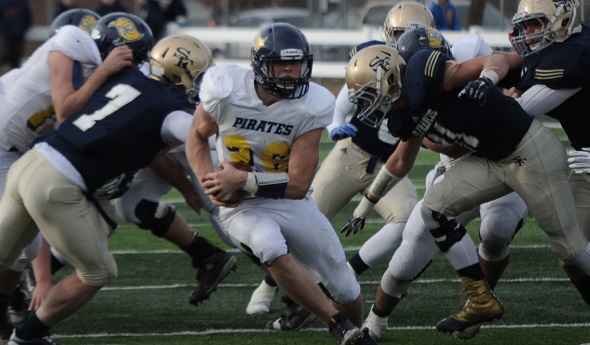
Arguably the most anticipated game statewide this side of Division 1 saw the reigning Division 7 runner-up Pirates (12-0) overcome a second straight undefeated opponent. The Gladiators (11-1) became the first team to hold P-W running back Jared Smith to fewer than 100 yards since his sophomore season two years ago, but the Pirates’ defense held St. Francis to its fewest points since last year’s Regional Final win over Boyne City. Click for more from the Traverse City Record-Eagle.
Other Regional Finals:
Ubly 22, New Lothrop 13 – Make this now the Bearcats’ best season since 2009 as they won their first Regional title and 12 games for the first time since that year; Ubly (12-0) got rushing and receiving touchdowns from Jonathan Brandel as it ended New Lothrop’s seventh straight 10-win season at 10-2.
Cassopolis 51, Concord 14 – The Rangers (11-1) set a program record for wins with their first Regional title by scoring the most points Concord (9-3) had given up since Week 8 of 2014; the Yellowjackets did finish this season with their most wins since 2001.
Detroit Loyola 36, Hudson 13 – The Bulldogs (10-2) attained a sixth straight 10-win season by beating a third league champion in three playoff games; Hudson (10-2) had won a share of the Lenawee County Activities Association title and was making its first Regional Final appearance since 2011.
Division 8
St. Ignace 14, Norway 12
The Saints (11-1) have had only two other close games this season, but secured their second straight Regional title relying on a defense that has given up only 131 points this season and only 38 over three playoff games. Norway, playing for its first Regional title since 2006, also shined defensively holding down a St. Ignace offense averaging 42 points per game heading into the day. The Knights finished 9-3, making a significant jump from 2-7 a year ago. Click for more from the Sault Ste. Marie Evening News.
Other Regional Finals:
Muskegon Catholic Central 35, Frankfort 0 – The reigning Division 8 champion Crusaders (12-2) earned their second straight shutout of the playoffs by holding Frankfort (11-1) scoreless for the first time since 2013.
Saginaw Michigan Lutheran Seminary 28, Royal Oak Shrine 7 – The Cardinals (10-2) clinched a third-straight 10-win season and second Regional title in three seasons; Shrine (9-3) did accomplish a nice bounce-back from 4-5 last season to win its first District title since 2008.
Ottawa Lake Whiteford 38, Climax-Scotts 18 – These two have met two straight postseasons as undefeated teams, and Whiteford (12-0) has won both meetings; the Bobcats made up for three turnovers by getting 100-plus yards rushing from both Logan Murphy and Jesse Kiefer and holding Climax-Scotts (11-1) to its fewest points since the teams met in the same round a year ago.
8-Player
Powers North Central 62, Pickford 22
The reigning champion Jets (12-0) earned their return to the MHSAA Final with 40 first-half points and 506 total yards while possessing the ball only 14 minutes. Running back Bobby Kleiman gained 123 yards on only eight carries, scoring three time on the ground, and also caught three passes for 98 yards and a score. The Panthers did finish their winningest season since 1991 at 10-2. Click for more from the Iron Mountain Daily News.
Deckerville 36, Wyoming Tri-unity Christian 6
The Eagles won a matchup of undefeated teams to set up another this weekend, handing Tri-unity Christian (11-1) its first and only loss of the fall. Deckerville (11-0) was held to its fewest points since Week 1, but still hasn’t allowed an opponent to score more than 12 this season. The Eagles had fallen in Semifinals the last two seasons. Click for more from the Huron Daily Tribune.
PHOTO: Pewamo-Westphalia running back Jared Smith breaks into an opening as Traverse City St. Francis defenders converge. (Click to see more from HighSchoolSportsScene.com.)