


MHSA(Q&)A: NFL official Ronald J. Winter
July 19, 2012
By Brian Spencer
Second Half
 Kalamazoo's Ron Winter has officiated in the National Football League for nearly two decades, and became a referee in 1999. But long before he joined the highest level of the game, he got his start on Michigan's high school fields.
Winter has officiated that sport at all three levels and also high school and college basketball. He's also served as a source of knowledge for officials around the state -- and an example for those hoping to start at the high school level and climb to the pros.
Winter remains registered as an MHSAA official, as he's been for 42 years. An associate professor emeritus of human performance and health education at Western Michigan University, Winter was appointed earlier this month to serve a two-year term on the Governor's Council on Physical Fitness, Health and Sports. The council focuses on increasing physical activity and health improvements.
He served on the WMU faculty first beginning in 1969 and then again from 1992-2008. Winter earned bachelor and master's degrees at Michigan State University.
Did you play any sports in high school or college?
I played football, basketball, baseball, and track in high school. However, once I got to Michigan State University, I started playing lacrosse. A couple guys that lived near me played lacrosse and asked me to come out to throw the ball around. After throwing with them a couple times they asked me to come out for the team. I ended up playing lacrosse for MSU for four years.
How did you decide to choose football as the sport you would officiate?
I started officiating as a student at MSU in their intramural program, officiating touch football and basketball. The next logical step was to then officiate in the high school leagues. From there, I began to proceed to all the different levels.
Are there specific requirements for becoming an NFL official?
The biggest requirement is experience. The progression that I went through went like this:
After officiating high school games, I went to the MIAA (Michigan Intercollegiate Athletic Association). They (MIAA) were looking for people that had 3-5 years of experience at the high school level. From there I went to the Mid-Continent conference. I wasn’t able to go to the Mid-American Conference because I was employed at Western Michigan University.
From there I went to the Big Ten. The Big Ten was looking for people with 5 to 10 years of experience in high school and people that had experience at different positions as an official. I ended up officiating in as a Big Ten football official for 10 years and a Big Ten basketball official for 15 years. I then submitted an application to the National Football League. Coincidentally, the NFL was scouting officials, and had followed me for four years before they finally asked me to be a part of the staff. The NFL decides on who they want to pursue through recommendations and personal interest. They look for personality traits as well as how (officials) carry themselves through different situations.
What has been your favorite level to officiate; High school, college or professional?
I enjoyed officiating all of them, but for different reasons.
I found high school to be the most fascinating because it’s all about the kids; they are playing the game for the love of the game. That is the purest sense of the sport. I loved being involved with kids simply because they love the game.
I found the Big Ten to be most exciting because of the kind of atmosphere that exists on a Big Ten campus on a Saturday afternoon. It’s electric. You don’t get that same sense or the same feel on Sunday afternoon in a pro stadium.
I found the NFL to be most intense. The NFL really has three or four different levels of play during the season. There is preseason play, the first third of the season, the second third of the season, and the last five games of the season. Each level is ramped up another notch as the season progresses. Playoffs are entirely different all together. In terms of the intensity and pure speed of the game, there is nothing like the NFL playoffs.
How important is getting along with your fellow officials on the field?
It’s imperatively important if you want to have a smooth and well-run game. This doesn’t mean that you have to buddy-buddy off the field, but on the field you have to be committed to one goal. We spend two or three hours on meetings Saturday afternoon to go over rules tests, tape, and more to prepare for the next game (and) to get over rough patches that develop on a personal level in a previous week. I need to know that the other six guys are focused and thinking about football like me. Everyone has to have confidence in one another. We spend plenty of time on Saturday to get to the point that we need to on Sunday.
What has been the most exciting game you’ve officiated?
I’ve been in plenty of exciting games from NFL playoff games, to the first Orange Bowl game, to the Rose Bowl, to the Division III Hope vs. Calvin basketball game, to when Indiana played Purdue in basketball. All of them were incredible to be a part of. During the Indiana vs. Purdue game, the arena was electric. The players, coaches, fans were intense. Everybody is totally focused on the game. Each coach had a tremendous respect for one another. Neither one wanted to show up or embarrass their counterpart. This game wasn’t that drastically different at the Division III level, however. The intensity of both was very similar.
Are there games that you get excited to officiate more than others, presently?
Not in terms of specific teams. It really just depends on the circumstances, of course. Pittsburgh vs. Baltimore is an intense game. The Jets vs. Patriots game is great. There are clearly rivalries that are very exciting to be a part of. The level of play and intensity of the athletes in the NFL is unmatched and can provide excitement every week.
What is the most difficult aspect of being a NFL official?
I would say that preparation and being able to maintain intensity on the field on Sunday are key aspects. The preparation is difficult because it’s time-consuming. It is a misconception that we simply show up on Sunday to work the game. By the time Sunday rolls around, I’ve spent over 20 hours during the week trying to prepare for a Sunday game. It isn’t hard in terms of physical labor, but difficult in terms of a time commitment. You have to have an understanding family to be in the occupational field that I am in.
Do you have any advice for aspiring officials who hope to make it to the league?
Practice, practice, practice. Be able to work any game at any level and get as much experience as you can. Be a good partner on the field. It takes time; it isn’t something that just happens. Like anything else, it takes practicing your trade to be able to make it to the top level.
Camden-Frontier Enjoys 8-Player Rebirth
By
Chip Mundy
Special for Second Half
October 20, 2016
By Chip Mundy
Special for Second Half
CAMDEN – When it comes to football at Camden-Frontier, fewer is better.
Three times better.

After enduring back-to-back winless seasons in 2014-15, Camden-Frontier made the switch from 11- to 8-player football. The result? The Redskins are 5-1 this season with a shot at making the MHSAA playoffs.
Camden, a farming village with 512 residents in the 2010 census, is nestled in a tri-state area just two miles east of the Michigan/Indiana border and 4 miles north of the Michigan/Ohio border. Frontier is a civil township just 11 miles northeast of Camden.
The school sits between the two along a peaceful country road that is void of traffic and other structures. Except on football weekends. This fall, the communities have connected with the football team and its success, even though the 8-player format wasn't embraced at the start, even by many of the players.
“At first, they didn't know how it was going to go,” said Ryan Sigler, athletic director and assistant football coach. “It was brand new to them, but it didn't take very long for them to see what it was going to be like. We did lose maybe six or seven kids who aren't playing and should be playing. They decided it wasn't for them, but I think after seeing how this year went and what's coming in the future, I think they will come back.
“It has been a positive experience, and the morale in the school is higher than it's ever been.”
Making the switch
After the second consecutive winless season in 2015, Camden-Frontier's football coach resigned, and the search was on for a new coach. In the process, switching to 8-player football became a possibility.
“I am a firm believer in JV football, and I want our kids to be able to play JV football,” Sigler said. “With our low numbers – I think we were 22 or 23 in our whole program last year – you're not going to have JV games because you take half of your kids and they go right to varsity.”
When Waldron football coach Mark Long's name popped into the discussion, Sigler and Camden-Frontier Superintendent Scott Riley explored the idea of going to 8-player. Not only did Long have experience and success in 8-player football at Waldron, Sigler and Riley could not get past the failures of the Redskins in the previous two seasons.
“Last year, we scored two touchdowns – one on offense and one on defense,” Sigler said. “The year before, we scored four touchdowns total.
“Scott and I kind of got talking, and we decided that Mark would be the right guy. He came to us in the process and said, 'If I come, I want to go 8-man football.' We kind of talked back and forth, what it would do for the program and how it would help us.”
Long agreed to leave Waldron, his hometown, to pursue a fresh, new challenge at Camden-Frontier.
“I had been coaching at Waldron for about 16 years,” he said. “I coached basketball and football, I was the athletic director, and we were extremely successful in football.
“I had the opportunity to go to Camden-Frontier and coach and take them from 11-man to 8-man, and it was something that I thought would be a good challenge.”
While Long's challenge was on the field, Sigler had to put together a schedule of 8-player teams. It was too late to join the Southern Michigan 8-man Football League, so he ended up with just a seven-game schedule, including a drive of 5 hours, 30 minutes that covered 298 miles to Pellston, which is just south of the Mackinac Bridge.
“We were not able to get into the league schedule, but we will be back in next year,” Sigler said. “We just got in too late, and we didn't want to break any contracts.
“Mark knew a lot of 8-man teams, so we could set our schedule, and we were able to get seven games. I wish we would have gotten at least eight. We're right in the mix for a playoff spot. It could come back to bite us that we only had a seven-game schedule.”
Making the sell
While setting the schedule at late notice was tough, selling 8-player football to a bunch of young men who had played only 11-player football was going to be tougher. Six or seven quit the program, but slowly the others bought into the new format.
“I was set on not playing varsity at all,” sophomore fullback/middle linebacker Cole Mapes said. “I heard that we were going to stay at 11-man for JV, and I didn't care for 8-man.
“Then I started seeing what was going on, and I saw how much dedication that Coach Mark put into it. With 11-man, we had no hope.”
Others slowly but surely accepted the new format. Long said the younger players were more open to the switch than the older players at first.
“A lot of the sophomores started showing up on Day 1 in the weight room and the 7-on-7s in the summer,” he said. “The young kids really bought into it quickly.”
Some of the veteran players, like junior guard/defensive end Austin Zilka, were more apprehensive about the move.
“My initial thought was, 'Why are we changing?'” Zilka said. “I understood that we hadn't had the best record, but I didn't understand why we were changing.
“I never thought about not playing because either way, when you pad up and get hit, it feels the same whether there are eight men on the field or 11 men. It took me about two weeks to get adjusted and (I) realized that I had no choice if I wanted to play football. Now, if I had a choice, I like that we're winning, but I like the teams that we played in 11-man. But I think I'd stick with 8-man.”
With the players buying into the program and the success, Sigler is hopeful players who decided not to play this season will return to the program next season.
“They decided it wasn't for them, but I think after seeing how this year went and what's coming in the future, I think they will come back,” he said.
Early wins – and doubts
Camden-Frontier started the season quickly, but not everybody was impressed. The 86-8 opening-game victory, along with wins by 56-0 and 50-0, left many in the community wondering if it all was simply because of the level of competition.
That question was to be answered in Week 5. On a Saturday – and Homecoming – Camden-Frontier hosted 8-player power Battle Creek St. Phillip, a team that lost in the MHSAA championship game in 2015 and had started its season 4-0.
 “I kind of felt uneasy just scheduling them,” Sigler said. “We had a bye week before we played St. Philip, so we prepared for two weeks. We're preaching the whole time that we have to prove that we're the type of football team that we want to be, and it is going to take hard work. We had the best two weeks of practice that we had all year.”
It turned out to be a signature moment of the season. The Redskins shut out St. Philip 22-0, and suddenly that 8-player football team that had beaten four nobodies in the eyes of the community was now the apple of the community's eye.
“It was huge for the community to see that there are other good 8-man football teams and there's going to be a lot tougher competition down the road,” Long said.
And the attitude toward the football team changed.
“We went into that game thinking that they were going to be good, and by all means they were, and it was one of the defining moments that we had as a team,” Zilka said. “And it proved to all the people that said, 'You guys beat a team that isn't very good 86-8, and you're not very good.' It showed that we're here to make a statement.
“They realized that we can play pretty good football and be a good 8-man team, and they kept encouraging us and it helped.”
Expectations from fans also were not negative as they had been in previous years.
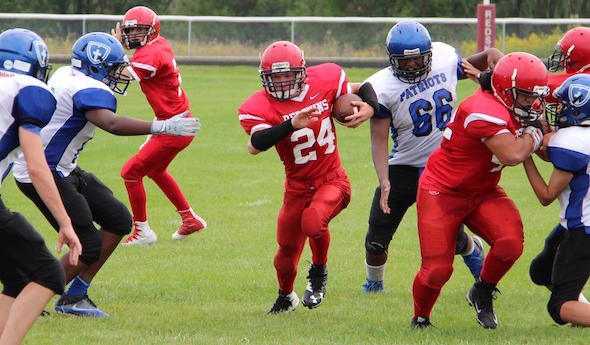
“The atmosphere at the football games is a lot better,” sophomore running back/outside linebacker Cale Lehman said. “People expected us to lose, and now it's like they know we have a chance at winning.”
Suddenly, following the Redskins was bordering on an epidemic.
“It was awesome,” Sigler said. “I've noticed a lot more people are staying longer at our games now. You'll have the parents who come out and stay for their kids, but families and others are coming out and staying for the whole game.
“We drove up to Pellston for a game – it was a five and a half hour drive – and we had more people in the stands than they had, and it was Parents' Night. It's been awesome how the parents and community have run with this. We had a full set of stands at Lawrence. People have really bought into this and gotten on board with it.”
Camden-Frontier lost to Lawrence 32-8 in a battle of unbeatens, and the next week was the trek to Pellston. Not many high school teams from small towns get to have a road game that includes an overnight stay.
“We went up Friday after school,” Sigler said. “Our middle school coach runs a logging company, and his logging company donated hotel rooms for us. Tight-knit communities do things for each other.
“We drove up and had the kids bring snacks and food and when we got out there, we grilled outside. It was awesome. We had hamburgers, hot dogs, chips, all that stuff. After that, we went and bowled for two hours, just to get them doing something fun and to relax.”
Then, on Saturday, the Redskins defeated Pellston 58-12.
“It was a team-bonding experience as well as a game,” Zilka said. “We had fun, and then we did what we came up there to do.”
Several parents who made the trip took their sons to see the Mackinac Bridge after the game.
“Some of those kids had never seen the bridge,” Sigler said. “Most of the parents went, and a lot of them surprised the players and took them to the bridge after the game. It was a cool experience.”
One hurdle remains
The season has been a full one. A switch from 11- to 8-player football. A new coach. New opponents on the schedule. A huge Homecoming victory. A 298-mile trip and a visit to the Mackinac Bridge.
What possibly could remain? How about this scenario: Camden-Frontier sits in the No. 16 spot in the points race for the playoffs. Sixteen teams qualify for the 8-player playoffs, and the Redskins need to win and maybe get a little help to secure their first postseason berth since 2000.
Tonight, Camden-Frontier will visit Waldron – yes, the same Waldron that was coached by Long for several years and is his hometown. A better script could not be written for the final game in the regular season with the playoffs on the line.
“I live in Waldron and my daughter goes to Waldron,” Long said. “I coached there and grew up there and played there, so it will be emotional for me and a little tough, but hopefully when the game starts, it will be just another game.”
While Waldron remains home, getting the chance to coach at a new place has been refreshing for Long.
“It has been a rejuvenation,” he said. “It's no different than a job. Once you've been someplace for a certain amount of time, you become complacent. I'm around new kids, but I really still care about the kids I coached at Waldron.”
And he has a great appreciation for the communities of Camden and Frontier and his new team of players.
“For them to come in and buy in – and the community to buy into 8-man football the way that they have – has been a blessing for me,” he said. “They have accepted me from Day One, and I can't say thank you enough.”
With newfound success, don't expect Camden-Frontier to rush back to 11-player football. But Sigler said never say never.
“I think we will stay here for a while, but I wouldn't say that we'll never go back to 11-man again, either,” Sigler said. “But it's not likely anytime soon.”
“The biggest misconception is that a lot of people look down on 8-man football. I didn't know at first if it was right for us, but I'm glad we did it. Obviously."
 Chip Mundy served as sports editor at the Brooklyn Exponent and Albion Recorder from 1980-86, and then as a reporter and later copy editor at the Jackson Citizen-Patriot from 1986-2011. He also co-authored Michigan Sports Trivia. E-mail him at [email protected] with story ideas for Jackson, Washtenaw, Hillsdale, Lenawee and Monroe counties.
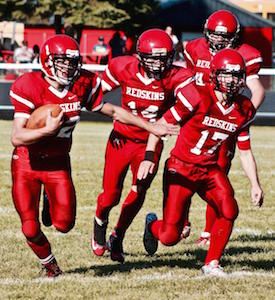
PHOTOS: (Top) Sophomore running back Cale Lehman finds an opening against Elyria Open Door Christian of Ohio. (Middle) Junior running back Hunter Fackler carries the ball as Austin Bennett (14) and Logan Barnes (17) provide blocking. (Photos by Matthew Lounsberry and Andrew King/Hillsdale Daily News.)