


MHSA(Q&)A: NFL official Ronald J. Winter
July 19, 2012
By Brian Spencer
Second Half
 Kalamazoo's Ron Winter has officiated in the National Football League for nearly two decades, and became a referee in 1999. But long before he joined the highest level of the game, he got his start on Michigan's high school fields.
Winter has officiated that sport at all three levels and also high school and college basketball. He's also served as a source of knowledge for officials around the state -- and an example for those hoping to start at the high school level and climb to the pros.
Winter remains registered as an MHSAA official, as he's been for 42 years. An associate professor emeritus of human performance and health education at Western Michigan University, Winter was appointed earlier this month to serve a two-year term on the Governor's Council on Physical Fitness, Health and Sports. The council focuses on increasing physical activity and health improvements.
He served on the WMU faculty first beginning in 1969 and then again from 1992-2008. Winter earned bachelor and master's degrees at Michigan State University.
Did you play any sports in high school or college?
I played football, basketball, baseball, and track in high school. However, once I got to Michigan State University, I started playing lacrosse. A couple guys that lived near me played lacrosse and asked me to come out to throw the ball around. After throwing with them a couple times they asked me to come out for the team. I ended up playing lacrosse for MSU for four years.
How did you decide to choose football as the sport you would officiate?
I started officiating as a student at MSU in their intramural program, officiating touch football and basketball. The next logical step was to then officiate in the high school leagues. From there, I began to proceed to all the different levels.
Are there specific requirements for becoming an NFL official?
The biggest requirement is experience. The progression that I went through went like this:
After officiating high school games, I went to the MIAA (Michigan Intercollegiate Athletic Association). They (MIAA) were looking for people that had 3-5 years of experience at the high school level. From there I went to the Mid-Continent conference. I wasn’t able to go to the Mid-American Conference because I was employed at Western Michigan University.
From there I went to the Big Ten. The Big Ten was looking for people with 5 to 10 years of experience in high school and people that had experience at different positions as an official. I ended up officiating in as a Big Ten football official for 10 years and a Big Ten basketball official for 15 years. I then submitted an application to the National Football League. Coincidentally, the NFL was scouting officials, and had followed me for four years before they finally asked me to be a part of the staff. The NFL decides on who they want to pursue through recommendations and personal interest. They look for personality traits as well as how (officials) carry themselves through different situations.
What has been your favorite level to officiate; High school, college or professional?
I enjoyed officiating all of them, but for different reasons.
I found high school to be the most fascinating because it’s all about the kids; they are playing the game for the love of the game. That is the purest sense of the sport. I loved being involved with kids simply because they love the game.
I found the Big Ten to be most exciting because of the kind of atmosphere that exists on a Big Ten campus on a Saturday afternoon. It’s electric. You don’t get that same sense or the same feel on Sunday afternoon in a pro stadium.
I found the NFL to be most intense. The NFL really has three or four different levels of play during the season. There is preseason play, the first third of the season, the second third of the season, and the last five games of the season. Each level is ramped up another notch as the season progresses. Playoffs are entirely different all together. In terms of the intensity and pure speed of the game, there is nothing like the NFL playoffs.
How important is getting along with your fellow officials on the field?
It’s imperatively important if you want to have a smooth and well-run game. This doesn’t mean that you have to buddy-buddy off the field, but on the field you have to be committed to one goal. We spend two or three hours on meetings Saturday afternoon to go over rules tests, tape, and more to prepare for the next game (and) to get over rough patches that develop on a personal level in a previous week. I need to know that the other six guys are focused and thinking about football like me. Everyone has to have confidence in one another. We spend plenty of time on Saturday to get to the point that we need to on Sunday.
What has been the most exciting game you’ve officiated?
I’ve been in plenty of exciting games from NFL playoff games, to the first Orange Bowl game, to the Rose Bowl, to the Division III Hope vs. Calvin basketball game, to when Indiana played Purdue in basketball. All of them were incredible to be a part of. During the Indiana vs. Purdue game, the arena was electric. The players, coaches, fans were intense. Everybody is totally focused on the game. Each coach had a tremendous respect for one another. Neither one wanted to show up or embarrass their counterpart. This game wasn’t that drastically different at the Division III level, however. The intensity of both was very similar.
Are there games that you get excited to officiate more than others, presently?
Not in terms of specific teams. It really just depends on the circumstances, of course. Pittsburgh vs. Baltimore is an intense game. The Jets vs. Patriots game is great. There are clearly rivalries that are very exciting to be a part of. The level of play and intensity of the athletes in the NFL is unmatched and can provide excitement every week.
What is the most difficult aspect of being a NFL official?
I would say that preparation and being able to maintain intensity on the field on Sunday are key aspects. The preparation is difficult because it’s time-consuming. It is a misconception that we simply show up on Sunday to work the game. By the time Sunday rolls around, I’ve spent over 20 hours during the week trying to prepare for a Sunday game. It isn’t hard in terms of physical labor, but difficult in terms of a time commitment. You have to have an understanding family to be in the occupational field that I am in.
Do you have any advice for aspiring officials who hope to make it to the league?
Practice, practice, practice. Be able to work any game at any level and get as much experience as you can. Be a good partner on the field. It takes time; it isn’t something that just happens. Like anything else, it takes practicing your trade to be able to make it to the top level.
Drive for Detroit: Week 5 in Review
September 29, 2014
By Geoff Kimmerly
Second Half editor
No set up is needed to explain the significance of many of the games played across Michigan during Week 5 of the MHSAA football season.
The scores speak for themselves.
Read on for some of the details behind a wide array of results that wowed many over this weekend.
In addition, Ishpeming (5-0) became the first playoff qualifier for 2014, and Battle Creek St. Philip put up one of the most incredible point totals in MHSAA history – 89 points after trailing early in its 8-player win.
Total, seven games this weekend saw teams combine to score more than 100 points – while six games saw both teams score in single digits, including one of the matchups highlighted below.
Bay and Thumb
Goodrich 41, Montrose 39
The game of the season in the Genesee Area Conference Red was shaping up as Montrose vs. Flint Beecher on Oct. 17 – until Goodrich changed things up substantially by ending the Rams’ 22-game league winning streak. That Beecher/Montrose matchup might still decide part of the league title – but Goodrich is back in play as a contender. Click for more from the Flint Journal.
Also noted:
Almont 23, Richmond 6 – The Raiders (5-0) remained perfect while ending a 12-game Blue Water Area Conference winning streak for Richmond (4-1).
Lapeer 63, Mount Pleasant 0 – This is the most impressive win of an early run by the first-year Lightning (5-0), which looks like the Saginaw Valley Association Red favorite after dominating the Oilers (3-2).
Burton Atherton 34, Flint Hamady 22 – Atherton (4-1) still trails in the Genesee Area Conference Blue by a win, but knocked Hamady (4-1) out of a tie for first.
Millington 30, North Branch 29 – Only a week after a huge win over rival Frankenmuth, Millington (5-0) just survived against the Broncos (1-4) to remain atop the Tri-Valley Conference East.
Southwest and Border
Battle Creek Lakeview 27, Stevensville Lakeshore 0
Lakeview has had plenty of success the last few seasons and is 19-3 over its last 22 games, two playoff losses included. But this might be the most impressive win of the run – although Lakeshore plays in the Southwest Michigan Athletic Conference East and Lakeview in the West, the Spartans (3-1) still should celebrate their first win (and in impressive fashion) over the Lancers (4-1) since 2001. Click for more from the Battle Creek Enquirer.
Also noted:
Battle Creek Central 21, St. Joseph 10 – The Bearcats (3-2) already have their most wins since 2008 and now an upset of one of the best teams annually from the southwest in St. Joseph (3-2).
Plainwell 31, Vicksburg 21 – The Wolverine B Conference East title may have been decided Friday, with Plainwell (4-1) bouncing back from a Week 4 loss to slow the upstart Bulldogs (4-1).
Paw Paw 62, Edwardsburg 57 – The favorites in the Wolverine B West also met and combined for more than 100 points for the second straight season as Paw Paw (3-2) took a 2-1 advantage on Edwardsburg (4-1) in their recent series.
South Haven 34, Dowagiac 28 – South Haven (2-3) hadn’t beaten Dowagiac since 2007 – or scored a point on the Chieftains (2-3) since 2011.
Lower Up North
Boyne City 28, Traverse City St. Francis 27 (OT)
This victory will become "legendary" if it ends up deciding the first Northern Michigan Football Conference Legends title. Boyne City (5-0) held on to first place after choosing to go for a 2-point conversion instead of an extra point that would’ve instead sent the game into a second overtime. Both losses for St. Francis (3-2) this season have come in OT. Click for more from the Petoskey News.
Also noted:
Traverse City Central 18, Gaylord 7 – The Big North Conference race is getting whittled down, with Central (4-1) putting much improved Gaylord (4-1) a game back of the leaders.
Suttons Bay 48, Charlevoix 19 – The Norsemen (4-1) with a win over East Jordan this week can clinch a share of the NMFC Legacy title; Charlevoix (2-3) must win out to guarantee a playoff berth.
Manistee 30, McBain 20 – The Chippewas (4-1) broke a four-game losing streak to McBain (2-3) to surpass last season’s win total with four more games to play.
Whittemore-Prescott 34, Lincoln Alcona 0 – The Cardinals (5-0) clinched a share of the North Star League’s Huron Shores title, although Alcona (3-2) can still gain a share with some Week 7 help from Rogers City.
Greater Detroit
Clarkston 42, Oxford 14
Clarkston (5-0) left no doubt which is the top team again in the Oakland Activities Association Red, downing Oxford (4-1) to go with previous wins over Rochester Hills Stoney Creek and surprise contender West Bloomfield. The Wolves, defending MHSAA Division 1 champions, broke open the game at the end of the first half and pulled away during the second. Click for more from the Detroit Free Press.
Also noted:
West Bloomfield 39, Lake Orion 0 – The Lakers (4-1) are off to their best start since 2000 with their only loss to Clarkston; Lake Orion (2-3) finds itself needing to win out to avoid missing the playoffs for the first time since 2000.
Farmington Hills Harrison 34, Southfield 27 (3 OT) – Harrison (4-1) kept its hopes alive for a share of the OAA White title, but now needs help from Southfield (3-2) against league leader Oak Park in Week 8.
Waterford Mott 20, Walled Lake Western 17 – Mott (4-1) equaled its highest win totals of the last six seasons and kept a share of the top spot in the Kensington Lakes Activities Association North by upending reigning champion Western (4-1).
Warren Woods-Tower 16, Madison Heights Madison 14 – Madison (4-1) had won 20 straight regular-season games, although Woods-Tower (5-0) nearly broke the streak in 2013 after becoming the first to fall in 2012.
West Michigan
Caledonia 42, Rockford 0
Caledonia opened this season with two impressive wins and looked like a team to watch until then falling to 2-2 (although those losses were to talented teams as well). Put the Fighting Scots (3-2) back on the watch list; over the last decade, only powerhouse Muskegon has managed to put this kind of loss on Rockford (4-1). Click for more from the Grand Rapids Press.
Also noted:
Grand Rapids Christian 35, Hudsonville 34 – Only the shock of the above result kept this from being the area’s most intriguing game of the weekend; Christian (4-1) scored the go-ahead points during the final minutes, delivering Hudsonville (3-2) its second one-point loss in successive weeks.
Grandville Calvin Christian 29, Wyoming Godwin Heights 28 – The Squires (2-3) trail by a win in the O-K Silver standings but still have hope for the playoffs after giving Godwin Heights (4-1) its first loss.
Grand Rapids South Christian 41, Grand Rapids Catholic Central 14 – Just when it looked like the Sailors (3-2) might struggle after opening with two losses (albeit against strong teams), they’re looking good to win out in the O-K Gold; GRCC (2-3) must do the same to guarantee a seventh straight playoff berth.
Muskegon Oakridge 36, Ravenna 20 – Oakridge (4-1) still owns supremacy in the West Michigan Conference although Ravenna (4-1) is poised to take a share of the league title if the Eagles fall over the next three weeks.
Mid-Michigan
Manchester 18, Hanover-Horton 16
The Flying Dutchmen dissolved a little of the thrill of Hanover-Horton’s turnaround season with a goalline stand that set up this week’s likely Cascades Conference championship game against Grass Lake. Both are undefeated in conference play – Manchester (4-1 overall) has played one more game – while Hanover-Horton sits tied for third but still 4-1 overall and with a strong shot at its first playoff berth since 2008. Click for more from the Jackson Citizen-Patriot.
Also noted:
Charlotte 42, Parma Western 35 – The Orioles (2-3) delivered another heart-breaker to Western (2-3) which has three losses by seven points or fewer.
Fowler 27, Dansville 6 – The Eagles (5-0) are setting up a Week 8 championship game against Pewamo-Westphalia after the two more or less eliminated Dansville (3-2) from Central Michigan Athletic Conference contention over the last two weeks.
Eaton Rapids 9, Portland 7 – This was another sign Eaton Rapids (3-2) has turned a corner as a program; after falling badly to Williamston in Week 4, the Greyhounds hung in a nail-biter against improving Portland (3-2).
Homer 40, Jonesville 16 – The Big 8 Conference looks to be a two-team race after Homer (5-0) dropped Jonesville (3-2) into third behind the Trojans and also-undefeated Union City.
Upper Peninsula
Bark River-Harris 22, Felch North Dickinson 18
Bark River-Harris (4-1) hasn’t won more than two games in a season since 2009 – and its four wins this fall equal the total of the last four seasons combined. The Broncos have won all four after losing on opening night to Crystal Falls Forest Park, but beating North Dickinson was by far the most impressive as the Nordics (3-2) are playoff regulars and went 8-3 a year ago. Click for more from the Escanaba Daily Press.
Also noted:
Iron Mountain 13, Ishpeming Westwood 8 – The Mountaineers (3-2) are shaping up as second-best in the Mid-Peninsula Athletic Conference, with Westwood (3-2) falling after two straight losses.
Marquette 21, Gladstone 13 – The Great Northern U.P. Conference race is again looking like Marquette (4-1) vs. Menominee, with Gladstone (3-2) falling to both in successive weeks.
St. Ignace 28, Johannesburg-Lewiston 0 – The Saints (5-0) are alone atop the Ski Valley Conference with the Cardinals (4-1) now in a tie for second place.
Hurley, Wis., 32, Bessemer 26 – Hurley (5-1) clinched a share of the Great Western Conference title while Bessemer (3-2) fell to third place despite a strong effort.
8-Player
Waldron 66, Webberville 46
When these two have met the last two seasons, it's been busy for the scoreboard operator. Waldron (4-1) scored its most points since Week 6 in 2012, and also scored its season-high points in 2013 in a 56-54 win over the Spartans (3-2). Click for more from the Hillsdale Daily News.
Also noted:
Kingston 26, Dryden 24 – The Cardinals (3-2) surpassed last season’s win total and kept a foot in the North Central Thumb 8-Man League race while handing Dryden (3-2) its second straight loss.
Big Rapids Crossroads Academy 26, Burton Madison 24 – The Cougars (1-4) earned their first win in 8 or 11-player since 2010.
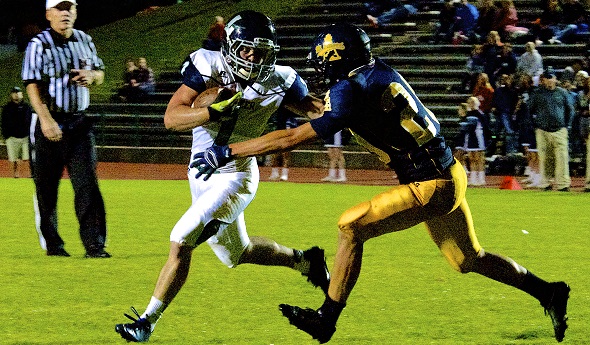
PHOTO: Lapeer, in its first season after former schools West and East combined this summer, is off to a 5-0 start. (Click to see more from HighSchoolSportsScene.com).