


MHSA(Q&)A: NFL official Ronald J. Winter
July 19, 2012
By Brian Spencer
Second Half
 Kalamazoo's Ron Winter has officiated in the National Football League for nearly two decades, and became a referee in 1999. But long before he joined the highest level of the game, he got his start on Michigan's high school fields.
Winter has officiated that sport at all three levels and also high school and college basketball. He's also served as a source of knowledge for officials around the state -- and an example for those hoping to start at the high school level and climb to the pros.
Winter remains registered as an MHSAA official, as he's been for 42 years. An associate professor emeritus of human performance and health education at Western Michigan University, Winter was appointed earlier this month to serve a two-year term on the Governor's Council on Physical Fitness, Health and Sports. The council focuses on increasing physical activity and health improvements.
He served on the WMU faculty first beginning in 1969 and then again from 1992-2008. Winter earned bachelor and master's degrees at Michigan State University.
Did you play any sports in high school or college?
I played football, basketball, baseball, and track in high school. However, once I got to Michigan State University, I started playing lacrosse. A couple guys that lived near me played lacrosse and asked me to come out to throw the ball around. After throwing with them a couple times they asked me to come out for the team. I ended up playing lacrosse for MSU for four years.
How did you decide to choose football as the sport you would officiate?
I started officiating as a student at MSU in their intramural program, officiating touch football and basketball. The next logical step was to then officiate in the high school leagues. From there, I began to proceed to all the different levels.
Are there specific requirements for becoming an NFL official?
The biggest requirement is experience. The progression that I went through went like this:
After officiating high school games, I went to the MIAA (Michigan Intercollegiate Athletic Association). They (MIAA) were looking for people that had 3-5 years of experience at the high school level. From there I went to the Mid-Continent conference. I wasn’t able to go to the Mid-American Conference because I was employed at Western Michigan University.
From there I went to the Big Ten. The Big Ten was looking for people with 5 to 10 years of experience in high school and people that had experience at different positions as an official. I ended up officiating in as a Big Ten football official for 10 years and a Big Ten basketball official for 15 years. I then submitted an application to the National Football League. Coincidentally, the NFL was scouting officials, and had followed me for four years before they finally asked me to be a part of the staff. The NFL decides on who they want to pursue through recommendations and personal interest. They look for personality traits as well as how (officials) carry themselves through different situations.
What has been your favorite level to officiate; High school, college or professional?
I enjoyed officiating all of them, but for different reasons.
I found high school to be the most fascinating because it’s all about the kids; they are playing the game for the love of the game. That is the purest sense of the sport. I loved being involved with kids simply because they love the game.
I found the Big Ten to be most exciting because of the kind of atmosphere that exists on a Big Ten campus on a Saturday afternoon. It’s electric. You don’t get that same sense or the same feel on Sunday afternoon in a pro stadium.
I found the NFL to be most intense. The NFL really has three or four different levels of play during the season. There is preseason play, the first third of the season, the second third of the season, and the last five games of the season. Each level is ramped up another notch as the season progresses. Playoffs are entirely different all together. In terms of the intensity and pure speed of the game, there is nothing like the NFL playoffs.
How important is getting along with your fellow officials on the field?
It’s imperatively important if you want to have a smooth and well-run game. This doesn’t mean that you have to buddy-buddy off the field, but on the field you have to be committed to one goal. We spend two or three hours on meetings Saturday afternoon to go over rules tests, tape, and more to prepare for the next game (and) to get over rough patches that develop on a personal level in a previous week. I need to know that the other six guys are focused and thinking about football like me. Everyone has to have confidence in one another. We spend plenty of time on Saturday to get to the point that we need to on Sunday.
What has been the most exciting game you’ve officiated?
I’ve been in plenty of exciting games from NFL playoff games, to the first Orange Bowl game, to the Rose Bowl, to the Division III Hope vs. Calvin basketball game, to when Indiana played Purdue in basketball. All of them were incredible to be a part of. During the Indiana vs. Purdue game, the arena was electric. The players, coaches, fans were intense. Everybody is totally focused on the game. Each coach had a tremendous respect for one another. Neither one wanted to show up or embarrass their counterpart. This game wasn’t that drastically different at the Division III level, however. The intensity of both was very similar.
Are there games that you get excited to officiate more than others, presently?
Not in terms of specific teams. It really just depends on the circumstances, of course. Pittsburgh vs. Baltimore is an intense game. The Jets vs. Patriots game is great. There are clearly rivalries that are very exciting to be a part of. The level of play and intensity of the athletes in the NFL is unmatched and can provide excitement every week.
What is the most difficult aspect of being a NFL official?
I would say that preparation and being able to maintain intensity on the field on Sunday are key aspects. The preparation is difficult because it’s time-consuming. It is a misconception that we simply show up on Sunday to work the game. By the time Sunday rolls around, I’ve spent over 20 hours during the week trying to prepare for a Sunday game. It isn’t hard in terms of physical labor, but difficult in terms of a time commitment. You have to have an understanding family to be in the occupational field that I am in.
Do you have any advice for aspiring officials who hope to make it to the league?
Practice, practice, practice. Be able to work any game at any level and get as much experience as you can. Be a good partner on the field. It takes time; it isn’t something that just happens. Like anything else, it takes practicing your trade to be able to make it to the top level.
A Game for Every Fan: Regional Finals
November 15, 2013
By Geoff Kimmerly
Second Half editor
It’s both notable, yet logical, that 25 undefeated teams remain among the 68 still alive in the MHSAA football playoffs heading into this weekend.
At this point in the season, the best teams rise to the top. But maintaining perfection over 11 weeks is something worth celebrating regardless – even as at least three of those teams are guaranteed to fall this weekend.
Three of 32 11-player Regional Finals will feature matchups of undefeateds this weekend. Both 8-player Semifinals also feature one team that hasn't lost.
A total of 13 games will be played tonight, with the other 21 – including both 8-player games – kicking off Saturday. See below for all 34 matchups, plus a little extra on the headliner from each 11-player division and both 8-Player semis.
Remember to follow all of the action again on MHSAA Score Center. And check out our four games live on Fox Sports Detroit’s Prep Zone: Battle Creek Pennfield at Grand Rapids South Christian, Saginaw Swan Valley at Lansing Sexton, Melvindale at St. Clair and St. Ignace at Beal City.
Division 1
Macomb Dakota (11-0) at Detroit Cass Tech (11-0)
Cass Tech has won three games by 10 or fewer points, and might need to draw on that experience again in this Regional Final. Dakota’s success coming out of the solid Macomb Area Conference Red mirrors that of the Technicians, even as its stars are a little less known statewide. Cass Tech has won the last two Division 1 titles, and that know-how no doubt will come in handy in this titanic clash.
Other Regional Finals: Hudsonville (8-3) at Flint Carman-Ainsworth (10-1), Rochester Adams (8-3) at Clarkston (10-1), Detroit Catholic Central (9-2) at Temperance Bedford (11-0).
Division 2
Detroit Martin Luther King (9-1) at Wyandotte Roosevelt (11-0)
This is Roosevelt’s third straight Regional Final and it is playing for a second straight Semifinal berth against a team that lost only to Cass Tech this fall. The difference this time might be the Bears’ offense, which is averaging 45 points per game and already has scored 100 more than in any season of its modern history. They’ll need to light up the board to keep up with King playmakers Jalen Embry and Avonte Maddox, who both will play at high-major schools at the college level.
Other Regional Finals: Midland (10-1) at Muskegon (10-1), Farmington Hills Harrison (10-1) at Portage Central (11-0), Detroit U-D Jesuit (7-4) at Birmingham Brother Rice (11-0).
Division 3
Zeeland West (10-1) at Mount Pleasant (10-1)
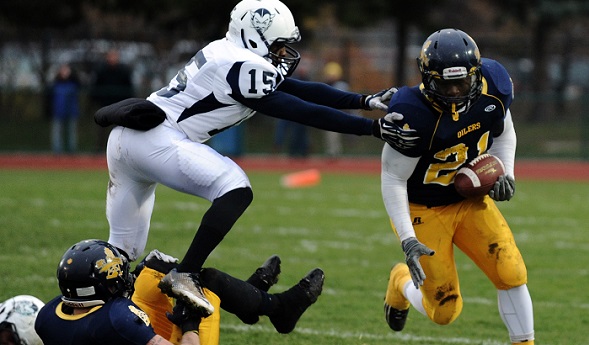
This has the feel of a Semifinal, with these two having survived wild runs already to get to this point. West avenged a Week 2 loss to Zeeland East to start the playoffs and then eliminated reigning champion Grand Rapids Christian last week – after closing the regular season with a 36-13 win over Byron Center, a possible opponent next week. Mount Pleasant bounced back this fall after finishing Division 3 runner-up in 2011 and then falling to 2-7 a year ago. The Oilers’ only loss was on opening night to DeWitt, which has emerged as the favorite in this division.
Other Regional Finals: Byron Center (8-3) at Stevensville Lakeshore (8-3), Eaton Rapids (7-4) at DeWitt (11-0), Melvindale (9-2) at St. Clair (10-1).
Division 4
Saginaw Swan Valley (11-0) at Lansing Sexton (11-0)
This game could be over in less than two hours with the way these two run the ball. Swan Valley junior Alex Grace is approaching the MHSAA single-season rushing record of 2,890 yards after also topping 2,000 last season. Sexton, meanwhile, hasn't scored fewer than 32 points since September and blends a strong inside running game with plenty of speed on the perimeter.
Other Regional Finals: Cadillac (11-0) at Comstock Park (11-0), Battle Creek Pennfield (10-1), at Grand Rapids South Christian (10-1), Detroit Country Day (8-3) at Marine City (10-1).
Division 5
Monroe St. Mary Catholic Central (10-1) at Livonia Clarenceville (11-0)
The last time Clarenceville made this kind of run was in 2001, when superstar Tim Shaw was finishing off a record-setting effort that would take him to Penn State and then the NFL. The Trojans have been rolling since opening this fall with three wins by seven or fewer points during the season’s first five weeks, although they had to survive a tough test in the District Final against Detroit University Prep. This is usual territory for St. Mary, which has won 10 games for the fifth time in six seasons and is playing for its second straight Semifinal berth.
Other Regional Finals: Standish-Sterling (9-1) at Menominee (11-0), Millington (9-2) at Muskegon Oakridge (10-1), Grand Rapids West Catholic (7-4) at Olivet (10-1).
Division 6
Madison Heights Madison (11-0) at Montrose (11-0)
Since the brackets came out four weeks ago, this has been seen as the likely matchup to decide which team might have the best chance to end Ithaca’s national-best winning streak (53 games). Coming off four straight shutouts, Madison barely survived last week against Flint Beecher, which plays in Montrose’s league and lost to the Rams by 16 in their matchup this fall. Montrose has crushed two strong opponents – Reese and Saginaw Nouvel – to start the playoffs and no doubt would love to see the Yellowjackets again after falling to them in the playoffs the last three years.
Other Regional Finals: Negaunee (10-1) at Ithaca (11-0), Schoolcraft (10-1) at Shelby (10-1), Constantine (7-4) at Clinton (11-0).
Division 7
Pewamo-Westphalia (10-1) at Harbor Beach (10-1)
Keyed by veteran quarterback Eli Kraft and a sturdy defense, Harbor Beach has made a nice jump into Division 7 after winning Division 8 in 2012. But Pewamo-Westphalia likely will be Harbor Beach’s strongest test to this point. P-W had to come back at the end last week to beat Carson City-Crystal but also beat a league champion the week before in Saugatuck.
Other Regional Finals: Lake City (10-1) at Ishpeming (11-0), Decatur (8-3) at Homer (10-1), Southfield Christian (10-1) at Detroit Loyola (11-0).
Division 8
Muskegon Catholic Central (9-2) at Mendon (11-0)
These southwestern powers are plenty familiar with each other – this will be their third straight playoff meeting and fifth in seven seasons. Muskegon Catholic hasn't lost since Week 2, also the last time it scored fewer than 40 points or gave up more than 16. Mendon is riding double figure wins for the seventh straight season with a combined score of 526-19 against its 11 opponents. That defensive effort is headed toward going down as one of the best in Michigan history.
Other Regional Finals: Felch North Dickinson (8-2) at Crystal Falls Forest Park (11-0), St. Ignace (9-2) at Beal City (11-0), Ottawa Lake Whiteford (9-2) at New Lothrop (11-0).
8-Player (Semifinals)
Kinde-North Huron (8-3) at Rapid River (11-0)
Rapid River has become an 8-player power, going 31-5 since making the switch three seasons ago. The Rockets are keyed by quarterback Jake Pearson, who has run for 2,166 yards and 39 touchdowns and throw for 963 yards and 13 more scores. North Huron is a great story as well; the Warriors were 0-9 in 2011 before improving to 6-5 last fall and then adding two more wins this season.
Lawrence (8-2) at Peck (11-0)
Peck rivals Rapid River as the most dominant team in 8-player this season, with all but two games decided by 20 points or more despite a schedule that included two matchups each against the first two 8-player MHSAA champions – Carsonville-Port Sanilac and Deckerville. The Pirates did beat Lawrence 61-38 all the way back in Week 4 – but the Tigers are primed to avenge. Last week they beat Battle Creek St. Philip after falling to St. Phil only two weeks prior.
PHOTO: Mount Pleasant (blue jerseys) ran away from Sault Ste. Marie 42-27 last week to earn this weekend’s matchup against Zeeland West. (Click to see more from High School Sports Scene.)