


MHSA(Q&)A: NFL official Ronald J. Winter
July 19, 2012
By Brian Spencer
Second Half
 Kalamazoo's Ron Winter has officiated in the National Football League for nearly two decades, and became a referee in 1999. But long before he joined the highest level of the game, he got his start on Michigan's high school fields.
Winter has officiated that sport at all three levels and also high school and college basketball. He's also served as a source of knowledge for officials around the state -- and an example for those hoping to start at the high school level and climb to the pros.
Winter remains registered as an MHSAA official, as he's been for 42 years. An associate professor emeritus of human performance and health education at Western Michigan University, Winter was appointed earlier this month to serve a two-year term on the Governor's Council on Physical Fitness, Health and Sports. The council focuses on increasing physical activity and health improvements.
He served on the WMU faculty first beginning in 1969 and then again from 1992-2008. Winter earned bachelor and master's degrees at Michigan State University.
Did you play any sports in high school or college?
I played football, basketball, baseball, and track in high school. However, once I got to Michigan State University, I started playing lacrosse. A couple guys that lived near me played lacrosse and asked me to come out to throw the ball around. After throwing with them a couple times they asked me to come out for the team. I ended up playing lacrosse for MSU for four years.
How did you decide to choose football as the sport you would officiate?
I started officiating as a student at MSU in their intramural program, officiating touch football and basketball. The next logical step was to then officiate in the high school leagues. From there, I began to proceed to all the different levels.
Are there specific requirements for becoming an NFL official?
The biggest requirement is experience. The progression that I went through went like this:
After officiating high school games, I went to the MIAA (Michigan Intercollegiate Athletic Association). They (MIAA) were looking for people that had 3-5 years of experience at the high school level. From there I went to the Mid-Continent conference. I wasn’t able to go to the Mid-American Conference because I was employed at Western Michigan University.
From there I went to the Big Ten. The Big Ten was looking for people with 5 to 10 years of experience in high school and people that had experience at different positions as an official. I ended up officiating in as a Big Ten football official for 10 years and a Big Ten basketball official for 15 years. I then submitted an application to the National Football League. Coincidentally, the NFL was scouting officials, and had followed me for four years before they finally asked me to be a part of the staff. The NFL decides on who they want to pursue through recommendations and personal interest. They look for personality traits as well as how (officials) carry themselves through different situations.
What has been your favorite level to officiate; High school, college or professional?
I enjoyed officiating all of them, but for different reasons.
I found high school to be the most fascinating because it’s all about the kids; they are playing the game for the love of the game. That is the purest sense of the sport. I loved being involved with kids simply because they love the game.
I found the Big Ten to be most exciting because of the kind of atmosphere that exists on a Big Ten campus on a Saturday afternoon. It’s electric. You don’t get that same sense or the same feel on Sunday afternoon in a pro stadium.
I found the NFL to be most intense. The NFL really has three or four different levels of play during the season. There is preseason play, the first third of the season, the second third of the season, and the last five games of the season. Each level is ramped up another notch as the season progresses. Playoffs are entirely different all together. In terms of the intensity and pure speed of the game, there is nothing like the NFL playoffs.
How important is getting along with your fellow officials on the field?
It’s imperatively important if you want to have a smooth and well-run game. This doesn’t mean that you have to buddy-buddy off the field, but on the field you have to be committed to one goal. We spend two or three hours on meetings Saturday afternoon to go over rules tests, tape, and more to prepare for the next game (and) to get over rough patches that develop on a personal level in a previous week. I need to know that the other six guys are focused and thinking about football like me. Everyone has to have confidence in one another. We spend plenty of time on Saturday to get to the point that we need to on Sunday.
What has been the most exciting game you’ve officiated?
I’ve been in plenty of exciting games from NFL playoff games, to the first Orange Bowl game, to the Rose Bowl, to the Division III Hope vs. Calvin basketball game, to when Indiana played Purdue in basketball. All of them were incredible to be a part of. During the Indiana vs. Purdue game, the arena was electric. The players, coaches, fans were intense. Everybody is totally focused on the game. Each coach had a tremendous respect for one another. Neither one wanted to show up or embarrass their counterpart. This game wasn’t that drastically different at the Division III level, however. The intensity of both was very similar.
Are there games that you get excited to officiate more than others, presently?
Not in terms of specific teams. It really just depends on the circumstances, of course. Pittsburgh vs. Baltimore is an intense game. The Jets vs. Patriots game is great. There are clearly rivalries that are very exciting to be a part of. The level of play and intensity of the athletes in the NFL is unmatched and can provide excitement every week.
What is the most difficult aspect of being a NFL official?
I would say that preparation and being able to maintain intensity on the field on Sunday are key aspects. The preparation is difficult because it’s time-consuming. It is a misconception that we simply show up on Sunday to work the game. By the time Sunday rolls around, I’ve spent over 20 hours during the week trying to prepare for a Sunday game. It isn’t hard in terms of physical labor, but difficult in terms of a time commitment. You have to have an understanding family to be in the occupational field that I am in.
Do you have any advice for aspiring officials who hope to make it to the league?
Practice, practice, practice. Be able to work any game at any level and get as much experience as you can. Be a good partner on the field. It takes time; it isn’t something that just happens. Like anything else, it takes practicing your trade to be able to make it to the top level.
A Game for Every Fan: Week 4
September 20, 2013
By Geoff Kimmerly
Second Half editor
Welcome to fall, Michigan. Be sure to bring a coat and umbrella when you venture out to watch your favorite football team this weekend.
And what better way to spend a fall evening than watching one of the many 3-0 vs. 3-0 matchups dotting our state as we head into the meat of many league schedules.
See below for what should be some of the best games this weekend, and be sure to monitor all the scores at the MHSAA Score Center.
West Michigan
Muskegon (3-0) at Lowell (3-0)
For the second straight week, Muskegon finds itself in the most anticipated game statewide. Seven days ago the Big Reds responded with a 45-0 victory over Rockford. Tonight they’ll try to make it three straight against Lowell after beating the Red Arrows by 15 during the regular season and then 15-13 in a District Final in 2012. Lowell has been similarly dominant this fall, but Muskegon surely will be its toughest test so far.
Others that caught my eye: Comstock Park (3-0) at Allendale (3-0), Caledonia (2-1) at Grandville (2-1), Hartford (3-0) at Saugatuck (2-1), Shelby (3-0) at Montague (2-1).
Southwest and Border
Portage Northern (3-0) at St. Joseph (3-0)
St. Joseph had similar aspirations a year ago after a 3-0 start – then fell 7-0 to Portage Northern in Week 4 and missed the playoffs with a final 5-4 record. This season’s run has included more impressive victories over Battle Creek Harper Creek and Stevensville Lakeshore, and vengeance no doubt is on the Bears’ minds.
Others that caught my eye: Decatur (3-0) at Gobles (1-2), Stevensville Lakeshore (2-1) at Portage Central (3-0), Quincy (2-1) at Jonesville (3-0), Otsego (2-1) at Plainwell (3-0).
Bay and Thumb
Saginaw Arthur Hill (3-0) at Midland (3-0)
The most impressive part of Arthur Hill’s start is that it includes wins over 2012 playoff teams Goodrich and Bay City Western – on top of the fact the Lumberjacks went 0-9, 3-6, 1-8 and 1-8, respectively, since their last playoff appearance in 2008. This game will be the true measuring stick as Midland has been the class of the Saginaw Valley Association with 15 straight league wins and the North division championship last season.
Others that caught my eye: Pontiac Notre Dame Prep (3-0) at Flint Powers Catholic (2-1), Lawrence (2-0) at Peck (3-0), Elkton-Pigeon-Bay Port (3-0) at Unionville-Sebewaing (3-0), Almont (3-0) at Richmond (2-1).
Greater Detroit and Southeast
Southfield (2-1) at Oak Park (3-0)
Little has slowed Oak Park over the last two seasons, and wins already this fall over Orchard Lake St. Mary’s and Rochester Adams are proof the Knights will be back in the mix in the Oakland Activities Association White. Southfield should be too – and would love to get a strong start to a string that follows with Farmington Hills Harrison, Oxford and Adams.
Others that caught my eye: Saline (3-0) at Ann Arbor Pioneer (2-1), Orchard Lake St. Mary's (2-1) at Detroit U-D Jesuit (3-0), Grosse Ile (3-0) at Monroe St. Mary Catholic Central (3-0), Warren DeLaSalle (2-1) at Birmingham Brother Rice (3-0).
Mid-Michigan
DeWitt (3-0) at Ionia (3-0)
This might not seem like much of a game considering the teams’ recent histories – but don’t expect the Panthers to overlook the rejuvenated Bulldogs, who have equaled their most wins in a season since 2006, the last they qualified for the playoffs. Ionia already has scored 125 points after totaling just 200 a year ago, and the defense has been pretty solid as well.
Others that caught my eye: Fowler (2-1) at Bath (2-1), Grand Blanc (2-1) at Brighton (2-1), Holt (1-2) at Lansing Everett (3-0), Carson City-Crystal (3-0) at Vestaburg (3-0).
Lower Up North
Grayling (3-0) at Traverse City St. Francis (2-1)
This arguably (but with little argument) was the best rivalry in the Lake Michigan Conference – although Grayling’s first win in their 10 games against each other didn’t come until last season after the Gladiators had left the conference for football. St. Francis can break the Vikings’ 12-game regular-season winning streak, dating to the Gladiators’ 20-19 win over Grayling in Week 9 of 2011.
Others that caught my eye: Elk Rapids (2-1) at Charlevoix (1-2), Whittemore-Prescott (3-0) at Standish-Sterling (3-0), Petoskey (2-1) at Traverse City West (2-1), Rogers City (2-1) at Hillman (2-1).
Upper Peninsula
Marquette (3-0) at Escanaba (0-3)
Escanaba obviously is off to a rough start, and Marquette has opened with three wins over 2012 playoff teams. But an intriguing side note to this game, in addition to being a Great Northern Conference opener, is one of the coaches on the Marquette sideline – Dan Flynn, formerly Escanaba’s coach from 1985-2011, is in his first season as an assistant with the Redmen. They’re looking to beat the Eskymos for the first time since 2010.
Others that caught my eye: Ishpeming Westwood (0-3) at Ishpeming (3-0), Iron Mountain (1-2) at Negaunee (3-0), Bessemer (3-0) at Lake Linden Hubbell (1-2), Stephenson (2-1) at Felch North Dickinson (3-0).
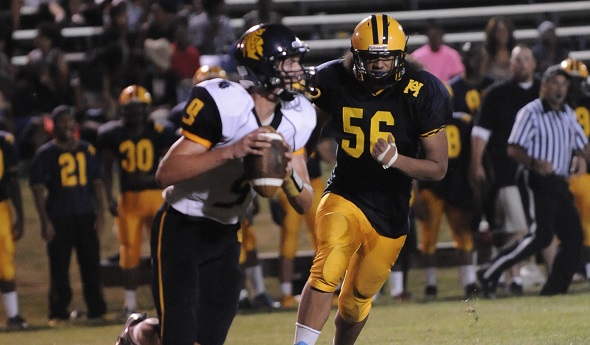
PHOTO: Saginaw Arthur Hill (in blue) defeated Goodrich on opening night and is in pursuit of its first 4-0 start since 2008. (Click to see more from High School Sports Scene.)