


MHSA(Q&)A: NFL official Ronald J. Winter
July 19, 2012
By Brian Spencer
Second Half
 Kalamazoo's Ron Winter has officiated in the National Football League for nearly two decades, and became a referee in 1999. But long before he joined the highest level of the game, he got his start on Michigan's high school fields.
Winter has officiated that sport at all three levels and also high school and college basketball. He's also served as a source of knowledge for officials around the state -- and an example for those hoping to start at the high school level and climb to the pros.
Winter remains registered as an MHSAA official, as he's been for 42 years. An associate professor emeritus of human performance and health education at Western Michigan University, Winter was appointed earlier this month to serve a two-year term on the Governor's Council on Physical Fitness, Health and Sports. The council focuses on increasing physical activity and health improvements.
He served on the WMU faculty first beginning in 1969 and then again from 1992-2008. Winter earned bachelor and master's degrees at Michigan State University.
Did you play any sports in high school or college?
I played football, basketball, baseball, and track in high school. However, once I got to Michigan State University, I started playing lacrosse. A couple guys that lived near me played lacrosse and asked me to come out to throw the ball around. After throwing with them a couple times they asked me to come out for the team. I ended up playing lacrosse for MSU for four years.
How did you decide to choose football as the sport you would officiate?
I started officiating as a student at MSU in their intramural program, officiating touch football and basketball. The next logical step was to then officiate in the high school leagues. From there, I began to proceed to all the different levels.
Are there specific requirements for becoming an NFL official?
The biggest requirement is experience. The progression that I went through went like this:
After officiating high school games, I went to the MIAA (Michigan Intercollegiate Athletic Association). They (MIAA) were looking for people that had 3-5 years of experience at the high school level. From there I went to the Mid-Continent conference. I wasn’t able to go to the Mid-American Conference because I was employed at Western Michigan University.
From there I went to the Big Ten. The Big Ten was looking for people with 5 to 10 years of experience in high school and people that had experience at different positions as an official. I ended up officiating in as a Big Ten football official for 10 years and a Big Ten basketball official for 15 years. I then submitted an application to the National Football League. Coincidentally, the NFL was scouting officials, and had followed me for four years before they finally asked me to be a part of the staff. The NFL decides on who they want to pursue through recommendations and personal interest. They look for personality traits as well as how (officials) carry themselves through different situations.
What has been your favorite level to officiate; High school, college or professional?
I enjoyed officiating all of them, but for different reasons.
I found high school to be the most fascinating because it’s all about the kids; they are playing the game for the love of the game. That is the purest sense of the sport. I loved being involved with kids simply because they love the game.
I found the Big Ten to be most exciting because of the kind of atmosphere that exists on a Big Ten campus on a Saturday afternoon. It’s electric. You don’t get that same sense or the same feel on Sunday afternoon in a pro stadium.
I found the NFL to be most intense. The NFL really has three or four different levels of play during the season. There is preseason play, the first third of the season, the second third of the season, and the last five games of the season. Each level is ramped up another notch as the season progresses. Playoffs are entirely different all together. In terms of the intensity and pure speed of the game, there is nothing like the NFL playoffs.
How important is getting along with your fellow officials on the field?
It’s imperatively important if you want to have a smooth and well-run game. This doesn’t mean that you have to buddy-buddy off the field, but on the field you have to be committed to one goal. We spend two or three hours on meetings Saturday afternoon to go over rules tests, tape, and more to prepare for the next game (and) to get over rough patches that develop on a personal level in a previous week. I need to know that the other six guys are focused and thinking about football like me. Everyone has to have confidence in one another. We spend plenty of time on Saturday to get to the point that we need to on Sunday.
What has been the most exciting game you’ve officiated?
I’ve been in plenty of exciting games from NFL playoff games, to the first Orange Bowl game, to the Rose Bowl, to the Division III Hope vs. Calvin basketball game, to when Indiana played Purdue in basketball. All of them were incredible to be a part of. During the Indiana vs. Purdue game, the arena was electric. The players, coaches, fans were intense. Everybody is totally focused on the game. Each coach had a tremendous respect for one another. Neither one wanted to show up or embarrass their counterpart. This game wasn’t that drastically different at the Division III level, however. The intensity of both was very similar.
Are there games that you get excited to officiate more than others, presently?
Not in terms of specific teams. It really just depends on the circumstances, of course. Pittsburgh vs. Baltimore is an intense game. The Jets vs. Patriots game is great. There are clearly rivalries that are very exciting to be a part of. The level of play and intensity of the athletes in the NFL is unmatched and can provide excitement every week.
What is the most difficult aspect of being a NFL official?
I would say that preparation and being able to maintain intensity on the field on Sunday are key aspects. The preparation is difficult because it’s time-consuming. It is a misconception that we simply show up on Sunday to work the game. By the time Sunday rolls around, I’ve spent over 20 hours during the week trying to prepare for a Sunday game. It isn’t hard in terms of physical labor, but difficult in terms of a time commitment. You have to have an understanding family to be in the occupational field that I am in.
Do you have any advice for aspiring officials who hope to make it to the league?
Practice, practice, practice. Be able to work any game at any level and get as much experience as you can. Be a good partner on the field. It takes time; it isn’t something that just happens. Like anything else, it takes practicing your trade to be able to make it to the top level.
1st & Goal: 2023 Playoff Week 2 Review
By
Geoff Kimmerly
MHSAA.com senior editor
November 6, 2023
This weekend’s 8-Player Regional Finals and 11-Player District Finals featured more rematches from the regular season that crop up when the best teams must face off again but with the winner moving on and the loser this time putting away the pads until next fall.
 And as we see just about every season, those matchups during the second week of this MHSAA Playoffs showed how much can change between the first meeting to the last – even if, in some cases, only a few weeks have passed between those two games.
8-player alone featured five rematches (of eight games total) – and three were won by the team that lost the first time, Martin enjoying the greatest reversal in flipping a 37-point defeat. The 11-player series saw its share of rematches as well – with a classic nearly stealing the thunder of another massive showdown in Division 1.
Of course, several individuals stood out over the weekend’s 72 games – but a couple require special recognition. Braylon Isom tied and reset the 11-player career receiving touchdowns record with his 49th and 50th in Saginaw Heritage’s 35-13 win over Midland Dow in Division 1. About a 1½-hour drive east, in Division 8, Ubly kicker Brett Mueller set the career extra points record with five more for 209 total as his team downed Harbor Beach 35-14.
See below for more of the most notable as we neared the halfway point of this postseason:
11-Player Division 1
HEADLINER Belleville 65, Saline 14 The growing legends of Belleville and quarterback Bryce Underwood added another chapter with the team’s 36th-straight win. Underwood was nearly perfect throwing the ball as the Tigers (11-0) also held Saline (9-2) to well below its 45 points-per-game average heading into the day. Click for more from the Ann Arbor News.
Check out Bryce Underwood's performance in the Division 1 District Final on November 4th, 2023! He completed 21 of 25 passes for 312 yards and scored four touchdowns, leading Belleville to a 65-14 victory over Saline. Delivered by @hungryhowies @BellevilleFB | @BHSBelleville… pic.twitter.com/5uHJR9DpCy
— STATE CHAMPS! Michigan (@statechampsmich) November 6, 2023
District Digest Clarkston 38, Lake Orion 37 Clarkston (6-5) dealt Lake Orion (10-1) the latter’s only loss of the season, doing so by avenging a 42-21 defeat by the Dragons in Week 7 and this time coming back from two touchdowns down with five minutes to play. Southfield Arts & Technology 36, Detroit Cass Tech 25 The Warriors (10-1) claimed their first District title since 2016, adding to a 29-27 win over Cass Tech from Week 1 and avenging last season’s District Final loss to the Technicians (7-4). Northville 24, Detroit Catholic Central 17 This also was a rematch of a 2022 District Final, with Northville (10-1) avenging last season’s 42-17 loss to the Shamrocks (8-3) to earn a rematch this week with Belleville. The Tigers dealt the Mustangs their only defeat this fall, in Week 9.
11-Player Division 2
HEADLINER Byron Center 31, Caledonia 28 A back-and-forth game during the second half went Byron Center’s way permanently on the final play as the Bulldogs (10-1) scored the go-ahead touchdown to clinch their first District title since 2016. Caledonia ended 8-3 and are a combined 30-7 over the last three seasons after reaching the Division 1 Final a year ago. Click for more from the Grand Rapids Press.
Relive the intense action and last-minute victory! Watch the thrilling highlights from the Division 2 @MHSAA Football District Final clash between Byron Center and Caledonia! 🏈 Byron Center secures a 31-28 win with a game-winning play.
🎥 WXMI-TV pic.twitter.com/78m78gExug— STATE CHAMPS! Michigan (@statechampsmich) November 6, 2023
District Digest Muskegon 42, Muskegon Mona Shores 28 The Big Reds (9-2) secured their 11th District championship over the last 12 seasons, adding to a Week 4 win over the rival Sailors (7-4). Roseville 24, Grosse Pointe South 17 A program that won its first District title in 2021 now has its second in three seasons, Roseville (8-3) earning it by avenging a 16-7 Week 5 loss to the eventual MAC White champion. Grosse Pointe South (9-2) capped its winningest season since 1987. Waterford Mott 34, Birmingham Seaholm 21 Mott (9-2) tied its school record for wins, per Michigan-Football.com, by also claiming a second District title in program history and second over the last three seasons. Seaholm finished 9-2, continuing a rise from 1-8 two seasons ago.
11-Player Division 3
HEADLINER Grand Rapids Forest Hills Central 45, Mount Pleasant 21 Forest Hills Central (10-1) took a massive step as it continues to build on last season’s Division 2 runner-up finish, as these two ended the regular season fourth and second, respectively, in Division 3 playoff-point average. The Oilers finished 9-2, their only other loss in their season opener. Click for more from the Mount Pleasant Morning Sun.
The Forest Hills Central Rangers are district champs once again. FHC handles Mount Pleasant 45-21.
S/O to @YousefNasserTV for the highlights@Mason_McDonald9 @HudkinsTy @jt_hartman @brendancargill1 @13OYSL pic.twitter.com/iJ76rbjP0T— Mark Skol, Jr. (@markskoljrTV) November 5, 2023
District Digest Zeeland West 46, Coopersville 32 After ending the regular season with three close losses, West (8-3) has bounced back with a repeat District championship and two of its five highest-scoring games this fall. Coopersville (8-3) ended its winningest season since 2007, and its three defeats were by a combined 18 points. Walled Lake Western 50, Auburn Hills Avondale 22 In clinching its first District title since 2019, Western (10-1) earned a rematch with the lone opponent it lost to this season, Mason. Avondale finished 9-2, its best since 2012. River Rouge 49, Riverview 27 The Panthers (7-4) ran their winning streak to six games with their first District title since 2020, and earned a rematch with Detroit Martin Luther King, which ended Rouge’s season in a playoff opener a year ago. Riverview saw an eight-game winning streak come to an end in finishing 9-2.
11-Player Division 4
HEADLINER Big Rapids 28, Whitehall 27 A final-seconds field-goal attempt block earned Big Rapids its first District title since 2003, as the Cardinals (10-1) also reached double-digit wins for the first time since that season. Whitehall (10-1) had entered the playoffs as one of only two undefeated teams in Division 4. Click for more from the Big Rapids Pioneer.
Big Rapids stuns Whitehall with late Field Goal blockhttps://t.co/V9AHlh9JS0 pic.twitter.com/9HMLz703ns
— FOX 17 Blitz (@FOX17Blitz) November 4, 2023
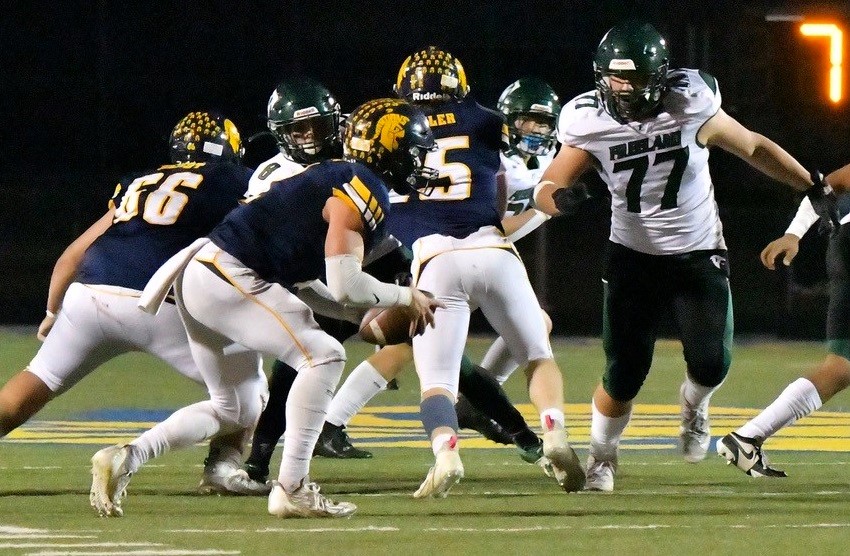
District Digest Niles 42, Paw Paw 13 Niles followed up its 56-18 Week 9 win over Paw Paw (9-2) that clinched the Wolverine Conference title with this victory to earn the Vikings (10-1) their first District championship. Haslett 30, Chelsea 22 The Vikings (8-3) went on the road and held on through the final play to clinch their first District title since 2005. Chelsea finished 9-2, nearly doubling its wins from a 5-5 run a year ago. Goodrich 21, Freeland 20 The reigning Division 4 runner-up followed up last season’s 10-9 District Final win over Freeland (9-2) as Easton Phipps scored the go-ahead touchdown for Goodrich (10-1) with 1:46 to play.
11-Player Division 5
HEADLINER Corunna 28, Pontiac Notre Dame Prep 17 Corunna (11-0) downed an unbeaten opponent for the second-straight week, and in doing so set a program record for wins as Jaden Edington starred again on both sides of the ball. Notre Dame (9-1) had defeated its opponents by an average score of 54-10. Click for more from the Owosso Argus-Press.
Congratulations to Corunna for being crowned Division 5 District Champions for the second time in three years! They secured an 28-17 victory against Notre Dame Prep. Next up, Corunna will be facing Lutheran North in the Regional Final.@CorunnaCavsFB | @cav_athletics
Powered… pic.twitter.com/FhEKlpR1vA— STATE CHAMPS! Michigan (@statechampsmich) November 4, 2023
District Digest Macomb Lutheran North 32, Marine City 30 Just 3-6 a year ago, Lutheran North (9-2) also set a program record for wins this weekend in winning its first District championship on a last-minute field goal. Marine City finished 9-2, its only other defeat coming in its season opener. Kingsford 19, Ogemaw Heights 14 Kingsford (10-1) finished its road trip with its first District championship since 2009 and after reaching 10 wins for the first time since 2004. Ogemaw Heights also finished 9-2, with its only other defeat coming in Week 1. Detroit Southeastern 26, Ann Arbor Father Gabriel Richard 22 Southeastern’s most recent District title had come in 2018, in Division 8, and the Jungaleers improved to 8-3 after an 0-2 start this fall. Father Gabriel Richard finished 8-3, up from 3-6 a year ago and its first winning record since 2017.
11-Player Division 6
HEADLINER Gladstone 28, Negaunee 14 Gladstone (9-2) won a District title and reached nine wins both for the second-straight season, and also avenged last year’s 18-12 Regional loss to Negaunee as the Miners went on to finish Division 6 runner-up. Negaunee’s only other losses this fall were to Iron Mountain in Week 9 and Gladstone 42-14 to start the league schedule in Week 2. Click for more from the Escanaba Daily Press.
District Digest Midland Bullock Creek 49, Chesaning 22 The Lancers (8-3) won their first District championship since 2005 and equaled their most wins since 2007, and after winning four games each of the last three seasons. Chesaning finished 9-2, its winningest run since 2001. Almont 40, Warren Michigan Collegiate 38 (OT) Almont (10-1) delivered Michigan Collegiate its lone loss after the Cougars (10-1) had come back from an early deficit in seeking what would have been a fourth-straight District title. The Pirates had fallen to Collegiate in their only other meeting, a 2021 District Final. Detroit Edison 32, Ecorse 6 Edison (8-3) continued its record-setting season with its first District championship, continuing to bounce back from last year’s 2-7 finish. Ecorse finished 8-2, reaching that win total for the third-straight season.
11-Player Division 7
HEADLINER North Muskegon 27, Lawton 24 North Muskegon (11-0) trailed by three points heading into the fourth quarter, but found the end zone one more time to clinch its first District championship since 2006 and tie the program record for wins set in 1981 and also tied in 1986. Lawton finished 9-2 and is a combined 31-6 over the last three seasons. Click for more from the Muskegon Chronicle.
Check out the highlights from the D-7 @MHSAA Football District Final clash between North Muskegon High School and Lawton! 🏈 North Muskegon emerged victorious with a nail-biting 27-24 win and secured their spot in the regional finale against Pewamo-Westphalia.
🎥 WXMI-TV pic.twitter.com/vGMHPbRhjO— STATE CHAMPS! Michigan (@statechampsmich) November 6, 2023
District Digest Millington 21, Cass City 20 The Cardinals (11-0) repeated as District champions, scoring the game-tying touchdown and connecting on the winning extra point with 1:52 to play. Cass City finished 8-3, a solid jump after back-to-back 5-5 seasons. Jackson Lumen Christi 26, Napoleon 0 These two collided in the playoffs for the second straight season, and Lumen Christi (10-1) followed last year’s Semifinal win by ending Napoleon’s season this time at 9-2. Menominee 50, Charlevoix 14 Menominee’s best season since 2017 continued in a big way as the Maroons improved to 9-2 and ended Charlevoix’s winningest season since 1977 also at 9-2.
11-Player Division 8
HEADLINER Ithaca 29, New Lothrop 28 Joe Dawe’s field goal with eight seconds to play sent Ithaca past New Lothrop (9-2) for a second-straight District championship after winning one in Division 7 a year ago. After not playing a single-digit game during the regular season, the Yellowjackets (11-0) have won both of their playoff games by a point. New Lothrop’s only other defeat this fall came by five, in Week 2 to Chesaning. Click for more from the Mount Pleasant Morning Sun.
"As Justin Tucker once said, my long snapper nailed the snap, my holder nailed the hold and I just kicked it!"
Senior Joe Dawe (@jdawe_4) hit a 31-yd FG in the final seconds to help Ithaca defeat New Lothrop in a thriller, 29-28. @ITHACAJACKETFB will play Ubly in regionals. pic.twitter.com/jBB4rilSnB— Yousef Nasser (@YousefNasserTV) November 4, 2023
District Digest Ubly 35, Harbor Beach 14 Ubly (11-0) claimed a fifth-straight District title and added to its 56-20 win over Harbor Beach (9-2) in Week 4. Ottawa Lake Whiteford 24, Hudson 14 Whiteford’s closest game since early September netted the Bobcats (11-0) their third District title in a row, and after Hudson (8-3) had won their last playoff meeting in a 2021 Semifinal. Clarkston Everest Collegiate 19, Marine City Cardinal Mooney 14 These two have met in league play and District Finals the last two seasons, and Everest (9-2) has won their last three matchups adding this to a 21-7 victory in Week 6. Cardinal Mooney ended 6-5 after bouncing back from an 0-2 start.
8-Player Division 1
HEADLINER Indian River Inland Lakes 40, St. Ignace 36 Inland Lakes (10-1) reached double-digit wins for the second time in three seasons and clinched a Regional title by avenging its lone loss of this fall. These two continued to match up about as closely as possible, with the Bulldogs claiming this meeting after St. Ignace won 30-28 in Week 4. The Saints ended their first season of 8-player at 9-2. Click for more from the Cheboygan Daily Tribune.
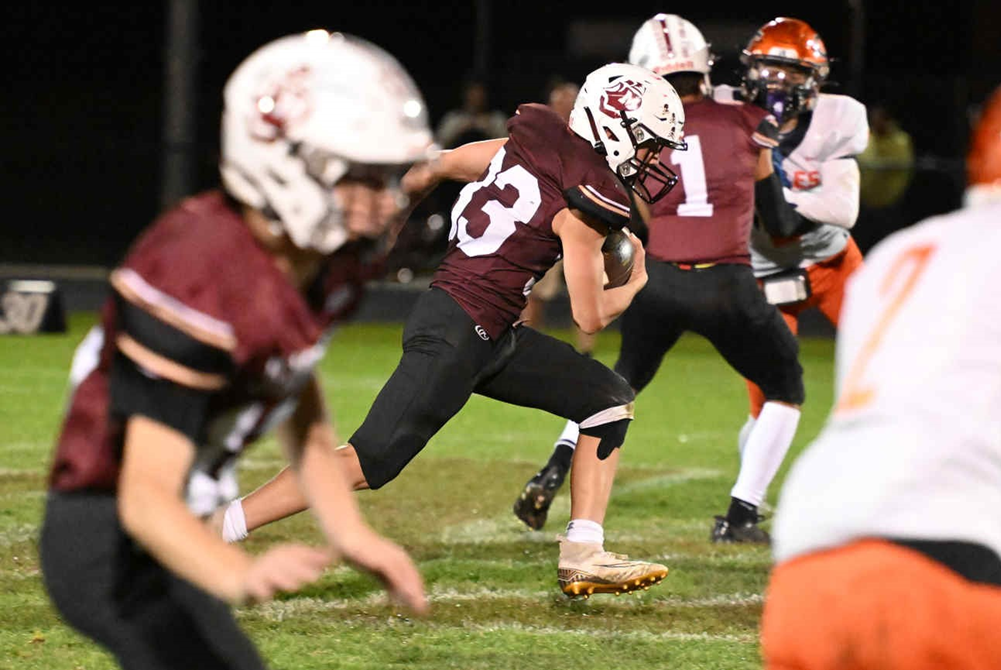
Regional Roundup Pickford 34, Norway 16 This was a rematch of Pickford’s 40-18 win in Week 7 and this time sent the Panthers (10-1) back to Semifinals for the first time since winning Division 2 in 2019. Norway’s 8-3 finish was its best since 2017. Kingston 26, Brown City 0 The Cardinals (9-2) have posted two of the most notable playoff victories to kick off any division, this one clinching a Regional title for the first time since 2019 but also avenging a 38-20 Week 3 loss to previously-undefeated Brown City (10-1). Martin 28, Gobles 6 Reigning Division 1 champion Martin (9-2) hurdled a major obstacle in Gobles (8-3), avenging a 53-16 loss to the Tigers from Week 4.
8-Player Division 2
HEADLINER Adrian Lenawee Christian 56, Climax-Scotts 16 The dominance Lenawee Christian (11-0) is exhibiting this fall may eclipse its work from its undefeated championship seasons of 2020 and 2021. The Cougars opened up a 13-point lead by halftime and then extended it for their ninth win of at least 40 points this fall. Climax-Scotts (10-1) posted its best record in five seasons of 8-player. Click for more from the Battle Creek Enquirer.
Regional Roundup Lake Linden-Hubbell 37, Powers North Central 18 There will be a new Division 2 champion as Lake Linden-Hubbell (8-3) ended North Central’s three-year run in this elimination game. The win also finished a season sweep of the Jets (8-3), as the Lakes won their Week 5 meeting 28-25. Deckerville 34, Portland St. Patrick 32 Deckerville (9-2) built a lead early and held on late to clinch a first Regional title since 2017 and end the Shamrocks’ run at 9-2 – a mighty bounce-back from 3-6 in 2022. Marion 48, Mount Pleasant Sacred Heart 6 Marion (10-0) claimed a fourth-straight Regional championship and will enter the Semifinals undefeated for the second-straight year, this win ending the strongest of Sacred Heart’s six seasons of 8-player at 9-2 – double the success of finishing 4-5 a year ago.
MHSAA.com's weekly “1st & Goal” previews and reviews are powered by MI Student Aid, a part of the Office of Postsecondary Financial Planning located within the Michigan Department of Treasury. MI Student Aid encourages students to pursue postsecondary education by providing access to student financial resources and information. MI Student Aid administers the state’s 529 college savings programs (MET/MESP), as well as scholarship and grant programs that help make college Accessible, Affordable and Attainable for you. Connect with MI Student Aid at www.michigan.gov/mistudentaid and find more information on Facebook and X (Twitter) @mistudentaid.
PHOTOS (Top) Martin's Haylen Buell charges into an opening during his team's win over Gobles. (Middle) Freeland defenders attempt to gauge Goodrich's next move during Friday's Martians win. (Top photo by Gary Shook; middle photo by Terry Lyons.)