


MHSA(Q&)A: NFL official Ronald J. Winter
July 19, 2012
By Brian Spencer
Second Half
 Kalamazoo's Ron Winter has officiated in the National Football League for nearly two decades, and became a referee in 1999. But long before he joined the highest level of the game, he got his start on Michigan's high school fields.
Winter has officiated that sport at all three levels and also high school and college basketball. He's also served as a source of knowledge for officials around the state -- and an example for those hoping to start at the high school level and climb to the pros.
Winter remains registered as an MHSAA official, as he's been for 42 years. An associate professor emeritus of human performance and health education at Western Michigan University, Winter was appointed earlier this month to serve a two-year term on the Governor's Council on Physical Fitness, Health and Sports. The council focuses on increasing physical activity and health improvements.
He served on the WMU faculty first beginning in 1969 and then again from 1992-2008. Winter earned bachelor and master's degrees at Michigan State University.
Did you play any sports in high school or college?
I played football, basketball, baseball, and track in high school. However, once I got to Michigan State University, I started playing lacrosse. A couple guys that lived near me played lacrosse and asked me to come out to throw the ball around. After throwing with them a couple times they asked me to come out for the team. I ended up playing lacrosse for MSU for four years.
How did you decide to choose football as the sport you would officiate?
I started officiating as a student at MSU in their intramural program, officiating touch football and basketball. The next logical step was to then officiate in the high school leagues. From there, I began to proceed to all the different levels.
Are there specific requirements for becoming an NFL official?
The biggest requirement is experience. The progression that I went through went like this:
After officiating high school games, I went to the MIAA (Michigan Intercollegiate Athletic Association). They (MIAA) were looking for people that had 3-5 years of experience at the high school level. From there I went to the Mid-Continent conference. I wasn’t able to go to the Mid-American Conference because I was employed at Western Michigan University.
From there I went to the Big Ten. The Big Ten was looking for people with 5 to 10 years of experience in high school and people that had experience at different positions as an official. I ended up officiating in as a Big Ten football official for 10 years and a Big Ten basketball official for 15 years. I then submitted an application to the National Football League. Coincidentally, the NFL was scouting officials, and had followed me for four years before they finally asked me to be a part of the staff. The NFL decides on who they want to pursue through recommendations and personal interest. They look for personality traits as well as how (officials) carry themselves through different situations.
What has been your favorite level to officiate; High school, college or professional?
I enjoyed officiating all of them, but for different reasons.
I found high school to be the most fascinating because it’s all about the kids; they are playing the game for the love of the game. That is the purest sense of the sport. I loved being involved with kids simply because they love the game.
I found the Big Ten to be most exciting because of the kind of atmosphere that exists on a Big Ten campus on a Saturday afternoon. It’s electric. You don’t get that same sense or the same feel on Sunday afternoon in a pro stadium.
I found the NFL to be most intense. The NFL really has three or four different levels of play during the season. There is preseason play, the first third of the season, the second third of the season, and the last five games of the season. Each level is ramped up another notch as the season progresses. Playoffs are entirely different all together. In terms of the intensity and pure speed of the game, there is nothing like the NFL playoffs.
How important is getting along with your fellow officials on the field?
It’s imperatively important if you want to have a smooth and well-run game. This doesn’t mean that you have to buddy-buddy off the field, but on the field you have to be committed to one goal. We spend two or three hours on meetings Saturday afternoon to go over rules tests, tape, and more to prepare for the next game (and) to get over rough patches that develop on a personal level in a previous week. I need to know that the other six guys are focused and thinking about football like me. Everyone has to have confidence in one another. We spend plenty of time on Saturday to get to the point that we need to on Sunday.
What has been the most exciting game you’ve officiated?
I’ve been in plenty of exciting games from NFL playoff games, to the first Orange Bowl game, to the Rose Bowl, to the Division III Hope vs. Calvin basketball game, to when Indiana played Purdue in basketball. All of them were incredible to be a part of. During the Indiana vs. Purdue game, the arena was electric. The players, coaches, fans were intense. Everybody is totally focused on the game. Each coach had a tremendous respect for one another. Neither one wanted to show up or embarrass their counterpart. This game wasn’t that drastically different at the Division III level, however. The intensity of both was very similar.
Are there games that you get excited to officiate more than others, presently?
Not in terms of specific teams. It really just depends on the circumstances, of course. Pittsburgh vs. Baltimore is an intense game. The Jets vs. Patriots game is great. There are clearly rivalries that are very exciting to be a part of. The level of play and intensity of the athletes in the NFL is unmatched and can provide excitement every week.
What is the most difficult aspect of being a NFL official?
I would say that preparation and being able to maintain intensity on the field on Sunday are key aspects. The preparation is difficult because it’s time-consuming. It is a misconception that we simply show up on Sunday to work the game. By the time Sunday rolls around, I’ve spent over 20 hours during the week trying to prepare for a Sunday game. It isn’t hard in terms of physical labor, but difficult in terms of a time commitment. You have to have an understanding family to be in the occupational field that I am in.
Do you have any advice for aspiring officials who hope to make it to the league?
Practice, practice, practice. Be able to work any game at any level and get as much experience as you can. Be a good partner on the field. It takes time; it isn’t something that just happens. Like anything else, it takes practicing your trade to be able to make it to the top level.
'Wakers' Continue Marching Together
November 5, 2019
By Geoff Kimmerly
Second Half editor
First the local media picked it up, which made sense – it was a great story, and easy to appreciate whether you’ve heard of Maple City or could find Fife Lake on the map.
In what was still perhaps surprising but a logical next step, The Associated Press and then Detroit Free Press and MLive took the story statewide. But then CNN and NPR told the rest of the U.S. – which was followed by interest from The Kelly Clarkson Show and a Skype interview with one of Ellen DeGeneres’ representatives.
There is no way Maple City Glen Lake athletic director Mark Mattson could’ve foreseen any of that publicity as he prepped for his football team’s home game Sept. 27. All he knew was that his high school didn’t have a marching band, and Fife Lake Forest Area – at least this season – didn’t have a varsity football team.
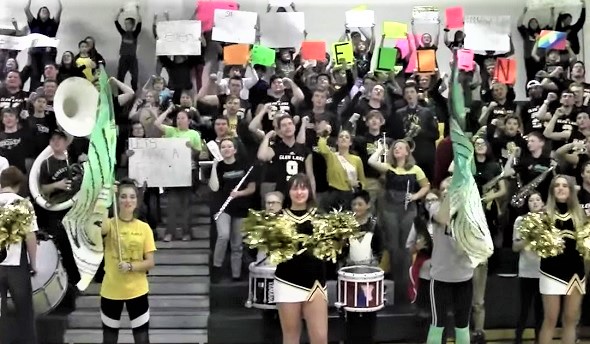
If you pay attention to high school sports in general or statewide news casually, you’ve probably heard some of the rest of this story. Mattson invited Forest Area director Brandon Deike and his band to play at Glen Lake’s game that night against Gladstone. A week later, after their story had been told all over the country, the schools combined for a “Marching for Ellen” spirit video hoping to land on the show.
Things have quieted back down substantially for the two small northern Lower Peninsula communities. But their march together continues.
“We don’t want it to end,” Mattson said. “Sometimes you see these initiatives begin, and it’s really cool, and they fizzle out. We want to work with our kids and their kids and Brandon over there to make cool things happen as we support each other – and at the end of the day to make his program grow and make our program grow over here.”
Glen Lake's athletic director said the Warrior marching band is welcome back anytime.https://t.co/RPXSNueHIx
— upnorthlive.com (@upnorthlive) September 29, 2019
A little background: Forest Area’s high school and Glen Lake’s are 45 miles away, or about an hour’s drive whether traveling through or around Traverse City. Glen Lake has nearly 250 students in its high school, and Forest Area has about 175.
Glen Lake’s football team is 9-1 and hosts Harrison on Friday in a Division 6 District Final. Forest Area started this fall playing 8-player football, and won its first game against Brethren 64-44. But the Warriors had started with a small roster that got smaller as the season got going – and by Week 3 didn’t have enough players to finish the season, so they canceled the rest of their games.
Meanwhile, Forest Area’s band has rebuilt mightily since the school’s music program was cut in 2011 – while Glen Lake’s band began this school year with one high schooler playing with a 10-member middle school group. In fact, Mattson asked his school’s football players and cheerleaders the last time they were at a home game where there was a band – and they couldn’t remember one.
So the Sept. 27 game happens, and all of the feel-good fanfare that came with it. With a few weeks, the statewide and national attention slowed way down – but the relationship between the schools was just beginning to grow.
A week later after the Gladstone game, Glen Lake hosted Elk Rapids on the night that was supposed to be Forest Area Homecoming – so during that school day, a group of Glen Lake football players and cheerleaders went over for Forest Area’s pep assembly, at first to be part of the “Marching for Ellen” video but then sticking around to take part in the Warriors’ festivities.
Then on a Monday night, Oct. 14, Mattson took a group of students to Traverse City to support Forest Area during the area’s band expo at Thirlby Field. There was some hope the schools might unite their forces again for Glen Lake’s final regular-season home game Oct. 25. But although that didn’t completely pan out, Forest Area did sent over 20 members of its band, who sat in bleachers on the track with Glen Lake’s student section, band and choir – and cheered on the now growing Glen Lake band, which included Mattson on the saxophone he’d stopped playing in sixth grade.
“One of the Forest Area kids called over from the bleachers, ‘Mr. Mattson, come here. I think we need to call our schools ‘Wakers,’” Mattson said (with the student referring to a combination of the mascot names Warriors and Lakers). “It really had gone from literally about zero to what we’ve got, and it’s a really collaborative partnership here."
“This isn’t their band director or myself making it happen. This is by and large kid driven. Our kids keep asking, ‘Are they coming for the game Friday night?’ Or their kids talk to Mr. Deike and say, ‘Can they come to our pep assembly?’ They know they’re welcome back to play with us any time.”
Mattson has recently taken over as administrator as well of Glen Lake’s fine arts department, and rebuilding the school’s band is a high priority. Glen Lake has brought in retired Traverse City West band directors Pat Brumbaugh and Flournoy Humphreys as “artists in residence” to revive the program. They’re teaching a two-day-a-week Intro to Band class, and Mattson said there are about 35 fifth and sixth-graders signed up.
Mattson also noted how the Forest Area band has opened up the perspective of his school’s football players, who have gained a real appreciation for all of the groups – cheerleaders and band especially – who join the players on the field in making for a great football night.
“What started from one simple gesture to help a school out and vice versa turned into, and I think Brandon would echo it, turned into valuable lessons for our society about teamwork and collaboration, and that kindness matters,” Mattson said. “When it’s driven by young people and really executed by our young people, how does it get better than that? They’re the next generation of leaders. To take it from simply, ‘Yeah, that sounds cool,’ to go and play at Glen Lake, to what it’s become, it’s a great lesson for all of us. That when these kids take the initiative and make it their own, special things happen – and that has happened.”