


MHSA(Q&)A: NFL official Ronald J. Winter
July 19, 2012
By Brian Spencer
Second Half
 Kalamazoo's Ron Winter has officiated in the National Football League for nearly two decades, and became a referee in 1999. But long before he joined the highest level of the game, he got his start on Michigan's high school fields.
Winter has officiated that sport at all three levels and also high school and college basketball. He's also served as a source of knowledge for officials around the state -- and an example for those hoping to start at the high school level and climb to the pros.
Winter remains registered as an MHSAA official, as he's been for 42 years. An associate professor emeritus of human performance and health education at Western Michigan University, Winter was appointed earlier this month to serve a two-year term on the Governor's Council on Physical Fitness, Health and Sports. The council focuses on increasing physical activity and health improvements.
He served on the WMU faculty first beginning in 1969 and then again from 1992-2008. Winter earned bachelor and master's degrees at Michigan State University.
Did you play any sports in high school or college?
I played football, basketball, baseball, and track in high school. However, once I got to Michigan State University, I started playing lacrosse. A couple guys that lived near me played lacrosse and asked me to come out to throw the ball around. After throwing with them a couple times they asked me to come out for the team. I ended up playing lacrosse for MSU for four years.
How did you decide to choose football as the sport you would officiate?
I started officiating as a student at MSU in their intramural program, officiating touch football and basketball. The next logical step was to then officiate in the high school leagues. From there, I began to proceed to all the different levels.
Are there specific requirements for becoming an NFL official?
The biggest requirement is experience. The progression that I went through went like this:
After officiating high school games, I went to the MIAA (Michigan Intercollegiate Athletic Association). They (MIAA) were looking for people that had 3-5 years of experience at the high school level. From there I went to the Mid-Continent conference. I wasn’t able to go to the Mid-American Conference because I was employed at Western Michigan University.
From there I went to the Big Ten. The Big Ten was looking for people with 5 to 10 years of experience in high school and people that had experience at different positions as an official. I ended up officiating in as a Big Ten football official for 10 years and a Big Ten basketball official for 15 years. I then submitted an application to the National Football League. Coincidentally, the NFL was scouting officials, and had followed me for four years before they finally asked me to be a part of the staff. The NFL decides on who they want to pursue through recommendations and personal interest. They look for personality traits as well as how (officials) carry themselves through different situations.
What has been your favorite level to officiate; High school, college or professional?
I enjoyed officiating all of them, but for different reasons.
I found high school to be the most fascinating because it’s all about the kids; they are playing the game for the love of the game. That is the purest sense of the sport. I loved being involved with kids simply because they love the game.
I found the Big Ten to be most exciting because of the kind of atmosphere that exists on a Big Ten campus on a Saturday afternoon. It’s electric. You don’t get that same sense or the same feel on Sunday afternoon in a pro stadium.
I found the NFL to be most intense. The NFL really has three or four different levels of play during the season. There is preseason play, the first third of the season, the second third of the season, and the last five games of the season. Each level is ramped up another notch as the season progresses. Playoffs are entirely different all together. In terms of the intensity and pure speed of the game, there is nothing like the NFL playoffs.
How important is getting along with your fellow officials on the field?
It’s imperatively important if you want to have a smooth and well-run game. This doesn’t mean that you have to buddy-buddy off the field, but on the field you have to be committed to one goal. We spend two or three hours on meetings Saturday afternoon to go over rules tests, tape, and more to prepare for the next game (and) to get over rough patches that develop on a personal level in a previous week. I need to know that the other six guys are focused and thinking about football like me. Everyone has to have confidence in one another. We spend plenty of time on Saturday to get to the point that we need to on Sunday.
What has been the most exciting game you’ve officiated?
I’ve been in plenty of exciting games from NFL playoff games, to the first Orange Bowl game, to the Rose Bowl, to the Division III Hope vs. Calvin basketball game, to when Indiana played Purdue in basketball. All of them were incredible to be a part of. During the Indiana vs. Purdue game, the arena was electric. The players, coaches, fans were intense. Everybody is totally focused on the game. Each coach had a tremendous respect for one another. Neither one wanted to show up or embarrass their counterpart. This game wasn’t that drastically different at the Division III level, however. The intensity of both was very similar.
Are there games that you get excited to officiate more than others, presently?
Not in terms of specific teams. It really just depends on the circumstances, of course. Pittsburgh vs. Baltimore is an intense game. The Jets vs. Patriots game is great. There are clearly rivalries that are very exciting to be a part of. The level of play and intensity of the athletes in the NFL is unmatched and can provide excitement every week.
What is the most difficult aspect of being a NFL official?
I would say that preparation and being able to maintain intensity on the field on Sunday are key aspects. The preparation is difficult because it’s time-consuming. It is a misconception that we simply show up on Sunday to work the game. By the time Sunday rolls around, I’ve spent over 20 hours during the week trying to prepare for a Sunday game. It isn’t hard in terms of physical labor, but difficult in terms of a time commitment. You have to have an understanding family to be in the occupational field that I am in.
Do you have any advice for aspiring officials who hope to make it to the league?
Practice, practice, practice. Be able to work any game at any level and get as much experience as you can. Be a good partner on the field. It takes time; it isn’t something that just happens. Like anything else, it takes practicing your trade to be able to make it to the top level.
Northern Schools Find Solution in NMFL
September 6, 2019
By Chris Dobrowolski
Special for Second Half
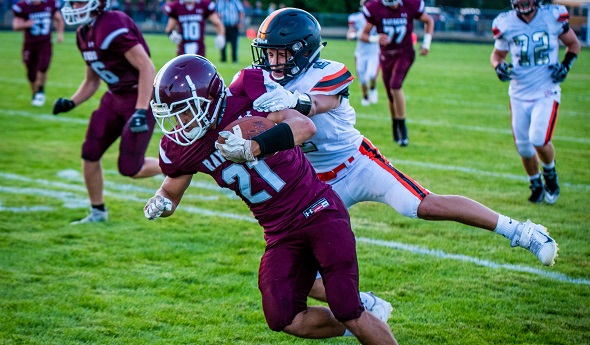
With 17 schools spread across 11 counties, the Northern Michigan Football League has created an indelible footprint since it was born into existence five years ago.
 The conference, made up of three divisions of schools in varying size, has been able to sustain and evolve despite an ever-changing football landscape up north that has made for a revolving door of membership from year to year.
“It continues to morph,” said Frankfort athletic director Dave Jackson, the conference’s commissioner and one of the founders of the league.
From the biggest schools in the Legends division — Benzie Central, Boyne City, Cheboygan, Grayling, Kalkaska, Kingsley and Traverse City St. Francis — to the smaller schools in the Leaders (Charlevoix, Elk Rapids, Frankfort, Mancelona and Maple City Glen Lake) and Legacy divisions (Harbor Springs, East Jordan, Inland Lakes, Johannesburg-Lewiston and St. Ignace) the NMFL has provided easy avenues for scheduling as well as good, competitive balance for the programs that call it home.
“The scheduling aspect is where I go back to it,” said Johannesburg-Lewiston football coach and athletic director Joe Smokevitch. “It’s just been huge for us. Going into 2020 and 2021 my schedule is full, basically with teams from within the conference. They’re not all division games. I am crossing over and playing those other schools. It’s really helped with scheduling. Not having to go far away to play somebody. You look at our schedule. We play some quality opponents. I think the conference is very strong from top to bottom.”
The idea for the league was hatched in 2012 between schools in the Lake Michigan and Northwest conferences. Both leagues were seeing problems from smaller schools trying to compete with larger ones, and neither side benefitting from the affiliation. So, the two merged as a 13-team league comprised of two divisions of similar-sized enrollments.
The league has rarely stayed intact from year to year, switching to the three-division alignment with the growth to 20 teams in 2016 when it absorbed the remaining teams in the Ski Valley Conference, as well as withstanding the loss of six schools to 8-player football in the span of four years.
“We’ve taken schools in the league that didn’t last very long,” said Jackson. “We took in Newberry and they lasted just a year, then suddenly they’re 8-man. We took in Gaylord St. Mary. We took in Central Lake. Those teams were just a year or two and suddenly they’re gone. Our constitution calls for a two-year process of getting out, but those teams that had to go 8-man, they’re out for the next year. So, suddenly you’re scrambling again, which is the one thing we were trying to keep from having to do because there is no planning when that last-minute 8-man decision comes along and schools decide to make that plunge. There’s nothing you can really do when a school says they’re going to do that. You can’t say, ‘Well, the constitution says … .’ They’re going to do what they need to do.”
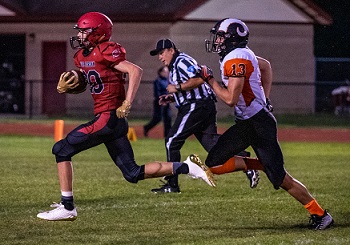 Fortunately for the league, it has been able to find suitable replacements at every turn. In fact, Ogemaw Heights and Sault Ste. Marie are set to join in 2020 to become part of the Legends division, bolstering the league to a robust 19 schools. Kalkaska and Boyne City will slide over to the Leaders division and Frankfort — one of the smallest 11-player football teams in the state — is moving to the Legacy division.
“It made sense to apply,” said Ogemaw Heights athletic director Jon Studley, noting four future conference foes already are on this year’s schedule. “We’re very excited about the opportunity to be a part of that. We’re going to be able to create some rivalries.
“I think fans of northern Michigan football benefit the most. They’re seeing competitive football week in and week out.”
As the NMFL has shown, the quality of football being played within the conference is at a high level, too. At least one team from the league has reached the Semifinal round of the MHSAA playoffs every season. Boyne City was a semifinalist in Division 6 in 2014, while St. Francis has represented the league in the Semifinals in 2015, 2017 and 2018. In 2016 two teams advanced that far — St. Ignace in Division 8 and Maple City Glen Lake in Division 6 — with Glen Lake reaching the Finals before falling to Jackson Lumen Christi 26-14.
“I think we’re really starting to get some respect,” said Glen Lake coach Jerry Angers. “I’ve talked to the teams downstate that we’ve played, they want to come up and play us. They’re not saying, ‘This is going to be an easy game.’ They’re saying, ‘This is going to be a fun game, and they’re going to give us something.’”
There remains the possibility the league will undergo more changes before it more comfortably stabilizes. Some schools have expressed interest in joining, and the threat of losing members to 8-player football remains for a few of the smallest schools. It’s nothing the league hasn’t dealt with before, however. Jackson said it comes down to maintaining a commitment to the schools that are in the conference and carefully examining any growth that could occur.
“We had our big meeting in December, and one thing we talked about is how we have to look out for each other,” said Jackson. “We’re trying to guarantee that the league will provide eight of your nine games. In most cases the league is providing all nine of the games. So, you know you’re going to have somebody to play and you’re not going to have to go looking. There’s a time we may control 11-man football for everything north of Lansing. I don’t know. It continues to grow because teams are looking for that stability and consistency year in and year out, so they know who their games are with and they know who they play.”
 Chris Dobrowolski has covered northern Lower Peninsula sports since 1999 at the Ogemaw County Herald, Alpena News, Traverse City Record-Eagle and currently as sports editor at the Antrim Kalkaska Review since 2016. He can be reached at [email protected] with story ideas for Manistee, Wexford, Missaukee, Roscommon, Ogemaw, Iosco, Alcona, Oscoda, Crawford, Kalkaska, Grand Traverse, Benzie, Leelanau, Antrim, Otsego, Montmorency, Alpena, Presque Isle, Cheboygan, Charlevoix and Emmet counties.
PHOTOS: (Top) Charlevoix, carrying the ball, opened this season with a 40-26 win over Elk Rapids. (Middle) East Jordan got a step on Harbor Springs on this play last week, but the Rams emerged with a slim 34-33 win. (Photos by Sports in Motion.)