


MHSA(Q&)A: NFL official Ronald J. Winter
July 19, 2012
By Brian Spencer
Second Half
 Kalamazoo's Ron Winter has officiated in the National Football League for nearly two decades, and became a referee in 1999. But long before he joined the highest level of the game, he got his start on Michigan's high school fields.
Winter has officiated that sport at all three levels and also high school and college basketball. He's also served as a source of knowledge for officials around the state -- and an example for those hoping to start at the high school level and climb to the pros.
Winter remains registered as an MHSAA official, as he's been for 42 years. An associate professor emeritus of human performance and health education at Western Michigan University, Winter was appointed earlier this month to serve a two-year term on the Governor's Council on Physical Fitness, Health and Sports. The council focuses on increasing physical activity and health improvements.
He served on the WMU faculty first beginning in 1969 and then again from 1992-2008. Winter earned bachelor and master's degrees at Michigan State University.
Did you play any sports in high school or college?
I played football, basketball, baseball, and track in high school. However, once I got to Michigan State University, I started playing lacrosse. A couple guys that lived near me played lacrosse and asked me to come out to throw the ball around. After throwing with them a couple times they asked me to come out for the team. I ended up playing lacrosse for MSU for four years.
How did you decide to choose football as the sport you would officiate?
I started officiating as a student at MSU in their intramural program, officiating touch football and basketball. The next logical step was to then officiate in the high school leagues. From there, I began to proceed to all the different levels.
Are there specific requirements for becoming an NFL official?
The biggest requirement is experience. The progression that I went through went like this:
After officiating high school games, I went to the MIAA (Michigan Intercollegiate Athletic Association). They (MIAA) were looking for people that had 3-5 years of experience at the high school level. From there I went to the Mid-Continent conference. I wasn’t able to go to the Mid-American Conference because I was employed at Western Michigan University.
From there I went to the Big Ten. The Big Ten was looking for people with 5 to 10 years of experience in high school and people that had experience at different positions as an official. I ended up officiating in as a Big Ten football official for 10 years and a Big Ten basketball official for 15 years. I then submitted an application to the National Football League. Coincidentally, the NFL was scouting officials, and had followed me for four years before they finally asked me to be a part of the staff. The NFL decides on who they want to pursue through recommendations and personal interest. They look for personality traits as well as how (officials) carry themselves through different situations.
What has been your favorite level to officiate; High school, college or professional?
I enjoyed officiating all of them, but for different reasons.
I found high school to be the most fascinating because it’s all about the kids; they are playing the game for the love of the game. That is the purest sense of the sport. I loved being involved with kids simply because they love the game.
I found the Big Ten to be most exciting because of the kind of atmosphere that exists on a Big Ten campus on a Saturday afternoon. It’s electric. You don’t get that same sense or the same feel on Sunday afternoon in a pro stadium.
I found the NFL to be most intense. The NFL really has three or four different levels of play during the season. There is preseason play, the first third of the season, the second third of the season, and the last five games of the season. Each level is ramped up another notch as the season progresses. Playoffs are entirely different all together. In terms of the intensity and pure speed of the game, there is nothing like the NFL playoffs.
How important is getting along with your fellow officials on the field?
It’s imperatively important if you want to have a smooth and well-run game. This doesn’t mean that you have to buddy-buddy off the field, but on the field you have to be committed to one goal. We spend two or three hours on meetings Saturday afternoon to go over rules tests, tape, and more to prepare for the next game (and) to get over rough patches that develop on a personal level in a previous week. I need to know that the other six guys are focused and thinking about football like me. Everyone has to have confidence in one another. We spend plenty of time on Saturday to get to the point that we need to on Sunday.
What has been the most exciting game you’ve officiated?
I’ve been in plenty of exciting games from NFL playoff games, to the first Orange Bowl game, to the Rose Bowl, to the Division III Hope vs. Calvin basketball game, to when Indiana played Purdue in basketball. All of them were incredible to be a part of. During the Indiana vs. Purdue game, the arena was electric. The players, coaches, fans were intense. Everybody is totally focused on the game. Each coach had a tremendous respect for one another. Neither one wanted to show up or embarrass their counterpart. This game wasn’t that drastically different at the Division III level, however. The intensity of both was very similar.
Are there games that you get excited to officiate more than others, presently?
Not in terms of specific teams. It really just depends on the circumstances, of course. Pittsburgh vs. Baltimore is an intense game. The Jets vs. Patriots game is great. There are clearly rivalries that are very exciting to be a part of. The level of play and intensity of the athletes in the NFL is unmatched and can provide excitement every week.
What is the most difficult aspect of being a NFL official?
I would say that preparation and being able to maintain intensity on the field on Sunday are key aspects. The preparation is difficult because it’s time-consuming. It is a misconception that we simply show up on Sunday to work the game. By the time Sunday rolls around, I’ve spent over 20 hours during the week trying to prepare for a Sunday game. It isn’t hard in terms of physical labor, but difficult in terms of a time commitment. You have to have an understanding family to be in the occupational field that I am in.
Do you have any advice for aspiring officials who hope to make it to the league?
Practice, practice, practice. Be able to work any game at any level and get as much experience as you can. Be a good partner on the field. It takes time; it isn’t something that just happens. Like anything else, it takes practicing your trade to be able to make it to the top level.
Drive for Detroit: Playoff Week 3 Preview
November 7, 2018
By Geoff Kimmerly
Second Half editor
The first MHSAA football finalists of this fall will celebrate this weekend, as four 8-player Semifinals will determine which teams move on to Marquette’s Superior Dome a week from Saturday.
 And 64 11-player teams have completed half of the “Drive for Detroit,” with this weekend’s Regional Finals setting up next weekend’s Semifinals and opportunities to visit Ford Field for extended Thanksgiving.
Below are the matchups in all 10 divisions this weekend, with a quick look at one from each 11-player bracket and all four 8-player Semifinals. We suggest seeing them live, of course. But we have more opportunities to watch online as well.
This week’s FOX Sports Detroit Prep Zone matchups are Dearborn Fordson at Clinton Township Chippewa Valley and Clarkston at Lapeer in Division 1, and Warren DeLaSalle at Port Huron Northern in Division 2. Those all will stream free of charge on FOXSportsDetroit.com and on the FOX Sports app. At least five more games will be viewable on MHSAA.tv, either live with subscription or free after 72 hours.
Games are Friday unless noted. “Drive for Detroit” is powered by MI Student Aid.
Division 1
Dearborn Fordson (10-1) at Clinton Township Chippewa Valley (11-0)
The Tractors showed they’re capable of beating anyone with last week’s 41-14 stunner of Detroit Cass Tech. Fordson is scoring 38 points per game while playing seven against playoff teams, and is a three-point Week 6 loss to Belleville from being undefeated. Chippewa Valley is the next giant up, coming off a 51-10 rematch win over Macomb Dakota and giving up only 15 points per game despite also playing seven against playoff qualifiers.
Other Regional Finals: FRIDAY Clarkston (9-2) at Lapeer (11-0), West Bloomfield (9-2) at Belleville (11-0). SATURDAY Rockford (7-4) at Saline (10-1).
Division 2
Portage Northern (9-2) at Muskegon Mona Shores (10-1)
The Huskies have won seven straight games and last week celebrated their first District title. The defense has shined; Northern is giving up 12 points per game and allowed more than 21 once, in a Week 4 loss to East Lansing. The Sailors beat Jenison last week for the second time this season, extending the margin from seven points in the first meeting to 39 in the rematch. Averaging 44 points per game, they may present the toughest offensive challenge the Huskies have faced.
Other Regional Finals: FRIDAY Livonia Franklin (7-4) at Birmingham Groves (9-2), Midland (8-3) at Walled Lake Western (8-3), Warren DeLaSalle (9-2) at Port Huron Northern (10-1).
Division 3
Cedar Springs (10-1) vs. Muskegon (11-0) at Grand Haven
 After eliminating Ottawa-Kent Conference Gold co-champs East Grand Rapids and Grand Rapids Christian the last two weeks, Muskegon takes on O-K White winner Cedar Springs. The Red Hawks last week won their first District title since 2000 and boast a defense giving up 10.5 points per game. The opportunity to make history in this one is even greater – the reigning Division 3 champ Big Reds have won 25 straight games and scored at least 42 points nine weeks running.
Other Regional Finals: FRIDAY Parma Western (10-1) at Zeeland East (10-1), Detroit Martin Luther King (9-2) at Allen Park (9-2). SATURDAY Farmington (8-3) vs. DeWitt (11-0) at Lansing Catholic.
Division 4
Escanaba (9-2) at Grand Rapids Catholic Central (10-1), Saturday
Grand Rapids Catholic Central has fared well against the Eskymos the last two seasons, winning their 2016 Regional Final 34-0 and last season’s Semifinal 24-0 on the way to claiming Division 4 championships both years. But Escanaba can find encouragement in a couple of places. The 24 points in last year’s meeting were the fewest GRCC scored in the playoffs. And four of the Escanaba offense’s six highest-scoring games this fall have come over the last five weeks.
Other Regional Finals: FRIDAY St. Clair (9-2) at Williamston (9-2). SATURDAY Holland Christian (8-3) at Edwardsburg (11-0), Chelsea (8-3) at Farmington Hills Harrison (8-3).
Division 5
Reed City (11-0) at Saginaw Swan Valley (11-0), Saturday
Reed City is playing in a Regional Final for the fourth time in five seasons, and as an undefeated team for the second time in three. Adding to that familiarity with the big stage is a familiar foe – Swan Valley defeated the Coyotes last year 29-14 in a Semifinal. Reed City has lost only three regular season games this decade, but there’s definitely something different this fall – notably a defense that is giving up 6.2 points per game. That unit will be key against a Vikings team scoring 43 points per and giving up only 8.9.
Other Regional Finals: FRIDAY Detroit Denby (9-2) at Marine City (9-2). SATURDAY Hudsonville Unity Christian (9-2) vs. Kalamazoo United (11-0) at Vicksburg, Frankenmuth (9-2) at Portland (11-0).
Division 6
Montague (9-2) at Schoolcraft (9-2)
The Eagles are playing for their first trip to the Semifinals since 2001, and have been in the mix making the Regional Final in 2013 and suffering their only losses of the season in District Finals in 2012 and 2016. Schoolcraft has played eight games against playoff teams this fall and still is averaging 45 points per game. Montague, playing in its second straight Regional Final, is averaging 44 points per contest with seven against playoff teams – and losses to only undefeated Division 5 contenders Reed City and Portland. Schoolcraft’s defeats also came to Division 5 playoff teams; Kalamazoo United is still alive.
Other Regional Finals: FRIDAY Kingsley at Traverse City St. Francis (11-0), Blissfield (7-4) at Jackson Lumen Christi (10-0). SATURDAY Montrose (9-2) at Flint Hamady (11-0).
Division 7
Pewamo-Westphalia (11-0) vs. New Lothrop (10-1) at Chesaning
An interesting note about P-W’s back-to-back Division 7 championship runs the last two seasons: Of six playoff games not including Semifinals, only three were played at home. The Pirates had to win District and Regional titles on the road last season, and beat the Hornets 35-14 to clinch the former. New Lothrop beat the first (Cass City) and second-place (Elkton-Pigeon-Bay Port Laker) teams from the Greater Thumb Conference West the last two weeks to set up this rematch.
Other Regional Finals: FRIDAY Roscommon (10-1) at Lake City (11-0), Riverview Gabriel Richard (7-4) at Madison Heights Madison (11-0). SATURDAY Monroe St. Mary Catholic Central (9-2) at Cassopolis (11-0).
Division 8
Breckenridge (11-0) at Ishpeming (11-0), Saturday
The Huskies will head north seeking their first Regional title and hoping a defense giving up just 4.3 points per game can lock down an Ishpeming offense scoring 42. Breckenridge also made the Regional Final last season, in Division 7, losing to Lake City by just two points. The Hematites shut out 2017 semifinalist Iron River West Iron County for the second time in five weeks to win the District title.
Other Regional Finals: FRIDAY Flint Beecher (8-3) at Harbor Beach (10-1). SATURDAY Mendon (7-4) at Holton (7-4), Detroit Southeastern (8-3) vs. Reading (11-0) at Hillsdale High School.
8-Player Division 1
SEMIFINALS
AuGres-Sims (11-0) at Pickford (11-0), Saturday
Before last week, these teams stacked up even more similarly than their records might indicate – Pickford’s six-point win over Suttons Bay in their Regional Final was its first close game since Week 3, and AuGres-Sims hasn’t allowed an opponent to get closer than 38 points all fall. Quarterback Caden Zeien has thrown for 1,928 yards and 34 touchdowns with only one interception for AuGres-Sims (plus run for 673 yards and 10 TDs), while his Pickford counterpart James Storey has thrown for 1,527 yards and 28 touchdowns and run for 782 yards and 15 scores. The Panthers also made the Semifinals the last two years and this will be their fifth time total trying to make the MHSAA Finals for the first time. For the Wolverines, this Semifinal is a first.
Colon (10-1) at Morrice (11-0)
Morrice is coming off its first Regional title since 1996 – although the Orioles did give up their first points since mid-September last week to Wyoming Tri-unity Christian in a 44-14 win. They are allowing 5.4 per game points overall while gaining nearly 360 yards in total offense. Colon’s lone defeat was to Tri-unity, 22-14 three weeks ago, but the Magi rebounded quickly to make their first Semifinal. Quarterback Hunter Nowak leads the Orioles' attack with 1,757 yards and 30 touchdowns rushing and 517 yards passing. Colon boasts a pair of 1,000 backs in Brandon Crawford (1,607 yards, 21 TDs) and quarterback Philip Alva (1,035/16 rushing, 461/8 passing).
8-Player Division 2
SEMIFINALS
Cedarville (7-4) at Rapid River (8-3)
Three of seven Great Lakes Conference East teams are still alive for MHSAA championships, and these two met in Week 7 with Rapid River claiming a 28-20 win to help lock up third place in the league. Rapid River downed reigning 8-player Division 2 champ Crystal Falls Forest Park last week and will be aware of the possibilities of a rematch disappointment – the Rockets opened these playoffs by beating Engadine by two after losing to the Eagles by 18 only two weeks prior. Cedarville is rolling again, having won its two playoff games by a combined 88-6 score, and led by quarterback Tristan Masuga (1,730 yards/21 TDs passing).
Portland St. Patrick (7-4) at Onekama (9-2), Saturday
The Shamrocks seemed all but forgotten a month ago and tied for fifth in the Southern Central Athletic Association A. But with four straight wins they’re back in the Semifinals for the second straight season and looking to get back to Superior Dome after finishing runner-up in Division 2 a year ago. Onekama, meanwhile, will be playing in its first Semifinal to continue an impressive five-year climb. The Portagers are giving up only 7.4 points per game and lost this fall only to Division 1 playoff teams Tri-unity and Suttons Bay – by a combined seven points. They've run for nearly 1,900 yards over nine games (two wins were forfeits) with Aaron Powers averaging 11.5 yards per carry and Ben Acton 8.9.
Second Half’s weekly “Drive for Detroit” previews and reviews are powered by MI Student Aid, a part of the Student Financial Services Bureau located within the Michigan Department of Treasury. MI Student Aid encourages students to pursue postsecondary education by providing access to student financial resources and information, including various student financial assistance programs to help make college more affordable for Michigan students. MI Student Aid administers the state’s 529 savings programs (MET/MESP) and eight additional aid programs within its Student Scholarships and Grants division. Click for more information and connect with MI Student Aid on Facebook and Twitter @mistudentaid.
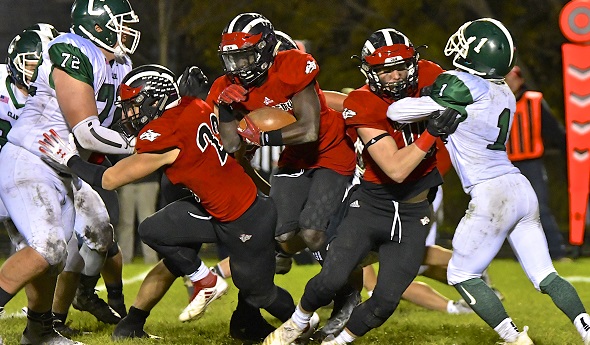
PHOTO: A Reed City ball carrier breaks through an opening during the Coyotes’ 38-7 District Final win over Clare last week. (Click to see more from HighSchoolSportsScene.com.)