


Michigan’s Football Numbers Game – Corrected
September 1, 2017
Today’s blog was written by MHSAA Second Half Editor Geoff Kimmerly
The demise of Michigan high school football has been greatly exaggerated – or, at least, recently misreported by one of the U.S.’s most recognizable newspapers that noted as part of a larger story on football decline that Michigan has seen a “net loss of 57 teams in the past five years.”
It’s easy to understand how this error took place – especially when a reporter is not familiar with the football landscape in our state – but that doesn’t make this statement any less misleading, or harmful considering the story since has been picked up by multiple large news organizations. So let’s quickly clear up the misinterpreted information:
-
The data that led to this error came from an annual participation report released by the National Federation of State High School Associations (NFHS). Every spring, state associations (like the MHSAA) from every state and Washington, D.C., tally up how many of their member schools have a sport and how many athletes play it.
-
For 2016-17, the MHSAA submitted to the NFHS a total of 580 schools with 11-player football – that number actually includes all schools that reported having at least one football player, including primary and secondary schools in co-ops. And yes, that 580 is 57 fewer than the 637 11-player schools the MHSAA submitted for 2012-13.
-
But saying Michigan has lost 57 football programs misses out on something incredibly significant – the MHSAA also submitted 60 schools with 8-player football last year, up from 16 in 2012-13, making that net decrease in football schools over five years 13 – far fewer than 57.
And with a few more brush strokes, the picture of football in our state actually shows a healthy landscape:
-
The 640 schools in Michigan with at least one football player for 2016-17, 11 and 8-player combined, is actually eight more than we reported to the NFHS four years ago and 10 more than three years ago.
-
A better picture of Michigan’s football consistency is shown by how many varsity programs are taking the field. This fall, that number is 616 – 555 11-player varsities and 61 8-player – and we also had 616 for most of the 2016 season, 616 in 2015 and 615 in 2014.
-
We’ve had programs bring back varsity teams this year, and in one case a school has a team on its own for the first time. Benzonia Benzie Central and Suttons Bay were unable to field varsities in 2016, but Benzie Central is back playing 11-player and Suttons Bay is back with an 8-player team. Brimley, an 8-player school going back to 2010, also is fielding a team again after being unable to do so last year. Mount Clemens played only two varsity games in 2016 and forfeited a third, but has seven scheduled for this fall and lost close in its opener last week. And Bear Lake, previously a secondary school in a co-op program, now has a team all its own for the first time and is playing at the 8-player level.
-
Yes, there has been a decrease in Michigan high school football participation when it comes to the number of players – for reasons we discuss frequently, including more extracurricular/entertainment options than ever for students, more who are specializing in other sports and safety fears that often are misplaced. But we’ve also seen a three percent drop in enrollment at MHSAA member schools over the last five years. And despite that trend, Michigan again had the sixth-highest 11-player football participation in the nation in 2016-17 (and seventh-highest in 8-player) while ranking 10th nationally in number of residents of high school age.
-
So yes, while a nine percent drop in the number of football players over the last five years in Michigan clearly is troubling, and something we’re working with the Michigan High School Football Coaches Association to reverse, let’s also put those numbers in perspective. At medium-sized to bigger schools, it could mean a roster of 40 might have only 36 players. A roster of 20 at an 8-player school might go down to 18. Neither would signal the need to eliminate a football program.
-
And that move by so many schools to 8-player? It definitely started as a way for low-participation programs to keep football (and has worked for most of them). While that still may be the driving force as schools move from 11 to 8, others have made the switch because most of their former opponents did and joining them makes scheduling easier and travel shorter. Michigan has a multitude of small towns, and you’ll find most of these 8-player programs in pockets in the thumb, southwest or northern Lower Peninsula, or Upper Peninsula. And keep in mind, only Class D teams remain eligible for the 8-player playoffs – and only two of 61 teams playing 8-player this fall are larger than Class D and its enrollment limit of 203 students for 2017-18.
The story behind “a decrease of 57 schools” clearly is a little complex to explain and explain away, but it’s necessary to do so.
Yes, Michigan’s total number of football players is down a few percent. But the sport’s prominence and importance in our schools and communities remains high.
4-Year QB Leads with What He's Learned
October 2, 2020
By Doug Donnelly
Special for Second Half
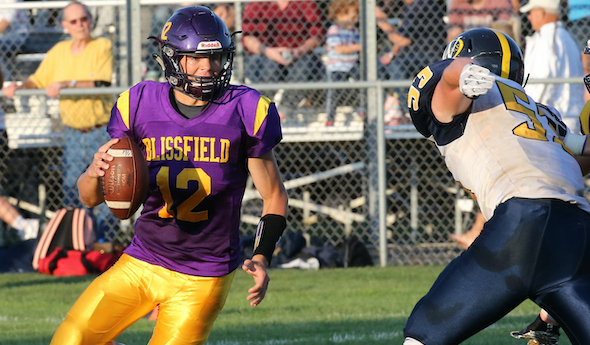
BLISSFIELD – Gavin Ganun is like a seasoned veteran.
 “I’m really confident now with everything I’m doing,” said the Blissfield quarterback. “I’ve seen a lot of things happen. There’s nothing that surprises me.”
Clinton’s football team might have something to say about that tonight when it travels to Blissfield for a colossal Lenawee County Athletic Association clash.
But there’s no denying that Ganun has seen just about everything by now. He’s making his 37th career start at quarterback for Blissfield and is having a sensational season.
“To me the game feels really slow now,” Ganun said while preparing to face the 2-0 Clinton squad this week. “I have plenty of time to see everything. I can calm myself down in the pocket. Even if there is pressure, I don’t feel it like I used to. I’m not worried about getting hit. I just stand back there, make the reads and find the open receiver.”
This year Ganun has had plenty of open receivers. He has great targets in wide receivers Zack Horky (6-foot-4) and Ty Wyman (6-6) and tight end Nick Ostas (6-2).
“One of them gets open every play,” Ganun said.
Over the first two weeks of the season, Ganun threw for a combined 611 yards and 10 touchdowns – five scores to Horky and three to Wyman – as Blissfield piled up wins over Dundee and reigning LCAA champion Hillsdale.
Ganun has looked great behind a Royals offensive line that has five new starters – tackles Blaine Pifer and Scott Jackson, guards Luke Nofzinger and Ricky Eisenmann and center Henry Smith.
 “It all starts with the line,” Ganun said. “They have come so far. They worked really hard to get better. Their pass blocking has been amazing.”
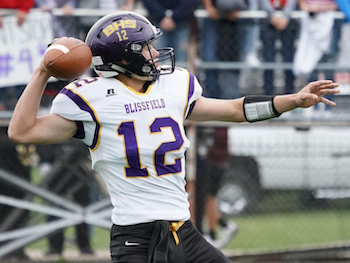
Ganun has been the starting Blissfield quarterback since game one of his freshman year. He has led Blissfield into the playoffs three straight seasons. For his career, he enters tonight’s game against Clinton with 4,953 passing yards and 56 passing touchdowns.
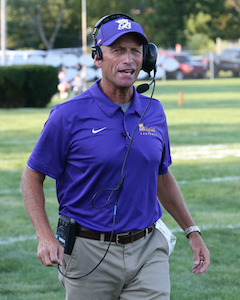
Ganun was coached his first two seasons by Ryan Love, who is now coaching at Morenci. Ron Estes returned to the Royals’ sideline last year and inherited Ganun as his QB. He couldn’t be happier with his signal-caller.
“There’s no panic in him,” Estes said. “He knows the offense inside and out. He knows what to do when things break down. He knows what to do and when to do it.”
Ganun said Estes gives him a lot of freedom to change the play at the line of scrimmage if he sees something when looking over the defense.
“When I was a freshman, we weren’t doing that,” he said. “But, now, I’m fine to do that anytime. If the defense is running what we think they will run, I don’t have to, but if they change things up, I can change things up.”
Ganun’s audibles have resulted in a couple big plays this season. Horky has caught two touchdown passes in the first quarter of both games.
“We have a good connection,” he said. “We’ve played together so long that we know what each other is going to do before we do it. We’ll just look at each other or say something really quick when we leave the huddle.”
 Clinton, which returned to the LCAA this season after just over a decade as a member of the Tri-County Conference, will be a stiff test for Blissfield. Clinton has been rolling during the first two weeks of the season, piling up more than 900 yards of offense – all on the ground.
Clinton coach Jeremy Fielder has watched a lot of film of Ganun lately and is impressed.
“He’s always been pretty good,” Fielder said. “You see it all with him. He’s an outstanding quarterback.”
Ganun plays three sports for the Royals and has been on varsity for all his entire career. He committed to play college baseball at Bowling Green State University, which announced in the spring that it was dropping baseball before re-examining that decision a month or so later. He’s happy he gets to play for the Falcons.
“I’m super excited,” he said. “I love that place. Everything about it is amazing.”
The Royals are trying to win their first LCAA championship since 2007, the same year Estes guided them to the Division 6 championship game before he stepped away – then returned – as head coach. Ganun knows Clinton stands in the way of that goal.
“It’s going to be very tough,” he said. “They are very physical. Both teams know what the other team wants to do.”
He also knows the Royals are playing at a high level right now.
“We have a great team bond,” he said. “We have been clicking on all cylinders.”
 Doug Donnelly has served as a sports and news reporter and city editor over 25 years, writing for the Daily Chief-Union in Upper Sandusky, Ohio from 1992-1995, the Monroe Evening News from 1995-2012 and the Adrian Daily Telegram since 2013. He's also written a book on high school basketball in Monroe County and compiles record books for various schools in southeast Michigan. E-mail him at [email protected] with story ideas for Jackson, Washtenaw, Hillsdale, Lenawee and Monroe counties.
PHOTOS: (Top) Blissfield quarterback Gavin Ganun prepares to take on an Ottawa Lake Whiteford defender during the 2019 season. (Middle) Ganun winds up to pass, also last season. (Below) Ron Estes returned as Blissfield coach in 2019. (Photos by Mike Dickie.)