


Michigan’s Football Numbers Game – Corrected
September 1, 2017
Today’s blog was written by MHSAA Second Half Editor Geoff Kimmerly
The demise of Michigan high school football has been greatly exaggerated – or, at least, recently misreported by one of the U.S.’s most recognizable newspapers that noted as part of a larger story on football decline that Michigan has seen a “net loss of 57 teams in the past five years.”
It’s easy to understand how this error took place – especially when a reporter is not familiar with the football landscape in our state – but that doesn’t make this statement any less misleading, or harmful considering the story since has been picked up by multiple large news organizations. So let’s quickly clear up the misinterpreted information:
-
The data that led to this error came from an annual participation report released by the National Federation of State High School Associations (NFHS). Every spring, state associations (like the MHSAA) from every state and Washington, D.C., tally up how many of their member schools have a sport and how many athletes play it.
-
For 2016-17, the MHSAA submitted to the NFHS a total of 580 schools with 11-player football – that number actually includes all schools that reported having at least one football player, including primary and secondary schools in co-ops. And yes, that 580 is 57 fewer than the 637 11-player schools the MHSAA submitted for 2012-13.
-
But saying Michigan has lost 57 football programs misses out on something incredibly significant – the MHSAA also submitted 60 schools with 8-player football last year, up from 16 in 2012-13, making that net decrease in football schools over five years 13 – far fewer than 57.
And with a few more brush strokes, the picture of football in our state actually shows a healthy landscape:
-
The 640 schools in Michigan with at least one football player for 2016-17, 11 and 8-player combined, is actually eight more than we reported to the NFHS four years ago and 10 more than three years ago.
-
A better picture of Michigan’s football consistency is shown by how many varsity programs are taking the field. This fall, that number is 616 – 555 11-player varsities and 61 8-player – and we also had 616 for most of the 2016 season, 616 in 2015 and 615 in 2014.
-
We’ve had programs bring back varsity teams this year, and in one case a school has a team on its own for the first time. Benzonia Benzie Central and Suttons Bay were unable to field varsities in 2016, but Benzie Central is back playing 11-player and Suttons Bay is back with an 8-player team. Brimley, an 8-player school going back to 2010, also is fielding a team again after being unable to do so last year. Mount Clemens played only two varsity games in 2016 and forfeited a third, but has seven scheduled for this fall and lost close in its opener last week. And Bear Lake, previously a secondary school in a co-op program, now has a team all its own for the first time and is playing at the 8-player level.
-
Yes, there has been a decrease in Michigan high school football participation when it comes to the number of players – for reasons we discuss frequently, including more extracurricular/entertainment options than ever for students, more who are specializing in other sports and safety fears that often are misplaced. But we’ve also seen a three percent drop in enrollment at MHSAA member schools over the last five years. And despite that trend, Michigan again had the sixth-highest 11-player football participation in the nation in 2016-17 (and seventh-highest in 8-player) while ranking 10th nationally in number of residents of high school age.
-
So yes, while a nine percent drop in the number of football players over the last five years in Michigan clearly is troubling, and something we’re working with the Michigan High School Football Coaches Association to reverse, let’s also put those numbers in perspective. At medium-sized to bigger schools, it could mean a roster of 40 might have only 36 players. A roster of 20 at an 8-player school might go down to 18. Neither would signal the need to eliminate a football program.
-
And that move by so many schools to 8-player? It definitely started as a way for low-participation programs to keep football (and has worked for most of them). While that still may be the driving force as schools move from 11 to 8, others have made the switch because most of their former opponents did and joining them makes scheduling easier and travel shorter. Michigan has a multitude of small towns, and you’ll find most of these 8-player programs in pockets in the thumb, southwest or northern Lower Peninsula, or Upper Peninsula. And keep in mind, only Class D teams remain eligible for the 8-player playoffs – and only two of 61 teams playing 8-player this fall are larger than Class D and its enrollment limit of 203 students for 2017-18.
The story behind “a decrease of 57 schools” clearly is a little complex to explain and explain away, but it’s necessary to do so.
Yes, Michigan’s total number of football players is down a few percent. But the sport’s prominence and importance in our schools and communities remains high.
Drive Complete: 2018 Finals in Review
November 26, 2018
By Geoff Kimmerly
Second Half editor
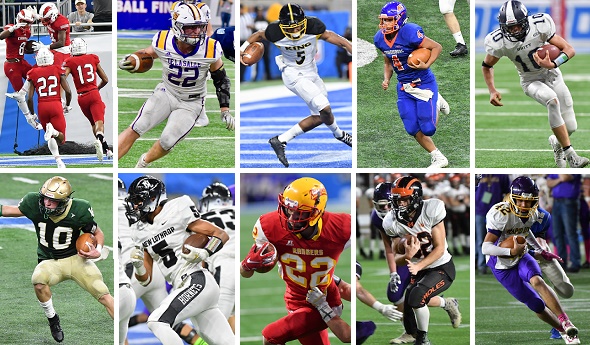
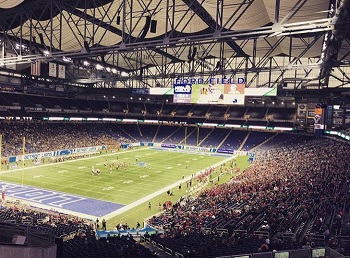
There was much anticipation entering the 2018 MHSAA Football Finals, beginning two weeks ago at the Superior Dome at Northern Michigan University and finishing Saturday at Detroit’s Ford Field.

They didn’t disappoint.
This season’s crowning weekends saw five first-time champions, two repeat title winners, two rise to the top for the first time in a while, and to end it all another re-emerging champion topple a 2017 winner in arguably the most awaited game of the entire series.
Second Half covered all 10 championship games last weekend at Ford Field and two weekends ago at the Superior Dome, with quick recaps and links (click on the game scores) to those stories below followed by notations of performances entered into the MHSAA Finals record book and a report on some of the biggest and best stories to emerge from the 2018 Finals.
Finals in Review
11-Player Division 1: Clinton Township Chippewa Valley 31, Clarkston 30
A year after Clarkston edged West Bloomfield by a point to win Division 1, Chippewa Valley claimed its first MHSAA title since 2001 by the same margin over the Wolves. The Big Reds stopped a go-ahead 2-point conversion try by Clarkston with 23 seconds to play to seal the win after previously leading by 14 points three times over the final three quarters.
11-Player Division 2: Warren DeLaSalle 29, Muskegon Mona Shores 16
The Pilots’ lockdown defense proved to have the upper hand against an explosive Mona Shores offense, as DeLaSalle broke away for its second straight Division 2 title after the teams were tied at halftime. Pilots coach Mike Giannone not only is the only coach to win football championships at two schools, but also became the first to win back-to-back at two (after also leading Macomb Dakota to Division 1 titles in 2006 and 2007).
 11-Player Division 3: Detroit Martin Luther King 41, Muskegon 25
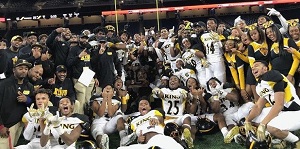
King finished this season’s Finals by avenging a three-point Week 2 loss to the 2017 champion. The Crusaders didn’t slow Muskegon’s record-setting rushing attack, but outgained the Big Reds in total yardage 400-315 as quarterbacks Dequan Finn and Cameron Martinez showed why they were two of the state’s best this fall.
11-Player Division 4: Edwardsburg 28, Chelsea 7
After falling short against Grand Rapids Catholic Central in 2017, Edwardsburg returned to its second Finals and won its first championship. The Eddies succeeded as they had all season; the offense ran for 382 yards and all four scores, while the defense got its season points allowed average to 9.9 per game after holding Chelsea to its fewest since 2014.
11-Player Division 5: Hudsonville Unity Christian 42, Portland 7
These Crusaders also won their first championship, in their first Finals appearance, finishing a playoff run that saw them defeat three teams ranked among the top six at the end of the regular season. Unity Christian got out to a 28-0 lead and finished with 279 yards rushing while holding the Raiders’ vaunted run attack to only 95.
11-Player Division 6: Jackson Lumen Christi 42, Montague 28
Lumen Christi added a first-time accomplishment to its long history of successes, clinching a three-peat for the first time by holding Montague to 14 points over the game’s first 45 minutes. The Titans ran for 348 yards and senior Nick Thomas gained 249 and scored twice on the ground to go with his team-high 10 tackles and two sacks.
11-Player Division 7: New Lothrop 50, Madison Heights Madison 44
This was not only the highest-scoring Final of the weekend, but of all-time. Neither team had been to a Finals since 2006, and Madison was seeking its first championship. But New Lothrop held on for its second title as quarterbacks Avery Moore and Austin Brown matched scores through much of the second half.
11-Player Division 8: Reading 39, Breckenridge 20
One of these teams was going to end up a first-time and undefeated champion, and Reading led off the 2018 Finals on Friday with the historic accomplishment in large part because of its dominance in the run game. The Rangers gained 296 yards on the ground and held the Huskies to a mere 24 and 198 yards of total offense.
8-Player Division 1: Morrice 44, Pickford 16
This also was going to produce a first-time and undefeated champion regardless of victor. After Pickford scored first, Morrice locked up its first title with 30 unanswered points over the next two quarters. Orioles quarterback Hunter Nowak capped his career with three rushing and one passing touchdown to go with 199 yards on the ground.
8-Player Division 2: Rapid River 30, Onekama 18
In its third 8-Player Finals try, Rapid River came away with its first MHSAA football title. The Rockets held on to the ball for an incredible 33½ minutes by extending drives with 10 third-down and four fourth-down conversions. Onekama was playing in its first Football Final, capping its second season of 8-player after a successful recent run with 11 on the field.
Record Report
Lumen Christi moved up to tied for fifth with its 13th Finals appearance. Muskegon (11th) and King (sixth) also moved up the list, and Warren DeLaSalle joined it by playing in its fifth championship game. Lumen Christi is tied for fourth all-time with 11 championships and became the 10th program to win three or more consecutively.
Three players made the list for longest kickoff return in a Final. New Lothrop’s Aidan Harrison ranks fourth after his 96-yard scoring sprint against Madison, while David Ellis raced 94 yards to the end zone for Chippewa Valley against Clarkston and Jacob Veale scored Portland’s only points against Unity Christian on a 91-yard return.
Tommy Schuster made the records with a perfect 13 of 13 passing for Chippewa Valley against Clarkston, becoming the first player with at least 12 attempts to complete all of his passes in an MHSAA Final.
As noted above, New Lothrop and Madison Heights Madison combined to score 94 points – breaking the previous record for highest-scoring Final of 91 by Belding and Detroit Country Day in the 1994 Class B championship game (a 50-41 Belding win). New Lothrop’s 50 points also tied for fourth most in an MHSAA Final.
That 94-point effort was a result in large part of work done by Madison quarterback Austin Brown and New Lothrop quarterback Avery Moore. Both made the records list with four rushing touchdowns in a Final and also for scoring 26 points (each had a 2-point conversion). Brown also was added for 298 passing yards, and his 403 of total offense tied for fifth. New Lothrop as a team was added for six rushing touchdowns, and Madison Heights Madison was added for total team passing yardage.
Reading’s Elijah Strine was added for becoming the first in Finals history to recover a fumble in the end zone for a touchdown.
Edwardsburg became the latest to not punt in a championship game, and Chelsea punted only once in their Division 4 Final – their one combined punt tied for second-fewest in a Final.
 Lumen Christi kicker Kevin Salazar connected on all six of his extra point attempts, and King’s Jerry Tucker made five of six (with the sixth attempt blocked). Both made the list for most extra points, Salazar tying for fourth most.
Lumen Christi running back Nick Thomas ran for 249 yards, the eighth most in a championship game. Muskegon quarterback Cameron Martinez also made the rushing list with 211 yards.
King quarterback Dequan Finn tied for fifth for touchdown passes with four against the Big Reds. Chelsea receiver Hunter Neff tied for fifth for receptions with 10 against the Eddies.
Morrice made the list for rushing yards as a team in the 8-Player Division 1 Final. The Orioles totaled 317 on 54 carries.
Rapid River made the 8-Player first downs list, moving the sticks 20 times in its Division 2 win.
Stories Behind the Scores
First-time champions: Five of this season’s 10 MHSAA football champions were first-time winners: Edwardsburg, Hudsonville Unity Christian, Reading, Morrice and Rapid River. That’s compared to only two first-time champs a year ago and one in 2016.
First time in a long time champions: Chippewa Valley’s title was its first since 2001, and New Lothrop won for the first time since 2006. Both had been building toward this moment, however. The Big Reds had made the playoffs all but three seasons since claiming the Division 2 title 17 years ago. New Lothrop has made the playoffs 19 straight seasons, and since winning Division 8 in 2006 had reached the Semifinals three times before this fall.
Closer Calls: In six games, teams were within 10 points of each other in the fourth quarter. Mona Shores pulled within five of DeLaSalle with 7:26 to play in Division 2 before the Pilots added a late touchdown. Muskegon pulled within 10 of King with 5:21 to play in Division 3 before the Crusaders scored again, and Onekama pulled within 10 of Rapid River in 8-Player Division 2 less than a minute into the fourth quarter before ultimately losing by 12. New Lothrop didn’t take the lead for good until 3:27 was left in Division 7, and as noted, Chippewa Valley escaped Clarkston by stopping a 2-point conversion try during the final minute in Division 1.
QB power: Elite quarterback play was on display all over the Finals. We talked a lot above about the heroics of Avery Moore and Austin Brown in Division 7 and Morrice's Hunter Nowak in 8-Player Division 1. In Division 3, Muskegon’s Cameron Martinez ran for 211 yards and two scores and threw a touchdown pass, while King’s Dequan Finn threw for 173 yards and four touchdowns and ran for 73 and a score. Tommy Schuster’s numbers for Chippewa Valley included the perfect passing for 205 yards and two touchdowns, and his Clarkston counterpart Jake Jensen ran for 121 yards and a score and completed 10-of-15 passes for 110 yards and a touchdown. Isaac TeSlaa led Unity Christian with 97 yards and two touchdowns on the round and completed 3 of 4 passes for 70 yards and a third score. Carter Staley kept his team in the Division 8 game with 14-of-19 passing for 177 yards and two touchdowns. Nolan Schultz ran for three touchdowns and a team-high 55 yards and completed 8-of-13 passes for 189 and a score for DeLaSalle.
Second Half’s weekly “Drive for Detroit” previews and reviews are powered by MI Student Aid, a part of the Student Financial Services Bureau located within the Michigan Department of Treasury. MI Student Aid encourages students to pursue postsecondary education by providing access to student financial resources and information, including various student financial assistance programs to help make college more affordable for Michigan students. MI Student Aid administers the state’s 529 savings programs (MET/MESP) and eight additional aid programs within its Student Scholarships and Grants division. Click for more information and connect with MI Student Aid on Facebook and Twitter @mistudentaid.