

Michigan's Football Past: A Must Read
By
Ron Pesch
MHSAA historian
September 27, 2016
By Ron Pesch
Special for Second Half
This week, the contents of my mailbox reminded me about one of my favorite items to collect – booklets and programs celebrating the history of Michigan high school football.
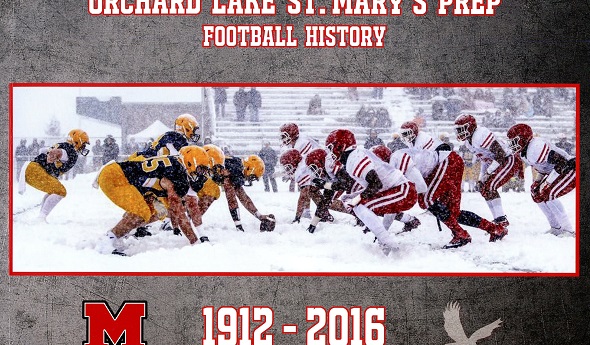
Contained within was the 2016 edition of the book, “Orchard Lake St. Mary’s Prep Football History.” Featuring a glorious image on the cover, it’s a delight to flip through. Rob Goddard and crew are to be commended on the fantastic job they’ve done with this 104-page chronicle.
The package recalled the first in my collection – a publication I helped create.
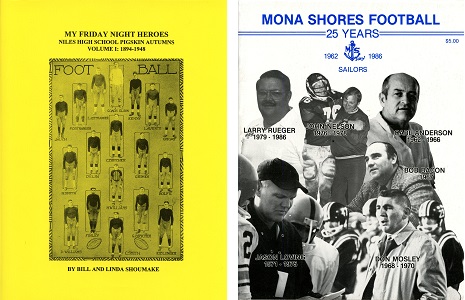
The 25-year celebration of Muskegon Mona Shores football was a modest piece, created before the days of desktop publishing. Because I had assembled the scores of the district’s games, I approached the school and found an individual willing to take a chance. Jerry Fitzpatrick, Sailors athletic director at the time, approved the idea of a booklet celebrating the school’s Silver Football Anniversary.
With gusto, we tapped into a host of resources and dove into digging out photos and details designed to capture everything we could on the years 1962 through 1985, with room for fans to collect details on the coming season. We even included a page on cheerleaders and Homecoming Kings and Queens in hopes of broadening our market.
My second acquisition was a document on Battle Creek Central football, created by MHSAA historian Dick Kishpaugh. It totaled 42 pages in length and included most everything there was to know about the Bearcats, Kishpaugh’s alma mater.
A souvenir football program celebrating Kalamazoo Central’s history followed, also heavily influenced by the work of Kishpaugh. A 60-year history of all sports at Gaylord St. Mary soon landed in my hands, passed on to me by sportswriter and historian Jay Soderberg, editor of the publication. A history of little Grant High School football, published, I believe, in 1979, was the next to arrive.
 In 1993, I partnered with baseball historian Marc Okkonen to produce “100 Years of Muskegon Big Red Football 1895-1994,” a 90-page history of our alma mater. That publication was marketed by the school’s Athletic Foundation as a fundraiser and sold well. To my delight, it seemed to spark the publication by a number of other districts of their football histories. Grand Haven and Escanaba followed a similar format and were both quick to market. Each book also celebrated a centennial of gridiron action. Other publications began to surface.
Riding a string of gridiron championships, Farmington Hills Harrison produced a 108-page program, highlighting the accomplishments from their 25-year football history, in 1994. Additional histories from Cadillac, Frankenmuth, Lowell, Negaunee, Boyne City, Niles, Sturgis and Traverse City appeared, some focused on football, others on all sports. So too did one highlighting the Centennial football game between Saginaw and Saginaw Arthur Hill, as did one a few years later celebrating the M & M game, among the nation’s oldest cross-border battles staged between Menominee and Marinette, Wisconsin.
But since then, things seem to have fallen silent. I believe a lengthy history on Grand Rapids Catholic Central made it to press, although I don’t possess a copy. I’ve seen, but have yet to acquire, a football booklet on Sparta High School football.
Do others exist? Enquiring minds want to know.
 During the gap, John Hulsebus has created, and continues to maintain and enhance a dream website, Michigan-football.com, containing an exhaustive collection of scores, season win-loss marks and records versus opponents for games played since 1950. The site lists schools, past and present for every high school in the state. Like many, I reference it often. Yet, for many schools in the state, that means as many as 55 years of gridiron action remains unrecorded.
Also missing are the stories that sit behind the scores: the players, the coaches, the drama, the locals and pageantry of a Friday night or a Saturday afternoon at the stadium. In the meantime, scrapbooks containing news clippings, game programs, and photographs, once prepared for our fathers, grandfathers and great-grandfathers, gather dust or disappear.
Tell me please, we haven’t forgotten to capture those details from our past?
 Ron Pesch has taken an active role in researching the history of MHSAA events since 1985 and began writing for MHSAA Finals programs in 1986, adding additional features and "flashbacks" in 1992. He inherited the title of MHSAA historian from the late Dick Kishpaugh following the 1993-94 school year, and resides in Muskegon. Contact him at [email protected] with ideas for historical articles.
PHOTOS: (Top) Orchard Lake St. Mary's annually produces an updated history of the school's football program. (Middle) Niles and Muskegon Mona Shores are among other programs that have documented their histories in book form. (Below) The program for the 100th game between Menominee and Marinette, Wis., was a keeper as well.
A Game for Every Fan: Week 5
September 25, 2014
By Geoff Kimmerly
Second Half editor
The MHSAA football season nearly stretches over four full months from the first practices until the final championship game ends at Ford Field in November.
But the regular season seems to fly by; just like that, we’re already halfway through and today a month away from the selection of this fall’s playoff divisions and brackets.
One team – two-time reigning Division 7 champion Ishpeming – can earn the first playoff berth of this fall with a win tonight and because it is playing only eight games during the regular season.
Read on for more of the most significant match-ups this weekend across the state.
West Michigan
Muskegon Oakridge (3-1) at Ravenna (4-0)
After three straight MHSAA Semifinal appearances from 2008-10, Ravenna fell back to the pack the last three seasons – finishing 4-5 each of the last two, even despite outscoring its opponents by 62 points in 2013. But the Bulldogs already have equaled that win total and can take another giant step back against Oakridge, a favorite in the West Michigan Conference that lost only on opening night to reigning Division 5 champion Grand Rapids West Catholic.
Others that caught my eye: Fruitport (2-2) at Muskegon Catholic Central (4-0), Rockford (4-0) at Caledonia (2-2), Grand Rapids South Christian (2-2) at Grand Rapids Catholic Central (2-2), Grand Rapids Forest Hills Northern (4-0) at Ada Forest Hills Eastern (2-2).
Bay and Thumb
Richmond (4-0) at Almont (4-0)
The Blue Devils are back on the march in the Blue Water Area Conference after finishing the league schedule perfect in 2013. Only seven points kept Almont from that accomplishment instead, and the Raiders are surely raring for this rematch after falling 42-35 to Richmond a year ago and finishing second in the conference. Almont opened this fall with three shutouts before giving up six points last week to Capac.
Others that caught my eye: Burton Atherton (3-1) at Flint Hamady (4-0), Goodrich (3-1) at Montrose (4-0), Midland Dow (4-0) at Flint Powers Catholic (3-1), Flint Kearsley (2-2) at Fenton (4-0).
Southwest and Border
Plainwell (3-1) at Vicksburg (4-0)
Vicksburg will look to keep its best start since 2010 going in this Wolverine B Conference East opener that could end up deciding the league champion. Plainwell was the league runner-up last season to Paw Paw, which this fall moved to the Wolverine B West, and has beaten Vicksburg in three straight including 26-3 a year ago. Plainwell fell to Edwardsburg by two last week, but Vicksburg has beaten the Eddies and Paw Paw over the last two weeks, respectively.
Others that caught my eye: Edwardsburg (3-1) at Paw Paw (3-1), Stevensville Lakeshore (4-0) at Battle Creek Lakeview (2-1), Battle Creek Harper Creek (2-2) at Battle Creek Pennfield (1-3), Lawton (2-2) at Decatur (4-0).
Greater Detroit
Clarkston (4-0) at Oxford (4-0)
Clarkston is tied with three others for the highest playoff point average in Michigan as it seeks to repeat as MHSAA Division 1 champion. But first up is Oakland Activities Association Red play and a quest for a fourth straight league title – although new to the league this season is Oxford, which fell to the Wolves by a mere 30-27 in last season’s Division 1 playoff opener.
Others that caught my eye: Detroit Catholic Central (2-2) at Birmingham Brother Rice (4-0), Monroe St. Mary Catholic Central (4-0) at Carleton Airport (3-1), Farmington Hills Harrison (3-1) at Southfield (3-1), Orchard Lake St. Mary's (4-0) at Warren DeLaSalle (3-1).
Lower Up North
Traverse City St. Francis (3-1) at Boyne City (4-0)
St. Francis is back in a league – the first-year Northern Michigan Football Conference – for the first time since 2011, and draws its toughest opponent so far in Boyne City. The Ramblers finished Lake Michigan Conference runners-up to Grayling the last two seasons after St. Francis left that conference for football. All three teams are in the Leaders division this season, but Boyne City is the only Michigan team to not yet give up a point – it’s outscored its first four opponents by a combined 166-0.
Others that caught my eye: Traverse City Central (3-1) at Gaylord (4-0), Mancelona (3-1) at Indian River Inland Lakes (3-1), Manistee (3-1) at McBain (2-2), Lincoln Alcona (3-1) at Whittemore-Prescott (4-0).
Mid-Michigan
Hanover-Horton (4-0) at Manchester (3-1)
Hanover-Horton is quickly advancing a turnaround after finishing 4-5 a year ago and a combined 14-31 over the last five seasons. The Comets already have avenged 2013 losses to Addison and Michigan Center over the last two weeks and now get Manchester, last season’s Cascades Conference co-champion and owner of six straight playoff berths.
Others that caught my eye: Fowler (4-0) at Dansville (3-1), Haslett (2-2) at DeWitt (4-0), Homer (4-0) at Jonesville (3-1), Newaygo (3-1) at Stanton Central Montcalm (3-1).
Upper Peninsula
Marquette (3-1) at Gladstone (3-1)
The road to Gladstone’s first playoff berth since 2008 doesn’t get any easier after last week’s loss to reigning MHSAA Division 5 runner-up Menominee. Marquette put 63 points on Gladstone in 2013 – although the Braves defense has been impressive holding its other three opponents this fall to 19 or fewer points.
Others that caught my eye: Iron Mountain (2-2) at Ishpeming Westwood (3-1), Menominee (4-0) at Kingsford (2-2), Maple City Glen Lake (2-1) at Lake Linden-Hubbell (3-1), Hurley, Wis. (4-1) at Bessemer (3-1)
8-Player
Posen (2-2) at Bellaire (4-0)
Bellaire on paper has looked more dominant during the season’s first half, outscoring three opponents 137-32 (the fourth win came as a forfeit). But the Eagles won’t look past Posen after falling to the Vikings 62-14 last season, a defeat that started a 1-4 skid to finish 2013. Posen’s two losses this season were to powerful Cedarville and Rapid River during the first two weeks.
Others that caught my eye: Waldron (3-1) at Webberville (3-1), Burr Oak (2-2) at Portland St. Patrick (4-0).
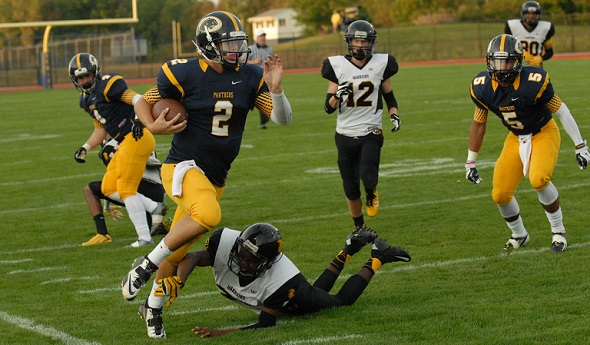
PHOTO: DeWitt defeated Lansing Waverly last week 56-12 and has won 30 straight league games dating to 2008. (Click to see more from HighSchoolSportsScene.com).