

Michigan's Football Past: A Must Read
By
Ron Pesch
MHSAA historian
September 27, 2016
By Ron Pesch
Special for Second Half
This week, the contents of my mailbox reminded me about one of my favorite items to collect – booklets and programs celebrating the history of Michigan high school football.
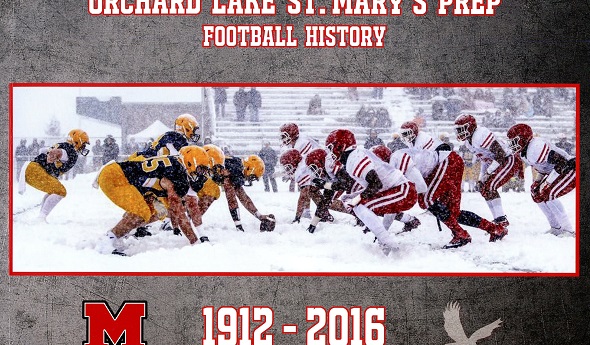
Contained within was the 2016 edition of the book, “Orchard Lake St. Mary’s Prep Football History.” Featuring a glorious image on the cover, it’s a delight to flip through. Rob Goddard and crew are to be commended on the fantastic job they’ve done with this 104-page chronicle.
The package recalled the first in my collection – a publication I helped create.
The 25-year celebration of Muskegon Mona Shores football was a modest piece, created before the days of desktop publishing. Because I had assembled the scores of the district’s games, I approached the school and found an individual willing to take a chance. Jerry Fitzpatrick, Sailors athletic director at the time, approved the idea of a booklet celebrating the school’s Silver Football Anniversary.
With gusto, we tapped into a host of resources and dove into digging out photos and details designed to capture everything we could on the years 1962 through 1985, with room for fans to collect details on the coming season. We even included a page on cheerleaders and Homecoming Kings and Queens in hopes of broadening our market.
My second acquisition was a document on Battle Creek Central football, created by MHSAA historian Dick Kishpaugh. It totaled 42 pages in length and included most everything there was to know about the Bearcats, Kishpaugh’s alma mater.
A souvenir football program celebrating Kalamazoo Central’s history followed, also heavily influenced by the work of Kishpaugh. A 60-year history of all sports at Gaylord St. Mary soon landed in my hands, passed on to me by sportswriter and historian Jay Soderberg, editor of the publication. A history of little Grant High School football, published, I believe, in 1979, was the next to arrive.
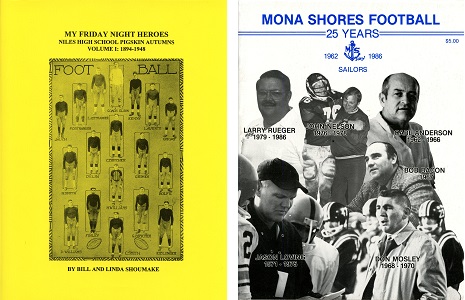 In 1993, I partnered with baseball historian Marc Okkonen to produce “100 Years of Muskegon Big Red Football 1895-1994,” a 90-page history of our alma mater. That publication was marketed by the school’s Athletic Foundation as a fundraiser and sold well. To my delight, it seemed to spark the publication by a number of other districts of their football histories. Grand Haven and Escanaba followed a similar format and were both quick to market. Each book also celebrated a centennial of gridiron action. Other publications began to surface.
Riding a string of gridiron championships, Farmington Hills Harrison produced a 108-page program, highlighting the accomplishments from their 25-year football history, in 1994. Additional histories from Cadillac, Frankenmuth, Lowell, Negaunee, Boyne City, Niles, Sturgis and Traverse City appeared, some focused on football, others on all sports. So too did one highlighting the Centennial football game between Saginaw and Saginaw Arthur Hill, as did one a few years later celebrating the M & M game, among the nation’s oldest cross-border battles staged between Menominee and Marinette, Wisconsin.
But since then, things seem to have fallen silent. I believe a lengthy history on Grand Rapids Catholic Central made it to press, although I don’t possess a copy. I’ve seen, but have yet to acquire, a football booklet on Sparta High School football.
Do others exist? Enquiring minds want to know.
 During the gap, John Hulsebus has created, and continues to maintain and enhance a dream website, Michigan-football.com, containing an exhaustive collection of scores, season win-loss marks and records versus opponents for games played since 1950. The site lists schools, past and present for every high school in the state. Like many, I reference it often. Yet, for many schools in the state, that means as many as 55 years of gridiron action remains unrecorded.
Also missing are the stories that sit behind the scores: the players, the coaches, the drama, the locals and pageantry of a Friday night or a Saturday afternoon at the stadium. In the meantime, scrapbooks containing news clippings, game programs, and photographs, once prepared for our fathers, grandfathers and great-grandfathers, gather dust or disappear.
Tell me please, we haven’t forgotten to capture those details from our past?
 Ron Pesch has taken an active role in researching the history of MHSAA events since 1985 and began writing for MHSAA Finals programs in 1986, adding additional features and "flashbacks" in 1992. He inherited the title of MHSAA historian from the late Dick Kishpaugh following the 1993-94 school year, and resides in Muskegon. Contact him at [email protected] with ideas for historical articles.
PHOTOS: (Top) Orchard Lake St. Mary's annually produces an updated history of the school's football program. (Middle) Niles and Muskegon Mona Shores are among other programs that have documented their histories in book form. (Below) The program for the 100th game between Menominee and Marinette, Wis., was a keeper as well.
In Return to Finals, Edwardsburg Reigns
By
Tom Markowski
Special for Second Half
November 23, 2018
DETROIT – Edwardsburg finished the deal on Friday, erasing much of the disappointment the final game of last season produced.
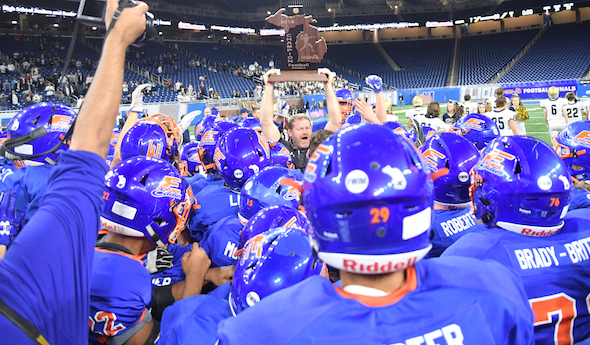
Although the Eddies’ offense was slow to jell, they controlled the clock and Chelsea’s multi-faceted attack to capture their first MHSAA Finals championship in any boys sport with a 28-7 victory in the Division 4 title game at Ford Field.
Edwardsburg has one other MHSAA title to its credit – the girls volleyball team won Class C in 1977.
“This is a huge moment for the program,” Edwardsburg coach Kevin Bartz said. “Last year was more of a surprise. Beating a good River Rouge team, we were just happy to be here. They were more focused this year and not getting involved with all of the hoopla.”
Edwardsburg defeated River Rouge, 32-21, in a Semifinal last season and then lost to Grand Rapids Catholic Central, 42-31, in the Final. Last week, the Eddies avenged that defeat, downing GRCC 46-44 in overtime in their Semifinal matchup.
The Eddies (14-0) entered this championship game averaging 48.5 points per contest this fall and had scored 196 during the playoffs. But Chelsea (10-4) was up to the task early, and its defense gave the team a chance at winning would have been its first football championship as well.
But an underrated unit is Edwardsburg’s defense. The Eddies have five shutouts to their credit this season, and their defense kept this game close until the offense got untracked.
“You hear a lot about our offense,” Bartz said, “but it was our defense that won the game.”
Mistakes, a missed field goal attempt and a failed fourth down try kept the scoring to a minimum in the first half.
Chelsea stopped an Edwardsburg try for a first down on 4th-and-1 at the Eddies’ 34, but the Bulldogs couldn’t take advantage of the fine field position as Bryce Blue intercepted a Chelsea pass in the end zone.
That turnover set up Edwardsburg’s lone touchdown of the first half, as Caden Goggins scored from five yards out. Isaiah Mitchell’s conversion run gave the Eddies an 8-0 lead with 1:53 left in the first quarter.
Chelsea came back on the next possession and scored on a four-yard touchdown pass from Quinn Starkey to Hunter Neff, who made a one-handed catch in the left corner to complete the play. Starkey was 3-of-3 passing for 50 yards on the 64-yard drive.
 The teams exchanged turnovers in the middle of the second quarter, and Chelsea couldn’t capitalize on a good scoring opportunity late. The Bulldogs drove from their 40 to the Edwardsburg 3, but a three-yard loss and an incomplete pass produced a bit of a dilemma for Chelsea coach Josh Lucas. He decided to go for the short field goal from the 6, but it missed to the right with 20 seconds left. Edwardsburg clung to an 8-7 lead at the break.
There were just two possessions in the third quarter, and only Edwardsburg made good on its opportunity.
The Eddies took the second half kickoff and drove 83 yards in 12 plays. Mac Gaideski, on his only carry of the drive, scored on a five-yard run. Quarterback Tre Harvey’s conversion run gave Edwardsburg a 16-7 lead with 6:39 left.
Chelsea used up the rest of the quarter, but its drive stalled at the Edwardsburg 32, and third and fourth down passes were incomplete.
Edwardsburg’s first drive of the fourth quarter didn’t produce any points, but it was just what Bartz wanted. His team burned 6:31 off the clock and pinned the Bulldogs on their 15.
Chelsea did not make a first down on its next drive, and the Eddies put the game away as Harvey ran five yards around right end for a touchdown and a 22-7 lead with 3:10 left.
“I came back with a vengeance this year,” Harvey said. “I wanted it. (Chelsea) came out strong in the beginning. They’re a good team. We preach playing strong in the third and fourth quarters. We definitely wear teams down.”
Edwardsburg rushed for 382 yards on 50 carries. The Eddies did not complete a pass in two attempts, but that’s not unusual for a T-formation team that prefers physicality at the line of scrimmage over big pass plays.
“The running backs deserve the credit,” Harvey said. “They’re the ones carrying out the fakes.
“We came in here not so much in awe as last year. I might have stared at the ceiling here too much a year ago.”
Goggins led Edwardsburg with 125 yards on 15 carries, and Chase Segar had 119 yards on 14 attempts.
For Chelsea, Starkey was 16-of-27 passing for 178 yards and one touchdown. The Bulldogs were held to 69 rushing yards.
“All of the credit goes to the line,” Sager said. “They made the holes. We had a mindset after last year. We weren’t used to the atmosphere then. I think now people will know where Edwardsburg is (located). We’re making them pay attention.”
Edwardsburg is located in the southwest part of the state, by the way.
PHOTOS: (Top) Edwardsburg celebrated earning its first MHSAA Finals championship in any boys sport Saturday at Ford Field. (Middle) Eddies linebacker Drew Bidwell brings down a Chelsea ball carrier.