

Michigan's Football Past: A Must Read
By
Ron Pesch
MHSAA historian
September 27, 2016
By Ron Pesch
Special for Second Half
This week, the contents of my mailbox reminded me about one of my favorite items to collect – booklets and programs celebrating the history of Michigan high school football.
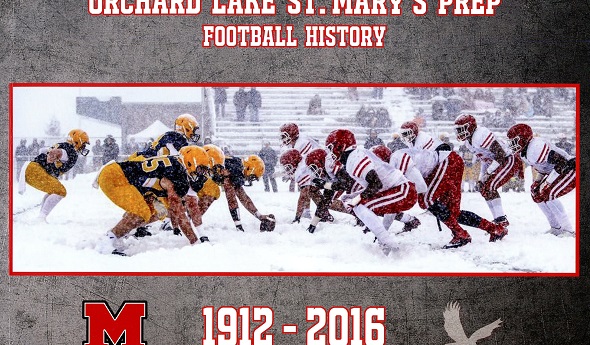
Contained within was the 2016 edition of the book, “Orchard Lake St. Mary’s Prep Football History.” Featuring a glorious image on the cover, it’s a delight to flip through. Rob Goddard and crew are to be commended on the fantastic job they’ve done with this 104-page chronicle.
The package recalled the first in my collection – a publication I helped create.
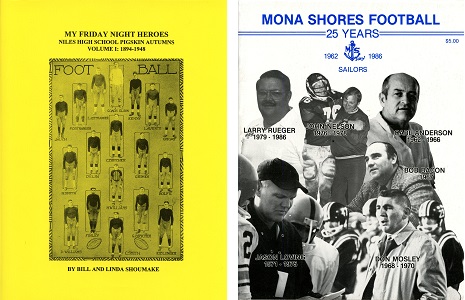
The 25-year celebration of Muskegon Mona Shores football was a modest piece, created before the days of desktop publishing. Because I had assembled the scores of the district’s games, I approached the school and found an individual willing to take a chance. Jerry Fitzpatrick, Sailors athletic director at the time, approved the idea of a booklet celebrating the school’s Silver Football Anniversary.
With gusto, we tapped into a host of resources and dove into digging out photos and details designed to capture everything we could on the years 1962 through 1985, with room for fans to collect details on the coming season. We even included a page on cheerleaders and Homecoming Kings and Queens in hopes of broadening our market.
My second acquisition was a document on Battle Creek Central football, created by MHSAA historian Dick Kishpaugh. It totaled 42 pages in length and included most everything there was to know about the Bearcats, Kishpaugh’s alma mater.
A souvenir football program celebrating Kalamazoo Central’s history followed, also heavily influenced by the work of Kishpaugh. A 60-year history of all sports at Gaylord St. Mary soon landed in my hands, passed on to me by sportswriter and historian Jay Soderberg, editor of the publication. A history of little Grant High School football, published, I believe, in 1979, was the next to arrive.
 In 1993, I partnered with baseball historian Marc Okkonen to produce “100 Years of Muskegon Big Red Football 1895-1994,” a 90-page history of our alma mater. That publication was marketed by the school’s Athletic Foundation as a fundraiser and sold well. To my delight, it seemed to spark the publication by a number of other districts of their football histories. Grand Haven and Escanaba followed a similar format and were both quick to market. Each book also celebrated a centennial of gridiron action. Other publications began to surface.
Riding a string of gridiron championships, Farmington Hills Harrison produced a 108-page program, highlighting the accomplishments from their 25-year football history, in 1994. Additional histories from Cadillac, Frankenmuth, Lowell, Negaunee, Boyne City, Niles, Sturgis and Traverse City appeared, some focused on football, others on all sports. So too did one highlighting the Centennial football game between Saginaw and Saginaw Arthur Hill, as did one a few years later celebrating the M & M game, among the nation’s oldest cross-border battles staged between Menominee and Marinette, Wisconsin.
But since then, things seem to have fallen silent. I believe a lengthy history on Grand Rapids Catholic Central made it to press, although I don’t possess a copy. I’ve seen, but have yet to acquire, a football booklet on Sparta High School football.
Do others exist? Enquiring minds want to know.
 During the gap, John Hulsebus has created, and continues to maintain and enhance a dream website, Michigan-football.com, containing an exhaustive collection of scores, season win-loss marks and records versus opponents for games played since 1950. The site lists schools, past and present for every high school in the state. Like many, I reference it often. Yet, for many schools in the state, that means as many as 55 years of gridiron action remains unrecorded.
Also missing are the stories that sit behind the scores: the players, the coaches, the drama, the locals and pageantry of a Friday night or a Saturday afternoon at the stadium. In the meantime, scrapbooks containing news clippings, game programs, and photographs, once prepared for our fathers, grandfathers and great-grandfathers, gather dust or disappear.
Tell me please, we haven’t forgotten to capture those details from our past?
 Ron Pesch has taken an active role in researching the history of MHSAA events since 1985 and began writing for MHSAA Finals programs in 1986, adding additional features and "flashbacks" in 1992. He inherited the title of MHSAA historian from the late Dick Kishpaugh following the 1993-94 school year, and resides in Muskegon. Contact him at [email protected] with ideas for historical articles.
PHOTOS: (Top) Orchard Lake St. Mary's annually produces an updated history of the school's football program. (Middle) Niles and Muskegon Mona Shores are among other programs that have documented their histories in book form. (Below) The program for the 100th game between Menominee and Marinette, Wis., was a keeper as well.
Veteran Ishpeming Takes Back D7 Title
November 28, 2015
By Geoff Kimmerly
Second Half editor
DETROIT – Michigan high school football players, if they’re most fortunate and their teams uncommonly successful, can play up to 20 playoff games during their careers.
 Saturday morning at Ford Field, Ishpeming seniors Ozzy Corp and Thomas Finegan joined that exclusive club. And with membership came a few lessons available to those who have experienced two MHSAA championships and a runner-up finish.
Don’t get frazzled when trailing by two touchdowns early. Don’t be fazed when a record-setting running back is galloping at you play after play after play.
And above all else, don’t forget a game has two halves – and their team tends to own the second one.
Despite trailing into the fourth quarter and failing to slow Pewamo-Westphalia’s Jared Smith over the first two, the Hematites stayed calm – and came back for a 22-16 win to clinch their third Division 7 championship in four seasons.
“We’re a second-half team. In the fourth quarter, we get tired, but we know how to fight through it, and I feel like that’s our advantage,” said Corp, the team’s starting quarterback the last two seasons. “We know how to face adversity. When things don’t step our way, we know how to fight back and stand right back up.”
This Ishpeming four-season has run included championship game wins twice over Detroit Loyola and now P-W, to go with a loss to Loyola in last season’s MHSAA Final. The Hematites were a combined 13-0 this fall and 52-2 over the last four seasons, losing only to Loyola last year and rival Negaunee midway through 2012.
Those are some incredibly impressive numbers – and would have been only a little less impressive if the numbers from Saturday’s first half would’ve stood up over the entire game.
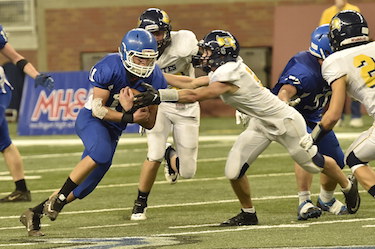 Pewamo-Westphalia junior running back Jared Smith, who finished this season with single-season records of 3,245 yards and 53 touchdowns rushing, had 112 and his lone score by halftime as the Pirates (13-1) held on to a 16-6 lead after scoring the game’s first two touchdowns and running 20 of the first 27 offensive plays. P-W’s first possession ended with a turnover on downs at Ishpeming’s 1-yard line after senior defensive end Luke Kuliu came up with a goal line stop.
“We didn’t have an answer,” Ishpeming coach Jeff Olson said of Smith. “We worked hard at stopping the cut back, and he got the cut back. We worked hard on stopping him from getting the outside; he got the outside. When he gets one on one, he’s extremely difficult to tackle.”
But not impossible to stop after all, as Ishpeming showed during the second half.
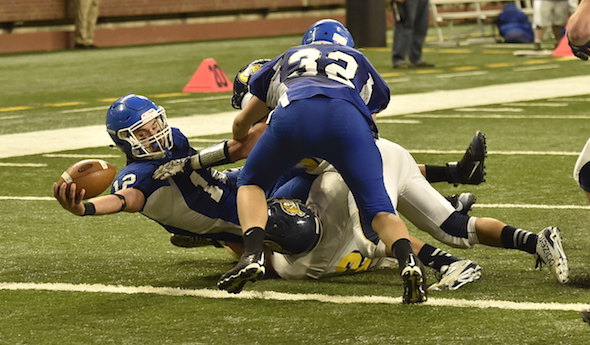
The Hematites picked up momentum with a 13-play drive that took up half of the second quarter before Corp scored his team’s first points with 2:41 to go in the second quarter. They carried it through the third quarter as both teams resorted to ramming their best runner back and forth against each other – Smith at times taking direct snaps for P-W and Corp blasting ahead from the shotgun for Ishpeming.
But the results were sharply different from the first half. Ishpeming gained 135 of its 211 yards during the third and fourth quarters as Corp added touchdown runs seven minutes into the second half and with 3:52 to play – the final score coming after a drive of 14 plays over nearly 8 minutes.
P-W managed only three first downs and 43 yards over the final two quarters, as Smith was contained to 37 yards rushing on eight carries. Ishpeming held onto the ball for 15 minutes and 19 seconds total in the second half to the Pirates’ 8:41 – controlling tempo a lot like P-W during the first quarter and a half.
“Because it’s our gameplan too,” Olson said. “When you’ve got two teams, something’s gotta budge.
“In the first half they were winning the line of scrimmage. I think we threw a couple of passes to try to loosen them up a little bit, back them up. But I think we did wear them down. I could see them breathing hard in the fourth quarter, definitely that last drive.”
P-W did have one chance to tie after taking over the ball at the 50 with 3:42 to play. The Pirates drove to Ishpeming’s 32-yard line, but with less than a minute remaining had to go to the pass for only the fourth and fifth times on the day. Both were incomplete – the last knocked away like a basketball blocked shot in front of the end zone by the 6-foot-5 Corp.
He ran 32 times for 128 yards and three scores after gaining only 33 yards on the ground during the first half. He also completed 6 of 11 passes for 77 yards and led the defense with 10 tackles. Senior defensive back Nick Comment had nine tackles.
P-W sophomore quarterback Jimmy Lehman did connect on a 50-yard touchdown pass to sophomore tight end Bryce Thelen during the first half. Senior linebacker Nate Jandernoa led the Pirates with nine tackles as they made their second appearance at Ford Field to go with a runner-up finish in Division 7 in 2011.
P-W will graduate seniors who filled only seven starting positions Saturday. A large group of expected returnees will play to get back to Detroit to take advantage of the knowledge they gained facing the most experienced tournament team in the state.
“It’s big for us to come in here, for our guys to get a look at what it’s like,” Smith said. “We’ve got a lot of guys coming back next year, so hopefully we’re coming right back with experience. We played a pretty good game, but next year we’ll know exactly what to expect.”
The MHSAA Football Finals are sponsored by the Michigan National Guard.
PHOTOS: (Top) Ishpeming quarterback Ozzy Corp reaches across the goal line for one of his three touchdowns Saturday. (Middle) Ishpeming running back Isaac Olson charges ahead through an opening in the Pewamo-Westphalia defense.