


Mixed Messages
November 27, 2013
One of the very few enjoyable aspects of waiting in an airport is the guiltless time it allows me to visit its bookstores and page slowly through some of the old classics I vaguely remember and the new releases I can’t wait to read.
Two months ago in one of the terminals of Sky Harbor Airport in Phoenix, my attention went quickly to a prominent display of books about football. Five titles were mostly critical of the game, focusing on the sport at the major college and professional levels. Down at the bottom of the display was one title that addressed the positive value of football to students, schools and communities.
One month ago, while I was eating breakfast, the television news reported on the results of new research about youth concussions. While the narration mentioned multiple sports, the video was mostly of football. I saw that story repeated on another television channel that evening. I wondered, how many times on how many channels did how many people get this gift of the latest youth concussion statistics for all sports presented in football-only wrapping paper?
The public is getting mixed messages about school-sponsored football. The problem of college and professional football is not the problem of school-sponsored football. And what problems of head trauma that do exist in school sports are not exclusively problems of football.
In fact, school-sponsored football has never been freer of serious injury than it is today – that’s true whether we are talking about heads, necks, knees or nicks. It’s the result of the most careful and cautious rules making, coaching and officiating ever. And it’s safer – not less so – as we ever more quickly assess and refer injuries to ever more educated and capable health care professionals.
Drive for Detroit: Week 1 in Review
August 28, 2017
By Geoff Kimmerly
Second Half editor
Does anyone remember a more eventful opening weekend than the one Michigan fans enjoyed these last few days?
The 2017 kickoff had comebacks, like Marshall’s from 28 down to win. It had record-book performances, like Austin Brown’s eight first-half touchdown passes for Madison Heights Madison and Jake Moody’s 57-yard field goal for Northville (see below).
57 yard field goal! @jmoods13 new school record! #Fab50 pic.twitter.com/RlcTL0YZmy
— Lisa Moody (@lmoody68) August 25, 2017
There were winning streaks broken, a rematch of a 2016 MHSAA Final, and two reigning champions facing off as well. Scoring? Two games saw a combined 110 points, one of them finishing in triple overtime. How about a massive upset by a team that didn’t win a game last year? Yep, yes, and got it.
Check out Jake Moody’s school-record kick, and then read on for the most significant games from every region of the state and 8-player as we get our “Drive for Detroit” rolling again and with our first Week 2 preview only three days away.
Bay & Thumb
Davison 56, Southfield Arts & Technology 54 (3 OT)
Davison eventually emerged from what tied for the 10th most high-scoring overtime game in MHSAA history. The Cardinals trailed by 14 heading into the fourth quarter but followed star running back Tariq Reid to the comeback win and most exciting finish of the Xenith Prep Football Classic at Wayne State University (which can be watched on replay on MHSAA.tv). Click for more from MLive-Detroit.
Also noted:
Grand Blanc 51, Flint Carman-Ainsworth 46 – Grand Blanc also pulled off a memorable comeback, scoring twice over the final 1:07 for a Vehicle City Classic win at Atwood Stadium also available for replay on MHSAA.tv.
Flint Southwestern 26, Flint Beecher 12 – Southwestern, with an opening win, equaled its total number of victories for both 2016 and 2015.
Marine City 42, Algonac 6 – After missing the playoffs last year for the first time since 1997, Marine City won big against an Algonac team that was a combined 21-5 over the last two seasons.
Richmond 19, Marysville 10 – The Blue Devils avenged last year’s only regular-season loss against a Marysville team that lost only in the District Finals last fall.
Greater Detroit
Detroit Central 32, Detroit Loyola 8
Central is riding a nice run with three straight playoff appearances, and its seven wins last year were the most since going 9-3 in 2010. But still, this was big: Loyola has played in Division 7 championship games four of the last five seasons including 2016, and hasn’t been held to single-digit scoring in a game since a 2015 Semifinal loss. The Trail Blazers rebounded from a 1-4 start last year to win a Division 6 District title, and it looks like the momentum has carried over to this fall. Click for more from the Detroit News.
Also noted:
Detroit East English 38, River Rouge 29 – East English is another playoff regular, with four berths in five seasons, but the Bulldogs missed last fall and River Rouge was 33-6 over the last three years and has major expectations for this one. Watch it on MHSAA.tv.
Macomb Dakota 31, Orchard Lake St. Mary’s 24 – The Cougars made it two seven-point opening-night wins in a row over the Eaglets, who still went on to win Division 3 championships the last two seasons.
Trenton 20, Allen Park 14 – This could end up being the Downriver League decider already, as Allen Park was perfect in the league last season (and 11-1 overall); this also was Trenton’s first win over the Jaguars since 1998 (a string of 10 straight losses) and first since the two became league mates in 2009.
Dearborn Divine Child 42, Benton Harbor 12 – Divine Child picked right back up after last year’s Division 3 Semifinal run, handing Benton Harbor its first regular-season loss since Week 8 in 2015.
Mid-Michigan
Grand Ledge 41, Hudsonville 14
This was quite a turnaround for a senior-loaded Comets team that fell to Hudsonville 21-14 in the 2016 opener. The Eagles scored first and the teams were tied 7-7 at halftime before the Comets broke free. Grand Ledge quarterback Nolan Bird threw for 229 yards and three touchdowns, including two to Cal Johnston. Click for more from WLNS (at 4:17).
Also noted:
New Lothrop 28, Lake Fenton 22 (OT) – After watching a 61-game regular-season winning streak end in Week 9 last October, New Lothrop started a new one against a Blue Devils team coming off a league title as well.
Haslett 43, Fowlerville 20 – The Vikings scored all of 154 points last season and finished 4-5, but posted their most points in nearly two years against a Gladiators team coming off a playoff berth.
Okemos 46, Mason 0 – This definitely bears watching; Okemos had a combined three wins over the last two seasons and scored only 158 points total last season while Mason has made the playoffs eight of the last nine years.
Ithaca 38, Clare 14 – For more than a half, the Yellowjackets’ now 65-game regular-season winning streak was under threat by annual playoff qualifier Clare.
Northern Lower Peninsula
Indian River Inland Lakes 27, St. Ignace 20
This was one of the biggest shockers statewide and especially for those following our smaller schools. Inland Lakes has had some recent success, with playoff berths in 2013 and 2014 – but went 0-9 last fall. St. Ignace, meanwhile, is coming off a second straight trip to the Division 8 Semifinals. The Saints started last season by shutting Inland Lakes out 44-0. Click for more from 9&10 News.
Also noted:
Frankfort 70, Manton 40 – These two tied for the highest-scoring 11-player game in the state in Week 1, Frankfort coming out on top after also winning the matchup 44-34 last year.
Traverse City St. Francis 21, Marquette 7 – St. Francis reportedly became the 12th program in state history with at least 500 victories with this one.
Boyne City 51, Negaunee 13 – The Ramblers went on a 25-0 second-half run to win big over one of the annual best from the Upper Peninsula (Negaunee was 10-1 last season).
Traverse City West 42, Midland 20 – The Titans made it three wins in five seasons and two in a row over one of the Saginaw Valley League’s strongest programs.
Southeast & Border
Jackson Lumen Christi 27, Grand Rapids West Catholic 24
Life after graduating single-season rushing record holder Bo Bell actually started out even better than a year ago for the Titans, who fell to West Catholic 30-13 last season on the way to winning the Division 6 championship. West Catholic, which went on to win Division 5 last fall, drove to the Titans’ 3-yard line but couldn’t get a go-ahead score before time expired. Click for more from the Grand Rapids Press.
Also noted:
Monroe St. Mary Catholic Central 28, Pewamo-Westphalia 21 – St. Mary appears to be a contender again after a 4-5 season, starting this one by handing the reigning Division 7 champ its first loss since the 2015 title game.
Michigan Center 35, Climax-Scotts 6 – The Cardinals handed Climax-Scotts its first regular-season loss since Week 8 of 2014 after falling to the Panthers 48-14 a year ago.
Hanover-Horton 31, Concord 28 – Staying in the Cascades Conference, Hanover-Horton started its rebound from 2-7 a year ago by downing the reigning Big 8 Conference co-champion Yellow Jackets.
Pittsford 13, Morenci 12 – Pittsford’s last two seasons ended in the playoffs, but began with 44-6 and 34-7 losses to Morenci.
Southwest Corridor
Marshall 35, Jackson 34 (OT)
The most impressive comeback of many this weekend arguably took place at Marshall, where the Redhawks found themselves down 28-0 in the second quarter and came all the way back to begin a turnaround from last season’s 4-5 finish. Jackson, 5-4 last fall, must bounce back quickly with tough Zeeland East up next. Click for more from the Battle Creek Enquirer.
Also noted:
Coloma 61, Gobles 8 – Coloma is playing this season for its first winning record since 2009 and first playoff berth since 2008, and beating a Gobles team that was 8-3 last year is an incredible start.
Vicksburg 38, Dowagiac 27 – Vicksburg came back from 10 points down in the third quarter in a matchup of 2016 playoff teams to run its winning streak over Dowagiac to three straight.
Kalamazoo Hackett 34, Saugatuck 21 – The Fighting Irish, a combined 7-11 over the last two seasons, handed Saugatuck its first regular-season loss since 2014 and after falling by 44 in this matchup a year ago.
Homer 36, Constantine 34 – These teams’ first meeting since 1956 (according to Michigan-Football.com) was decided by a Homer touchdown pass with four seconds to play.
Upper Peninsula
Ishpeming 34, Iron Mountain 7
Iron Mountain may have scored first in the latest of this annual series, but Ishpeming certainly left a strong impression beginning its bounce-back from last season’s uncharacteristic 3-5 run. Last year’s opener saw the Mountaineers end the Hematites’ 27-game regular-season winning streak, so Ishpeming no doubt was inspired even more than usual against its traditional Week 1 rival. Click for more from the Marquette Mining Journal.
Also noted:
Bark River-Harris 14, Iron River West Iron County 12 – The Broncos started making last year’s 3-6 finish a memory with one of its best defensive performances in three seasons and against a 2016 playoff team.
Gladstone 42, Gwinn 0 – Gwinn also was a playoff team last year and Gladstone also was 3-6, but the Braves flipped this one big-time after losing 36-16 in their 2016 meeting.
Hancock 21, Lake Linden-Hubbell 14 – In winning a season opener for the first time since 2010, Hancock also ended Lake Linden-Hubbell’s 18-game regular-season winning streak that began opening night 2016.
Menominee 26, Marinette (Wis.) 6 – The 111th meeting of this record interstate rivalry saw Menominee move its all-time advantage to 54-50-7.
West Michigan
Grand Rapids Catholic Central 20, Detroit Country Day 7
The rematch of last season’s Division 4 championship game was only a tad more high-scoring than last year’s defensive struggle, as GRCC put up 20 points this time to follow up that 10-7 victory when they last met at Ford Field. The Cougars scored the first 20 points of the game, in fact, leading off with a pair of touchdowns in the first quarter as quarterback Jack Bowen threw for one and ran in another. Click for more from the Grand Rapids Press.
Also noted:
Montague 48, Reed City 14 – The Wildcats not only took a first step toward a third straight playoff season, but handed Reed City its first regular-season loss since Week 9 of 2014.
Grand Rapids Christian 38, DeWitt 30 – The Eagles held off a late DeWitt comeback attempt in a matchup of what could be two of the top Division 3 teams in the state again.
Rockford 14, Saline 0 – The Rams made up for missing last year’s opener with a team-wide sickness by handing usually high-scoring Saline its first shutout since 2006.
Hudsonville Unity Christian 52, Allendale 44 – These two returning playoff teams were even a few points better after combining for 72 a year ago; Unity Christian downed the Falcons for the fourth straight time.
8-Player
Battle Creek St. Philip 14, Wyoming Tri-unity Christian 8 (OT)
After just missing the playoffs last season at 5-4, St. Philip took a major step toward guaranteeing a return by edging a Tri-unity team that went 11-1 and made the Semifinals in 2016. Both teams shined defensively in an uncharacteristically low-scoring 8-player game, even a matchup of elite teams. Click for more from WZZM13.
Also noted:
Brimley 26, Posen 18 – Brimley couldn’t field a team last season, but back on the field the Bays got their first win since 2014.
Rapid River 38, Crystal Falls Forest Park 36 – Forest Park’s only two losses in last year’s 8-player debut were to eventual champion Powers North Central, and Rapid River avenged a 64-22 defeat in this one.
North Adams-Jerome 48, Burr Oak 46 – The Rams equaled last season’s win total in their 8-player debut after making the switch this past offseason.
Bellevue 40, Webberville 6 – The Broncos also switched from 11-player after last season and two straight 3-5 finishes, and they got off to a great start downing a 2016 playoff team.
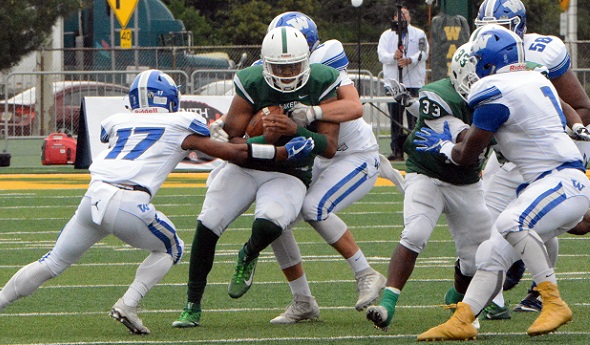
PHOTO: Walled Lake Western defenders wrap up a West Bloomfield ball carrier during Western's 19-14 win Thursday at Wayne State University. (Photo by John Johnson).