

Moment: Comets Make Last Minute Count
October 8, 2020
By John Johnson
MHSAA Director of Broadcast Properties
A hop and a wave.
That’s what it took for Grand Ledge to pull off the most unlikely of comebacks in the 2000 Division 1 MHSAA Football title game at the Pontiac Silverdome, doing what no team has ever done – scoring two touchdowns during the final minute to claim a 19-14 victory over Utica Eisenhower.
The game was your typical large-school, heavyweight fight, tied at 7-7 with less than five minutes to play when Eisenhower’s Chris Hoover broke loose for a 36-yard scoring run. But Grand Ledge bounced right back, mounting an 80-yard drive following the ensuing kickoff, capped by quarterback Matt Bohnet’s five-yard scramble to the end zone.
With just 53 seconds left on the clock, Comets coach Pat O’Keefe, already known as one of the state’s most successful baseball coaches, decided he had to gamble. Go for two.
“We were tired,” O’Keefe told the Lansing State Journal after the game. “I thought the momentum was there for us and I didn’t want to play overtime.
“We thought about it a little bit, and I saw it in the kid’s faces. I asked Matt (Bohnet) what he wanted to do and he said, ‘Let’s go for the win.’”
But the conversion play broke down. Bohnet couldn’t find an open receiver and was tackled short of the goal line.
Everyone in the Silverdome knew what was coming next. No one could have seen, however, what was going to happen.
The onside kick by Nick Sandy took a textbook hop, and Colin O’Keefe flew through the air to grab it and give the Comets new life.
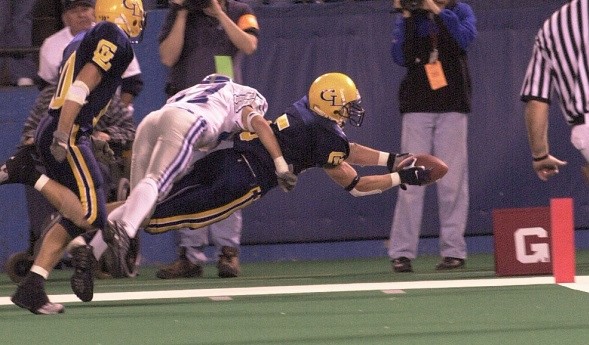
Two plays later, Bohnet was scrambling again – and a wide-open Tim George was downfield waving at him. Bohnet connected with George at the 15-yard line, and after shaking off one would-be tackler, George headed for the end zone, finishing with a pylon dive that gave the Comets the lead. It was the second TD catch of the game for George.
“I caught the ball and got bumped,” George told The Detroit News. “I saw the goal line and I knew I had to get there. I didn’t even think about going out of bounds.”
You can watch the final moments of the FOX Sports Detroit coverage of the 2000 Grand Ledge-Utica Eisenhower game below.
PHOTO: Grand Ledge's Tim George dives for the winning touchdown during the final seconds of the 2000 Division 1 Final at the Pontiac Silverdome. (Photo by Gary Shook.)

Committees Fail Critical Issues
June 7, 2013
Typically, each sport committee meets once each year for three to five hours, during which time it considers proposals that come from schools, leagues and the state’s coaches association for the sport; and the proposals most often deal with allowing more regular-season events and more qualifiers to the MHSAA postseason tournament.
Occasionally there is a proposal that might improve sportsmanship. But much more often the proposals would increase conflicts between academics and athletics and/or strain overstressed local budgets. And almost never is there a proposal that would address the health and safety of participants (the Wrestling Committee has been an occasional exception and the Competitive Cheer Committee is a routine exception).
While coaches associations must shoulder some of the blame because they’ve brought MHSAA committees “trivial” topics, at least in comparison to the tougher health and safety topics, much of the cause of MHSAA committee ineffectiveness is that the committees don’t meet long enough or often enough to research serious problems and develop well-thought-out solutions. That is forgivable because it is difficult to get commitments from busy people all across Michigan to be absent from their regular jobs and travel dozens or even hundreds of miles, and to do so multiple times each year – which is what it takes to more fully understand complex problems and more carefully construct solutions. Meetings have to be few and they have to be efficient.
However, facing the worst publicity football has seen since the mid-1970s, we knew we had to supplement the football committee process. We did so by appointing a special Football Task Force of optimum size and experienced, representative makeup to meet on however many occasions are necessary during 2013 to accomplish three purposes:
- Review practice policies to improve acclimatization of players and reduce head trauma.
- Review competition rules to reduce head trauma and the frequency of the sport’s most injurious game situations.
- Develop promotions that extol the value of football to students, schools and communities and the safety record of school-based football.
The promotional efforts have begun to be rolled out; game rule modifications are being investigated; and four proposals for changing football practice policies have been prepared. They will be the topic of our next posting.