

Moment: Eaglets Clinch on Late TD Catch
September 24, 2020
By Geoff Kimmerly
Second Half editor
More than three months had passed since the last time Ky’ren Cunningham had lined up as a receiver for Orchard Lake St. Mary’s.
But with one last desperate chance to win the Division 3 championship on the line during the 2016 Final, the Eaglets’ running back moved back into unfamiliar territory.
Cunningham even switched spots in the alignment with teammate Clay Antishin, moving outside as St. Mary’s lined up from the Muskegon 18-yard line trailing 28-23 with 10 seconds to play.
But Cunningham was in the right spot all along.
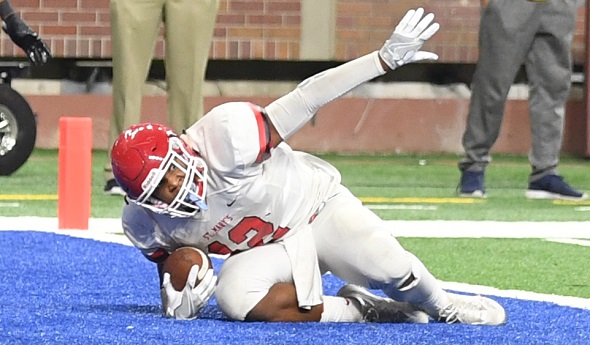
Six seconds later he split a pair of defenders in the Ford Field end zone and hauled in Caden Prieskorn’s pass to give the Eaglets a 29-28 lead it wouldn’t relinquish.
“I play running back,” said Cunningham, a junior at the time. “It was one-on-one and the safety didn’t come over the top. Caden just threw it. He just made the read.
“My body felt so weak (when I caught it). I don’t remember much.”
Longtime Detroit sportswriter Tom Markowski described the play’s setup this way in his report for Second Half:
Make no mistake. This was desperation, and it was a makeshift play. Cunningham is a starting running back. The last time he lined up as a receiver was in the first game this season against Macomb Dakota. Coach George Porritt ditched that plan afterward. Cunningham would stay in the backfield.
“It was a pistol right,” Prieskorn said after the game. “All we knew was we were going to have man-on-man coverage.”
St. Mary’s had entered the playoffs 5-4, running its record to 10-4 with the victory. The championship finished a string of three straight Division 3 titles for the Eaglets.
PHOTO: Orchard Lake St. Mary’s Ky’ren Cunningham rolls up with the ball tucked after scoring the game-winning touchdown in his team’s 2016 Division 3 championship victory over Muskegon.

Committees Fail Critical Issues
June 7, 2013
Typically, each sport committee meets once each year for three to five hours, during which time it considers proposals that come from schools, leagues and the state’s coaches association for the sport; and the proposals most often deal with allowing more regular-season events and more qualifiers to the MHSAA postseason tournament.
Occasionally there is a proposal that might improve sportsmanship. But much more often the proposals would increase conflicts between academics and athletics and/or strain overstressed local budgets. And almost never is there a proposal that would address the health and safety of participants (the Wrestling Committee has been an occasional exception and the Competitive Cheer Committee is a routine exception).
While coaches associations must shoulder some of the blame because they’ve brought MHSAA committees “trivial” topics, at least in comparison to the tougher health and safety topics, much of the cause of MHSAA committee ineffectiveness is that the committees don’t meet long enough or often enough to research serious problems and develop well-thought-out solutions. That is forgivable because it is difficult to get commitments from busy people all across Michigan to be absent from their regular jobs and travel dozens or even hundreds of miles, and to do so multiple times each year – which is what it takes to more fully understand complex problems and more carefully construct solutions. Meetings have to be few and they have to be efficient.
However, facing the worst publicity football has seen since the mid-1970s, we knew we had to supplement the football committee process. We did so by appointing a special Football Task Force of optimum size and experienced, representative makeup to meet on however many occasions are necessary during 2013 to accomplish three purposes:
- Review practice policies to improve acclimatization of players and reduce head trauma.
- Review competition rules to reduce head trauma and the frequency of the sport’s most injurious game situations.
- Develop promotions that extol the value of football to students, schools and communities and the safety record of school-based football.
The promotional efforts have begun to be rolled out; game rule modifications are being investigated; and four proposals for changing football practice policies have been prepared. They will be the topic of our next posting.