

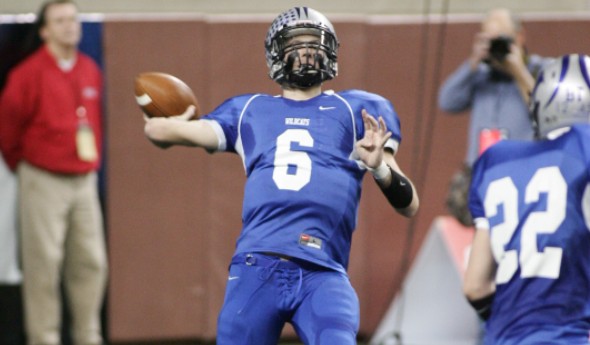
Moment: Montague, Kater Air it Out
October 1, 2020
By John Johnson
MHSAA Director of Broadcast Properties
A lot of people say in any sport that there’s a play, or a sequence of plays, that swings a game – that locks down the outcome.
You might be able to define “swing” with a defensive red zone stop and the longest pass play in MHSAA Football Finals history during the 2008 Division 6 championship game.
Montague quarterback Cody Kater found Anthony Root down the right sideline for a pitch and catch that went for 98 yards and squashed a potential comeback by Leslie in a 41-20 win for the Panthers at Ford Field.
The swing began just three plays earlier, when the Montague defense stopped Leslie on downs deep in its own territory with about four minutes to play in the first half. The Blackhawks were knocking on the door, looking to cut into a 21-6 lead when a 4th-and-goal pass fell incomplete.
The Panthers were backed up, but they didn’t back down.
“They thought they had us and, boom, we’re 98 yards the other way,” Kater said to the Detroit Free Press. “I think the ball had even gotten tipped a little bit, but Anthony made a great play.” The pair had already connected for a 46-yard scoring pass in the first quarter.
Montague continued the swing moments later with a pass interception by Jordan Degen with a minute to play that led to a TD run by A.J. LaRue, which gave the Wildcats a 35-6 halftime lead.
Kater was an efficient 4 of 6 passing for 175 yards in the game, while Root accounted for 144 of that total with his two scoring catches. The Wildcats defense forced four turnovers.
PHOTO: Montague's Cody Kater launches a pass from his team's end zone in 2008 that turned into a 98-yard reception, the longest in MHSAA Finals history.
Be the Referee: You Make the OT Call
September 26, 2019
This week, MHSAA assistant director Brent Rice presents a "You Make the Call" regarding a penalty during football overtime.
Be The Referee is a series of short messages designed to help educate people on the rules of different sports, to help them better understand the art of officiating, and to recruit officials.
Below is this week's segment - You Make the Overtime Call - Listen
Let’s test your rules knowledge with this football You Make The Call.
A close game has gone to overtime, and Team A scores a touchdown on its first possession. During the extra point try, the kick is good, but Team B is called for roughing the kicker. What are Team A’s options?
You make the call.
In this case, the kicking team has two options – one is to accept the penalty and reattempt the point after from a yard and a half out, or accept the penalty on the succeeding spot, which would begin Team B’s overtime possession – 1st and Goal – that’s right – 1st and goal – at the 25-yard line.
Sept. 19: Swimming Finishing Touch - Listen
Sept. 12: Curbing Gamesmanship By Substitution - Listen
Sept. 5: Football Safety Rules Changes - Listen
Aug. 29: 40-Second Play Clock - Listen