

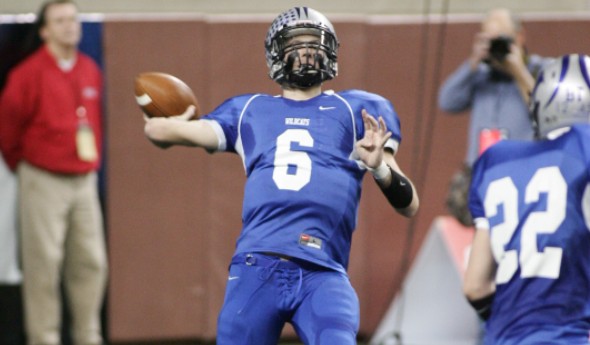
Moment: Montague, Kater Air it Out
October 1, 2020
By John Johnson
MHSAA Director of Broadcast Properties
A lot of people say in any sport that there’s a play, or a sequence of plays, that swings a game – that locks down the outcome.
You might be able to define “swing” with a defensive red zone stop and the longest pass play in MHSAA Football Finals history during the 2008 Division 6 championship game.
Montague quarterback Cody Kater found Anthony Root down the right sideline for a pitch and catch that went for 98 yards and squashed a potential comeback by Leslie in a 41-20 win for the Panthers at Ford Field.
The swing began just three plays earlier, when the Montague defense stopped Leslie on downs deep in its own territory with about four minutes to play in the first half. The Blackhawks were knocking on the door, looking to cut into a 21-6 lead when a 4th-and-goal pass fell incomplete.
The Panthers were backed up, but they didn’t back down.
“They thought they had us and, boom, we’re 98 yards the other way,” Kater said to the Detroit Free Press. “I think the ball had even gotten tipped a little bit, but Anthony made a great play.” The pair had already connected for a 46-yard scoring pass in the first quarter.
Montague continued the swing moments later with a pass interception by Jordan Degen with a minute to play that led to a TD run by A.J. LaRue, which gave the Wildcats a 35-6 halftime lead.
Kater was an efficient 4 of 6 passing for 175 yards in the game, while Root accounted for 144 of that total with his two scoring catches. The Wildcats defense forced four turnovers.
PHOTO: Montague's Cody Kater launches a pass from his team's end zone in 2008 that turned into a 98-yard reception, the longest in MHSAA Finals history.

Football's Status
June 16, 2017
Football has enjoyed a status within our schools that is unmatched by any other sport.
It attracts more participants than any other interscholastic sport.
Unlike many other sports (think especially of ice hockey, lacrosse and soccer), football began in the high school setting and was not imported from community programs.
And until the past decade, football has not had to cope with out-of-season programs run by non-school groups and commercial entities that are so troublesome – think especially of basketball, ice hockey, soccer and volleyball, but really all sports except football, until recent years.
The growth of 7-on-7 passing leagues and tournaments is the most obvious concern as commercial interests move in to profit from a mostly unregulated summer environment, as began to occur in basketball 30 years ago and has spread to many other sports since.
The Olympic movement has fueled some of this as national governing bodies have engineered programs for younger athletes in efforts to increase medal counts on which the U.S. Olympic Committee bases funding.
The quixotic pursuit of college scholarships is another powerful stimulant; and while the NCAA could have banned its coaches from recruiting away from school venues, it has not done so; and non-school entities have begun to tailor their events toward convenient although costly recruiting venues.
We can expect these events to spread like an invasive species through football unless, learning from the past, the NCAA makes these events off-limits to its coaches, and/or organizations like ours across the country will not only regulate but also conduct programs during the summer.