

Moment: Montague, Kater Air it Out
October 1, 2020
By John Johnson
MHSAA Director of Broadcast Properties
A lot of people say in any sport that there’s a play, or a sequence of plays, that swings a game – that locks down the outcome.
You might be able to define “swing” with a defensive red zone stop and the longest pass play in MHSAA Football Finals history during the 2008 Division 6 championship game.
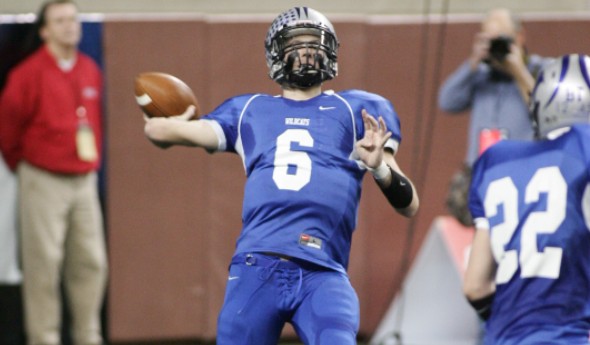
Montague quarterback Cody Kater found Anthony Root down the right sideline for a pitch and catch that went for 98 yards and squashed a potential comeback by Leslie in a 41-20 win for the Panthers at Ford Field.
The swing began just three plays earlier, when the Montague defense stopped Leslie on downs deep in its own territory with about four minutes to play in the first half. The Blackhawks were knocking on the door, looking to cut into a 21-6 lead when a 4th-and-goal pass fell incomplete.
The Panthers were backed up, but they didn’t back down.
“They thought they had us and, boom, we’re 98 yards the other way,” Kater said to the Detroit Free Press. “I think the ball had even gotten tipped a little bit, but Anthony made a great play.” The pair had already connected for a 46-yard scoring pass in the first quarter.
Montague continued the swing moments later with a pass interception by Jordan Degen with a minute to play that led to a TD run by A.J. LaRue, which gave the Wildcats a 35-6 halftime lead.
Kater was an efficient 4 of 6 passing for 175 yards in the game, while Root accounted for 144 of that total with his two scoring catches. The Wildcats defense forced four turnovers.
PHOTO: Montague's Cody Kater launches a pass from his team's end zone in 2008 that turned into a 98-yard reception, the longest in MHSAA Finals history.
MHSAA Opposes Big Ten Friday Football
November 2, 2016
By Geoff Kimmerly
Second Half editor
The executive director of the Michigan High School Athletic Association said today that he is “disappointed and disheartened” by the Big Ten Conference announcement that it will play and televise football games on Friday nights beginning with the 2017 season.
Friday night football remains one of the strongest and longest-standing traditions in high school athletics, and the MHSAA has fought since the start of this century to keep Friday nights sacred against the overstepping of college football and the damage televised Big Ten games are now expected to cause to attendance and media coverage of the sport at the high school level.
MHSAA Executive Director John E. “Jack” Roberts was contacted by both Big Ten Conference commissioner Jim Delany and Michigan State University athletic director Mark Hollis before the decision was announced. Roberts said he is appreciative of Michigan State and University of Michigan’s low tolerance to be included in this venture – at most, both will host a Thursday or Friday night game during Labor Day weekend and play one Friday night away game during the remainder of a season – but remains frustrated that similar respect for high school football was not shown by the conference as a whole.
Michigan State has played Friday night games during Labor Day weekend the last six seasons, hosting five and playing at Western Michigan University in 2015. However, most Michigan high school games continue to be scheduled and played on the Thursday before Labor Day, relieving holiday travel conflicts in most communities. University of Michigan did play on the Thursday before Labor Day at University of Utah in 2015, but has not played on a Friday night of Labor Day weekend this decade. The Wolverines are one of five Big Ten schools without a Friday night game in 2017.
“We are saddened by this decision. We had hoped that the Big Ten Conference would stay above this. We think this cheapens the Big Ten brand,” Roberts said. “Fans won’t like this. Recruits won’t like this. And high school football coaches won’t like this.
“We are grateful that Michigan State University and the University of Michigan are trying to minimize the effects of this decision by the Big Ten. But overall, this is just the latest step by major college athletics in the pursuit of cash that is just crushing high school sports.”
The MHSAA has shown its opposition to the use of Friday nights for televised collegiate football games for more than 15 years, dating back to 2001 when the NCAA lifted its restrictions on Friday night telecasts, which at first led to the broadcasting of “mid-major conference” games on the same night traditionally reserved for high school athletes.
The MHSAA launched in 2001 its “Save Our Friday Nights” campaign to emphasize the role that Friday night high school athletic events play in communities and to rally MHSAA member schools to contact NCAA member school football coaches, athletic directors and conference commissioners to voice their concerns.
In addition to causing lower attendance at events going up against Big Ten football games, Roberts anticipates that Friday night college games also will leave high school football as a secondary priority in many media markets. More than 80 radio stations statewide cover high school games regularly, but many also carry Michigan State or University of Michigan football. High school football could lose significant time on local TV highlights shows and in print and online coverage as well, as resources are diverted to cover a college game – potentially quieting significantly the positive buzz that comes from the typical high school football Friday night.
“Everyone knows that football is struggling right now,” Roberts said. “It’s getting a lot of bad publicity. Participation is declining. And now this; there couldn’t be worse timing.”
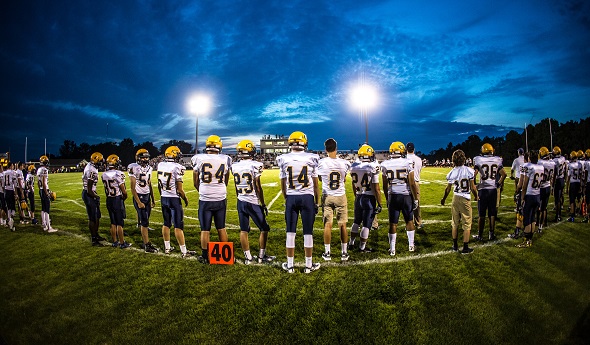
PHOTO: Grand Ledge takes on Okemos under the Friday night lights this season. (Click to see more from HighSchoolSportsScene.com.)