

Muskegon Grad Casts 'Magic' in HBO Series
June 15, 2020
By Tom Kendra
Special for Second Half
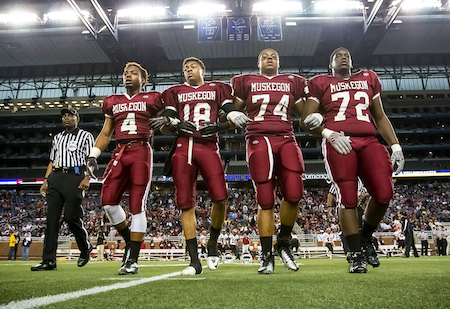
The last time many people saw Quincy Crosby was during his final high school football game at Ford Field back in 2012, when the 6-foot-3, 280-pounder was a senior captain for Muskegon High School.
 Chances are most didn’t notice him, since he was doing the unheralded dirty work as the starting center for the Big Reds, who lost a 35-28 heartbreaker to Bloomfield Hills Brother Rice that day in the MHSAA Division 2 Final.
The next time many see Crosby, he will be front and center, and impossible to miss, showing off an entirely different skill set.
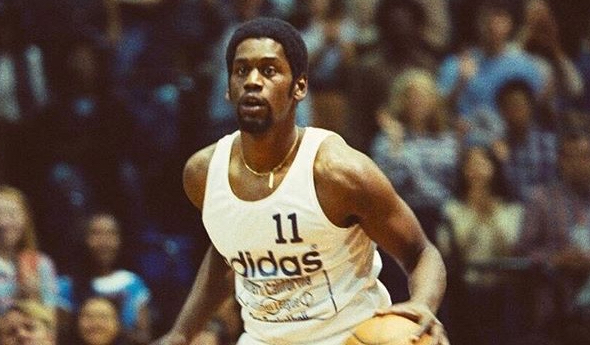
Crosby, 24, has transformed from bruising lineman to up-and-coming Hollywood star, who last year landed a dream role as Michigan’s own Earvin “Magic” Johnson in the upcoming HBO series focusing on the Los Angeles Lakers’ “Showtime” era of the 1980s.
“I’m just a kid from Muskegon; now I’m playing Magic on a TV show. How cool is that?” said Crosby, who played football and was a theater major at Kalamazoo College after his prep days. “I guess this is the big break I’ve been waiting for my whole life. Every part I didn’t get was worth it to get this one.”
The show, which is being produced by former Lakers standout Rick Fox, was originally titled “Showtime.” But that name was scrubbed when it was picked up by HBO, a competing network with Showtime. Right now, the series is referred to by the generic, “Untitled Lakers Project.”
The one-hour limited series drama is based on Jeff Pearlman’s book “Showtime: Magic, Kareem, Riley, and the Los Angeles Lakers Dynasty of the 1980s.” The Untitled Lakers Project is described by HBO as a fast-break series chronicling the professional and personal lives of the 1980s Los Angeles Lakers, one of sports’ most revered and dominant dynasties—a team that defined its era, both on and off the court.
The series features some big names, including John C. Reilly as Jerry Buss, Solomon Hughes as Kareem Abdul-Jabbar and Jason Clarke as Jerry West. In the cast list, Crosby goes by his stage name of Quincy Isaiah – which are his first and middle names, respectively.
The series was expected to debut this month to coincide with the NBA Finals, but production delays due to Covid-19 and the suspension and uncertainty of the NBA season have pushed that tentative starting date back to June, 2021.
The delay hasn’t kept Crosby off Cloud 9.
Crosby landed the part in early June of last year, and in the days following that announcement, he went to Game 5 of the NBA Finals, where Fox introduced him to celebrities like Jalen Rose, Jerry West and Common. Then he hung out in Las Vegas for some NBA summer-league games, where the stargazing continued. He has yet to meet Magic, but expects that to happen soon.
“Everyone is telling me this is a game-changer, that this is going to be huge,” Crosby said. “I’m just so thankful for the opportunity.”
Catching the bug
Muskegon High School football coach Shane Fairfield wasn’t surprised to learn that his former team captain and three-year varsity player had earned a leading role in a television show – but as a basketball star?
“I said: ‘Basketball? You ain’t got no game!” Fairfield said with a laugh. “But the reality is, that role was kind of made for him. Quincy has that charisma and that big, amazing smile, just like Magic.”
Crosby’s transition from one of the “Brothers of Destruction” on the Big Reds’ offensive line to thespian actually began a few months after that crushing loss to Brother Rice.
 That game started Muskegon’s incredible run of seven football Finals appearances in eight years, and the Big Reds have the winningest program in state football history and rank No. 7 in the nation with 859 wins (dating back to 1895). But the school had not been able to put on a spring musical in more than 20 years due to budget cuts.
But that spring, in a stroke of fortune, the school was selected in NBC’s 2013 “Smash” Make A Musical contest and awarded funding to put on the classic musical, “Thoroughly Modern Millie.”
Crosby said theater director Karli Baldus talked him into trying out for the show, and he landed the comical part of Ching Ho.
“I caught the bug, big time,” Crosby recalled with a laugh. “I thought it was the best thing.”
He also noticed parallels right away with football, with both requiring hours and hours of practice and repetition in preparation for game time – or show time.
“When I was playing football, I wouldn’t be able to think about anything else and I would just get zoned out on what I had to do on the line,” said Crosby. “It’s the same thing in acting. You practice until you know it by heart, and then you get out there and just let it go. Acting is all instincts.”
Crosby took acting classes at Kalamazoo, but due to football, never had enough time to be part of the big productions.
That all changed after performing a sketch in his television production class his junior year. He got pulled aside by his professor, who told Crosby he saw major acting potential in him and encouraged him to get more involved his senior year.
That heartfelt plea led Crosby to not only quit the football team after three years as a starter on the offensive line, but also to change his major from business to theater. He then blossomed on the stage his senior year, working behind the scenes in the fall production of “The Rocky Horror Picture Show” before earning major roles of Walter Lee Younger in “Raisin In The Sun” and Benny in “In The Heights.”
Finding the Magic
Shortly after graduating from K-College in 2017 with a theater degree, Crosby made his way to Hollywood to pursue his acting dream, only to find it was a bumpy road – to say the least.
Crosby was able to land small roles in short productions like “Corporate Coffee” and “Anomaly,” but his bid for major roles was met by rejection after rejection.
In those moments, he said, his background as an offensive lineman at Muskegon got him through.
“I learned to embrace the grind playing football at Muskegon,” said Crosby, the son of Delores Crosby and the late Gregory Crosby, who died when Quincy was just 3 years old. “You know, being an offensive lineman helped too. You get blamed when things go wrong and none of the praise when things go right, so you learn to just stay in your bubble and grind.”
 His Hollywood experience nearly ground to a halt in early 2019, and he was about to enlist in the Navy when his agent and fellow Muskegon native Terrance Williams helped him land the audition that would change his life.
Ironically, he didn’t even get a script until the day of the audition and while others had memorized their lines, Crosby read directly from the script. He still landed a callback for the lead role of Magic and, six days later, he was ready and brought his “A game.”
“Walking out of the callback, the casting director told me to keep my phone close because that was a really good audition,” said Crosby.
The only thing left was a basketball audition with Fox in a high school gym, which clinched the role, Crosby said.
Fox and Crosby then started making the Hollywood rounds before shooting the pilot in October, after which the series was picked up by HBO in November. After a lengthy delay due to Covid-19, the plan is to shoot the first year of the series this fall, starting when Magic was drafted by the Lakers out of Michigan State in 1979.
One benefit of the delay is that it has given Crosby time to watch reams of old Magic footage and try to capture his nuances – on and off the court.
“The good thing about playing Magic is that there is so much video and footage of him out there,” said Crosby. “There’s so many things I’ve picked up – the way he walks and the way he always says ‘right’ after sentences. I’m getting better and better at it.”
Meanwhile, back in Muskegon, the Big Reds’ coaching staff is continuing its year-round quest to get more players into college and prepared for life after high school. Fairfield said he can’t wait to have his team watch the Lakers series and see one of their own in a starring role.
“Quincy is an example to our kids that there are so many avenues to success,” Fairfield said. “Making the NFL is one-in-a-million. What we emphasize is that you take what you learn here – hard work, discipline, perseverance, humility – and you apply it to anything you want to do in life.”
This is the first installment in a weekly summer “Made in Michigan” series catching up with this state's past high school athletes as they continue their stories.
 Tom Kendra worked 23 years at The Muskegon Chronicle, including five as assistant sports editor and the final six as sports editor through 2011. E-mail him at [email protected] with story ideas for Muskegon, Oceana, Mason, Lake, Oceola, Mecosta and Newaygo counties.
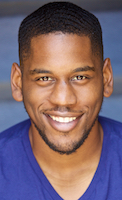
PHOTOS: (Top) Quincy Crosby plays Magic Johnson in an upcoming HBO series. (Middle) Crosby, now seven years after graduating from Muskegon High. (Below) Crosby, far right, heads to midfield with his teammates for the coin flip before the 2012 Division 2 Final at Ford Field. (Top and middle photos courtesy of Quincy Crosby. Below photo by Tim Reilly.)
Drive for Detroit: Week 1 in Review
August 27, 2018
By Geoff Kimmerly
Second Half editor
A new season means new beginnings on high school football fields all over Michigan.
 Owosso surely is feeling a resurgence after ending a 35-game losing streak with a 23-18 win over rival Corunna. Same for Memphis, which saw a 26-game losing streak end with a 14-12 win over Burton Bentley. And don’t forget Farwell, which ended a 17-game winless streak by beating Coleman 20-18.
And how about all of 8-player, which saw both MHSAA champions from a year ago defeated this opening weekend? Just like that, those brackets seem a little wider open this fall.
Every team has a chance to create something memorable, and below are some from each region of the state that got off to the quickest starts. “Drive for Detroit” is sponsored by MI Student Aid.
Bay & Thumb
HEADLINER: Ortonville-Brandon 26, Fenton 21 The Blackhawks ended Fenton’s Flint Metro League winning streak at 29, earning their first win over the Tigers since 2011. Fenton has won at least a share of the league title all seven seasons this decade, but hasn’t had to play catch-up since losing its 2012 opener. Click for more from the Flint Journal.
Also of note: New Lothrop 48, Maple City Glen Lake 16 The Hornets have won 72 of their last 73 regular-season games, and this one could end up among the most impressive of the string.
Remember this one: Elkton-Pigeon-Bay Port Laker 36, Hudson 6 These are both annual small-school powers, and last year Laker went on to finish 10-2 despite losing to the Tigers in Week 1.
More shoutouts: Marysville 14, Richmond 0 Beating the playoff regular Blue Devils to start the season always is a good sign, especially after Marysville lost last year and finished 4-5. Grand Blanc 38, Midland Dow 35 The Bobcats have moved to the Saginaw Valley League this fall; although Dow is in the other division, this was an impressive start.
Greater Detroit
HEADLINER: Belleville 40, Brighton 35 Brighton quarterback Will Jontz starred but Belleville prevailed, scoring during the final minute to pull ahead for good. The Tigers are considered MHSAA championship contenders coming off a one-loss season. Click for more from the Detroit News.
Also of note: Oak Park 31, Utica Eisenhower 13 Beating the reigning Macomb Area Conference champ is big, especially after Oak Park lost last year’s matchup 24-7.
Remember this one: Northville 28, Livonia Franklin 14 The Patriots went on to finish Division 2 runners-up after a close win over Northville last year in Week 3. Northville is looking to bounce back from a 3-6 finish.
More shoutouts: Detroit Martin Luther King 52, East St. Louis, Ill. 38 The Crusaders made a statement beating one of the top programs in Illinois. Detroit Cass Tech 40, River Rouge 7 Both made the MHSAA Semifinals last season.
Mid-Michigan
HEADLINER: Pewamo-Westphalia 38, Ithaca 0 The Pirates ended Ithaca's 73-game winning streak in the most unexpected way, dealing the usually high-scoring Yellowjackets their first shutout since 2004. P-W may have graduated some big names from the back-to-back Division 7 championship teams, but there's still plenty of power. Click for more from the Lansing State Journal.
Also of note: Haslett 28, Coldwater 7 The Vikings' vast improvement in 2017 is carrying over, as Haslett won big against a Coldwater team riding five straight playoff appearances.
Remember this one: DeWitt 22, Grand Rapids Christian 10 A year ago, DeWitt lost to Christian in the opener and came back to beat the Eagles in the Pre-District round. Could they meet again?
More shoutouts: Breckenridge 20, Beaverton 19 The Huskies avenged last season's opening-night loss, their only regular-season defeat of the last two seasons. East Lansing 40, St. Johns 6 After a one-point game in 2017, the Trojans more comfortably made it three straight against the Redwings.
Northern Lower Peninsula
HEADLINER: Alpena 30, Escanaba 21 Beating an Escanaba team that made the Division 3 Semifinals a year ago might be the best victory for Alpena since its last playoff season in 2004. The Wildcats had lost eight of the last nine to the Eskymos and are coming off back-to-back 2-7 seasons – but have plenty to be excited about this week. Click for more from the Alpena News.
Also of note: Tawas 48, Lincoln Alcona 24 The Braves are looking to bounce back from a 2-6 finish a year ago, and what a way to start than by avenging last season’s 33-point loss to the Tigers.
Remember this one: Traverse City West 17, Midland 15 The way the maps sort out, these opening-night foes could end up in the same playoff District for the second year in a row – and West owns a 4-2 advantage in their recent series.
More shoutouts: Rogers City 20, Whittemore-Prescott 17 The Hurons fell to W-P by 37 a year ago and had lost all five games of their recent series with the Cardinals. Roscommon 44, Grayling 34 The Bucks also avenged a big 2017 loss, having fallen to Grayling by 46 a year ago.
Southeast & Border
HEADLINER: Jackson Lumen Christi 34, Grand Rapids West Catholic 12 The Titans have now won three of four recent openers against West Catholic, with this one notable as Lumen is the back-to-back Division 6 champion and West Catholic has won five straight Division 5 titles. Both have new contributors taking over key roles, but with aspirations surely high again. Click for more from the Jackson Citizen Patriot.
Also of note: Michigan Center 29, Homer 0 The Cardinals are coming off a shared Cascades Conference title and playoff berth, and shutting out another 2017 playoff team was a great way to restart a run.
Remember this one: Brooklyn Columbia Central 24, Napoleon 0 Columbia Central has opened with four straight wins over Napoleon (another of the Cascades co-champs a year ago) and made the playoffs the last three years.
More shoutouts: Pittsford 28, Morenci 0 Both teams have made the playoffs the last four seasons, but in 2017 Pittsford won their meeting by just a point. Monroe St. Mary Catholic Central 37, Harper Woods Chandler Park 30 The Falcons closed last fall winning six of their final eight games and have to be glad to open with another victory over a Chandler Park program that’s made the playoffs nine straight seasons.
Southwest Corridor
HEADLINER: Benton Harbor 19, Battle Creek Harper Creek 17 With a new coach taking over after a historic three-year run, and Harper Creek entering this season coming off one of its best finishes ever, it was tough to know what to expect for Benton Harbor last week. Expectations surely jumped after this win. Click for more from the St. Joseph Herald-Palladium.
Also of note: Battle Creek Central 34, St. Joseph 27 The Bearcats haven’t made the playoffs since 2008 but enjoyed one of its best recent wins over a Bears team that has made the postseason 10 of the last 12 years.
Remember this one: Niles 32, Battle Creek Lakeview 27 The Vikings were 2-7 last season and a combined 7-20 over the last three, but avenged last season’s 31-0 defeat to a Spartans team that also is a regular in the playoff hunt.
More shoutouts: Kalamazoo United 46, Berrien Springs 7 Eric Wenzel tossed six touchdown passes for United in a meeting of 2017 playoff teams. Dowagiac 54, Vicksburg 14 The Chieftains broke a three-year losing streak against Vicksburg and could be the early pick to push annual favorite Edwardsburg in the Wolverine Conference.
Upper Peninsula
HEADLINER: Iron Mountain 12, Negaunee 9 Half the Upper Peninsula will be watching as the newly-expanded Western Peninsula Athletic Conference sorts itself out this fall. But Iron Mountain quickly made ample noise after winning just one game a year ago. Negaunee is coming off a rare sub-.500 season too but was a regular contender in the old Mid-Peninsula Conference. Click for more from the Iron Mountain Daily News.
Also of note: Norway 54, Lake Linden-Hubbell 30 Coming off two straight nine-win seasons, the Knights will have lots of competition on their side of the new West-PAC, making this opening win over a frequent contender potentially key.
Remember this one: Iron River West Iron County 14, Munising 0 The Wykons are coming off a Division 8 Semifinal run last fall and might be the team Norway sees at the end of the West-PAC Small-school race – at least literally, since they meet in Week 9.
More shoutouts: Gwinn 36, Bark River-Harris 20 The Modeltowners had beaten Bark River-Harris once in the last five season – in 2016, when they made the playoffs for the first time since 1999. Hancock 28, L'Anse 27 Hancock’s best season last fall since 2006 still included a two-point loss to L’Anse, now avenged.
West Michigan
HEADLINER: Muskegon 36, Warren DeLaSalle 21 Not much is needed to build up this game’s significance other than to remind that Muskegon is the reigning Division 3 champion and DeLaSalle last year’s winner in Division 2. The Big Reds’ running game could be in midseason form already. Click for more from the Muskegon Chronicle.
Also of note: Reed City 34, Montague 13 Even as Reed City tied its program record last fall with 11 wins, that run started with a 21-point loss to Montague – which went on to win 11 games as well.
Remember this one: Grand Rapids Forest Hills Central 21, Jenison 19 The Rangers have high expectations after last season’s record 12-win season – which could be good news for a Jenison team looking for its first playoff berth since 2003.
More shoutouts: Zeeland East 36, East Grand Rapids 27 Both won nine games in 2017, and both should be in league and playoff mixes again. Holland West Ottawa 35, Stevensville Lakeshore 10 West Ottawa went from 2-7 in 2016 to 10-2 in 2017 and may not be done after handing the Lancers their first opening-night loss since 2006.
8-Player
HEADLINER: Eben Junction Superior Central 46, Crystal Falls Forest Park 24 The Cougars have made significant strides the last few seasons and won their last three games of 2017. But the Trojans beat Superior Central by 42 during the regular season on the way to winning last season’s 8-player Division 2 title. Click for more from the Iron Mountain Daily News.
Also of note: Onaway 40, Central Lake 28 Last season’s 8-player Division 1 champion also began this campaign in defeat as Onaway held the Trojans to their fewest points in 14 games of this format.
Remember this one: Stephenson 46, Cedarville 40 These two have played their last two games against each other, and Stephenson has won both. A repeat playoff meeting in a few months would make for another intriguing rematch.
More shoutouts: Engadine 64, Powers North Central 34 The Eagles posted their highest point total since Week 4 of 2016 in downing the two-time champ. Hillman 34, Mount Pleasant Sacred Heart 27 This began the 8-player chapter for two proud small-school, formerly 11-player programs.
Second Half’s weekly “Drive for Detroit” previews and reviews are powered by MI Student Aid, a part of the Student Financial Services Bureau located within the Michigan Department of Treasury. MI Student Aid encourages students to pursue postsecondary education by providing access to student financial resources and information, including various student financial assistance programs to help make college more affordable for Michigan students. MI Student Aid administers the state’s 529 savings programs (MET/MESP) and eight additional aid programs within its Student Scholarships and Grants division. Click for more information and connect with MI Student Aid on Facebook and Twitter @mistudentaid.
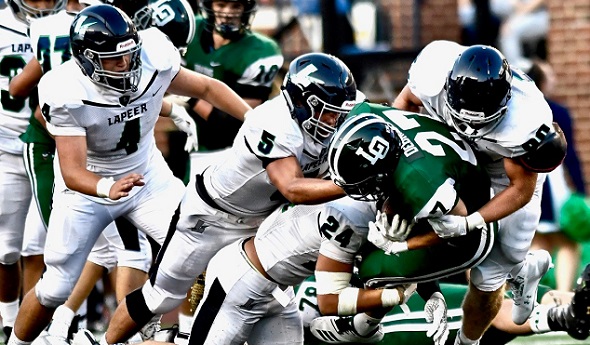
PHOTO: Lapeer's defense swarms around a Lake Orion ball carrier during the Lightning's 17-7 win Thursday at University of Michigan. (Photo by Terry Lyons.)