

New Field Next Step in Glen Lake Surge
August 31, 2017
By Dennis Chase
Special for Second Half
MAPLE CITY – With school about to begin, Glen Lake will be hosting perhaps its biggest event of the school year tonight.
 Perennial power Traverse City St. Francis heads up to Leelanau County to take on the Lakers in a Week 2 football showdown.
Glen Lake, a 42-20 winner over Kingsley in last week’s season opener, is coming off an 11-3 campaign that ended in the MHSAA Division 6 Final at Ford Field. The Lakers lost the title game to Jackson Lumen Christi 26-14.
St. Francis, a 21-7 victor over Marquette last weekend, finished 11-1 a year ago, losing to eventual Division 7 champion Pewamo-Westphalia 17-14 in the Regional Finals.
“Anytime you play St. Francis – it doesn’t matter if you play them on the beach – it’s a big game,” Lakers coach Jerry Angers said.
The two teams will not be playing in the sand tonight. They’ll be playing on Glen Lake’s new synthetic field, which workers put the finishing touches on to meet a down-to-the-wire deadline this week.
The field is the latest positive for the Glen Lake program.
The school board considered installing a new natural grass field, but opted for the artificial turf because of its “usability.”
“Once you accept the premise that the football field needed to be replaced, it wasn’t that much of a leap to go to artificial turf (over natural grass) given how much more we can use it,” superintendent Sander Scott said. “Usability – that was the determining factor.”
The field will be used by other sports teams as well as physical education classes.
“That’s the beauty of it,” athletic director Jennifer Johnston added. “Our entire student body and community can reap the benefits of having a field like that.”
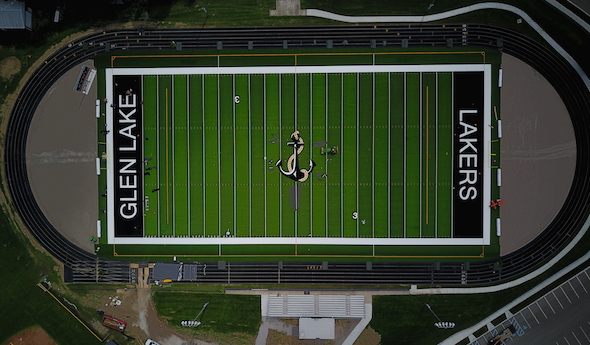 The school board approved spending nearly $850,000 on the surface, but Scott said “it’s looking like it’s going to come in well below that.”
Scott said officials put added emphasis on drainage, an issue that’s plagued Traverse City’s Thirlby Field.
“We’re aware of the challenges Thirlby Field has had (with its synthetic surface), so we really made sure we did not duplicate whatever mistake that was done there,” he said. “We probably overbuilt for drainage.”
The field is not the only new enhancement fans will notice tonight. Officials “beefed up” the wireless network at the field and brought back the berms on the home side for those who prefer lawn seating to bleachers.
The upgrades add to the momentum that’s building in the athletic program. Glen Lake was named the Traverse City Record-Eagle’s School of Year in 2016-17 after the football team reached the MHSAA Finals and the girls basketball team the Semifinals. In addition, Nichole Cox won a third consecutive individual MHSAA Finals golf championship.
“We’re on an upswing,” Angers said. “Everybody is upbeat.
“I know we savored it (last year’s football tournament run). Hopefully, it will fuel us this year – and in years to come.”
Johnston said her message to fall coaches was “keep doing what you’re doing because it’s working.”
“We have a vision and that’s to work hard to improve every day with pride, class and integrity,” she added.
It’s that motto that the school emphasized in ads that ran in the Record-Eagle fall sports tab and in the Leelanau Enterprise.
“We wanted to promote and brand our athletic department,” Johnston said.
Still, Johnston noted, the school has goals other than winning for its student athletes.
“We want to prepare our students to be successful in the real world and contribute to society in a positive way,” she said. “We have high expectations on the playing field, but it starts in the classroom.”
 Speaking of the classroom, Glen Lake is on a roll there, too. The school conducted a search this summer for two secondary math teachers with proven records of increasing student achievement. The school even offered a signing bonus. Forty-six teachers applied, compared to 14 for a similar position at another local high school.
Glen Lake ended up hiring two teachers with more than 20 years of experience.
“The one thing we do that distinguishes us from other schools,” Scott said, “is that we will give teachers credit for all their years. When I was part of other districts, the highest they typically go is six years. If you’re a teacher with 20-plus years, you’re not going to take a huge pay cut to move. We wanted to eliminate that (obstacle). We just posted an elementary opening and had 153 applicants.”
For Johnston, she had another reason to celebrate the 2016-17 sports season. Her father, Roy, who coaches basketball at Beaverton, became the state’s all-time winningest coach in that sport last winter.
“I was really excited for him,” she said. “He’s definitely stood the test of time. He’ll be the first to tell you that you’re not put in that position, to reach a milestone like that, without a lot of good players and without the support of a great community and school. To me, the entire Beaverton community earned that accolade.”
When Glen Lake was making its run to Ford Field last fall, Johnston was quick to mention to Angers that he should enjoy every minute of it.
“I said, ‘Jerry, you have to realize my dad’s been coaching 46 years and the furthest he’s made it is to the Semifinals,” she said. “You never know. (The Finals are) quite an accomplishment. Enjoy it to the fullest.”
One game into the new season, Angers already is raving about the support his team is receiving from the student body and community.
“The crowd we had at Kingsley was unbelievable,” he said. “And I expect it will continue to grow.”
Especially with St. Francis coming to town tonight.
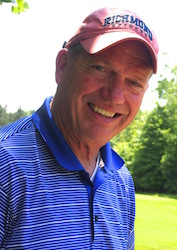 But for all the good cheer, Glen Lake is also without a familiar face this season. Paul Christiansen stepped down as girls golf coach after last season, ending a coaching career that started at the school in 1973.
“I texted him after our coaches meeting in August,” Johnston said. “I said, ‘It was sure weird not having you at that coaches meeting.’ He texted me back and said, ‘Trust me, it was sure weird not being there.’”
When Christiansen started in the fall of 1973, he was an assistant varsity football coach and boys JV basketball coach. By the next year, he had become the head football and boys varsity track coach, in addition to coaching JV basketball for his close friend Don Miller.
“After the second year, our superintendent said three (coaching jobs) is too many, especially with two as a head coach at the varsity level,” Christiansen recalled. “He said, ‘I don’t care which ones you do, but pick two. I think you’ll be better off.’”
Christiansen gave up football. But he later picked up a third sport again when he coached girls middle school basketball. He would end up coaching boys JV basketball for 25 years and boys and girls varsity track 20 years apiece. In all, he coached 92 sports seasons at Glen Lake.
“It’s an odd feeling after 44 years,” Christiansen said. “It’s like, ‘Whoa!’ But it was time to move on.”
Christiansen went out on a high note after Cox became just the third girl in MHSAA history to win three consecutive individual golf titles. She’s now at Bowling Green University.
“I didn’t script it that way, but if you were to script it, going out with an individual or team championship would be the way,” he said.
Glen Lake had just three golfers last season, not enough to compete as a team. The school dropped the sport this season.
“For Glen Lake to allow us to keep competing (last season), even though we didn’t have a full complement of players to count as a team score, I was really thankful for that,” Christiansen said. “And Nichole was especially thankful.”
Cox’s title was part of a “wave of success” that highlighted the last school year.
But this is a new year. New teams. New challenges.
Angers, for one, is hoping to keep that momentum rolling, although he lost some talented players to graduation, including eight defensive starters.
“The key is you want to retool (not rebuild) every year and I think that’s where we are right now with the program,” he said.
St. Francis will be a good test.
 Dennis Chase worked 32 years as a sportswriter at the Traverse City Record-Eagle, including as sports editor from 2000-14. He can be reached at [email protected] with story ideas for Manistee, Wexford, Missaukee, Roscommon, Ogemaw, Iosco, Alcona, Oscoda, Crawford, Kalkaska, Grand Traverse, Benzie, Leelanau, Antrim, Otsego, Montmorency, Alpena, Presque Isle, Cheboygan, Charlevoix and Emmet counties.
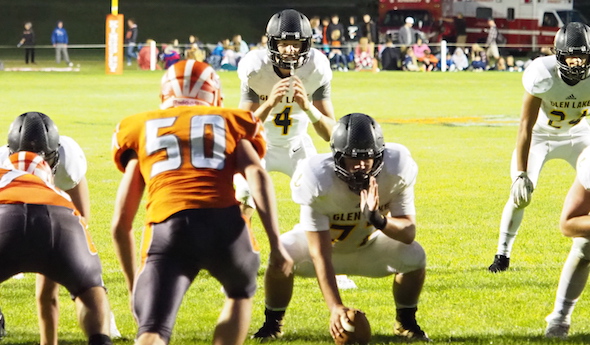
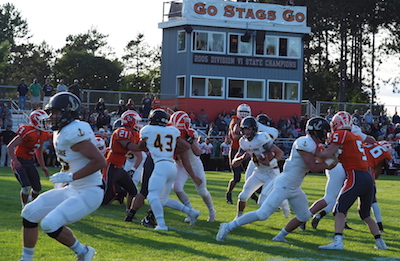
PHOTOS: (Top) Maple City Glen Lake quarterback Cade Peterson prepares to take a snap last season. (Middle top) A drone's view of the new artificial turf field at Glen Lake, set to debut Friday. (Middle below) Peterson breaks through a hole following a block by teammate Max Guilbeau (43). (Below) Recently retired coach Paul Christiansen. (Photos courtesy of Greg Guilbeau [action] Scott Jozwiak [drone] and Don Miller [Christiansen].)
Performance: Cass Tech's Rodney Hall
December 1, 2016
 Rodney Hall
Detroit Cass Tech senior – Football
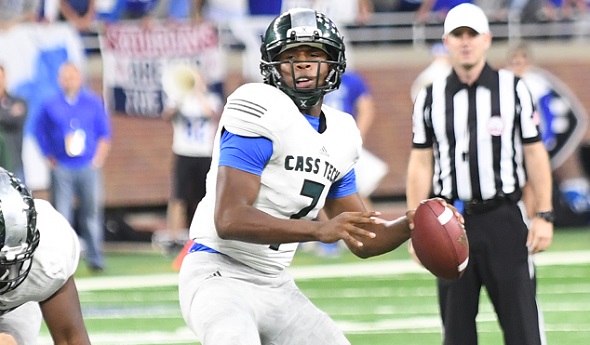
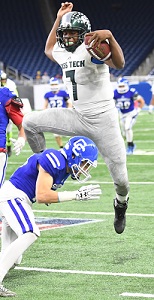
A year ago, Hall’s junior season ended on the Ford Field sideline, watching Cass Tech fall 41-27 to Romeo in the Division 1 Final after he suffered a lower leg injury two weeks before. But he came back this season fueled by championship motivation, and made it pay off. Hall threw for 220 yards and an MHSAA Finals record-tying five touchdown passes to lead the Technicians to a 49-20 win over Detroit Catholic Central in the Division 1 Final on Saturday and earn the Michigan National Guard “Performance of the Week.”
Hall started a pair of playoff games as a freshman before taking over the varsity fulltime in 2014 and leading Cass Tech to a 12-1 record. The Technicians were a combined 36-3 under him the last three seasons and scored a program-record 619 points (44.2 per game) this fall. The 6-foot-2, 210-pound signal-caller completed 10 of 18 passes in the Final and also ran for 58 yards on only seven carries. He finished this season 142 of 238 passing for 2,535 yards and 28 touchdowns, after a junior season when he threw for 2,232 yards and 20 touchdowns and ran for 1,053 yards and 14 scores.
 After admitting Saturday to being a little timid to run at the start of the fall, and with a steel plate still in his ankle, Hall ran for a combined 253 yards and three touchdowns over his final three playoff games. He has committed to sign to play football at Northern Illinois University but said he’s unsure which course of study he’ll pursue. MLive-Detroit reported Hall carries a 3.4 grade-point average in its feature on the Technicians standout as one of 10 finalists for MLive’s High School Football Player of the Year award.
Coach Thomas Wilcher said: Let's say it like this: He lost one game his first year, two games his second year, zero games his third year. That's enough said. ... I think the most important thing about Rodney Hall is you have to look at his stats. He has phenomenal stats. He has a phenomenal win-loss record. I haven't been around anything like that before. I just look at his game – (he's) the gamer. He's always bringing back a victory. We went down to the wire several times, and it was all about him. And I just told him this week, 'Look, I don't need you to run the ball. All I want you to do is throw the ball. You should throw the ball for over 300 yards.’ That’s it. And I told him, just stick with the game plan; no running. And I just kept telling the offensive coordinator, don't let him run. Let him throw it. That's it."
Performance Point: “Just to be able to make it back to this point and play in this game, I was just excited to come play, and glad we won,” Hall said. “The offense was clicking, and guys were open. They did the rest. I just put it to them. … (At last season’s Final) I was crying. I was hurt that I couldn't be out there to help my teammates. I wanted (this year) bad. We made history at Cass because I think we’re the first team to go 14-0 and win the state championship. We just wanted to win this game because we’ve been losing ever since we came into high school. We have a lot of wins, but we’ve been coming up short for the last three years – and it’s great to come out with the championship this year.”
Learning to run again: “I came in (to this season), I was a little timid to run, actually. I didn't want to get hurt again and miss this opportunity. Coach, he's been pressing me to run all year, and when I finally do, I get positive yards.”
 Star among the stars: “Quarterback is simple. You just have to keep everybody on the right track and make sure teammates don’t get down when we get behind. The last two weeks we’ve been losing, and I just remind my guys, ‘Come on, we can win this. We’re going to go back and score.’ Just remind them to keep scoring, remind the defense we’re going to keep getting stops, and just keep everybody’s heads up.”
Pass is present: “This year, I’ve been a way better passer. Because all offseason, I haven’t been able to run. I’ve just been working the pocket, making sure I’m looking at everything, making sure I’m reading the defense better. And I’ve had a better passing year this year, I believe.”
Leaving a legacy: “I just can’t believe it’s over with. I just want people to know I was a guy to go out there and give it all I’ve got. Just sell out for the team, and that’s what you should do – and you’ll end up a champion.”
- Geoff Kimmerly, Second Half editor
Every week during the 2016-17 school year, Second Half and the Michigan National Guard will recognize a “Performance of the Week" from among the MHSAA's 750 member high schools.
The Michigan Army National Guard provides trained and ready forces in support of the National Military Strategy, and responds as needed to state, local, and regional emergencies to ensure peace, order, and public safety. The Guard adds value to our communities through continuous interaction. National Guard soldiers are part of the local community. Guardsmen typically train one weekend per month and two weeks in the summer. This training maintains readiness when needed, be it either to defend our nation's freedom or protect lives and property of Michigan citizens during a local natural disaster.
Previous 2016-17 honorees:
Nov. 24: Ally Cummings, Novi volleyball – Read
Nov. 17: Chloe Idoni, Fenton volleyball – Read
Nov. 10: Adelyn Ackley, Hart cross country – Read
Nov. 3: Casey Kirkbride, Mattawan soccer – Read
Oct. 27: Colton Yesney, Negaunee cross country – Read
Oct. 20: Varun Shanker, Midland Dow tennis – Read
Oct. 13: Anne Forsyth, Ann Arbor Pioneer cross country – Read
Oct. 6: Shuaib Aljabaly, Coldwater cross country – Read
Sept. 29: Taylor Seaman, Brighton swimming & diving – Read
Sept. 22: Maggie Farrell, Battle Creek Lakeview cross country – Read
Sept. 15: Franki Strefling, Buchanan volleyball – Read
Sept. 8: Noah Jacobs, Corunna cross country – Read
PHOTOS: (Top) Detroit Cass Tech's Rodney Hall prepares to unload a pass during Saturday's Division 1 Final at Ford Field. (Middle) Hall hurdles a would-be Detroit Catholic Central tackler.